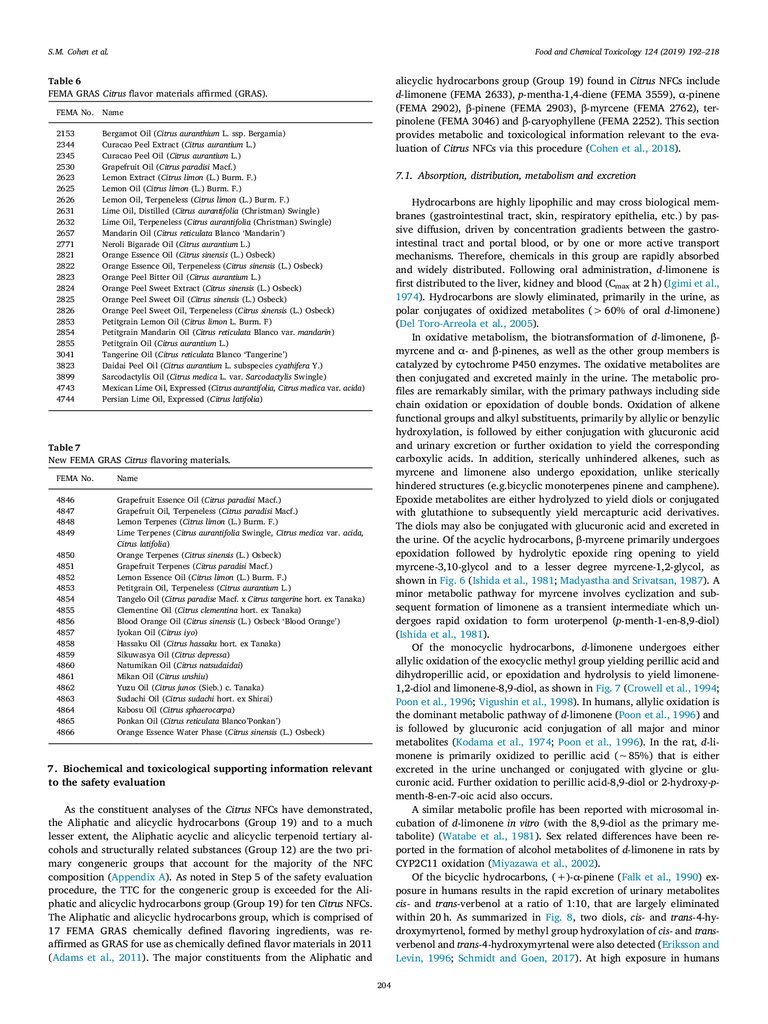
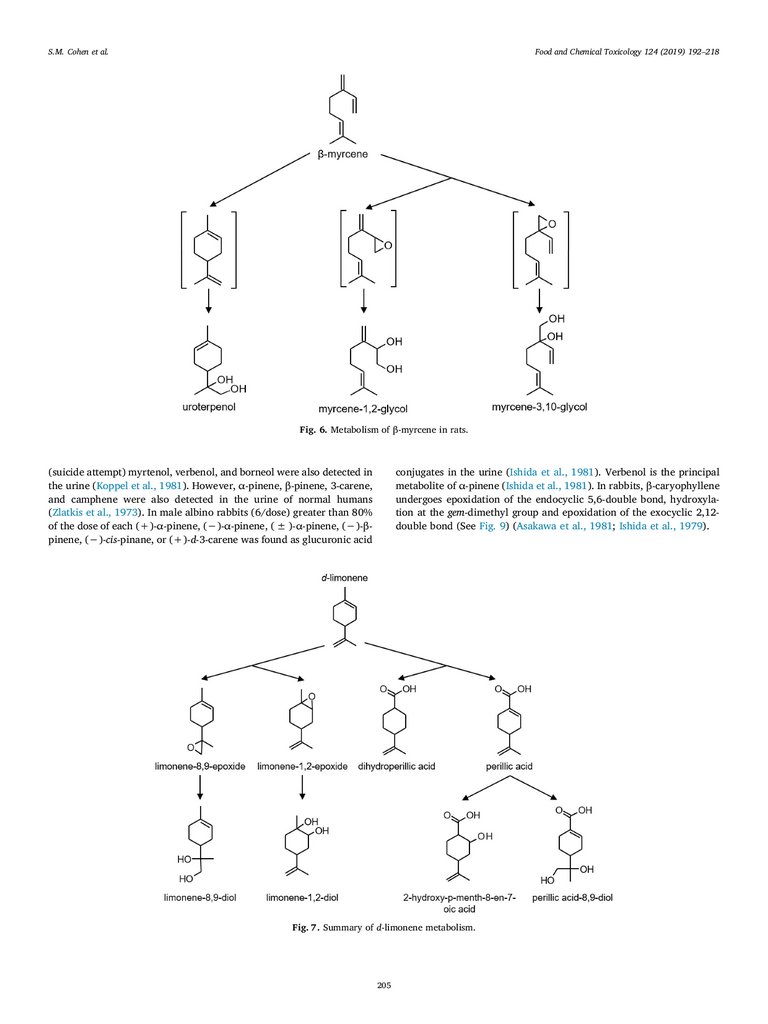
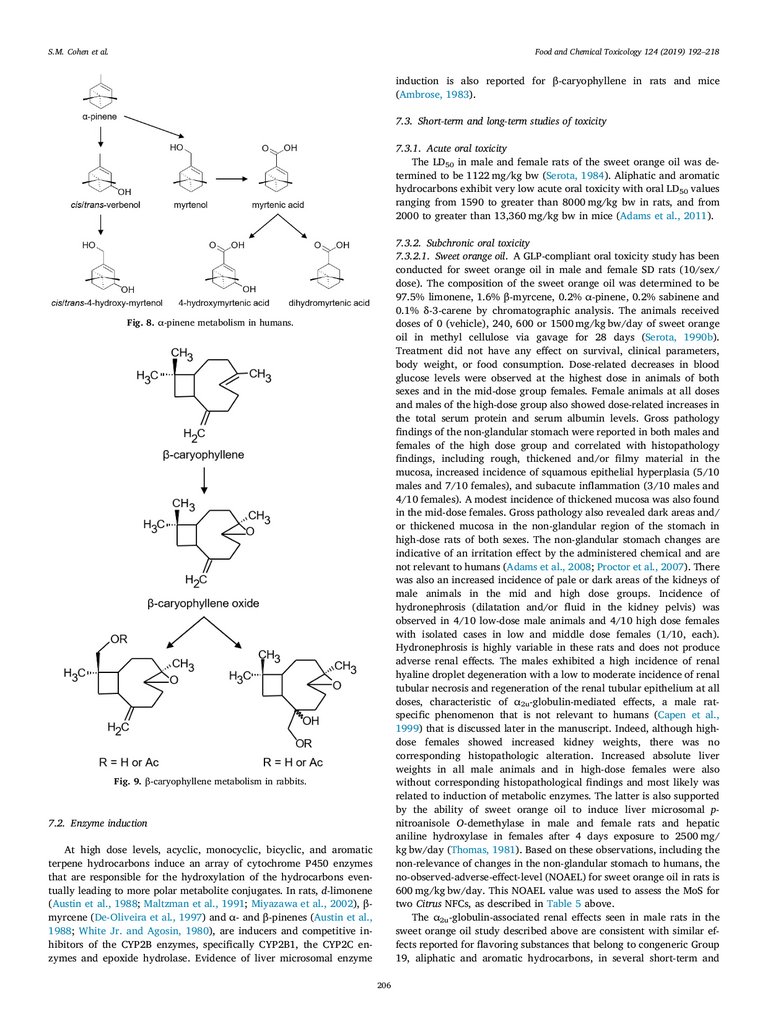
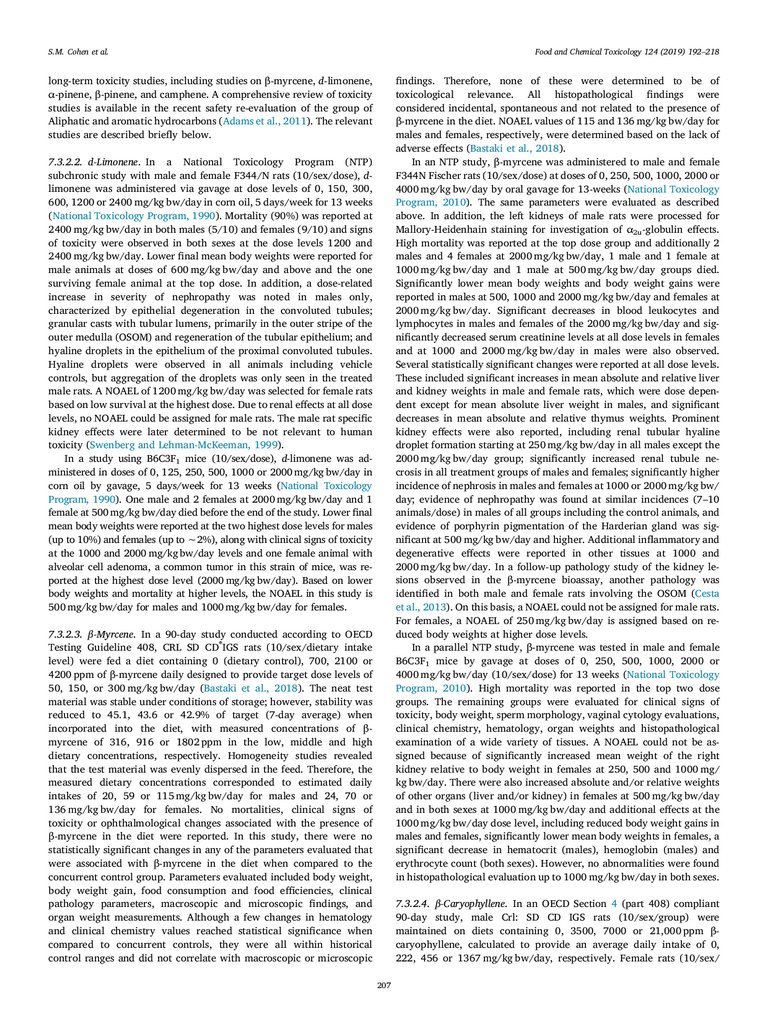

 medicine
Similar presentations:









Food and Chemical Toxicology
1.
Food and Chemical Toxicology 124 (2019) 192–218Contents lists available at ScienceDirect
Food and Chemical Toxicology
journal homepage: www.elsevier.com/locate/foodchemtox
FEMA GRAS assessment of natural flavor complexes: Citrus-derived
flavoring ingredients
T
Samuel M. Cohena, Gerhard Eisenbrandb, Shoji Fukushimac, Nigel J. Gooderhamd,
F. Peter Guengeriche, Stephen S. Hechtf, Ivonne M.C.M. Rietjensg, Maria Bastakih,
Jeanne M. Davidsenh, Christie L. Harmanh, Margaret McGowenh, Sean V. Taylori,∗
a
Havlik-Wall Professor of Oncology, Dept. of Pathology and Microbiology, University of Nebraska Medical Center, 983135 Nebraska Medical Center, Omaha, NE, 681983135, USA
b
Food Chemistry & Toxicology, Kühler Grund 48/1, 69126 Heidelberg, Germany
c
Japan Bioassay Research Center, 2445 Hirasawa, Hadano, Kanagawa, 257-0015, Japan
d
Dept. of Surgery and Cancer, Imperial College London, Sir Alexander Fleming Building, London, SW7 2AZ, United Kingdom
e
Dept. of Biochemistry, Vanderbilt University School of Medicine, Nashville, TN, 37232-0146, USA
f
Masonic Cancer Center, Dept. of Laboratory Medicine and Pathology, University of Minnesota, Cancer and Cardiovascular Research Building, 2231 6th St. SE,
Minneapolis, MN, 55455, USA
g
Division of Toxicology, Wageningen University, Stippeneng 4, 6708 WE, Wageningen, the Netherlands
h
Flavor and Extract Manufacturers Association, 1101 17th Street, NW Suite 700, Washington, DC, 20036, USA
i
Scientific Secretary to the FEMA Expert Panel, 1101 17th Street, NW Suite 700, Washington, DC, 20036, USA
ARTICLE INFO
ABSTRACT
Keywords:
Citrus
Natural flavor complex
Botanical
GRAS
Safety evaluation
In 2015, the Expert Panel of the Flavor and Extract Manufacturers Association (FEMA) initiated a re-evaluation
of the safety of over 250 natural flavor complexes (NFCs) used as flavoring ingredients. This publication is the
first in a series and summarizes the evaluation of 54 Citrus-derived NFCs using the procedure outlined in Smith
et al. (2005) and updated in Cohen et al. (2018) to evaluate the safety of naturally-occurring mixtures for their
intended use as flavoring ingredients. The procedure relies on a complete chemical characterization of each NFC
intended for commerce and organization of each NFC's chemical constituents into well-defined congeneric
groups. The safety of the NFC is evaluated using the well-established and conservative threshold of toxicological
concern (TTC) concept in addition to data on absorption, metabolism and toxicology of members of the congeneric groups and the NFC under evaluation. As a result of the application of the procedure, 54 natural flavor
complexes derived from botanicals of the Citrus genus were affirmed as generally recognized as safe (GRAS)
under their conditions of intended use as flavoring ingredients based on an evaluation of each NFC and the
constituents and congeneric groups therein.
Abbreviations: CF, Correction factor; CFR, Code of federal regulations; CHO, Chinese hamster ovary (cells); CYP, Cytochrome P450 (enzymes); DFG, Deutsche
Forschungsgemeinschaft; DTC, Decision tree class; EFFA, European Flavour Association; EFSA, European Food Safety Authority; EMEA, European Medicines Agency;
ERS/USDA, Economic Research Service/U.S. Department of Agriculture; FAO, Food and Agriculture Organization; FDA, Food and Drug Administration; FEMA, Flavor
and Extract Manufacturers Association; FID, Flame ionization detector; GC, Gas chromatography; GC-MS, Gas chromatography-mass spectrometry; GEF, Global
evaluation factor; GLP, Good laboratory practice; GRAS, Generally recognized as safe; IARC, International Agency for Research on Cancer; IFEAT, International
Federation of Essential Oils and Aroma Trades; IOFI, International Organization of the Flavor Industry; JECFA, Joint FAO/WHO Expert Committee on Food Additives;
JFFMA, Japan Fragrance and Flavor Materials Association; LC-MS, Liquid chromatography-mass spectrometry; LD50, Median lethal dose; MF, Mutant frequency;
MLA, Mouse lymphoma assay; MoS, Margin of safety; MSD, Mass spectrometric detector; NAS, National Academy of Sciences; NFC, Natural flavoring complex;
NOAEL, No observed adverse effect level; NTP, National Toxicology Program; OECD, Organization for Economic Co-Operation and Development; OSOM, Outer stripe
of the outer medulla; PCI, Per capita intake; SCE, Sister chromatid exchange; SD, Sprague-Dawley (rat); SKLM, Senate Commission on Food Safety (Germany); TTC,
Threshold of toxicological concern; UDS, Unscheduled DNA synthesis (assay); USDA, U.S. Department of Agriculture; US-EPA, U.S. Environmental Protection Agency;
WHO, World Health Organization
∗
Corresponding author.
E-mail address: staylor@vertosolutions.net (S.V. Taylor).
https://doi.org/10.1016/j.fct.2018.11.052
Received 17 April 2018; Received in revised form 19 November 2018; Accepted 23 November 2018
Available online 24 November 2018
0278-6915/ © 2018 The Authors. Published by Elsevier Ltd. This is an open access article under the CC BY-NC-ND license
(http://creativecommons.org/licenses/BY-NC-ND/4.0/).
2.
Food and Chemical Toxicology 124 (2019) 192–218S.M. Cohen et al.
1. Introduction
folding process. These materials are rich in monoterpenes, particularly
d-limonene, a major constituent in Citrus essential oils. The collection of
Citrus essential oils by distillation of Citrus peels and/or Citrus juices is
generally not practiced since distillation produces lower quality oils (Di
Giacomo and Di Giacomo, 2002). The exception is lime oil. Both distilled and cold-expressed lime oils are currently in commerce. The sharp
flavor of distilled lime oil is desirable for some products and remains an
important flavoring ingredient.
The remaining categories of Citrus flavoring materials are the petitgrain/neroli oils and Citrus extracts. Petitgrain oils are prepared by
steam distillation of the buds and/or leaves of the Citrus plant. Neroli oil
is prepared by the steam distillation of the flowers of C. aurantium.
Finally, Citrus extracts are prepared from the fruit peel or the peel oil for
use as flavoring ingredients.
For over fifty years, the Expert Panel of the Flavor and Extract
Manufacturers Association (FEMA) has served as the primary, independent body evaluating the safety of flavoring ingredients for use in
human food. The Expert Panel evaluates flavoring ingredients to determine if they can be considered “generally recognized as safe” (GRAS)
for their intended use as flavoring ingredients consistent with the 1958
Food Additive Amendment to the Federal Food Drug, and Cosmetic Act
(Hallagan and Hall, 1995, 2009). Currently, the FEMA Expert Panel has
determined that over 2700 flavoring ingredients have met the criteria
for GRAS status under conditions of intended use as flavoring ingredients.
A key part of the FEMA GRAS program is the cyclical re-evaluation
of the GRAS status of flavoring ingredients determined to be GRAS by
the FEMA Expert Panel. Flavoring ingredients are generally divided into
two broad categories, chemically-defined flavoring materials and natural flavor complexes (NFCs). The chemically defined flavoring materials are typically single chemical substances whereas the NFCs are
naturally occurring mixtures typically derived from botanical materials.
The Panel has previously completed two re-evaluations of the chemically defined flavoring ingredients and in 2015 expanded the re-evaluation program to include more than 250 NFCs on the FEMA GRAS list
and other relevant NFCs using a scientifically-based procedure for the
safety evaluation of NFCs (Cohen et al., 2018; Smith et al., 2005). The
procedure describes a step-wise evaluation of the chemical composition
of an NFC. Since many NFCs are products of common plant biochemical
pathways (Schwab et al., 2008), the constituents can be organized into
a limited number of well-established chemical groups referred to as
congeneric groups. The safety of the intake of each congeneric group
from consumption of the NFC is evaluated in the context of data on
absorption, metabolism, and toxicology of members of the congeneric
group. Groups of NFCs of similar chemical composition or taxonomy
have been assembled to facilitate the re-evaluation of all the NFCs. The
first group re-evaluated comprises flavoring ingredients derived from
the Citrus genus and is the subject of the present report.
In 2015, the FEMA Expert Panel issued a call for data requesting
complete chemical analyses and physical properties for ∼50 Citrusderived NFCs known to be used globally by the flavor industry.
Members from the International Organization of the Flavor Industry
(IOFI), including FEMA (United States), the Japan Fragrance and Flavor
Materials Association (JFFMA), the European Flavour Association
(EFFA), in addition to the International Federation of Essential Oils and
Aroma Trades (IFEAT), responded, providing data on Citrus oils currently in commerce for the purpose of flavoring food and beverage
products. The Citrus flavoring materials re-evaluated by the Expert
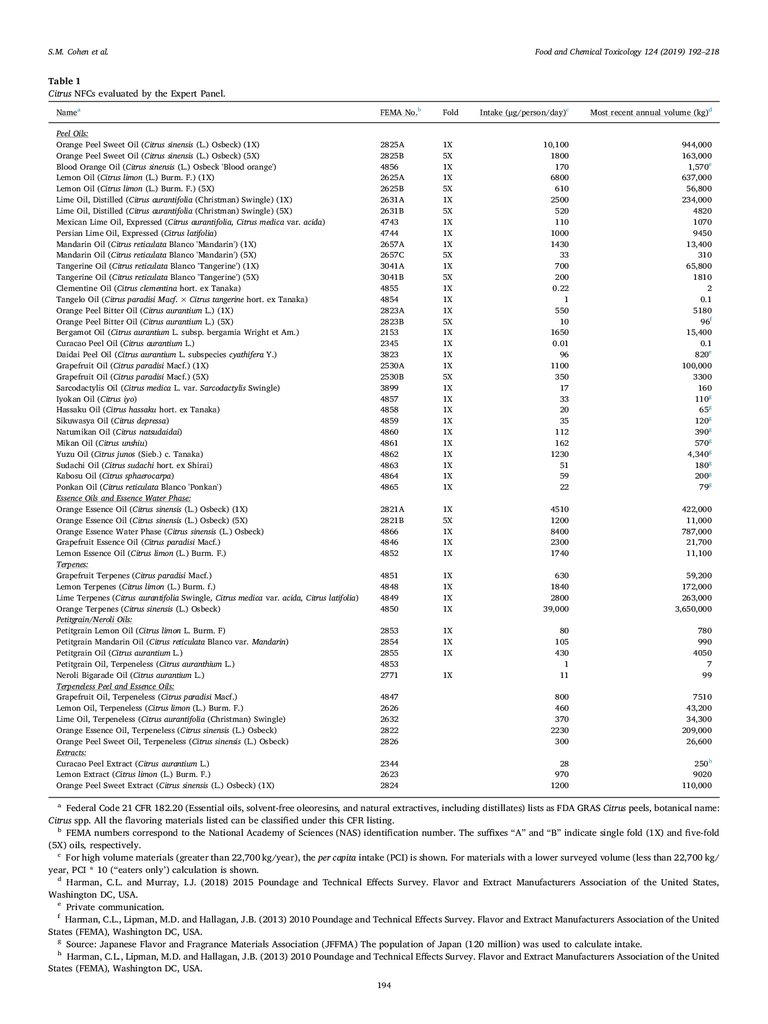
Panel are listed in Table 1 and are grouped based on the source of the
flavoring ingredient.
The Citrus NFCs listed in Table 1 have been divided into six general
types: 1) peel oils; 2) essence oils and water phase essence; 3) terpenes;
4) petitgrain, and neroli oils; 5) terpeneless peel and essence oils; and 6)
extracts. For several major Citrus fruit crops including sweet oranges,
lemons, grapefruits and limes, two types of Citrus oils are produced for
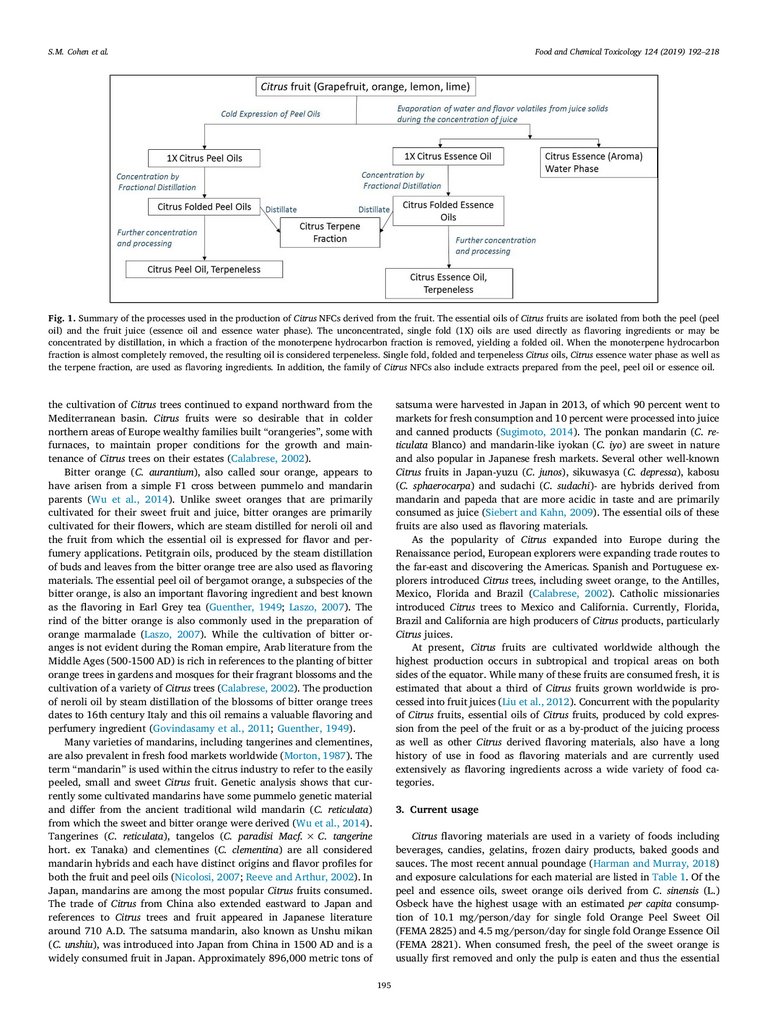
use as flavoring materials, as outlined in Fig. 1. Essential “peel” oils are
collected by cold-expression from the peels of these fruits (left) while
“essence” or “aroma” is collected in the concentration step following
the juicing of the whole fruit (right). The essence collected is separated
into the oil and water phases, resulting in Citrus essence oils and Citrus
essence water phase. Both peel oils and essence oils recovered directly
from Citrus fruit without further concentration are considered to be
unfolded and termed single fold (1X). Single fold Citrus oils may be
concentrated by fractional distillation to produce “folded oils” which
are also commonly used as flavoring materials. Highly concentrated oils
in which the monoterpene hydrocarbon content has been greatly reduced are termed “terpeneless”. Orange, lemon, lime and grapefruit
terpenes are flavoring materials derived from the distillate of the
2. History of food use
The Citrus genus includes a variety of fruits commonly found in
markets for fresh consumption such as sweet oranges, lemons, grapefruits, tangerines, mandarins and limes. Juice products from sweet orange, lemon and grapefruit are high volume products in western consumer markets. Other Citrus fruits, such as bergamot and bitter orange
are usually cultivated for their essential oils. In Japan, popular Citrus
fruits include iyokan, hassaku, sikuwasya, natsumikan, mikan, yuzu,
sudachi, kabosu and ponkan.
Despite the wide variety of Citrus fruits available today, genetic
analysis of Citrus trees indicate that all Citrus varieties known today
originated from only a few types, the pummelo (C. maxima), the citron
(C. medica), the mandarin and the uncultivated papeda (C. papeda)
(Carbonell-Caballero et al., 2015; Velasco and Licciardello, 2014; Wu
et al., 2014). All Citrus species are believed to have originated in
southeast China and the Malaysian archipelago. East-west trade routes
facilitated the introduction and eventual cultivation of Citrus into
western territories (Calabrese, 2002). Archeological excavations indicate that citron trees were cultivated in Persia around ∼4000 BC.
Citrons are a small round fruit that are typically eaten whole. Both
lemon and lime arose from the hybridization of citron with papeda, a
wild, uncultivated Citrus species. Alexander the Great brought citrons to
the ancient Greeks and Romans by ∼300 BC and the fruits are described in both Greek and Roman literature of that time as the “fruit of
Persia” or the “fruit of Media”. The Greeks are thought to have taken
citrons into Palestine around 200 BC and a Jewish coin minted in 136
BC depicts a citron on one side. The citron is mentioned in the Old
Testament of the Bible and is part of the Jewish autumn Feast of the
Tabernacles. During the time of the Roman Empire, citron, lemon and
lime were cultivated throughout the territory as evidenced by their
appearance in the artwork from Rome, Carthage, Sicily, Northern Africa
(Algeria and Tunisia) and Spain (Calabrese, 2002; Laszo, 2007).
The pummelo (C. maxima), also called shaddock, is similar in
overall size to grapefruit and is grown in southern Asia where it remains
a popular food. Grapefruit, a popular food in western markets, is a
hybrid of the pummelo that first appeared in the Caribbean Citrus
groves in the 17th century (Laszo, 2007). In Japan, hassaku (C. hassaku)
and natumikan (C. natsudaidai) are similar in size and consumed similarly to grapefruit and are probably genetically related to the pummelo
(Hirai et al., 1986).
Recent genetic analysis of the sweet orange (C. sinensis) genome
indicates that it is derived from a yet undetermined series of crosses
between pummelo and mandarin species (Wu et al., 2014). Sweet oranges are cultivated primarily for their sweet fruit and juice for sale in
food markets and the essential oil is a valuable flavoring ingredient.
Due to a lack of references to the sweet orange in historical texts and
artwork, the history of the cultivation of the sweet orange (C. sinenesis)
is not clear. While it appears that the sweet orange originated in China,
there is little reference to this Citrus fruit until it was recorded as being
grown around Lisbon in 1520 (Laszo, 2007). During the Renaissance,
193
3.
Food and Chemical Toxicology 124 (2019) 192–218S.M. Cohen et al.
Table 1
Citrus NFCs evaluated by the Expert Panel.
Namea
Peel Oils:
Orange Peel Sweet Oil (Citrus sinensis (L.) Osbeck) (1X)
Orange Peel Sweet Oil (Citrus sinensis (L.) Osbeck) (5X)
Blood Orange Oil (Citrus sinensis (L.) Osbeck 'Blood orange')
Lemon Oil (Citrus limon (L.) Burm. F.) (1X)
Lemon Oil (Citrus limon (L.) Burm. F.) (5X)
Lime Oil, Distilled (Citrus aurantifolia (Christman) Swingle) (1X)
Lime Oil, Distilled (Citrus aurantifolia (Christman) Swingle) (5X)
Mexican Lime Oil, Expressed (Citrus aurantifolia, Citrus medica var. acida)
Persian Lime Oil, Expressed (Citrus latifolia)
Mandarin Oil (Citrus reticulata Blanco 'Mandarin') (1X)
Mandarin Oil (Citrus reticulata Blanco 'Mandarin') (5X)
Tangerine Oil (Citrus reticulata Blanco 'Tangerine') (1X)
Tangerine Oil (Citrus reticulata Blanco 'Tangerine') (5X)
Clementine Oil (Citrus clementina hort. ex Tanaka)
Tangelo Oil (Citrus paradisi Macf. × Citrus tangerine hort. ex Tanaka)
Orange Peel Bitter Oil (Citrus aurantium L.) (1X)
Orange Peel Bitter Oil (Citrus aurantium L.) (5X)
Bergamot Oil (Citrus aurantium L. subsp. bergamia Wright et Am.)
Curacao Peel Oil (Citrus aurantium L.)
Daidai Peel Oil (Citrus aurantium L. subspecies cyathifera Y.)
Grapefruit Oil (Citrus paradisi Macf.) (1X)
Grapefruit Oil (Citrus paradisi Macf.) (5X)
Sarcodactylis Oil (Citrus medica L. var. Sarcodactylis Swingle)
Iyokan Oil (Citrus iyo)
Hassaku Oil (Citrus hassaku hort. ex Tanaka)
Sikuwasya Oil (Citrus depressa)
Natumikan Oil (Citrus natsudaidai)
Mikan Oil (Citrus unshiu)
Yuzu Oil (Citrus junos (Sieb.) c. Tanaka)
Sudachi Oil (Citrus sudachi hort. ex Shirai)
Kabosu Oil (Citrus sphaerocarpa)
Ponkan Oil (Citrus reticulata Blanco 'Ponkan')
Essence Oils and Essence Water Phase:
Orange Essence Oil (Citrus sinensis (L.) Osbeck) (1X)
Orange Essence Oil (Citrus sinensis (L.) Osbeck) (5X)
Orange Essence Water Phase (Citrus sinensis (L.) Osbeck)
Grapefruit Essence Oil (Citrus paradisi Macf.)
Lemon Essence Oil (Citrus limon (L.) Burm. F.)
Terpenes:
Grapefruit Terpenes (Citrus paradisi Macf.)
Lemon Terpenes (Citrus limon (L.) Burm. f.)
Lime Terpenes (Citrus aurantifolia Swingle, Citrus medica var. acida, Citrus latifolia)
Orange Terpenes (Citrus sinensis (L.) Osbeck)
Petitgrain/Neroli Oils:
Petitgrain Lemon Oil (Citrus limon L. Burm. F)
Petitgrain Mandarin Oil (Citrus reticulata Blanco var. Mandarin)
Petitgrain Oil (Citrus aurantium L.)
Petitgrain Oil, Terpeneless (Citrus auranthium L.)
Neroli Bigarade Oil (Citrus aurantium L.)
Terpeneless Peel and Essence Oils:
Grapefruit Oil, Terpeneless (Citrus paradisi Macf.)
Lemon Oil, Terpeneless (Citrus limon (L.) Burm. F.)
Lime Oil, Terpeneless (Citrus aurantifolia (Christman) Swingle)
Orange Essence Oil, Terpeneless (Citrus sinensis (L.) Osbeck)
Orange Peel Sweet Oil, Terpeneless (Citrus sinensis (L.) Osbeck)
Extracts:
Curacao Peel Extract (Citrus aurantium L.)
Lemon Extract (Citrus limon (L.) Burm. F.)
Orange Peel Sweet Extract (Citrus sinensis (L.) Osbeck) (1X)
FEMA No.b
Fold
Intake (μg/person/day)c
Most recent annual volume (kg)d
2825A
2825B
4856
2625A
2625B
2631A
2631B
4743
4744
2657A
2657C
3041A
3041B
4855
4854
2823A
2823B
2153
2345
3823
2530A
2530B
3899
4857
4858
4859
4860
4861
4862
4863
4864
4865
1X
5X
1X
1X
5X
1X
5X
1X
1X
1X
5X
1X
5X
1X
1X
1X
5X
1X
1X
1X
1X
5X
1X
1X
1X
1X
1X
1X
1X
1X
1X
1X
10,100
1800
170
6800
610
2500
520
110
1000
1430
33
700
200
0.22
1
550
10
1650
0.01
96
1100
350
17
33
20
35
112
162
1230
51
59
22
944,000
163,000
1,570e
637,000
56,800
234,000
4820
1070
9450
13,400
310
65,800
1810
2
0.1
5180
96f
15,400
0.1
820e
100,000
3300
160
110g
65g
120g
390g
570g
4,340g
180g
200g
79g
2821A
2821B
4866
4846
4852
1X
5X
1X
1X
1X
4510
1200
8400
2300
1740
422,000
11,000
787,000
21,700
11,100
4851
4848
4849
4850
1X
1X
1X
1X
630
1840
2800
39,000
59,200
172,000
263,000
3,650,000
2853
2854
2855
4853
2771
1X
1X
1X
80
105
430
1
11
780
990
4050
7
99
4847
2626
2632
2822
2826
800
460
370
2230
300
7510
43,200
34,300
209,000
26,600
2344
2623
2824
28
970
1200
250h
9020
110,000
1X
a
Federal Code 21 CFR 182.20 (Essential oils, solvent-free oleoresins, and natural extractives, including distillates) lists as FDA GRAS Citrus peels, botanical name:
Citrus spp. All the flavoring materials listed can be classified under this CFR listing.
b
FEMA numbers correspond to the National Academy of Sciences (NAS) identification number. The suffixes “A” and “B” indicate single fold (1X) and five-fold
(5X) oils, respectively.
c
For high volume materials (greater than 22,700 kg/year), the per capita intake (PCI) is shown. For materials with a lower surveyed volume (less than 22,700 kg/
year, PCI * 10 (“eaters only’) calculation is shown.
d
Harman, C.L. and Murray, I.J. (2018) 2015 Poundage and Technical Effects Survey. Flavor and Extract Manufacturers Association of the United States,
Washington DC, USA.
e
Private communication.
f
Harman, C.L., Lipman, M.D. and Hallagan, J.B. (2013) 2010 Poundage and Technical Effects Survey. Flavor and Extract Manufacturers Association of the United
States (FEMA), Washington DC, USA.
g
Source: Japanese Flavor and Fragrance Materials Association (JFFMA) The population of Japan (120 million) was used to calculate intake.
h
Harman, C.L., Lipman, M.D. and Hallagan, J.B. (2013) 2010 Poundage and Technical Effects Survey. Flavor and Extract Manufacturers Association of the United
States (FEMA), Washington DC, USA.
194
4.
Food and Chemical Toxicology 124 (2019) 192–218S.M. Cohen et al.
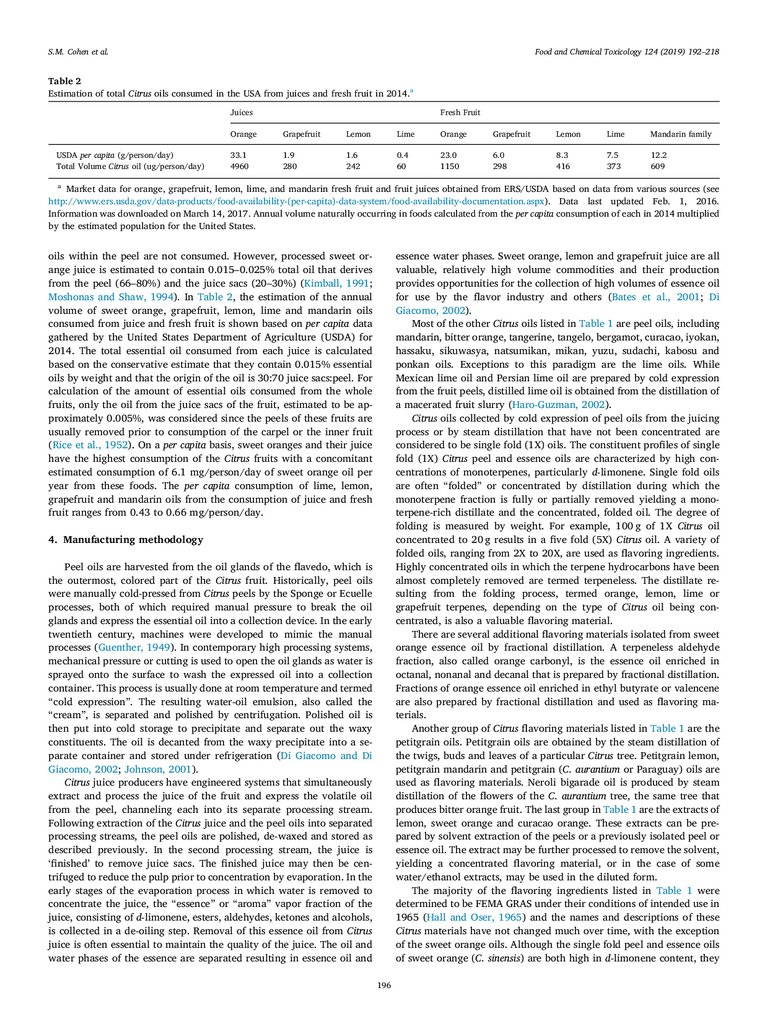
Fig. 1. Summary of the processes used in the production of Citrus NFCs derived from the fruit. The essential oils of Citrus fruits are isolated from both the peel (peel
oil) and the fruit juice (essence oil and essence water phase). The unconcentrated, single fold (1X) oils are used directly as flavoring ingredients or may be
concentrated by distillation, in which a fraction of the monoterpene hydrocarbon fraction is removed, yielding a folded oil. When the monoterpene hydrocarbon
fraction is almost completely removed, the resulting oil is considered terpeneless. Single fold, folded and terpeneless Citrus oils, Citrus essence water phase as well as
the terpene fraction, are used as flavoring ingredients. In addition, the family of Citrus NFCs also include extracts prepared from the peel, peel oil or essence oil.
the cultivation of Citrus trees continued to expand northward from the
Mediterranean basin. Citrus fruits were so desirable that in colder
northern areas of Europe wealthy families built “orangeries”, some with
furnaces, to maintain proper conditions for the growth and maintenance of Citrus trees on their estates (Calabrese, 2002).
Bitter orange (C. aurantium), also called sour orange, appears to
have arisen from a simple F1 cross between pummelo and mandarin
parents (Wu et al., 2014). Unlike sweet oranges that are primarily
cultivated for their sweet fruit and juice, bitter oranges are primarily
cultivated for their flowers, which are steam distilled for neroli oil and
the fruit from which the essential oil is expressed for flavor and perfumery applications. Petitgrain oils, produced by the steam distillation
of buds and leaves from the bitter orange tree are also used as flavoring
materials. The essential peel oil of bergamot orange, a subspecies of the
bitter orange, is also an important flavoring ingredient and best known
as the flavoring in Earl Grey tea (Guenther, 1949; Laszo, 2007). The
rind of the bitter orange is also commonly used in the preparation of
orange marmalade (Laszo, 2007). While the cultivation of bitter oranges is not evident during the Roman empire, Arab literature from the
Middle Ages (500-1500 AD) is rich in references to the planting of bitter
orange trees in gardens and mosques for their fragrant blossoms and the
cultivation of a variety of Citrus trees (Calabrese, 2002). The production
of neroli oil by steam distillation of the blossoms of bitter orange trees
dates to 16th century Italy and this oil remains a valuable flavoring and
perfumery ingredient (Govindasamy et al., 2011; Guenther, 1949).
Many varieties of mandarins, including tangerines and clementines,
are also prevalent in fresh food markets worldwide (Morton, 1987). The
term “mandarin” is used within the citrus industry to refer to the easily
peeled, small and sweet Citrus fruit. Genetic analysis shows that currently some cultivated mandarins have some pummelo genetic material
and differ from the ancient traditional wild mandarin (C. reticulata)
from which the sweet and bitter orange were derived (Wu et al., 2014).
Tangerines (C. reticulata), tangelos (C. paradisi Macf. × C. tangerine
hort. ex Tanaka) and clementines (C. clementina) are all considered
mandarin hybrids and each have distinct origins and flavor profiles for
both the fruit and peel oils (Nicolosi, 2007; Reeve and Arthur, 2002). In
Japan, mandarins are among the most popular Citrus fruits consumed.
The trade of Citrus from China also extended eastward to Japan and
references to Citrus trees and fruit appeared in Japanese literature
around 710 A.D. The satsuma mandarin, also known as Unshu mikan
(C. unshiu), was introduced into Japan from China in 1500 AD and is a
widely consumed fruit in Japan. Approximately 896,000 metric tons of
satsuma were harvested in Japan in 2013, of which 90 percent went to
markets for fresh consumption and 10 percent were processed into juice
and canned products (Sugimoto, 2014). The ponkan mandarin (C. reticulata Blanco) and mandarin-like iyokan (C. iyo) are sweet in nature
and also popular in Japanese fresh markets. Several other well-known
Citrus fruits in Japan-yuzu (C. junos), sikuwasya (C. depressa), kabosu
(C. sphaerocarpa) and sudachi (C. sudachi)- are hybrids derived from
mandarin and papeda that are more acidic in taste and are primarily
consumed as juice (Siebert and Kahn, 2009). The essential oils of these
fruits are also used as flavoring materials.
As the popularity of Citrus expanded into Europe during the
Renaissance period, European explorers were expanding trade routes to
the far-east and discovering the Americas. Spanish and Portuguese explorers introduced Citrus trees, including sweet orange, to the Antilles,
Mexico, Florida and Brazil (Calabrese, 2002). Catholic missionaries
introduced Citrus trees to Mexico and California. Currently, Florida,
Brazil and California are high producers of Citrus products, particularly
Citrus juices.
At present, Citrus fruits are cultivated worldwide although the
highest production occurs in subtropical and tropical areas on both
sides of the equator. While many of these fruits are consumed fresh, it is
estimated that about a third of Citrus fruits grown worldwide is processed into fruit juices (Liu et al., 2012). Concurrent with the popularity
of Citrus fruits, essential oils of Citrus fruits, produced by cold expression from the peel of the fruit or as a by-product of the juicing process
as well as other Citrus derived flavoring materials, also have a long
history of use in food as flavoring materials and are currently used
extensively as flavoring ingredients across a wide variety of food categories.
3. Current usage
Citrus flavoring materials are used in a variety of foods including
beverages, candies, gelatins, frozen dairy products, baked goods and
sauces. The most recent annual poundage (Harman and Murray, 2018)
and exposure calculations for each material are listed in Table 1. Of the
peel and essence oils, sweet orange oils derived from C. sinensis (L.)
Osbeck have the highest usage with an estimated per capita consumption of 10.1 mg/person/day for single fold Orange Peel Sweet Oil
(FEMA 2825) and 4.5 mg/person/day for single fold Orange Essence Oil
(FEMA 2821). When consumed fresh, the peel of the sweet orange is
usually first removed and only the pulp is eaten and thus the essential
195
5.
Food and Chemical Toxicology 124 (2019) 192–218S.M. Cohen et al.
Table 2
Estimation of total Citrus oils consumed in the USA from juices and fresh fruit in 2014.a
Juices
USDA per capita (g/person/day)
Total Volume Citrus oil (ug/person/day)
Fresh Fruit
Orange
Grapefruit
Lemon
Lime
Orange
Grapefruit
Lemon
Lime
Mandarin family
33.1
4960
1.9
280
1.6
242
0.4
60
23.0
1150
6.0
298
8.3
416
7.5
373
12.2
609
a
Market data for orange, grapefruit, lemon, lime, and mandarin fresh fruit and fruit juices obtained from ERS/USDA based on data from various sources (see
http://www.ers.usda.gov/data-products/food-availability-(per-capita)-data-system/food-availability-documentation.aspx). Data last updated Feb. 1, 2016.
Information was downloaded on March 14, 2017. Annual volume naturally occurring in foods calculated from the per capita consumption of each in 2014 multiplied
by the estimated population for the United States.
oils within the peel are not consumed. However, processed sweet orange juice is estimated to contain 0.015–0.025% total oil that derives
from the peel (66–80%) and the juice sacs (20–30%) (Kimball, 1991;
Moshonas and Shaw, 1994). In Table 2, the estimation of the annual
volume of sweet orange, grapefruit, lemon, lime and mandarin oils
consumed from juice and fresh fruit is shown based on per capita data
gathered by the United States Department of Agriculture (USDA) for
2014. The total essential oil consumed from each juice is calculated
based on the conservative estimate that they contain 0.015% essential
oils by weight and that the origin of the oil is 30:70 juice sacs:peel. For
calculation of the amount of essential oils consumed from the whole
fruits, only the oil from the juice sacs of the fruit, estimated to be approximately 0.005%, was considered since the peels of these fruits are
usually removed prior to consumption of the carpel or the inner fruit
(Rice et al., 1952). On a per capita basis, sweet oranges and their juice
have the highest consumption of the Citrus fruits with a concomitant
estimated consumption of 6.1 mg/person/day of sweet orange oil per
year from these foods. The per capita consumption of lime, lemon,
grapefruit and mandarin oils from the consumption of juice and fresh
fruit ranges from 0.43 to 0.66 mg/person/day.
essence water phases. Sweet orange, lemon and grapefruit juice are all
valuable, relatively high volume commodities and their production
provides opportunities for the collection of high volumes of essence oil
for use by the flavor industry and others (Bates et al., 2001; Di
Giacomo, 2002).
Most of the other Citrus oils listed in Table 1 are peel oils, including
mandarin, bitter orange, tangerine, tangelo, bergamot, curacao, iyokan,
hassaku, sikuwasya, natsumikan, mikan, yuzu, sudachi, kabosu and
ponkan oils. Exceptions to this paradigm are the lime oils. While
Mexican lime oil and Persian lime oil are prepared by cold expression
from the fruit peels, distilled lime oil is obtained from the distillation of
a macerated fruit slurry (Haro-Guzman, 2002).
Citrus oils collected by cold expression of peel oils from the juicing
process or by steam distillation that have not been concentrated are
considered to be single fold (1X) oils. The constituent profiles of single
fold (1X) Citrus peel and essence oils are characterized by high concentrations of monoterpenes, particularly d-limonene. Single fold oils
are often “folded” or concentrated by distillation during which the
monoterpene fraction is fully or partially removed yielding a monoterpene-rich distillate and the concentrated, folded oil. The degree of
folding is measured by weight. For example, 100 g of 1X Citrus oil
concentrated to 20 g results in a five fold (5X) Citrus oil. A variety of
folded oils, ranging from 2X to 20X, are used as flavoring ingredients.
Highly concentrated oils in which the terpene hydrocarbons have been
almost completely removed are termed terpeneless. The distillate resulting from the folding process, termed orange, lemon, lime or
grapefruit terpenes, depending on the type of Citrus oil being concentrated, is also a valuable flavoring material.
There are several additional flavoring materials isolated from sweet
orange essence oil by fractional distillation. A terpeneless aldehyde
fraction, also called orange carbonyl, is the essence oil enriched in
octanal, nonanal and decanal that is prepared by fractional distillation.
Fractions of orange essence oil enriched in ethyl butyrate or valencene
are also prepared by fractional distillation and used as flavoring materials.
Another group of Citrus flavoring materials listed in Table 1 are the
petitgrain oils. Petitgrain oils are obtained by the steam distillation of
the twigs, buds and leaves of a particular Citrus tree. Petitgrain lemon,
petitgrain mandarin and petitgrain (C. aurantium or Paraguay) oils are
used as flavoring materials. Neroli bigarade oil is produced by steam
distillation of the flowers of the C. aurantium tree, the same tree that
produces bitter orange fruit. The last group in Table 1 are the extracts of
lemon, sweet orange and curacao orange. These extracts can be prepared by solvent extraction of the peels or a previously isolated peel or
essence oil. The extract may be further processed to remove the solvent,
yielding a concentrated flavoring material, or in the case of some
water/ethanol extracts, may be used in the diluted form.
The majority of the flavoring ingredients listed in Table 1 were
determined to be FEMA GRAS under their conditions of intended use in
1965 (Hall and Oser, 1965) and the names and descriptions of these
Citrus materials have not changed much over time, with the exception
of the sweet orange oils. Although the single fold peel and essence oils
of sweet orange (C. sinensis) are both high in d-limonene content, they
4. Manufacturing methodology
Peel oils are harvested from the oil glands of the flavedo, which is
the outermost, colored part of the Citrus fruit. Historically, peel oils
were manually cold-pressed from Citrus peels by the Sponge or Ecuelle
processes, both of which required manual pressure to break the oil
glands and express the essential oil into a collection device. In the early
twentieth century, machines were developed to mimic the manual
processes (Guenther, 1949). In contemporary high processing systems,
mechanical pressure or cutting is used to open the oil glands as water is
sprayed onto the surface to wash the expressed oil into a collection
container. This process is usually done at room temperature and termed
“cold expression”. The resulting water-oil emulsion, also called the
“cream”, is separated and polished by centrifugation. Polished oil is
then put into cold storage to precipitate and separate out the waxy
constituents. The oil is decanted from the waxy precipitate into a separate container and stored under refrigeration (Di Giacomo and Di
Giacomo, 2002; Johnson, 2001).
Citrus juice producers have engineered systems that simultaneously
extract and process the juice of the fruit and express the volatile oil
from the peel, channeling each into its separate processing stream.
Following extraction of the Citrus juice and the peel oils into separated
processing streams, the peel oils are polished, de-waxed and stored as
described previously. In the second processing stream, the juice is
‘finished’ to remove juice sacs. The finished juice may then be centrifuged to reduce the pulp prior to concentration by evaporation. In the
early stages of the evaporation process in which water is removed to
concentrate the juice, the “essence” or “aroma” vapor fraction of the
juice, consisting of d-limonene, esters, aldehydes, ketones and alcohols,
is collected in a de-oiling step. Removal of this essence oil from Citrus
juice is often essential to maintain the quality of the juice. The oil and
water phases of the essence are separated resulting in essence oil and
196
6.
Food and Chemical Toxicology 124 (2019) 192–218S.M. Cohen et al.
differ in flavor and in the profile of their minor constituents such as
octanal and decanal. In past volumes of use surveys conducted by FEMA
and the National Academy of Sciences, three sweet orange oil flavoring
materials were surveyed:
Additives (JECFA) in its evaluation of chemically defined flavoring
materials (JECFA, 1997, 1998, 1999, 2000a; b, 2001, 2002, 2004,
2005). The Cramer decision tree class assigned to each congeneric
group is determined by assigning the most conservative class for the
constituents within each group.
The analytical results for each Citrus NFC were reviewed and several
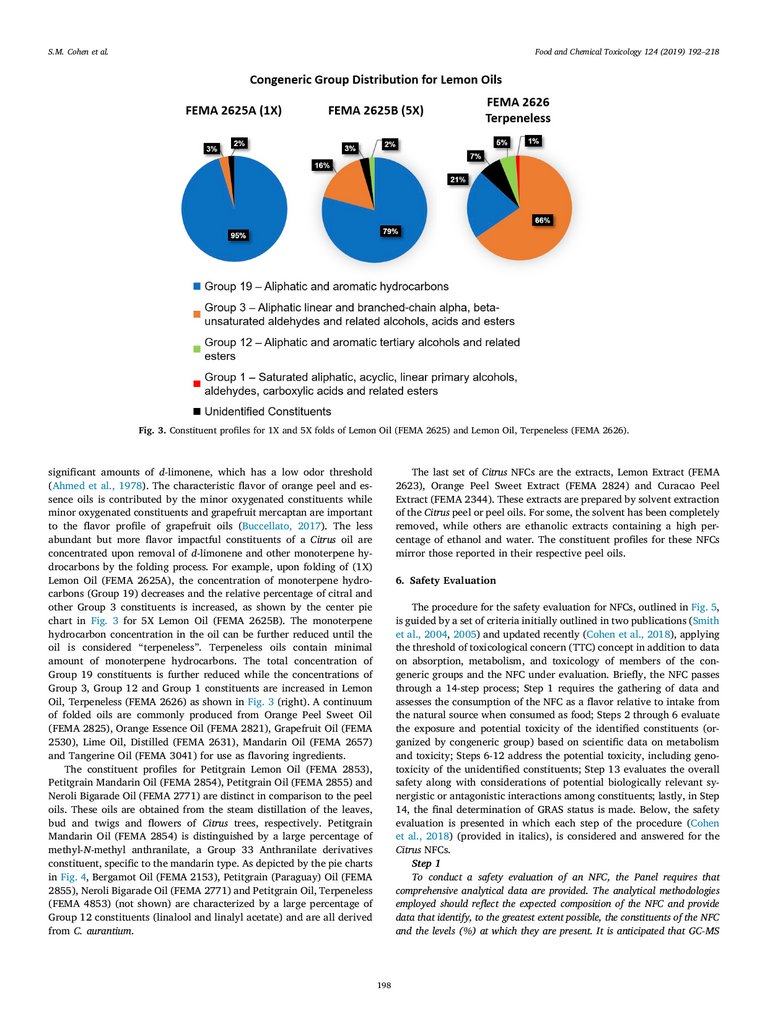
trends emerged. The congeneric group distribution for single fold
Lemon Oil (FEMA 2625A) is depicted in a pie chart in Fig. 3. For many
of the single fold peel and essence oils, Group 19 constituents (Aliphatic
and aromatic hydrocarbons) are a large percentage of the total composition. These constituents include d-limonene, β-pinene, and pmentha-1,4-diene. Group 1 (Saturated aliphatic acyclic, linear primary
alcohols, aldehydes, carboxylic acids and related esters) compounds
such as octanal, nonanal and decanal and Group 3 (Aliphatic linear and
branched-chain alpha, beta-unsaturated aldehydes and related alcohols,
acids and esters) compounds, such as citral are often present at lower
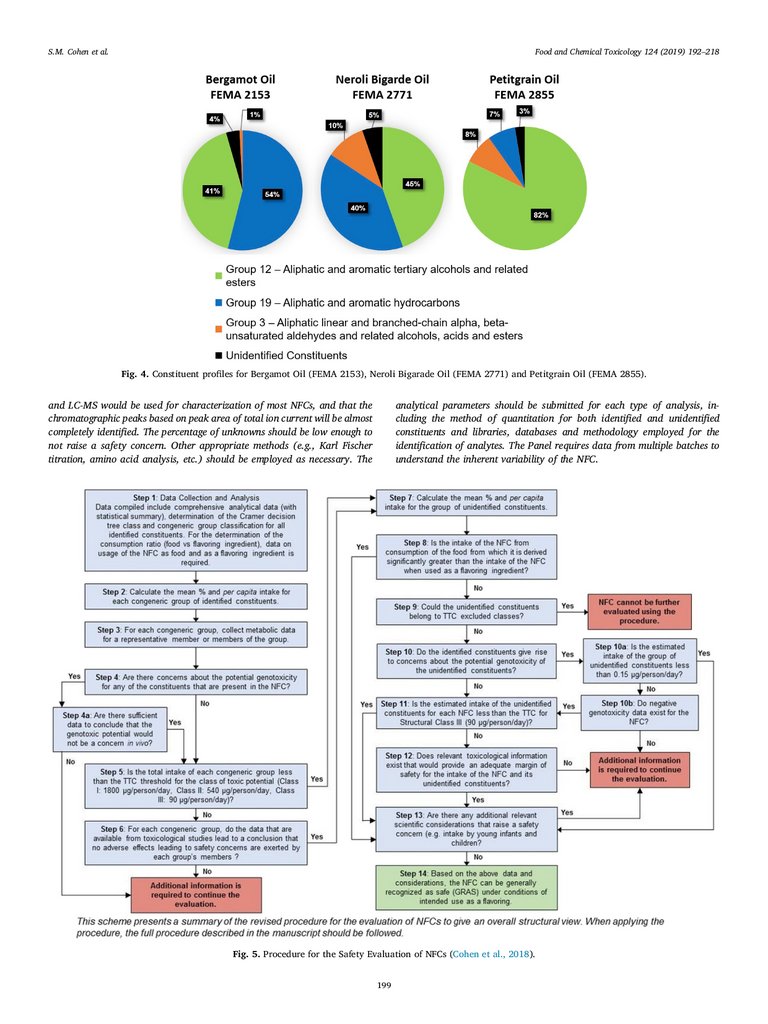
concentrations in single fold Citrus NFCs. The constituent profile of
Bergamot Oil (FEMA 2153) contains relatively high percentages of
Group 12 (aliphatic and aromatic tertiary alcohols and related esters)
compounds such as linalool and linalyl acetate compared to other single
fold peel oils (Fig. 4, right). The constituent profile of single fold Lime
Oil, Distilled (FEMA 2631A) is characterized by higher levels of alphaterpineol (Group 12) in comparison to cold expressed lime oils and
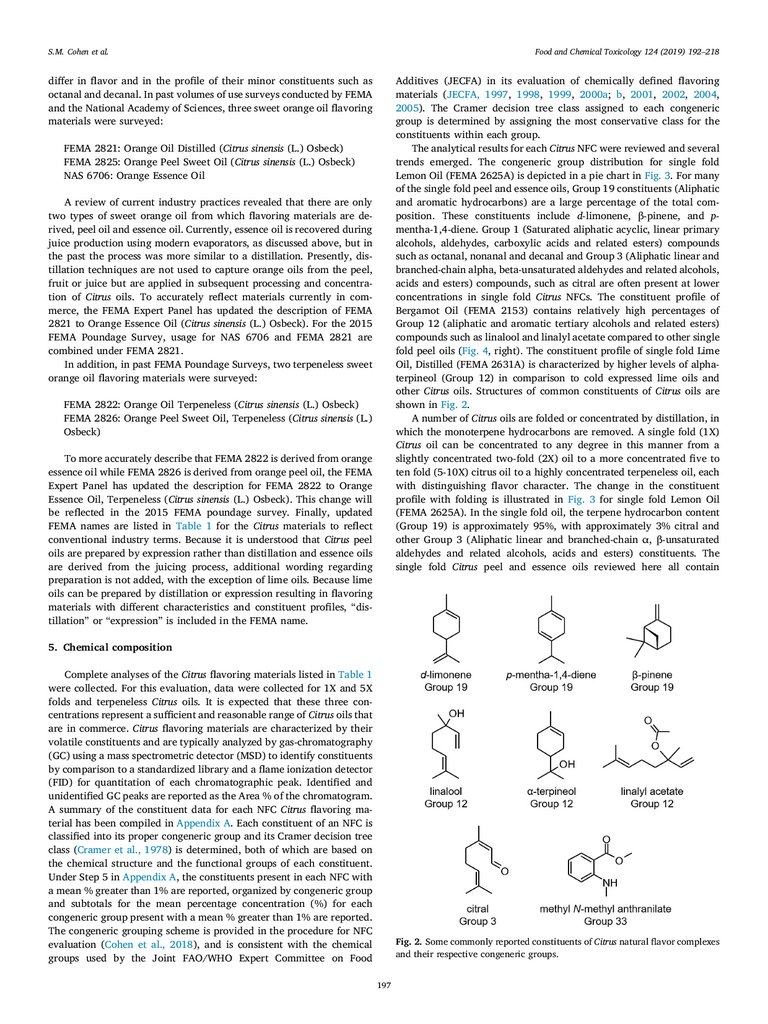
other Citrus oils. Structures of common constituents of Citrus oils are
shown in Fig. 2.
A number of Citrus oils are folded or concentrated by distillation, in
which the monoterpene hydrocarbons are removed. A single fold (1X)
Citrus oil can be concentrated to any degree in this manner from a
slightly concentrated two-fold (2X) oil to a more concentrated five to
ten fold (5-10X) citrus oil to a highly concentrated terpeneless oil, each
with distinguishing flavor character. The change in the constituent
profile with folding is illustrated in Fig. 3 for single fold Lemon Oil
(FEMA 2625A). In the single fold oil, the terpene hydrocarbon content
(Group 19) is approximately 95%, with approximately 3% citral and
other Group 3 (Aliphatic linear and branched-chain α, β-unsaturated
aldehydes and related alcohols, acids and esters) constituents. The
single fold Citrus peel and essence oils reviewed here all contain
FEMA 2821: Orange Oil Distilled (Citrus sinensis (L.) Osbeck)
FEMA 2825: Orange Peel Sweet Oil (Citrus sinensis (L.) Osbeck)
NAS 6706: Orange Essence Oil
A review of current industry practices revealed that there are only
two types of sweet orange oil from which flavoring materials are derived, peel oil and essence oil. Currently, essence oil is recovered during
juice production using modern evaporators, as discussed above, but in
the past the process was more similar to a distillation. Presently, distillation techniques are not used to capture orange oils from the peel,
fruit or juice but are applied in subsequent processing and concentration of Citrus oils. To accurately reflect materials currently in commerce, the FEMA Expert Panel has updated the description of FEMA
2821 to Orange Essence Oil (Citrus sinensis (L.) Osbeck). For the 2015
FEMA Poundage Survey, usage for NAS 6706 and FEMA 2821 are
combined under FEMA 2821.
In addition, in past FEMA Poundage Surveys, two terpeneless sweet
orange oil flavoring materials were surveyed:
FEMA 2822: Orange Oil Terpeneless (Citrus sinensis (L.) Osbeck)
FEMA 2826: Orange Peel Sweet Oil, Terpeneless (Citrus sinensis (L.)
Osbeck)
To more accurately describe that FEMA 2822 is derived from orange
essence oil while FEMA 2826 is derived from orange peel oil, the FEMA
Expert Panel has updated the description for FEMA 2822 to Orange
Essence Oil, Terpeneless (Citrus sinensis (L.) Osbeck). This change will
be reflected in the 2015 FEMA poundage survey. Finally, updated
FEMA names are listed in Table 1 for the Citrus materials to reflect
conventional industry terms. Because it is understood that Citrus peel
oils are prepared by expression rather than distillation and essence oils
are derived from the juicing process, additional wording regarding
preparation is not added, with the exception of lime oils. Because lime
oils can be prepared by distillation or expression resulting in flavoring
materials with different characteristics and constituent profiles, “distillation” or “expression” is included in the FEMA name.
5. Chemical composition
Complete analyses of the Citrus flavoring materials listed in Table 1
were collected. For this evaluation, data were collected for 1X and 5X
folds and terpeneless Citrus oils. It is expected that these three concentrations represent a sufficient and reasonable range of Citrus oils that
are in commerce. Citrus flavoring materials are characterized by their
volatile constituents and are typically analyzed by gas-chromatography
(GC) using a mass spectrometric detector (MSD) to identify constituents
by comparison to a standardized library and a flame ionization detector
(FID) for quantitation of each chromatographic peak. Identified and
unidentified GC peaks are reported as the Area % of the chromatogram.
A summary of the constituent data for each NFC Citrus flavoring material has been compiled in Appendix A. Each constituent of an NFC is
classified into its proper congeneric group and its Cramer decision tree
class (Cramer et al., 1978) is determined, both of which are based on
the chemical structure and the functional groups of each constituent.
Under Step 5 in Appendix A, the constituents present in each NFC with
a mean % greater than 1% are reported, organized by congeneric group
and subtotals for the mean percentage concentration (%) for each
congeneric group present with a mean % greater than 1% are reported.
The congeneric grouping scheme is provided in the procedure for NFC
evaluation (Cohen et al., 2018), and is consistent with the chemical
groups used by the Joint FAO/WHO Expert Committee on Food
Fig. 2. Some commonly reported constituents of Citrus natural flavor complexes
and their respective congeneric groups.
197
7.
Food and Chemical Toxicology 124 (2019) 192–218S.M. Cohen et al.
Fig. 3. Constituent profiles for 1X and 5X folds of Lemon Oil (FEMA 2625) and Lemon Oil, Terpeneless (FEMA 2626).
The last set of Citrus NFCs are the extracts, Lemon Extract (FEMA
2623), Orange Peel Sweet Extract (FEMA 2824) and Curacao Peel
Extract (FEMA 2344). These extracts are prepared by solvent extraction
of the Citrus peel or peel oils. For some, the solvent has been completely
removed, while others are ethanolic extracts containing a high percentage of ethanol and water. The constituent profiles for these NFCs
mirror those reported in their respective peel oils.
significant amounts of d-limonene, which has a low odor threshold
(Ahmed et al., 1978). The characteristic flavor of orange peel and essence oils is contributed by the minor oxygenated constituents while
minor oxygenated constituents and grapefruit mercaptan are important
to the flavor profile of grapefruit oils (Buccellato, 2017). The less
abundant but more flavor impactful constituents of a Citrus oil are
concentrated upon removal of d-limonene and other monoterpene hydrocarbons by the folding process. For example, upon folding of (1X)
Lemon Oil (FEMA 2625A), the concentration of monoterpene hydrocarbons (Group 19) decreases and the relative percentage of citral and
other Group 3 constituents is increased, as shown by the center pie
chart in Fig. 3 for 5X Lemon Oil (FEMA 2625B). The monoterpene
hydrocarbon concentration in the oil can be further reduced until the
oil is considered “terpeneless”. Terpeneless oils contain minimal
amount of monoterpene hydrocarbons. The total concentration of
Group 19 constituents is further reduced while the concentrations of
Group 3, Group 12 and Group 1 constituents are increased in Lemon
Oil, Terpeneless (FEMA 2626) as shown in Fig. 3 (right). A continuum
of folded oils are commonly produced from Orange Peel Sweet Oil
(FEMA 2825), Orange Essence Oil (FEMA 2821), Grapefruit Oil (FEMA
2530), Lime Oil, Distilled (FEMA 2631), Mandarin Oil (FEMA 2657)
and Tangerine Oil (FEMA 3041) for use as flavoring ingredients.
The constituent profiles for Petitgrain Lemon Oil (FEMA 2853),
Petitgrain Mandarin Oil (FEMA 2854), Petitgrain Oil (FEMA 2855) and
Neroli Bigarade Oil (FEMA 2771) are distinct in comparison to the peel
oils. These oils are obtained from the steam distillation of the leaves,
bud and twigs and flowers of Citrus trees, respectively. Petitgrain
Mandarin Oil (FEMA 2854) is distinguished by a large percentage of
methyl-N-methyl anthranilate, a Group 33 Anthranilate derivatives
constituent, specific to the mandarin type. As depicted by the pie charts
in Fig. 4, Bergamot Oil (FEMA 2153), Petitgrain (Paraguay) Oil (FEMA
2855), Neroli Bigarade Oil (FEMA 2771) and Petitgrain Oil, Terpeneless
(FEMA 4853) (not shown) are characterized by a large percentage of
Group 12 constituents (linalool and linalyl acetate) and are all derived
from C. aurantium.
6. Safety Evaluation
The procedure for the safety evaluation for NFCs, outlined in Fig. 5,
is guided by a set of criteria initially outlined in two publications (Smith
et al., 2004, 2005) and updated recently (Cohen et al., 2018), applying
the threshold of toxicological concern (TTC) concept in addition to data
on absorption, metabolism, and toxicology of members of the congeneric groups and the NFC under evaluation. Briefly, the NFC passes
through a 14-step process; Step 1 requires the gathering of data and
assesses the consumption of the NFC as a flavor relative to intake from
the natural source when consumed as food; Steps 2 through 6 evaluate
the exposure and potential toxicity of the identified constituents (organized by congeneric group) based on scientific data on metabolism
and toxicity; Steps 6-12 address the potential toxicity, including genotoxicity of the unidentified constituents; Step 13 evaluates the overall
safety along with considerations of potential biologically relevant synergistic or antagonistic interactions among constituents; lastly, in Step
14, the final determination of GRAS status is made. Below, the safety
evaluation is presented in which each step of the procedure (Cohen
et al., 2018) (provided in italics), is considered and answered for the
Citrus NFCs.
Step 1
To conduct a safety evaluation of an NFC, the Panel requires that
comprehensive analytical data are provided. The analytical methodologies
employed should reflect the expected composition of the NFC and provide
data that identify, to the greatest extent possible, the constituents of the NFC
and the levels (%) at which they are present. It is anticipated that GC-MS
198
8.
Food and Chemical Toxicology 124 (2019) 192–218S.M. Cohen et al.
Fig. 4. Constituent profiles for Bergamot Oil (FEMA 2153), Neroli Bigarade Oil (FEMA 2771) and Petitgrain Oil (FEMA 2855).
and LC-MS would be used for characterization of most NFCs, and that the
chromatographic peaks based on peak area of total ion current will be almost
completely identified. The percentage of unknowns should be low enough to
not raise a safety concern. Other appropriate methods (e.g., Karl Fischer
titration, amino acid analysis, etc.) should be employed as necessary. The
analytical parameters should be submitted for each type of analysis, including the method of quantitation for both identified and unidentified
constituents and libraries, databases and methodology employed for the
identification of analytes. The Panel requires data from multiple batches to
understand the inherent variability of the NFC.
Fig. 5. Procedure for the Safety Evaluation of NFCs (Cohen et al., 2018).
199
9.
Food and Chemical Toxicology 124 (2019) 192–218S.M. Cohen et al.
a. Consumption of foods from which the NFCs are derived
Calculate the per capita daily intake (PCI) of the NFC based on the
annual volume added to food.
For NFCs with a reported volume of use greater than 22,700 kg (50,000
lbs), the intake may be calculated by assuming that consumption of the NFC
is spread among the entire population, on a case-by-case basis. In these
cases, the PCI is calculated as follows:
PCI (µg / person/ day ) =
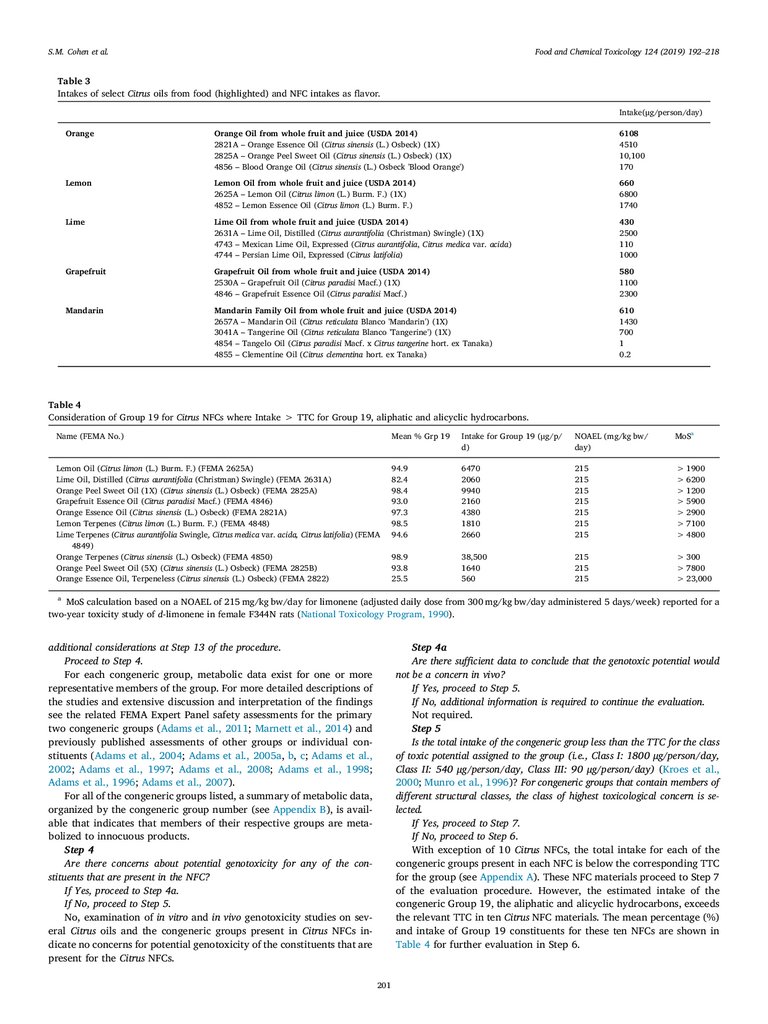
from juice and fresh fruit is estimated to be 6.1 mg/person/day. In
comparison, the per capita intakes for sweet orange NFCs Orange Peel
Sweet Oil (1X) – FEMA 2825A and Orange Essence Oil (1X) – FEMA
2821A were calculated to be 10.1 and 4.5 mg/person/day, respectively.
The per capita consumption of lime, lemon, grapefruit and mandarin
oils from the consumption of juice and fresh fruit ranges from 0.43 to
0.66 mg/person/day. In general, these intakes are typically lower than
those estimated for the related lime, lemon, grapefruit and mandarin
NFCs. For example, the per capita intake for Lemon Oil (1X) (FEMA
2625A) and Lemon Essence Oil (FEMA 4852) was calculated to be 6.8
and 1.7 mg/person/day, respectively compared to an intake of 0.66
mg/person/day from fresh fruit and juice.
b. Identification of all known constituents and assignment of Cramer
Decision Tree Class
In this Step, the results of the complete chemical analyses for each NFC
are examined, and for each constituent the Cramer Decision Tree Class
(DTC) is determined (Cramer et al., 1978).
c. Assignment of the constituents to Congeneric Groups; assignment of
congeneric group DTC.
In this Step, the identified constituents are sorted by their structural
features into congeneric groups. Each congeneric group should be expected,
based on established data, to exhibit consistently similar rates and pathways
of absorption, distribution, metabolism and excretion, and common toxicological endpoints (e.g. benzyl acetate, benzaldehyde, and benzoic acid are
expected to have similar toxicological properties). The congeneric groups are
listed in Appendix A.
Assign a decision tree structural class to each congeneric group. Within a
congeneric group, when there are multiple decision tree structural classes for
individual constituents, the class of highest toxicological concern is assigned
to the group. In cases where constituents do not belong to a congeneric group,
potential safety concerns would be addressed in Step 13.
Proceed to Step 2.
All reported constituents in 54 NFCs were organized by congeneric
group and a summary report for each NFC is shown in Appendix A. In
Appendix A, the congeneric groups with constituents with a mean%
greater or equal to 1% of the NFC are listed in order of highest to lowest
mean%. For each congeneric group listed, the constituents with a mean
% equal or greater than 1% are also shown and the minor constituents
(< 1%) are summed and reported. The total mean% for each congeneric group is subtotaled and reported with the DTC for the group.
Step 2
D intake3 of each congeneric group. (a) is calculated by summing the
mean percentage of each of the constituents within a congeneric group, and
(b) is calculated from consumption of the NFC and the mean percentage.
Calculation of PCI for each constituent congeneric group of the
NFC:where:
annual volume in kg × 109
population × CF × 365 days
where:
The annual volume of use of NFCs currently used as flavorings for food is
reported in flavor industry surveys (Gavin et al., 2008; Harman et al.,
2013; Harman and Murray, 2018; Lucas et al., 1999 ). A correction
factor (CF) is used in the calculation to correct for possible incompleteness of
the annual volume survey. For flavorings, including NFCs, that are undergoing GRAS re-evaluation, the CF, currently 0.8, is established based on the
response rate from the most recently reported flavor industry volume-of-use
surveys.
For new flavorings undergoing an initial GRAS evaluation the anticipated volume is used and a correction factor of 0.6 is applied which is a
conservative assumption that only 60% of the total anticipated volume is
reported.
For NFCs with a reported volume of use less than 22,700 kg (50,000
lbs), the eaters’ population intake assumes that consumption of the NFC is
distributed among only 10% of the entire population. In these cases, the per
capita intake for assuming a 10%“eaters only” population (PCI × 10) is
calculated as follows:
PCI × 10 (µg / person/ day ) =
annual volume in kg × 109
× 10
population × CF × 365 days
If applicable, estimate the intake resulting from consumption of the
commonly consumed food from which the NFC is derived. The aspect of food
use is particularly important. It determines whether intake of the NFC occurs
predominantly from the food of which it is derived, or from the NFC itself
when it is added as a flavoring ingredient (Stofberg and Grundschober,
1987)1. At this Step, if the conditions of use2 for the NFC result in levels that
differ from intake of the same constituents in the food source, it should be
reported.
As discussed earlier, the Citrus NFCs under consideration in this
evaluation are derived from the peel of the fruit or flowers, twigs and
buds of the Citrus tree, not the inner fruit which is commonly consumed
as food. Some Citrus species such as the bitter orange (C. aurantium) are
not typically consumed as juice or whole fruit but cultivated for their
flowers and peel oils. Therefore, a direct comparison of whole fruit
consumption to the consumption of the related NFC as flavor in food is
not applicable for the Citrus NFCs. However, measurable amounts of
essential oil are present in the Citrus juice sacs comprising the inner
fruit and in Citrus juices. Table 2 contains an estimation of the per capita
intake of sweet orange, lemon, lime, grapefruit and mandarin oils,
which are consumed in the USA, from juices and fresh fruit in 2014. In
Table 3, the estimated intake of essential oils from fruit and juice
consumption is compiled with the estimated per capita consumption of
the NFCs derived from sweet orange (C. sinensis), lemon (C. limon), lime
(C. aurantifolia and latifolia), grapefruit (C. paradisi) and mandarin types
(includes tangelo, clementine) (C. reticulata, C. paradisi Macf. × C.
tangerine hort. ex Tanaka), C. clemenina). The intake of sweet orange oil
Intake of congeneric group (µg / person /day )
Mean % congeneric group × Intake of NFC (µg / person /day )
=
100
The mean % is the mean percentage % of the congeneric group.
The intake of NFC (μg/person/day) is calculated using the PCI × 10 or
PCI equation as appropriate.
Proceed to Step 3.
In the summary report for each NFC provided in Appendix A, the
total mean% for each congeneric group is subtotaled and reported with
the DTC and intake (PCI × 10 or PCI, as appropriate) for each congeneric group listed.
Step 3
For each congeneric group, collect metabolic data for a representative
member or members of the group. Step 3 is critical in assessing whether the
metabolism of the members of each congeneric group would require
1
See Stofberg and Grundschober, 1987 for data on the consumption of NFCs
from commonly consumed foods.
2
The focus throughout this evaluation sequence is on the intake of the constituents of the NFC. To the extent that processing conditions, for example, alter
the intake of constituents, those conditions of use need to be noted, and their
consequences evaluated in arriving at the safety judgments that are the purpose
of this procedure.
3
See Smith et al., 2005 for a discussion on the use of PCI × 10 for exposure
calculations in the procedure.
200
10.
Food and Chemical Toxicology 124 (2019) 192–218S.M. Cohen et al.
Table 3
Intakes of select Citrus oils from food (highlighted) and NFC intakes as flavor.
Intake(μg/person/day)
Orange
Orange Oil from whole fruit and juice (USDA 2014)
2821A – Orange Essence Oil (Citrus sinensis (L.) Osbeck) (1X)
2825A – Orange Peel Sweet Oil (Citrus sinensis (L.) Osbeck) (1X)
4856 – Blood Orange Oil (Citrus sinensis (L.) Osbeck 'Blood Orange')
6108
4510
10,100
170
Lemon
Lemon Oil from whole fruit and juice (USDA 2014)
2625A – Lemon Oil (Citrus limon (L.) Burm. F.) (1X)
4852 – Lemon Essence Oil (Citrus limon (L.) Burm. F.)
660
6800
1740
Lime
Lime Oil from whole fruit and juice (USDA 2014)
2631A – Lime Oil, Distilled (Citrus aurantifolia (Christman) Swingle) (1X)
4743 – Mexican Lime Oil, Expressed (Citrus aurantifolia, Citrus medica var. acida)
4744 – Persian Lime Oil, Expressed (Citrus latifolia)
430
2500
110
1000
Grapefruit
Grapefruit Oil from whole fruit and juice (USDA 2014)
2530A – Grapefruit Oil (Citrus paradisi Macf.) (1X)
4846 – Grapefruit Essence Oil (Citrus paradisi Macf.)
580
1100
2300
Mandarin
Mandarin Family Oil from whole fruit and juice (USDA 2014)
2657A – Mandarin Oil (Citrus reticulata Blanco 'Mandarin') (1X)
3041A – Tangerine Oil (Citrus reticulata Blanco 'Tangerine') (1X)
4854 – Tangelo Oil (Citrus paradisi Macf. x Citrus tangerine hort. ex Tanaka)
4855 – Clementine Oil (Citrus clementina hort. ex Tanaka)
610
1430
700
1
0.2
Table 4
Consideration of Group 19 for Citrus NFCs where Intake > TTC for Group 19, aliphatic and alicyclic hydrocarbons.
Name (FEMA No.)
Mean % Grp 19
Intake for Group 19 (μg/p/
d)
NOAEL (mg/kg bw/
day)
MoSa
Lemon Oil (Citrus limon (L.) Burm. F.) (FEMA 2625A)
Lime Oil, Distilled (Citrus aurantifolia (Christman) Swingle) (FEMA 2631A)
Orange Peel Sweet Oil (1X) (Citrus sinensis (L.) Osbeck) (FEMA 2825A)
Grapefruit Essence Oil (Citrus paradisi Macf.) (FEMA 4846)
Orange Essence Oil (Citrus sinensis (L.) Osbeck) (FEMA 2821A)
Lemon Terpenes (Citrus limon (L.) Burm. F.) (FEMA 4848)
Lime Terpenes (Citrus aurantifolia Swingle, Citrus medica var. acida, Citrus latifolia) (FEMA
4849)
Orange Terpenes (Citrus sinensis (L.) Osbeck) (FEMA 4850)
Orange Peel Sweet Oil (5X) (Citrus sinensis (L.) Osbeck) (FEMA 2825B)
Orange Essence Oil, Terpeneless (Citrus sinensis (L.) Osbeck) (FEMA 2822)
94.9
82.4
98.4
93.0
97.3
98.5
94.6
6470
2060
9940
2160
4380
1810
2660
215
215
215
215
215
215
215
> 1900
> 6200
> 1200
> 5900
> 2900
> 7100
> 4800
98.9
93.8
25.5
38,500
1640
560
215
215
215
> 300
> 7800
> 23,000
a
MoS calculation based on a NOAEL of 215 mg/kg bw/day for limonene (adjusted daily dose from 300 mg/kg bw/day administered 5 days/week) reported for a
two-year toxicity study of d-limonene in female F344N rats (National Toxicology Program, 1990).
additional considerations at Step 13 of the procedure.
Proceed to Step 4.
For each congeneric group, metabolic data exist for one or more
representative members of the group. For more detailed descriptions of
the studies and extensive discussion and interpretation of the findings
see the related FEMA Expert Panel safety assessments for the primary
two congeneric groups (Adams et al., 2011; Marnett et al., 2014) and
previously published assessments of other groups or individual constituents (Adams et al., 2004; Adams et al., 2005a, b, c; Adams et al.,
2002; Adams et al., 1997; Adams et al., 2008; Adams et al., 1998;
Adams et al., 1996; Adams et al., 2007).
For all of the congeneric groups listed, a summary of metabolic data,
organized by the congeneric group number (see Appendix B), is available that indicates that members of their respective groups are metabolized to innocuous products.
Step 4
Are there concerns about potential genotoxicity for any of the constituents that are present in the NFC?
If Yes, proceed to Step 4a.
If No, proceed to Step 5.
No, examination of in vitro and in vivo genotoxicity studies on several Citrus oils and the congeneric groups present in Citrus NFCs indicate no concerns for potential genotoxicity of the constituents that are
present for the Citrus NFCs.
Step 4a
Are there sufficient data to conclude that the genotoxic potential would
not be a concern in vivo?
If Yes, proceed to Step 5.
If No, additional information is required to continue the evaluation.
Not required.
Step 5
Is the total intake of the congeneric group less than the TTC for the class
of toxic potential assigned to the group (i.e., Class I: 1800 μg/person/day,
Class II: 540 μg/person/day, Class III: 90 μg/person/day) (Kroes et al.,
2000; Munro et al., 1996)? For congeneric groups that contain members of
different structural classes, the class of highest toxicological concern is selected.
If Yes, proceed to Step 7.
If No, proceed to Step 6.
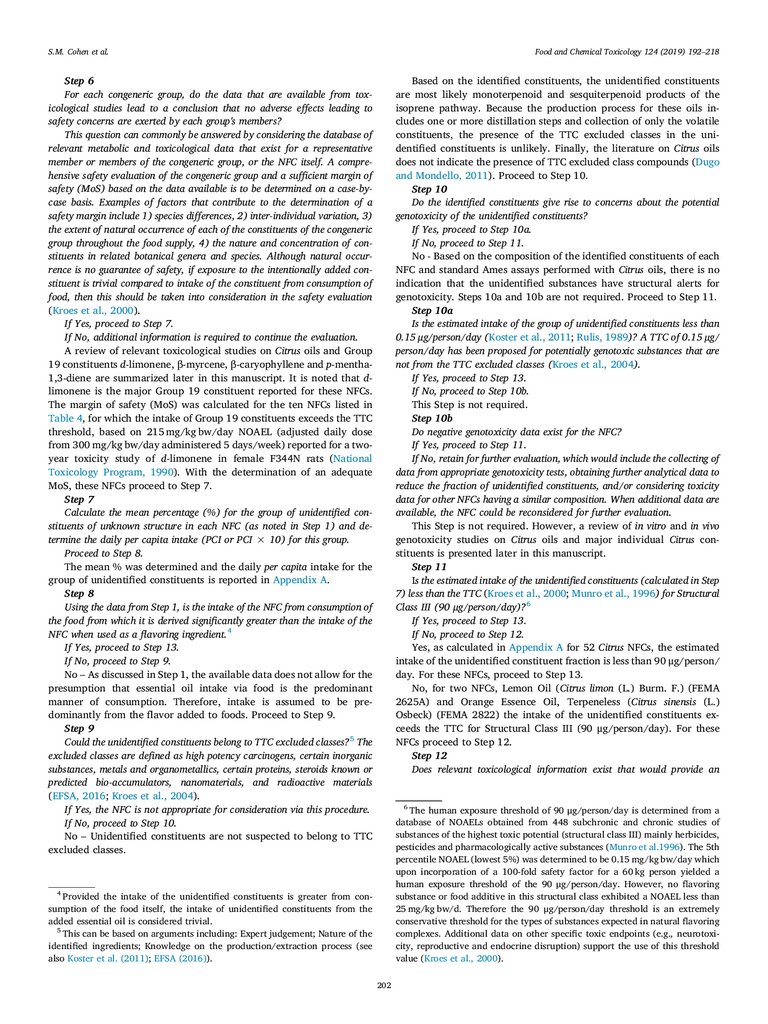
With exception of 10 Citrus NFCs, the total intake for each of the
congeneric groups present in each NFC is below the corresponding TTC
for the group (see Appendix A). These NFC materials proceed to Step 7
of the evaluation procedure. However, the estimated intake of the
congeneric Group 19, the aliphatic and alicyclic hydrocarbons, exceeds
the relevant TTC in ten Citrus NFC materials. The mean percentage (%)
and intake of Group 19 constituents for these ten NFCs are shown in
Table 4 for further evaluation in Step 6.
201
11.
Food and Chemical Toxicology 124 (2019) 192–218S.M. Cohen et al.
Step 6
For each congeneric group, do the data that are available from toxicological studies lead to a conclusion that no adverse effects leading to
safety concerns are exerted by each group's members?
This question can commonly be answered by considering the database of
relevant metabolic and toxicological data that exist for a representative
member or members of the congeneric group, or the NFC itself. A comprehensive safety evaluation of the congeneric group and a sufficient margin of
safety (MoS) based on the data available is to be determined on a case-bycase basis. Examples of factors that contribute to the determination of a
safety margin include 1) species differences, 2) inter-individual variation, 3)
the extent of natural occurrence of each of the constituents of the congeneric
group throughout the food supply, 4) the nature and concentration of constituents in related botanical genera and species. Although natural occurrence is no guarantee of safety, if exposure to the intentionally added constituent is trivial compared to intake of the constituent from consumption of
food, then this should be taken into consideration in the safety evaluation
(Kroes et al., 2000).
If Yes, proceed to Step 7.
If No, additional information is required to continue the evaluation.
A review of relevant toxicological studies on Citrus oils and Group
19 constituents d-limonene, β-myrcene, β-caryophyllene and p-mentha1,3-diene are summarized later in this manuscript. It is noted that dlimonene is the major Group 19 constituent reported for these NFCs.
The margin of safety (MoS) was calculated for the ten NFCs listed in
Table 4, for which the intake of Group 19 constituents exceeds the TTC
threshold, based on 215 mg/kg bw/day NOAEL (adjusted daily dose
from 300 mg/kg bw/day administered 5 days/week) reported for a twoyear toxicity study of d-limonene in female F344N rats (National
Toxicology Program, 1990). With the determination of an adequate
MoS, these NFCs proceed to Step 7.
Step 7
Calculate the mean percentage (%) for the group of unidentified constituents of unknown structure in each NFC (as noted in Step 1) and determine the daily per capita intake (PCI or PCI × 10) for this group.
Proceed to Step 8.
The mean % was determined and the daily per capita intake for the
group of unidentified constituents is reported in Appendix A.
Step 8
Using the data from Step 1, is the intake of the NFC from consumption of
the food from which it is derived significantly greater than the intake of the
NFC when used as a flavoring ingredient.4
If Yes, proceed to Step 13.
If No, proceed to Step 9.
No – As discussed in Step 1, the available data does not allow for the
presumption that essential oil intake via food is the predominant
manner of consumption. Therefore, intake is assumed to be predominantly from the flavor added to foods. Proceed to Step 9.
Step 9
Could the unidentified constituents belong to TTC excluded classes?5 The
excluded classes are defined as high potency carcinogens, certain inorganic
substances, metals and organometallics, certain proteins, steroids known or
predicted bio-accumulators, nanomaterials, and radioactive materials
(EFSA, 2016; Kroes et al., 2004).
If Yes, the NFC is not appropriate for consideration via this procedure.
If No, proceed to Step 10.
No – Unidentified constituents are not suspected to belong to TTC
excluded classes.
Based on the identified constituents, the unidentified constituents
are most likely monoterpenoid and sesquiterpenoid products of the
isoprene pathway. Because the production process for these oils includes one or more distillation steps and collection of only the volatile
constituents, the presence of the TTC excluded classes in the unidentified constituents is unlikely. Finally, the literature on Citrus oils
does not indicate the presence of TTC excluded class compounds (Dugo
and Mondello, 2011). Proceed to Step 10.
Step 10
Do the identified constituents give rise to concerns about the potential
genotoxicity of the unidentified constituents?
If Yes, proceed to Step 10a.
If No, proceed to Step 11.
No - Based on the composition of the identified constituents of each
NFC and standard Ames assays performed with Citrus oils, there is no
indication that the unidentified substances have structural alerts for
genotoxicity. Steps 10a and 10b are not required. Proceed to Step 11.
Step 10a
Is the estimated intake of the group of unidentified constituents less than
0.15 μg/person/day (Koster et al., 2011; Rulis, 1989)? A TTC of 0.15 μg/
person/day has been proposed for potentially genotoxic substances that are
not from the TTC excluded classes (Kroes et al., 2004).
If Yes, proceed to Step 13.
If No, proceed to Step 10b.
This Step is not required.
Step 10b
Do negative genotoxicity data exist for the NFC?
If Yes, proceed to Step 11.
If No, retain for further evaluation, which would include the collecting of
data from appropriate genotoxicity tests, obtaining further analytical data to
reduce the fraction of unidentified constituents, and/or considering toxicity
data for other NFCs having a similar composition. When additional data are
available, the NFC could be reconsidered for further evaluation.
This Step is not required. However, a review of in vitro and in vivo
genotoxicity studies on Citrus oils and major individual Citrus constituents is presented later in this manuscript.
Step 11
Is the estimated intake of the unidentified constituents (calculated in Step
7) less than the TTC (Kroes et al., 2000; Munro et al., 1996) for Structural
Class III (90 μg/person/day)?6
If Yes, proceed to Step 13.
If No, proceed to Step 12.
Yes, as calculated in Appendix A for 52 Citrus NFCs, the estimated
intake of the unidentified constituent fraction is less than 90 μg/person/
day. For these NFCs, proceed to Step 13.
No, for two NFCs, Lemon Oil (Citrus limon (L.) Burm. F.) (FEMA
2625A) and Orange Essence Oil, Terpeneless (Citrus sinensis (L.)
Osbeck) (FEMA 2822) the intake of the unidentified constituents exceeds the TTC for Structural Class III (90 μg/person/day). For these
NFCs proceed to Step 12.
Step 12
Does relevant toxicological information exist that would provide an
6
The human exposure threshold of 90 μg/person/day is determined from a
database of NOAELs obtained from 448 subchronic and chronic studies of
substances of the highest toxic potential (structural class III) mainly herbicides,
pesticides and pharmacologically active substances (Munro et al.1996). The 5th
percentile NOAEL (lowest 5%) was determined to be 0.15 mg/kg bw/day which
upon incorporation of a 100-fold safety factor for a 60 kg person yielded a
human exposure threshold of the 90 μg/person/day. However, no flavoring
substance or food additive in this structural class exhibited a NOAEL less than
25 mg/kg bw/d. Therefore the 90 μg/person/day threshold is an extremely
conservative threshold for the types of substances expected in natural flavoring
complexes. Additional data on other specific toxic endpoints (e.g., neurotoxicity, reproductive and endocrine disruption) support the use of this threshold
value (Kroes et al., 2000).
4
Provided the intake of the unidentified constituents is greater from consumption of the food itself, the intake of unidentified constituents from the
added essential oil is considered trivial.
5
This can be based on arguments including: Expert judgement; Nature of the
identified ingredients; Knowledge on the production/extraction process (see
also Koster et al. (2011); EFSA (2016)).
202
12.
Food and Chemical Toxicology 124 (2019) 192–218S.M. Cohen et al.
Table 5
Consideration of Citrus NFCs with an intake of unidentified constituents in excess of the TTC for Structural Class III.
Name
FEMA No.
NOAEL (mg/kg bw/day)
Intake of NFC (μg/p/day)
MoSa (NFC)
Lemon Oil (Citrus limon (L.) Burm. F.)
Orange Essence Oil, Terpeneless (Citrus sinensis (L.) Osbeck)
2625A
2822
600
600
6800
2230
> 5000
> 16,000
a
MoS calculation based on NOAEL determined for sweet orange oil in rats of 600 mg/kg bw/day from a 28-day oral gavage study (Serota, 1990a, 1990b).
adequate margin of safety for the intake of the NFC and its unidentified
constituents?
This question may be addressed by considering data for the NFC or an
NFC with similar composition. It may have to be considered further on a
case-by-case basis, particularly for NFCs with primarily non-volatile constituents.
If Yes, proceed to Step 13.
If No, perform appropriate toxicity tests or obtain further analytical data
to reduce the fraction of unidentified constituents. Resubmit for further
evaluation.
Yes, the NOAEL for sweet orange oil in rats is 600 mg/kg bw/day
from a 28-day oral gavage study (Serota, 1990a) and provides an
adequate margin of safety for the Citrus NFCs Lemon Oil (C. limon (L.)
Burm. F. (FEMA 2625A) and Orange Essence Oil, Terpeneless (C. sinensis (L.) Osbeck) (FEMA 2822) with a total intake of unidentified
constituents above TTC for Structural Class III (Table 5). Proceed to
Step 13.
Step 13
Are there any additional relevant scientific considerations that raise a
safety concern (e.g. intake by young infants and children)?
If Yes, acquire and evaluate additional data required to address the
concern before proceeding to Step 14.
If No, proceed to Step 14.
A further evaluation to consider possible exposure to children and
infants, given their lower body weights and the potential for differences
in toxicokinetics and toxicodynamics as compared to adults, was conducted. Table 4 lists the congeneric groups that exceed TTC threshold
and Table 5 lists two NFCs for which the intake of the unknown constituent fraction exceeds the TTC thresholds for Class 3. In each instance, the margin of safety remains > 100 using a body weight of
20 kg. For Orange Essence Oil, Terpeneless (FEMA 2822), the intake of
congeneric Group 12 (aliphatic and aromatic tertiary alcohols and related esters) was below but close to the TTC threshold. When compared
to the NOAEL for linalool, the principal constituent of this congeneric
group in orange essence oil, terpeneless, a margin of safety of greater
than 1900 (based on 20 kg) was determined from a 12 week study in
mice (Oser, 1967).
Furocoumarin compounds are a well-known group of natural food
constituents occurring mainly in plants belonging to the Rutaceae (e.g.
Citrus) and Umbelliferae (e.g. parsnips, carrots, parsley, celery) (Dolan
et al., 2010). Considered to be natural pesticides, plants produce furocoumarins to defend against various viruses, bacteria, and insects
(Wagstaff, 1991). While furocoumarins have been shown to be present
in Citrus oils, the NFC Citrus oils are often processed in a manner that
reduces their furocoumarin content compared to the freshly harvested
peel oil (Frérot and Decorzant, 2004). For bergamot oil, methods for the
reduction of bergapten include an alkaline treatment, vacuum fractional distillation techniques and fractionation using super critical fluid
technology (Gionfriddo et al., 2004). In general, NFC Citrus oils are
often further processed by distillation for the purpose of concentrating
or folding the oil or remove higher molecular weight compounds that
color the oil. Because of their lower volatility, the furocoumarin content
of distilled oils is reduced compared to the raw essential oil.
Furocoumarins have both phototoxic and photomutagenic properties following exposure to UV light and thus the use of furocoumarincontaining materials in skin-care and cosmetic products is regulated
(Cosmetic Ingredient Review Expert Panel, 2016; Scientific Committee
on Consumer Products, 2005). In the European Medicines Agency
(EMEA) Committee on Herbal Medicines draft report on the risks associated with furocoumarins contained in preparations of Angelica
archangelica L., a daily intake of 15 μg/day furocoumarins in herbal
medicinal preparations was considered not to pose an unacceptable risk
to consumers (European Medicines Agency, 2007).
In consideration of the limited information on the typical intake of
furocoumarin compounds from food and their potential effects, regulatory bodies have not regulated dietary exposure to furocoumarin
content from food. In “Furocoumarins in Plant Foods” published in
1996 by the Nordic Council of Ministers, the Nordic Working Group on
Natural Toxins presents a risk assessment on toxicological effects that
may occur with the consumption of furocoumarins at levels present in
fruits and vegetables (Nordic Working Group on Natural Toxins, 1996).
While gaps in knowledge regarding the occurence, intake and bioavailability of furocoumarins consumed with food exist, the working
group concluded that the average daily intake of furocoumarins in food
is unlikely to elicit a phototoxic response or increase the cancer risk in
internal organs not exposed to UVA ultraviolet light. The group acknowledges that repeated consumption of furocoumarin-rich foods
could result in higher concentrations in the serum that are correlated
with a phototoxic response (Nordic Working Group on Natural Toxins,
1996). In a 1996 report, the Committee on Toxicity, Mutagenicity,
Carcinogenicity of Chemicals in Food, Consumer Products and the Environment, Department of Health, Britian concluded “that the likelihood of any risk to health from dietary intakes of furocoumarins was
very small” (COT, 1998). In 2004, the DFG Senate Commission on Food
Safety – Germany (SKLM) published its toxicological assessment on
furocoumarins in foods, concluding that “additional risk of skin cancer
arising from the consumption of typical quantities of furocoumarincontaining food, which remain significantly below the range of phototoxic doses, is regarded as insignificant” (SKLM, 2004). In 2010, the
SKLM published an update that included an analysis of estimated furocoumarin intakes from non-flavored and flavored foods which determined that intakes from non-flavored food such as grapefruit juice
was a much higher source of furocoumarins than flavored foods, such as
drinks flavored with lime oils (Gorgus et al., 2010; SKLM, 2010). In this
updated report, the SKLM confirmed its 2004 opinion that furocoumarins in food do not present a significant risk for phototoxic effects (SKLM, 2010). The FEMA Expert Panel concurs with these opinions and concludes that the potential additional safety concerns
arising from the extremely low level of furocoumarins present in Citrusderived NFCs used as flavor ingredients does not present a safety concern under conditions of intended use.
Step 14
Based on the above data and considerations, the NFC can be generally
recognized as safe (GRAS) under conditions of intended use as a flavoring
ingredient.
Based on the above assessment and the application of the judgment
of the FEMA Expert Panel that the current FEMA GRAS Citrus NFCs are
affirmed as GRAS under conditions of intended use as flavor substances
and are listed in Table 6. Citrus flavor materials that were not previously evaluated by the Panel have been determined to be GRAS under
conditions of intended use and are listed in Table 7.
203
13.
Food and Chemical Toxicology 124 (2019) 192–218S.M. Cohen et al.
alicyclic hydrocarbons group (Group 19) found in Citrus NFCs include
d-limonene (FEMA 2633), p-mentha-1,4-diene (FEMA 3559), α-pinene
(FEMA 2902), β-pinene (FEMA 2903), β-myrcene (FEMA 2762), terpinolene (FEMA 3046) and β-caryophyllene (FEMA 2252). This section
provides metabolic and toxicological information relevant to the evaluation of Citrus NFCs via this procedure (Cohen et al., 2018).
Table 6
FEMA GRAS Citrus flavor materials affirmed (GRAS).
FEMA No.
Name
2153
2344
2345
2530
2623
2625
2626
2631
2632
2657
2771
2821
2822
2823
2824
2825
2826
2853
2854
2855
3041
3823
3899
4743
4744
Bergamot Oil (Citrus auranthium L. ssp. Bergamia)
Curacao Peel Extract (Citrus aurantium L.)
Curacao Peel Oil (Citrus aurantium L.)
Grapefruit Oil (Citrus paradisi Macf.)
Lemon Extract (Citrus limon (L.) Burm. F.)
Lemon Oil (Citrus limon (L.) Burm. F.)
Lemon Oil, Terpeneless (Citrus limon (L.) Burm. F.)
Lime Oil, Distilled (Citrus aurantifolia (Christman) Swingle)
Lime Oil, Terpeneless (Citrus aurantifolia (Christman) Swingle)
Mandarin Oil (Citrus reticulata Blanco ‘Mandarin’)
Neroli Bigarade Oil (Citrus aurantium L.)
Orange Essence Oil (Citrus sinensis (L.) Osbeck)
Orange Essence Oil, Terpeneless (Citrus sinensis (L.) Osbeck)
Orange Peel Bitter Oil (Citrus aurantium L.)
Orange Peel Sweet Extract (Citrus sinensis (L.) Osbeck)
Orange Peel Sweet Oil (Citrus sinensis (L.) Osbeck)
Orange Peel Sweet Oil, Terpeneless (Citrus sinensis (L.) Osbeck)
Petitgrain Lemon Oil (Citrus limon L. Burm. F)
Petitgrain Mandarin Oil (Citrus reticulata Blanco var. mandarin)
Petitgrain Oil (Citrus aurantium L.)
Tangerine Oil (Citrus reticulata Blanco ‘Tangerine’)
Daidai Peel Oil (Citrus aurantium L. subspecies cyathifera Y.)
Sarcodactylis Oil (Citrus medica L. var. Sarcodactylis Swingle)
Mexican Lime Oil, Expressed (Citrus aurantifolia, Citrus medica var. acida)
Persian Lime Oil, Expressed (Citrus latifolia)
7.1. Absorption, distribution, metabolism and excretion
Hydrocarbons are highly lipophilic and may cross biological membranes (gastrointestinal tract, skin, respiratory epithelia, etc.) by passive diffusion, driven by concentration gradients between the gastrointestinal tract and portal blood, or by one or more active transport
mechanisms. Therefore, chemicals in this group are rapidly absorbed
and widely distributed. Following oral administration, d-limonene is
first distributed to the liver, kidney and blood (Cmax at 2 h) (Igimi et al.,
1974). Hydrocarbons are slowly eliminated, primarily in the urine, as
polar conjugates of oxidized metabolites (> 60% of oral d-limonene)
(Del Toro-Arreola et al., 2005).
In oxidative metabolism, the biotransformation of d-limonene, βmyrcene and α- and β-pinenes, as well as the other group members is
catalyzed by cytochrome P450 enzymes. The oxidative metabolites are
then conjugated and excreted mainly in the urine. The metabolic profiles are remarkably similar, with the primary pathways including side
chain oxidation or epoxidation of double bonds. Oxidation of alkene
functional groups and alkyl substituents, primarily by allylic or benzylic
hydroxylation, is followed by either conjugation with glucuronic acid
and urinary excretion or further oxidation to yield the corresponding
carboxylic acids. In addition, sterically unhindered alkenes, such as
myrcene and limonene also undergo epoxidation, unlike sterically
hindered structures (e.g.bicyclic monoterpenes pinene and camphene).
Epoxide metabolites are either hydrolyzed to yield diols or conjugated
with glutathione to subsequently yield mercapturic acid derivatives.
The diols may also be conjugated with glucuronic acid and excreted in
the urine. Of the acyclic hydrocarbons, β-myrcene primarily undergoes
epoxidation followed by hydrolytic epoxide ring opening to yield
myrcene-3,10-glycol and to a lesser degree myrcene-1,2-glycol, as
shown in Fig. 6 (Ishida et al., 1981; Madyastha and Srivatsan, 1987). A
minor metabolic pathway for myrcene involves cyclization and subsequent formation of limonene as a transient intermediate which undergoes rapid oxidation to form uroterpenol (p-menth-1-en-8,9-diol)
(Ishida et al., 1981).
Of the monocyclic hydrocarbons, d-limonene undergoes either
allylic oxidation of the exocyclic methyl group yielding perillic acid and
dihydroperillic acid, or epoxidation and hydrolysis to yield limonene1,2-diol and limonene-8,9-diol, as shown in Fig. 7 (Crowell et al., 1994;
Poon et al., 1996; Vigushin et al., 1998). In humans, allylic oxidation is
the dominant metabolic pathway of d-limonene (Poon et al., 1996) and
is followed by glucuronic acid conjugation of all major and minor
metabolites (Kodama et al., 1974; Poon et al., 1996). In the rat, d-limonene is primarily oxidized to perillic acid (∼85%) that is either
excreted in the urine unchanged or conjugated with glycine or glucuronic acid. Further oxidation to perillic acid-8,9-diol or 2-hydroxy-pmenth-8-en-7-oic acid also occurs.
A similar metabolic profile has been reported with microsomal incubation of d-limonene in vitro (with the 8,9-diol as the primary metabolite) (Watabe et al., 1981). Sex related differences have been reported in the formation of alcohol metabolites of d-limonene in rats by
CYP2C11 oxidation (Miyazawa et al., 2002).
Of the bicyclic hydrocarbons, (+)-α-pinene (Falk et al., 1990) exposure in humans results in the rapid excretion of urinary metabolites
cis- and trans-verbenol at a ratio of 1:10, that are largely eliminated
within 20 h. As summarized in Fig. 8, two diols, cis- and trans-4-hydroxymyrtenol, formed by methyl group hydroxylation of cis- and transverbenol and trans-4-hydroxymyrtenal were also detected (Eriksson and
Levin, 1996; Schmidt and Goen, 2017). At high exposure in humans
Table 7
New FEMA GRAS Citrus flavoring materials.
FEMA No.
Name
4846
4847
4848
4849
Grapefruit Essence Oil (Citrus paradisi Macf.)
Grapefruit Oil, Terpeneless (Citrus paradisi Macf.)
Lemon Terpenes (Citrus limon (L.) Burm. F.)
Lime Terpenes (Citrus aurantifolia Swingle, Citrus medica var. acida,
Citrus latifolia)
Orange Terpenes (Citrus sinensis (L.) Osbeck)
Grapefruit Terpenes (Citrus paradisi Macf.)
Lemon Essence Oil (Citrus limon (L.) Burm. F.)
Petitgrain Oil, Terpeneless (Citrus aurantium L.)
Tangelo Oil (Citrus paradise Macf. x Citrus tangerine hort. ex Tanaka)
Clementine Oil (Citrus clementina hort. ex Tanaka)
Blood Orange Oil (Citrus sinensis (L.) Osbeck ‘Blood Orange’)
Iyokan Oil (Citrus iyo)
Hassaku Oil (Citrus hassaku hort. ex Tanaka)
Sikuwasya Oil (Citrus depressa)
Natumikan Oil (Citrus natsudaidai)
Mikan Oil (Citrus unshiu)
Yuzu Oil (Citrus junos (Sieb.) c. Tanaka)
Sudachi Oil (Citrus sudachi hort. ex Shirai)
Kabosu Oil (Citrus sphaerocarpa)
Ponkan Oil (Citrus reticulata Blanco’Ponkan’)
Orange Essence Water Phase (Citrus sinensis (L.) Osbeck)
4850
4851
4852
4853
4854
4855
4856
4857
4858
4859
4860
4861
4862
4863
4864
4865
4866
7. Biochemical and toxicological supporting information relevant
to the safety evaluation
As the constituent analyses of the Citrus NFCs have demonstrated,
the Aliphatic and alicyclic hydrocarbons (Group 19) and to a much
lesser extent, the Aliphatic acyclic and alicyclic terpenoid tertiary alcohols and structurally related substances (Group 12) are the two primary congeneric groups that account for the majority of the NFC
composition (Appendix A). As noted in Step 5 of the safety evaluation
procedure, the TTC for the congeneric group is exceeded for the Aliphatic and alicyclic hydrocarbons group (Group 19) for ten Citrus NFCs.
The Aliphatic and alicyclic hydrocarbons group, which is comprised of
17 FEMA GRAS chemically defined flavoring ingredients, was reaffirmed as GRAS for use as chemically defined flavor materials in 2011
(Adams et al., 2011). The major constituents from the Aliphatic and
204
14.
Food and Chemical Toxicology 124 (2019) 192–218S.M. Cohen et al.
Fig. 6. Metabolism of β-myrcene in rats.
(suicide attempt) myrtenol, verbenol, and borneol were also detected in
the urine (Koppel et al., 1981). However, α-pinene, β-pinene, 3-carene,
and camphene were also detected in the urine of normal humans
(Zlatkis et al., 1973). In male albino rabbits (6/dose) greater than 80%
of the dose of each (+)-α-pinene, (−)-α-pinene, ( ± )-α-pinene, (−)-βpinene, (−)-cis-pinane, or (+)-d-3-carene was found as glucuronic acid
conjugates in the urine (Ishida et al., 1981). Verbenol is the principal
metabolite of α-pinene (Ishida et al., 1981). In rabbits, β-caryophyllene
undergoes epoxidation of the endocyclic 5,6-double bond, hydroxylation at the gem-dimethyl group and epoxidation of the exocyclic 2,12double bond (See Fig. 9) (Asakawa et al., 1981; Ishida et al., 1979).
Fig. 7. Summary of d-limonene metabolism.
205
15.
Food and Chemical Toxicology 124 (2019) 192–218S.M. Cohen et al.
induction is also reported for β-caryophyllene in rats and mice
(Ambrose, 1983).
7.3. Short-term and long-term studies of toxicity
7.3.1. Acute oral toxicity
The LD50 in male and female rats of the sweet orange oil was determined to be 1122 mg/kg bw (Serota, 1984). Aliphatic and aromatic
hydrocarbons exhibit very low acute oral toxicity with oral LD50 values
ranging from 1590 to greater than 8000 mg/kg bw in rats, and from
2000 to greater than 13,360 mg/kg bw in mice (Adams et al., 2011).
7.3.2. Subchronic oral toxicity
7.3.2.1. Sweet orange oil. A GLP-compliant oral toxicity study has been
conducted for sweet orange oil in male and female SD rats (10/sex/
dose). The composition of the sweet orange oil was determined to be
97.5% limonene, 1.6% β-myrcene, 0.2% α-pinene, 0.2% sabinene and
0.1% δ-3-carene by chromatographic analysis. The animals received
doses of 0 (vehicle), 240, 600 or 1500 mg/kg bw/day of sweet orange
oil in methyl cellulose via gavage for 28 days (Serota, 1990b).
Treatment did not have any effect on survival, clinical parameters,
body weight, or food consumption. Dose-related decreases in blood
glucose levels were observed at the highest dose in animals of both
sexes and in the mid-dose group females. Female animals at all doses
and males of the high-dose group also showed dose-related increases in
the total serum protein and serum albumin levels. Gross pathology
findings of the non-glandular stomach were reported in both males and
females of the high dose group and correlated with histopathology
findings, including rough, thickened and/or filmy material in the
mucosa, increased incidence of squamous epithelial hyperplasia (5/10
males and 7/10 females), and subacute inflammation (3/10 males and
4/10 females). A modest incidence of thickened mucosa was also found
in the mid-dose females. Gross pathology also revealed dark areas and/
or thickened mucosa in the non-glandular region of the stomach in
high-dose rats of both sexes. The non-glandular stomach changes are
indicative of an irritation effect by the administered chemical and are
not relevant to humans (Adams et al., 2008; Proctor et al., 2007). There
was also an increased incidence of pale or dark areas of the kidneys of
male animals in the mid and high dose groups. Incidence of
hydronephrosis (dilatation and/or fluid in the kidney pelvis) was
observed in 4/10 low-dose male animals and 4/10 high dose females
with isolated cases in low and middle dose females (1/10, each).
Hydronephrosis is highly variable in these rats and does not produce
adverse renal effects. The males exhibited a high incidence of renal
hyaline droplet degeneration with a low to moderate incidence of renal
tubular necrosis and regeneration of the renal tubular epithelium at all
doses, characteristic of α2u-globulin-mediated effects, a male ratspecific phenomenon that is not relevant to humans (Capen et al.,
1999) that is discussed later in the manuscript. Indeed, although highdose females showed increased kidney weights, there was no
corresponding histopathologic alteration. Increased absolute liver
weights in all male animals and in high-dose females were also
without corresponding histopathological findings and most likely was
related to induction of metabolic enzymes. The latter is also supported
by the ability of sweet orange oil to induce liver microsomal pnitroanisole O-demethylase in male and female rats and hepatic
aniline hydroxylase in females after 4 days exposure to 2500 mg/
kg bw/day (Thomas, 1981). Based on these observations, including the
non-relevance of changes in the non-glandular stomach to humans, the
no-observed-adverse-effect-level (NOAEL) for sweet orange oil in rats is
600 mg/kg bw/day. This NOAEL value was used to assess the MoS for
two Citrus NFCs, as described in Table 5 above.
The α2u-globulin-associated renal effects seen in male rats in the
sweet orange oil study described above are consistent with similar effects reported for flavoring substances that belong to congeneric Group
19, aliphatic and aromatic hydrocarbons, in several short-term and
Fig. 8. α-pinene metabolism in humans.
Fig. 9. β-caryophyllene metabolism in rabbits.
7.2. Enzyme induction
At high dose levels, acyclic, monocyclic, bicyclic, and aromatic
terpene hydrocarbons induce an array of cytochrome P450 enzymes
that are responsible for the hydroxylation of the hydrocarbons eventually leading to more polar metabolite conjugates. In rats, d-limonene
(Austin et al., 1988; Maltzman et al., 1991; Miyazawa et al., 2002), βmyrcene (De-Oliveira et al., 1997) and α- and β-pinenes (Austin et al.,
1988; White Jr. and Agosin, 1980), are inducers and competitive inhibitors of the CYP2B enzymes, specifically CYP2B1, the CYP2C enzymes and epoxide hydrolase. Evidence of liver microsomal enzyme
206
16.
Food and Chemical Toxicology 124 (2019) 192–218S.M. Cohen et al.
long-term toxicity studies, including studies on β-myrcene, d-limonene,
α-pinene, β-pinene, and camphene. A comprehensive review of toxicity
studies is available in the recent safety re-evaluation of the group of
Aliphatic and aromatic hydrocarbons (Adams et al., 2011). The relevant
studies are described briefly below.
findings. Therefore, none of these were determined to be of
toxicological relevance. All histopathological findings were
considered incidental, spontaneous and not related to the presence of
β-myrcene in the diet. NOAEL values of 115 and 136 mg/kg bw/day for
males and females, respectively, were determined based on the lack of
adverse effects (Bastaki et al., 2018).
In an NTP study, β-myrcene was administered to male and female
F344N Fischer rats (10/sex/dose) at doses of 0, 250, 500, 1000, 2000 or
4000 mg/kg bw/day by oral gavage for 13-weeks (National Toxicology
Program, 2010). The same parameters were evaluated as described
above. In addition, the left kidneys of male rats were processed for
Mallory-Heidenhain staining for investigation of α2u-globulin effects.
High mortality was reported at the top dose group and additionally 2
males and 4 females at 2000 mg/kg bw/day, 1 male and 1 female at
1000 mg/kg bw/day and 1 male at 500 mg/kg bw/day groups died.
Significantly lower mean body weights and body weight gains were
reported in males at 500, 1000 and 2000 mg/kg bw/day and females at
2000 mg/kg bw/day. Significant decreases in blood leukocytes and
lymphocytes in males and females of the 2000 mg/kg bw/day and significantly decreased serum creatinine levels at all dose levels in females
and at 1000 and 2000 mg/kg bw/day in males were also observed.
Several statistically significant changes were reported at all dose levels.
These included significant increases in mean absolute and relative liver
and kidney weights in male and female rats, which were dose dependent except for mean absolute liver weight in males, and significant
decreases in mean absolute and relative thymus weights. Prominent
kidney effects were also reported, including renal tubular hyaline
droplet formation starting at 250 mg/kg bw/day in all males except the
2000 mg/kg bw/day group; significantly increased renal tubule necrosis in all treatment groups of males and females; significantly higher
incidence of nephrosis in males and females at 1000 or 2000 mg/kg bw/
day; evidence of nephropathy was found at similar incidences (7–10
animals/dose) in males of all groups including the control animals, and
evidence of porphyrin pigmentation of the Harderian gland was significant at 500 mg/kg bw/day and higher. Additional inflammatory and
degenerative effects were reported in other tissues at 1000 and
2000 mg/kg bw/day. In a follow-up pathology study of the kidney lesions observed in the β-myrcene bioassay, another pathology was
identified in both male and female rats involving the OSOM (Cesta
et al., 2013). On this basis, a NOAEL could not be assigned for male rats.
For females, a NOAEL of 250 mg/kg bw/day is assigned based on reduced body weights at higher dose levels.
In a parallel NTP study, β-myrcene was tested in male and female
B6C3F1 mice by gavage at doses of 0, 250, 500, 1000, 2000 or
4000 mg/kg bw/day (10/sex/dose) for 13 weeks (National Toxicology
Program, 2010). High mortality was reported in the top two dose
groups. The remaining groups were evaluated for clinical signs of
toxicity, body weight, sperm morphology, vaginal cytology evaluations,
clinical chemistry, hematology, organ weights and histopathological
examination of a wide variety of tissues. A NOAEL could not be assigned because of significantly increased mean weight of the right
kidney relative to body weight in females at 250, 500 and 1000 mg/
kg bw/day. There were also increased absolute and/or relative weights
of other organs (liver and/or kidney) in females at 500 mg/kg bw/day
and in both sexes at 1000 mg/kg bw/day and additional effects at the
1000 mg/kg bw/day dose level, including reduced body weight gains in
males and females, significantly lower mean body weights in females, a
significant decrease in hematocrit (males), hemoglobin (males) and
erythrocyte count (both sexes). However, no abnormalities were found
in histopathological evaluation up to 1000 mg/kg bw/day in both sexes.
7.3.2.2. d-Limonene. In a National Toxicology Program (NTP)
subchronic study with male and female F344/N rats (10/sex/dose), dlimonene was administered via gavage at dose levels of 0, 150, 300,
600, 1200 or 2400 mg/kg bw/day in corn oil, 5 days/week for 13 weeks
(National Toxicology Program, 1990). Mortality (90%) was reported at
2400 mg/kg bw/day in both males (5/10) and females (9/10) and signs
of toxicity were observed in both sexes at the dose levels 1200 and
2400 mg/kg bw/day. Lower final mean body weights were reported for
male animals at doses of 600 mg/kg bw/day and above and the one
surviving female animal at the top dose. In addition, a dose-related
increase in severity of nephropathy was noted in males only,
characterized by epithelial degeneration in the convoluted tubules;
granular casts with tubular lumens, primarily in the outer stripe of the
outer medulla (OSOM) and regeneration of the tubular epithelium; and
hyaline droplets in the epithelium of the proximal convoluted tubules.
Hyaline droplets were observed in all animals including vehicle
controls, but aggregation of the droplets was only seen in the treated
male rats. A NOAEL of 1200 mg/kg bw/day was selected for female rats
based on low survival at the highest dose. Due to renal effects at all dose
levels, no NOAEL could be assigned for male rats. The male rat specific
kidney effects were later determined to be not relevant to human
toxicity (Swenberg and Lehman-McKeeman, 1999).
In a study using B6C3F1 mice (10/sex/dose), d-limonene was administered in doses of 0, 125, 250, 500, 1000 or 2000 mg/kg bw/day in
corn oil by gavage, 5 days/week for 13 weeks (National Toxicology
Program, 1990). One male and 2 females at 2000 mg/kg bw/day and 1
female at 500 mg/kg bw/day died before the end of the study. Lower final
mean body weights were reported at the two highest dose levels for males
(up to 10%) and females (up to ∼2%), along with clinical signs of toxicity
at the 1000 and 2000 mg/kg bw/day levels and one female animal with
alveolar cell adenoma, a common tumor in this strain of mice, was reported at the highest dose level (2000 mg/kg bw/day). Based on lower
body weights and mortality at higher levels, the NOAEL in this study is
500 mg/kg bw/day for males and 1000 mg/kg bw/day for females.
7.3.2.3. β-Myrcene. In a 90-day study conducted according to OECD
Testing Guideline 408, CRL SD CD®IGS rats (10/sex/dietary intake
level) were fed a diet containing 0 (dietary control), 700, 2100 or
4200 ppm of β-myrcene daily designed to provide target dose levels of
50, 150, or 300 mg/kg bw/day (Bastaki et al., 2018). The neat test
material was stable under conditions of storage; however, stability was
reduced to 45.1, 43.6 or 42.9% of target (7-day average) when
incorporated into the diet, with measured concentrations of βmyrcene of 316, 916 or 1802 ppm in the low, middle and high
dietary concentrations, respectively. Homogeneity studies revealed
that the test material was evenly dispersed in the feed. Therefore, the
measured dietary concentrations corresponded to estimated daily
intakes of 20, 59 or 115 mg/kg bw/day for males and 24, 70 or
136 mg/kg bw/day for females. No mortalities, clinical signs of
toxicity or ophthalmological changes associated with the presence of
β-myrcene in the diet were reported. In this study, there were no
statistically significant changes in any of the parameters evaluated that
were associated with β-myrcene in the diet when compared to the
concurrent control group. Parameters evaluated included body weight,
body weight gain, food consumption and food efficiencies, clinical
pathology parameters, macroscopic and microscopic findings, and
organ weight measurements. Although a few changes in hematology
and clinical chemistry values reached statistical significance when
compared to concurrent controls, they were all within historical
control ranges and did not correlate with macroscopic or microscopic
7.3.2.4. β-Caryophyllene. In an OECD Section 4 (part 408) compliant
90-day study, male Crl: SD CD IGS rats (10/sex/group) were
maintained on diets containing 0, 3500, 7000 or 21,000 ppm βcaryophyllene, calculated to provide an average daily intake of 0,
222, 456 or 1367 mg/kg bw/day, respectively. Female rats (10/sex/
207
17.
Food and Chemical Toxicology 124 (2019) 192–218S.M. Cohen et al.
group) were maintained on diets containing 0, 3500, 14,000 or
56,000 ppm β-caryophyllene, calculated to provide an average daily
intake of 0, 263, 1033 or 4278 mg/kg bw/day, respectively (Bauter,
2013).
Stability of test substance in the diet was evaluated by analyzing
dietary levels of β-caryophyllene on Day 0, 4, 7 and 10 after preparation and showed that the test article was homogeneously distributed
and stable. The eyes of all rats were examined by focal illumination and
indirect ophthalmoscopy before beginning the study and on Day 91.
During the study, animals were observed for viability, signs of gross
toxicity and behavioral changes at least once daily and weekly for a
battery of detailed clinical observations. Body weights were recorded
twice during acclimation and prior to test initiation and together with
food consumption, approximately weekly thereafter and prior to
terminal sacrifice. Urine and blood samples were collected on Day 85
from all study animals for urinalysis, hematology and clinical chemistry
determinations. Coagulation assessments were performed on Day 94 or
95, prior to necropsy. Gross necropsies and histological evaluation of
selected organs and tissues were performed on all study animals.
At the end of the study, there were no mortalities, clinical or ophthalmological changes attributable to dietary intake of β-caryophyllene.
At the highest dose level in both the male and female study groups,
statistically significant concentration-dependent reductions in body
weight, body weight gain, food consumption and food efficiency were
reported and attributed to the possible decrease in test substance palatability at high dietary levels.
Statistically significant changes in hematology, clinical chemistry,
coagulation and urinalysis parameters were observed in mid and highdose male and female rats. Most of the observed changes were not
concentration dependent, within the range of historical values and had
no direct correlation with a histological evaluation. However, concentration-dependent decreases in glucose and increases in triglyceride
concentrations, correlating with changes in liver weights in females
were considered the possible metabolic result of test substance administration. Also, fine granular casts, potentially related to α2u-globulin accumulation, were found in the urine of some males in all the
test groups as well as the control group.
Macroscopic findings included enlarged livers in the high dose female group that corresponded to histological evidence of concentration
dependent hepatocellular hypertrophy. In the high dose male group,
enlarged kidneys were reported that correlated with an increase in relative kidney weights and microscopic findings of nephropathy and
tubular cytoplasmic droplets in the kidneys. This most likely is related
to the α2u-globulin nephropathy that was reported in the histopathologic examination of the male rats. Kidney cells of affected males were
reported to have necrotic nuclei and an increase in eosinophilic cytoplasm. Consistent with this spontaneous nephropathy, there were also
increases in the number and size of hyaline droplets present in the
kidneys. This was confirmed by positive Mallory-Heidenhain staining of
the kidney sections from all male rats. The staining showed a concentration-dependent increase in intensity correlated to increasing
dietary levels of β-caryophyllene (Garlick, 2013). Based on the International Agency for Research on Cancer (IARC) criteria defining the
occurrence of α2u-globulin nephropathy, these observations are consistent with previous studies that define α2u-globulin nephropathy in
the male rat. The development of α2u-globulin nephropathy has been
shown to be specific to the male rat and as discussed in the analysis of
the d-limonene study in rats, this effect is not considered relevant to
human health.
A no-observed-adverse effect level (NOAEL) of 3500 ppm (equivalent to approximately 222 mg/kg bw/day for males and 263 mg/kg bw/
day in females) is determined for β-caryophyllene based on histologic
evidence of hepatocyte hypertrophy reported at the mid and high male
and female dose groups.
7.3.3. Long term studies of toxicity and carcinogenicity
Chronic toxicity and carcinogenicity studies have been conducted
for representatives of the congeneric group of hydrocarbons, d-limonene and β-myrcene, in both mice and rats.
7.3.3.1. d-Limonene. B6C3F1 mice (50/sex/dose) were administered dlimonene either at 0, 250 or 500 mg/kg bw/day (males) or 500 or
1000 mg/kg bw/day (females) in corn oil by gavage, 5 days/week for
103 weeks (National Toxicology Program, 1990). Lower final mean
body weights were reported in high-dose female mice after week 28 to
the study's termination. No other clinical signs of toxicity were
reported. Mortality was not dose related, with higher incidence in the
low-dose male group than the high-dose male mice. The incidence of
multinucleated and cytomegalic hepatocytes in the high dose male mice
was significantly higher than in control mice but the incidences of
hepatocellular adenomas or carcinomas (combined) in d-limonene
treated mice were not significantly different from vehicle controls. No
other chemical-related neoplasms were reported in any of the mice
treated with d-limonene and it was concluded that there was no
evidence of carcinogenic activity of d-limonene for male or female
B6C3F1 mice under the conditions of this 2-year gavage study.
In F344/N rats, the effects of chronic d-limonene administration at
dose levels of 0, 75 or 150 mg/kg bw/day (males) or 0, 300 or 600 mg/
kg bw/day (females) in corn oil by gavage, 5 days/week for 103 weeks
were evaluated (National Toxicology Program, 1990). Lower mean
body weights were observed at the high dose in male rats after 2 weeks
of treatment and in female rats after week 28 to study termination.
Increased mortality was observed in the high dose female group after
week 39, relative to both controls and male rats. No other chemicalrelated clinical signs were reported for the duration of the study. Observations in the kidneys of male rats showed dose-related increases in
the incidence of mineralization of the renal papilla and focal hyperplasia of the epithelium lining the papilla, a dose-related increase in the
severity of nephropathy and increased incidences of tubular cell hyperplasia and neoplasia consistent with findings in sub-chronic studies
with this and other related hydrocarbons. The incidences of tubular cell
adenoma and of tubular cell adenoma with tubular cell adenocarcinomas combined in treated male rats were significantly higher (0/50,
8/50 and 7/50, respective to dose) than the incidence of the control
group. The NTP review concluded that under the conditions of this 2year study, there was clear evidence of carcinogenic activity of d-limonene for male F344/N rats, based on the increased incidences of
tubular cell hyperplasia, adenomas, and adenocarcinomas of the
kidney, but no evidence of carcinogenic activity of d-limonene in female rats up to 600 mg/kg bw/day. A significant dose-related increase
in α2u-globulin in the kidney accompanied by a significant increase in
renal tubular cell hyperplasia relative to controls and a lack of these
findings in female rats is consistent with these tumors occurring secondary to α2u-globulin nephropathy. No other treatment-related lesions
were found.
7.3.3.2. α2u-globulin nephropathy in male rats. Responding to the
findings of renal toxicity reported in male rats but absent in female
rats by the NTP study, several concurrent and subsequent studies were
conducted to further characterize and understand the mechanisms of
renal toxicity presented by d-limonene. A short-term study was
performed with young adult male F344/N rats (5/dose), in which dlimonene was administered via gavage at dose levels of 0, 75, 150 or
300 mg/kg bw/day, 5 days a week for up to 27 days (Kanerva et al.,
1987). The effects observed in the male rats were similar to those
previously seen in comparable studies on the effects of decalin, in which
the dose-related formation of hyaline droplets, accumulation of a
specific protein in renal cortical tissues, accumulation of dose-related
granular cast formation in the outer zone of the medulla and cortical
208
18.
Food and Chemical Toxicology 124 (2019) 192–218S.M. Cohen et al.
alterations that were collectively classified as nephrosis were observed.
At the time this study was reported, the authors noted the emerging
pattern of nephropathy in male rats, with similar effects observed in
sub-chronic studies of other hydrocarbons such as unleaded gasoline,
norbornadiene and cyclopentadiene (Kanerva et al., 1987).
The emergence of renal toxicity in male rats with the administration
of lower doses of d-limonene was the focus of a sub-chronic study with
male Fischer 344 rats in which d-limonene was administered via gavage
at dose levels of 0, 2, 5, 10, 30 or 75 mg/kg bw/day, 5 days/week for 13
weeks (Webb et al., 1989). In this study, interim sacrifices were performed on subgroups of animals (5/dose/time point) on days 8 and 15
for the 10 mg/kg bw/day dose group and on days 8, 15, 22, and 29 for
the control and high dose groups. The remaining animals (10/dose)
were terminated on day 91. Findings included significantly increased
relative kidney and relative liver weights in high dose rats; hyaline
droplet formation in the kidneys, granular casts and multiple cortical
changes, diagnosed as chronic nephrosis, starting at 10 mg/kg bw/day
and from day 8 of treatment. There were no histopathological changes
noted in the livers of treated rats.
Subsequently, the specific protein found to accumulate in the renal
cortical tissues was identified as α2u-globulin by amino acid sequencing
following its isolation from male rat kidney tissues collected following
the administration of [14C]-d-limonene. Solvent extraction of the α2uglobulin protein fraction and chromatographic analysis found both dlimonene and its metabolite d-limonene-1,2-oxide to be associated with
α2u-globulin, with d-limonene-1,2-oxide to be the major form. Dialysis
experiments determined both d-limonene and d-limonene-1,2-oxide are
reversibly bound to this protein (Lehman-McKeeman et al., 1989).
When tested orally in male and female beagle dogs (3/sex/dose) at
dose levels of 0, 0.4, 1.2, or 3.6 mL/kg bw/day (approximately, 0, 340,
1000 and 3000 mg/kg bw/day, respectively) for approximately 6
months, d-limonene caused frequent vomiting, a decrease in body
weight, and decreased total cholesterol and blood sugar levels at the top
two doses (statistical significance was not reported) (Tsuji et al.,
1975a). Protein casts in the renal tubules of female and male dogs were
noted at dose levels of 340 and 1000 mg/kg bw/day, respectively. No
other histological changes were reported.
In another study in male and female adult beagle dogs (5/sex/dose),
d-limonene was administered by gavage for 6 months (Webb et al.,
1990) at doses of 0, 100 or 1000 mg/kg bw/day divided in two daily
doses. Diarrhea and emesis occurred periodically with the same frequency in the high and low-dose groups. A 35% increase in serum
cholesterol and a 2-fold increase in serum alkaline phosphatase occurred at the high dose in both sexes. Unlike the findings reported
earlier by Tsuji et al., 1975a, 1975b, no significant changes in body
weights, feed consumption, or significant changes in organ weights
were observed, except for a positive trend and a statistically significant
increase at the high dose in relative kidney weights in males and females and absolute kidney weights in females. At the end of the study, a
full histopathological analysis found no significant alterations. No evidence of hyaline droplets or kidney histological abnormalities were
reported. In the absence of nephrotoxicity effects in either male or female dogs, the authors concluded that the effects of d-limonene on the
male rat kidney were species- and sex-specific.
Upon review, a number of substances including d-limonene were
identified that induce the development of nephropathy in the male rat
by the formation of hyaline droplets in proximal tubule cells due to the
accumulation of α2u-globulin (Hard et al., 1993). The accumulation of
hyaline droplets leads to renal cell injury, and in response, cell proliferation in the kidney leads to the development of renal tumors
(Lehman-McKeeman, 2010). Extensive analyses on the development of
α2u-globulin nephropathy in the male rat and evidence that this type of
nephropathy is unlikely to occur in humans and other species (Flamm
and Lehman-McKeeman, 1991; Swenberg et al., 1989) led the U.S.
Environmental Protection Agency (US-EPA) and IARC to conclude that
the development of α2u-globulin nephropathy in male rats should not
be used to estimate the nephrotoxic or cancer hazard for humans (USEPA, Capen et al., 1999, 1991). These agencies also developed criteria
for identifying agents that induce this effect.
The evidence collected in the NTP and other studies on d-limonene
indicate that the renal nephrotoxicity observed in male rats is due to
α2u-globulin nephropathy and meets the IARC criteria that includes: 1)
a lack of genotoxic activity, 2) male rat specificity for nephropathy and
renal tumors, 3) observation of the accumulation of protein droplets
and the induction of characteristic histopathological changes in shorterterm studies, 4) identification of α2u-globulin as the protein that accumulation in tubule cells, 5) demonstration of the reversible binding of
the substance or metabolite to α2u-globulin, 6) induction of sustained
increased cell proliferation in the renal cortex and 7) similarities in
dose-response relationship of the tumor outcome with the histopathological end-points (Capen et al., 1999). IARC determined that d-limonene meets these criteria (Swenberg and Lehman-McKeeman, 1999).
Because d-limonene fully meets the IARC criteria defining the occurrence of α2u-globulin nephropathy, it was used as a positive control for
studies examining renal effects upon the administration of methyl isobutyl ketone in male rats (Borghoff et al., 2015).
In its reviews of d-limonene for use as a flavoring ingredient, both
the European Food Safety Authority (EFSA) and JECFA concurred that
the male rat nephropathy observed in the NTP studies is not relevant to
humans (EFSA, 2015a; JECFA, 2005). The FEMA Expert Panel, concurs
with EFSA in assessing that the NOAEL for d-limonene is 215 mg/
kg bw/day based on the NOAEL observed for female rats in the 103
week NTP study, (adjusted daily dose from 300 mg/kg bw/day administered 5 days/week) (National Toxicology Program, 1990). In addition, this NOAEL value was used to assess the MoS for ten Citrus NFCs,
as described in Table 4 above.
7.3.3.3. β-Myrcene. B6C3F1 mice (50/sex/dose) were administered 0,
250, 500 or 1000 mg β-myrcene/kg bw/day in corn oil by gavage, 5
days/week for 104 or 105 weeks (National Toxicology Program, 2010).
Increased mortality was noted at 1000 mg/kg bw/day in males (21/50)
and females (17/50) surviving to the end of the study and overall mean
survival of 577 and 552 days, respectively, and lower body weight gain
at all dose levels were reported. The liver was the primary target organ
of toxicity in both males and females. Due to increased mortality at the
top dose, no data on neoplastic lesions were reported in that group.
Male mice were more susceptible to neoplastic effects than female mice
and showed significant (p < 0.001) increases in the incidences of
hepatocellular adenomas at 250 and 500 mg/kg bw/day (41/50 and
43/50, respectively), hepatocellular carcinomas (20/50 and 28/50,
respectively), hepatoblastomas (6/50 and 11/50, respectively), and
hepatocellular adenomas or carcinomas (combined) (44/50 and 48/50,
respectively). However, the incidence in the control group for these
tumors was also high, with hepatocellular adenomas (26/50),
hepatocellular carcinomas (14/50) and combined hepatocellular
adenomas or carcinomas (33/50).
In female mice, smaller increases relative to male mice were reported at the same dose levels in the incidences of hepatocellular
adenoma (13/50 and 6/50, respectively), hepatocellular carcinoma (7/
50 and 2/50, respectively), and hepatocellular adenoma or carcinoma
(combined) (18/50, 36% and 8/50, 16%, respectively). The respective
incidences in the control group were also lower (6/50, 1/50 and 7/50,
respectively). The above findings were significant at the 250 mg/
kg bw/day but not the 500 mg/kg bw/day group. Other effects included
dose dependent hepatocellular hypertrophy, increased incidences of
bone marrow atrophy (mid-dose females), lymphoid follicle atrophy of
the spleen (significant for mid-dose females and dose-related for males),
atrophy in the mandibular lymph node (mid-dose females), forestomach inflammation and squamous epithelial hyperplasia (mid-dose
females), decreased incidences of pancreatic islet hyperplasia (mid-dose
males) and of uterine endometrial hyperplasia (low- and mid-dose females).
209
19.
Food and Chemical Toxicology 124 (2019) 192–218S.M. Cohen et al.
The NTP review concluded that there was clear evidence of carcinogenic activity in male mice and equivocal evidence in female mice
under the conditions of this 2-year study based on the liver tumors.
However, the relevance of mouse hepatocellular tumors to predict
human cancer risk has been questioned previously because of lack of
human relevance of the mode-of-action, the wide difference in exposure
in the human compared to the mouse, and the high background incidence in many mouse strains indicating much greater susceptibility in
mice compared to humans (Carmichael et al., 1997; Holsapple et al.,
2006; Velazquez et al., 1996). The sensitivity of the B6C3F1 male mouse
liver to toxicity and secondary neoplastic changes was widely recognized long before this NTP study (Haseman et al., 1984, 1986, 1990;
Maronpot, 2009; Maronpot et al., 1987), and by the NTP itself (KingHerbert and Thayer, 2006). First, male B6C3F1 mice consistently demonstrate a high background incidence of hepatocellular adenomas,
carcinomas and adenomas and carcinomas (combined). The NTP program reports a high historical spontaneous incidence of liver neoplasms
in male B6C3F1 mice, with combined hepatocellular adenoma and
carcinomas rates of 60% for males and 32% for females reported as of
2007 (Maronpot, 2009). The background incidence in vehicle control
mice of combined hepatocellular adenomas or carcinomas in the βmyrcene study was 66% for males and 14% for females (National
Toxicology Program, 2010). Second, it is recognized that hepatocellular
neoplasms seen in 2-year bioassays in B6C3F1 mice with non-genotoxic
chemicals are typically secondary to chronic toxicity and regenerative
cellular proliferation or secondary to direct mitogenicity as a function
of dose (Allen et al., 2004; Boobis et al., 2009; Cohen, 2010; Meek et al.,
2003; Ring and Eskofier, 2015), and evidence of hepatic effects in short
duration studies is a good predictor of hepatic neoplasia in chronic
studies and the higher susceptibility of the male mouse (Allen et al.,
2004; Cohen, 2010; Holsapple et al., 2006; Ring and Eskofier, 2015). In
fact, the NTP has delisted the status of substances as liver carcinogens
on this basis (e.g. p-nitrosodiphenylamine, in 5th and 6th Annual Report on Carcinogens). Critical reviews of the overall pattern of hepatocellular tumors in the mouse model and new understanding of nongenotoxic modes of action in the development of rodent tumors have
led to the conclusion that mouse hepatocarcinogenicity in the absence
of genotoxicity is not predictive for human cancer risk assessment at
expected human exposure levels (Billington et al., 2010; Cohen, 2010;
Corton et al., 2014; Elcombe et al., 2014; Holsapple et al., 2006; Kobets
and Williams, 2018; Osimitz et al., 2013). Because of the high sensitivity of B6C3F1 mice to liver tumors, in the absence of genotoxicity
(see evidence discussed below), the effects observed in the 2-year βmyrcene study were not regarded as relevant to humans (EFSA, 2011).
In a similar chronic 2-year bioassay in F344/N rats (50/sex/dose),
β-myrcene was administered at 0, 250, 500 or 1000 mg/kg bw/day in
corn oil by gavage, 5 days/week for 104 weeks (National Toxicology
Program, 2010). As with mice, significant mortality was reported in
male rats, with no animals surviving to the end of the study at the high
dose group. Mortality was also seen in females but on a lower scale with
33 animals surviving to the end of the study in the top dose group.
Decreased body weights were reported for both males and females at
the top dose. Unlike the findings of hepatic toxicity in mice, kidneys
were the target organ of toxicity in rats exposed to β-myrcene, with
higher susceptibility in male animals compared to female.
Incidence of pathology findings was not reported for the top dose
group of males due to extensive mortality. Male rats showed dose-related increases in levels of renal papillary mineralization (1/50, 2%,
48/50, 96% and 40/50, 80%) and nephrosis (0/50, 0%, 42/50, 84%
and 46/50, 92%), respectively, at 250 and 500 mg/kg bw/day. There
was little or no renal tubule atypical hyperplasia (0/50, 0%, 0/50, 0%
and 2/50, 4%), but significant increases in incidences of renal adenomas (0/50, 0%, 12/50, 24% and 13/50, 26%) and lower incidences
(not statistically significant) of carcinomas (0/50, 0%, 3/50, 6% and 1/
50, 2%) were observed in the treated groups. The incidence of chronic
progressive nephropathy was extensive and similar in all male groups
including the control (45–48 animals/dose). Epithelial hyperplasia of
the lining of renal papilla was significantly higher in the 250 and
500 mg/kg bw/day treated groups (42% and 38%, respectively), compared to control (0%). However, this epithelial hyperplasia involves the
lining of the papilla, not the kidney pelvis urothelium and is a manifestation of chronic progressive nephropathy, not a direct effect of the
chemical on the epithelium. In females, the incidence and severity of
renal effects were less pronounced. Nephropathy was reported also in
females across all groups including the control, albeit at a lower incidence compared to males, and was statistically significantly higher in
treated groups (52%, 86%, 82% and 88% in control, low, middle, and
high dose groups, respectively). Renal tubule nephrosis was significantly increased in the 500 and 1000 mg/kg bw/day groups (54%
and 90%, respectively, compared to 0% in the control group) and
epithelial hyperplasia of the lining of the papilla was increased in all
female dose groups (2%, 24%, 30%, and 38%, respectively). Renal tubule adenomas were present in 4% of 1000 mg/kg bw/day females
which was higher than the incidence reported in historical controls.
Time-to-first-tumor was also longer in females (689 days) than males
(551 days). Another renal pathology was revealed in the OSOM of male
and female rats in a follow up investigation where the kidney slides
were reviewed (Cesta et al., 2013). This nephrosis was characterized by
dilation of the S3 tubules, nuclear enlargement and luminal pyknotic
cells of the outermost OSOM was minimal in the 90-day study, but in
the 2-year study it was more pronounced and showed a direct dosecorrelation (Cesta et al., 2013). The authors suggested that further
study is needed to clarify the mechanism of action and show the relation of this pathology to humans (Cesta et al., 2013).
Other effects reported included decreases in basophilic foci and
mixed cell foci of the liver, increased eosinophilic foci of the liver,
decreased chronic inflammation of the liver, increased chronic inflammation of the nose, increased chronic active inflammation of the
forestomach, increased thyroid gland C-cell adenoma, and increased
cystic endometrial hyperplasia of the uterus.
The NTP review concluded that there was clear evidence of carcinogenic activity in male rats, based on increased incidences of renal
tubule neoplasms, and equivocal evidence in female rats, based on increased incidences of renal tubule adenoma, under the conditions of
this 2-year study.
In the review of the renal pathology of the NTP study of β-myrcene
(Cesta et al., 2013; National Toxicology Program, 2010), it was concluded that the tumors in the low dose males were due to α2u-globulin
nephropathy and thus are not relevant to humans. However, they
concluded that the tumors in the mid and high dose males and incidences reported in high dose females were due to other factors in
addition to the α2u-nephopathy.
Chronic progressive nephropathy is common in rats, including in
the F344 strain used in the NTP study (Baetche et al., 1991; Hard et al.,
2012, 2013; Lock and Hard, 2004; Travlos et al., 2011) with the effects
more common and more severe in males than females (Hard and Khan,
2004; Hard and Seely, 2005; Haseman et al., 2003; Seely et al., 2002;
Swenberg and Lehman-McKeeman, 1999). The reason for this sex difference is unknown but differences between sexes have been observed
in various tubular functions, such as the higher expression of organic
anion transporter type 1 in the proximal tubule of males (Buist et al.,
2002) and higher production and excretion of α2u-globulin from the
liver (Swenberg, 1993).
Chronic progressive nephropathy in rats is recognized as not relevant to humans (Hard et al., 2009). Chronic progressive nephropathy
is known to be associated with an increased incidence of renal tubular
neoplasms, but renal tumors arise secondary to chronic progressive
nephropathy only in its most severe form. These tumors are also not
considered relevant to humans (Baetche et al., 1991; Capen et al., 1999;
Hard et al., 2012, 2013; Lock and Hard, 2004; Travlos et al., 2011).
However, in the review by Cesta et al. (2013), the severity of the
chronic progressive nephropathy in the β-myrcene-treated rats with
210
20.
Food and Chemical Toxicology 124 (2019) 192–218S.M. Cohen et al.
renal neoplasms was not considered of the severity usually associated
with development of such neoplasms. Cesta et al. (2013) concluded that
the renal tumors in the mid and high dose males and those few in females were related to the unusual nephrosis identified in β-myrcenetreated rats. While it is likely that this nephrosis is specific to the rat and
appears to be a high dose effect given the unique lesions were not observed in the Bastaki study (Bastaki et al., 2018), it is not possible to
conclude that the lesions are not relevant to humans. However, the
lesions haven't been observed previously in humans, which also supports the likely species specificity and potential interaction with both
CPN and the α2u-globulin effect in the rat given high doses of β-myrcene. Further, even if the lesions are considered relevant to humans, βmyrcene is non-genotoxic allowing a consideration of a threshold for
carcinogenicity using the NOAEL determined in the Bastaki et al. study
(EFSA, 2015b). The renal tumors occurring in the rats treated with βmyrcene are likely not relevant to humanssince the chemical is nongenotoxic, neither the renal effects nor tumors were detected in mice,
the rat is known to be highly susceptible to these renal effects, especially males, and the renal effects of α2u-globulin nephropathy and
chronic progressive nephropathy, and possibly the nephrosis, are not
relevant to humans.
lumbar and fused ribs, and delayed ossification which recovered during
post-natal development. In addition, significant differences in absolute
and relative organ weights were found at both dose levels in female
offspring, but no other significant differences in organ weights of male
offspring were observed. Therefore, the maternal NOAEL is 591 mg/
kg bw/day but a NOAEL for the offspring could not be determined.
Similar effects were reported for Wistar rats after oral administration of 0, 591 or 2869 mg/kg bw/day of d-limonene on days 9–15 of
gestation (Tsuji et al., 1975b). Maternal toxicity was noted in the high
dose only, including mortality. Signs of toxicity including organ weight
effects and delayed ossification were seen in both male and female
offspring at both dose levels.
d-Limonene was administered to pregnant Japanese white rabbits
from gestational days 6–18 at dose levels of 0, 250, 500 or 1000 mg/
kg bw/day (Kodama et al., 1976). Maternal toxicity including mortality
and a significant, transient decrease in food consumption and body
weight gain were reported at the middle and high dose. No evidence of
toxicity, effect on growth or any significant visceral or skeletal abnormalities were found in the offspring. The maternal NOAEL is
250 mg/kg bw/day and the NOAEL for offspring toxicity is greater than
1000 mg/kg bw/day.
β-Myrcene, administered via gavage to female Wistar rats on gestation days 6–15 at doses of 0, 250, 500 or 1200 mg/kg bw/day, resulted in maternal and fetal toxicity only in the high-dose group and
was limited to transient decreased maternal body weight gain, mortality in one dam, lower numbers of visible implantation sites and of
live fetuses, lower fetal weights and an increased incidence of fetal
skeletal malformations. The maternal and fetal NOAEL is determined to
be 500 mg/kg bw/day (Delgado et al., 1993a). In a follow-up study, βmyrcene was administered to pregnant Wistar rats via gavage at dose
levels of 0, 250, 500, 1000 or 1500 mg/kg bw/day from gestational day
15 to postnatal day 21 to test peri- and post-natal developmental
toxicity in rats (Delgado et al., 1993b). Adverse effects were observed at
500 mg/kg bw/day and above, including a dose-related decrease in
birth weight, increased perinatal and postnatal mortality, and delayed
developmental landmarks. Impaired fertility in female offspring was
also reported at the highest two dose levels. Maternal toxicity was
evident only in the high-dose group; longer labor duration in the two
highest dose groups, and significantly higher number of stillbirths in the
high-dose group were also reported. The developmental toxicity NOAEL
for this study was reported to be 250 mg/kg bw/day.
In another study, 60 rats (15 male, 45 female) were given β-myrcene
via gavage at doses of 0, 100, 300 or 500 mg/kg bw/day (Paumgartten
et al., 1998). Males were treated for 91 days prior to mating, and during
mating, while females were treated for 21 days prior to mating until 21
days after birth (weaning). Males were terminated at the end of the
mating period and one-third of the females in each group were terminated on day 21 of pregnancy. The remaining females were terminated
after weaning (postnatal day 21). A slight increase in the relative and
absolute liver and kidney weights of males in the high dose group were
the only significant difference observed between control and test animals. A significantly higher resorption rate and lower number of live
fetuses per implantation site were noted in the high-dose group. The
slightly increased frequency of skeletal malformations noted also occurred in the controls and were attributed to strain-specific effects. The
NOAEL for this study is determined to be 300 mg/kg bw/day, based on
the slight fetotoxic effects observed at 500 mg/kg bw/day.
The developmental toxicity of p-mentha-1,3-diene was evaluated in
SD rats following daily oral doses of 0, 30, 60, 125 or 250 mg/kg bw/
day on days 6–15 of gestation (Araujo et al., 1996). Decreased maternal
body weight gain was observed at 125 mg/kg bw/day and higher and
but reduced fetal body weights were observed at the highest (250 mg/
kg bw/day) dose. Delayed ossification and minor skeletal malformations were reported in pups at doses of 60 mg/kg bw/day and higher
but later research has indicated that these types of changes are transient
variations and do not represent malformations (DeSesso and Scialli,
7.4. Reproductive and developmental toxicity
7.4.1. Sweet orange oil
In a reproductive/developmental screen, sweet orange oil was administered by oral gavage to virgin female Crl:CD® rats at doses of 375,
750 or 1500 mg/kg bw/day (10 animals/dose) for seven days prior to
mating, through cohabitation/mating, gestation, delivery and for four
days post-parturition/lactation (Hoberman, 1989). No dam mortality
was reported during the study. Observations of excessive salivation for
all test groups during pre-mating and gestation were noted as well as
during lactation but only for the mid and high-dose groups. Decreased
motor activity and urine staining of the abdominal fur were observed
during the pre-mating period for mid and high-dose rats. Body weight
gain reduction in all dose groups and a statistically significant weight loss
and associated significantly reduced feed consumption in the high dose
group were reported during the pre-mating period but were transient and
did not result in overall dose-related or statistically significant differences in average maternal weights, body weight gain or feed consumption when compared to controls over the test period. Mating performance
and fertility were not affected at any dose. A significantly increased incidence of stillborn pups, pup mortality and lower body weight gains of
surviving pups were reported in the high dose group. A significantly
higher pup mortality in the low and mid-dose groups was attributed to
the death of one whole litter in each group. There were no other adverse
effects at doses up to 1500 mg/kg bw/day, such as the average duration
of cohabitation or gestation, implantations, or pup sex ratios. The pups
showed no malformations or gross lesions attributable to sweet orange
oil administration. The authors of the study determined the maternal
NOAEL for sweet orange oil to be less than 375 mg/kg bw/day based on
the clinical signs of toxicity and lower body weight gain, despite the
temporary nature of the effects. The NOAEL for the pups is 750 mg/
kg bw/day based on the increased numbers of stillbirths, mortality and
decreases in body weight gain at the highest dose. Overall, sweet orange
oil was not considered to be hazardous to female rat reproductive performance or on development and pup growth.
7.4.2. Group 19: Aliphatic and aromatic hydrocarbons
d-Limonene administered to pregnant ICR mice from days 7–12 of
gestation at dose levels of 0, 591 or 2363 mg/kg bw/day resulted in
adverse effects for dams at the high dose level and at both dose levels
for offspring (Kodama et al., 1977). Maternal toxicity was limited to
significantly reduced body weight gains at the high dose. Toxicity in the
offspring included significantly lower body weight in males, significantly decreased relative thymus weights, increased incidences of
211
21.
Food and Chemical Toxicology 124 (2019) 192–218S.M. Cohen et al.
2018) and these changes were not statistically significant. The only
change at 125 mg/kg that was statistically significant was a delay in
ossification that is unlikely to represent an adverse effect since it self
corrects by the time of weaning (DeSesso and Scialli, 2018). These effects are considered to be secondary to maternal toxicity, are transient
and appear to recover completely postnatally (Kimmel et al., 2014).
Based on these observations, there were no developmental adverse effects in this study so a developmental toxicity NOAEL cannot be determined. Based on the observed maternal toxicity at the two highest
dose levels, the NOAEL is 60 mg/kg bw/day. However, weight changes
have not been detected at similar test doses in other studies, raising
concerns about the reliability of this study.
uvrA, petitgrain paraquay oil demonstrated no mutagenicity in either
the presence or absence of S-9 activation at dose levels up to 5000 μg/
plate. In a chromosomal aberration study in Chinese hamster fibroblast
cells, grapefruit oil (up to 63 μg/mL), lemon oil (up to 125 μg/mL), lime
oil (up to 40 μg/mL) and orange oil (up to 125 μg/mL) showed no
ability to induce polyploidy (Ishidate et al., 1984). In an OECD compliant in vitro mammalian cell micronucleus test using human peripheral blood lymphocytes performed in both the presence and absence of
an Aroclor-induced S-9 activation system, petitgrain paraquay oil (up to
400 μg/mL) failed to show an increase in micronucleus induction relative to the vehicle control (Roy, 2015).
7.5.3. Group 19: Aliphatic and aromatic hydrocarbons
Genotoxicity studies on hydrocarbons, the primary constituent
group, are summarized below. The overall evidence for this group of
substances indicates absence of genotoxicity.
7.5. Genotoxicity
In vitro and in vivo genotoxicity studies relevant to the safety evaluation of Citrus oils are summarized briefly below. Additional information on the Aliphatic and alicyclic hydrocarbons group is available in Adams et al. (2011).
7.5.3.1. d-Limonene. No evidence of genotoxicity has been reported for
d-limonene in several in vitro assays. It was negative for mutagenicity in
several Ames assays in multiple S. typhimurium strains (TA97, TA98,
TA100, TA1535, TA1537, TA1538, and/or TA102, UTH8413, or
UTH8414) with and without S-9 metabolic activation at
concentrations up to 5000 μg/plate or up to 150,000 nL/plate
(Connor et al., 1985; DeGraff, 1983; Florin et al., 1980; Haworth
et al., 1983; Heck et al., 1989; Müller et al., 1993). It was also negative
for genotoxicity in the chromosomal aberration assay with Chinese
hamster ovary (CHO) cells at concentrations ranging from 10 to 500 μg/
mL (Anderson et al., 1990); in the sister chromatid exchange (SCE)
assay in CHO cells at concentrations ranging from 1.4 to 162 μg/mL
(Anderson et al., 1990; Kauderer et al., 1991; Sasaki et al., 1989); and in
the MLA in L5178Y cells at concentrations up to 100 μg/mL with and
without S-9 metabolic activation (Heck et al., 1989; Myhr et al., 1990).
These findings are consistent with lack of mutagenicity in vivo in the
mammalian spot test in 126 mouse embryos of C57BL/6JHan and Tstock crossed animals exposed in utero, following intraperitoneal
injection of dams with 215 mg/kg bw/day of d-limonene during
gestation days 9–11 (Fahrig, 1984). In the umu test in which
induction of the umuDC-lacZ genes by DNA damage is measured, DNA
damage was not detected when d-limonene was incubated with S.
typhimurium TA 1535/pSK1002 at concentrations up to 500 μg/mL both
in the presence and absence of an S-9 metabolic system. In this study,
the S-9 fraction was prepared from livers of SD rats treated with sodium
phenobarbital and 5,6-benzoflavone (Yasunaga et al., 2004).
In an in vivo mutagenicity assay, limonene was administered at a
concentration of 1% in the food of ten (10) male Big BlueTM rats.
Analysis of the diet indicated that the concentration of limonene decreased over time from a dose of ∼522 mg/kg bw/day at the start to
∼360 mg/kg bw/day at the end of the 10-day feeding period. All animals were sacrificed 14 days after the final dose of limonene. DNA was
extracted from the liver and kidneys, transformed into E. coli and the
mutant frequency was determined. The mutant frequency in rats administered limonene was not increased in comparison to rats on the
control diet (Turner et al., 2001).
In a series of comet assays, d-limonene, administered orally to mice
and rats at a single dose of 2000 mg/kg, was not found to induce DNA
damage in stomach, colon, liver, kidney, bladder, lung, brain and bone
marrow tissues (Sekihashi et al., 2002). In an alkaline comet assay
(pH > 13) d-limonene, administered to four (4) male SD rats by oral
gavage, did not induce DNA damage at concentrations up to 2000 mg/
kg bw (Nesslany et al., 2007).
7.5.1. Sweet orange oil
Among the Citrus oils, sweet orange oil has been tested in several
genotoxicity assays. Sweet orange oil was negative for mutagenicity in a
standard reverse mutation assay, with S. typhimurium strains TA1535,
TA1537, TA1538, TA98 and TA100, at concentrations up to 5000 μg/
plate in the absence and presence of a S-9 bioactivation system, derived
from Aroclor 1254-induced male SD rat livers (DeGraff, 1983; Heck
et al., 1989). Sweet orange oil also showed no evidence of mutagenic
activity when tested in an unscheduled DNA synthesis (UDS) assay in rat
liver hepatocytes for 18–20 h at concentrations of 0.002–0.5 μL/mL
(Curran, 1987; Heck et al., 1989). The top concentration resulted in
excessive cytotoxicity in this assay. Weak evidence of mutagenicity was
detected for sweet orange oil in the mouse lymphoma forward mutation
assay with L5178Y TK ± mouse lymphoma cells (Cifone, 1983). In this
assay, the L5178Y TK ± mouse lymphoma cells were incubated with
1.25–50 nL/mL of sweet orange oil in the absence of S-9 and with
5–120 nL/mL in the presence of S-9. Mutagenicity was observed at the
top two concentrations (40–50 nL/mL) in the absence of S-9 where excessive toxicity also occurred (> 96%). Increased mutant frequencies
were also seen in a semi-concentration dependent manner from 60 to
120 nL/mL in the presence of S-9, which was directly related to the degree of cytotoxicity (mutant frequency was higher in cultures with higher
toxicity) (Cifone, 1983; Heck et al., 1989). The increased mutant frequencies in the presence of S-9 in this assay would not meet current
standards for a biologically relevant result according to the International
Workgroup on Genotoxicity Tests for the Mouse Lymphoma Assay (MLA)
(Kirkland et al., 2007b). It is also worth noting that the L5178Y mouse
lymphoma cells are deficient in p53 function (Kirkland et al., 2007a;
Storer et al., 1997) and therefore would fail to undergo cell cycle arrest
and apoptosis as a result of DNA damage. The p53 deficiency results in
increased mutation rates compared to those in p53-competent cells.
Therefore, considering the small magnitude of mutant frequency increases and the scale of cytotoxicity associated with larger mutant frequencies, as well as the clearly negative results in the Ames and other
genotoxicity assays, the results of this MLA assay are considered to be not
biologically relevant.
7.5.2. Other Citrus NFCs
Lime oil (20 mg/disk) and grapefruit oil (25 mg/disk) showed
mutagenic activity in the spore-rec assay only in the absence of S-9
metabolic activation, although the degree of cytotoxicity was unclear in
this study (Ueno et al., 1984). In another rec assay, lemon and orange
oils showed no indication of mutagenic activity in the absence or presence of S-9, in either the spore plate or liquid methods (Kuroda et al.,
1989). In an OECD compliant Ames study using S. typhimurium strains
TA98, TA100, TA1535, and TA1537 and Esherichia coli strain WP2
7.5.3.2. β-Myrcene. No evidence of mutagenicity has been reported for
β-myrcene when tested in the Ames assay in several S. typhimurium
strains (TA97, TA98, TA100 and TA1535) with and without S-9
metabolic activation at concentrations up to 10,000 μg/plate (Connor
et al., 1985; DeGraff, 1983; Florin et al., 1980; Gomes-Carneiro et al.,
212
22.
Food and Chemical Toxicology 124 (2019) 192–218S.M. Cohen et al.
2005; Haworth et al., 1983; Heck et al., 1989; Jagannath, 1984; Müller
et al., 1993; National Toxicology Program, 2010; Rockwell and Raw,
1979). β-Myrcene was also negative for mutagenicity in Escherichia coli
strain WP2 uvrA/pKM101 with and without S-9 metabolic activation
(National Toxicology Program, 2010). β-Myrcene did not induce
mutagenesis in E. coli WP2 IC185 and E. coli WP2 IC185 oxyR mutant
IC202 at concentrations up to 1500 μg/plate (Mitic-Culafic et al., 2009)
and did not induce DNA damage when incubated with human
hepatoma HepG2 cells or human lymphoma NC-NC cells at
concentrations up to 7.34 μM (Mitic-Culafic et al., 2009).
β-Myrcene was negative for genotoxicity in the SCE assay using
human lymphocytes at concentrations up to 1000 μg/mL with and
without metabolic activation (Kauderer et al., 1991) and in a separate
SCE assay using V79 and hepatic tumor Chinese hamster cells at concentrations up to 500 μg/mL with and without metabolic activation
(Röscheisen et al., 1991).
The lack of genotoxicity for β-myrcene has been confirmed in two in
vivo studies: a chromosomal aberration (clastogenicity) assay in the
bone marrow of male and female Wistar rats (2 or 4/sex/dose) at doses
of 0, 100, 500 or 1000 mg/kg bw (Zamith et al., 1993); and a more
recent micronucleus assay in the peripheral blood of male and female
mice (5 or 2/sex/dose) 0, 250, 500, 1000 or 2000 mg/kg bw as part of
an NTP study (National Toxicology Program, 2010).
7.5.3.4. β-Caryophyllene. No evidence of mutagenicity has been
reported for β-caryophyllene when tested in the Ames assay in
several S. typhimurium strains TA98, TA100, TA1535, TA1537 and
TA1538 and E. coli WP2uvrA with and without S-9 metabolic activation
at concentrations up to 150,000 μg/plate (Di Sotto et al., 2008; Heck
et al., 1989; Jagannath, 1984). In two additional in vitro assays, no
evidence of genotoxicity was found for β-caryophyllene in the UDS
assay in rat hepatocytes at concentrations up to 10,000 μg/mL or in an
SCE assays in CHO K-1 hamster cells at concentrations up to 333 μM
(68,000 mg/mL) (Anderson et al., 1990; Kauderer et al., 1991; Sasaki
et al., 1989).
In an in vivo micronucleus assay, male mice (5/sex/dose) were administered a single dose of 0, 20, 200 or 2000 mg/kg bw of β-caryophyllene in corn oil by gavage. No significant increase in the induction of micronucleated polychromatic erythrocytes in sampled
blood was observed in any of the treatments groups (Molina-Jasso et al.,
2009). In a follow up study, groups of male mice (5/sex/dose) were
administered 0, 20, 200 or 2000 mg/kg bw β-caryophyllene by corn oil
gavage for three consecutive days with blood sampled and smears for
analysis prepared at 24, 48, 72 and 96 h post administration. There was
no significant increase in miconucleated polychromatic erythrocytes
observed (Molina-Jasso et al., 2009).
7.5.3.5. p-Mentha-1,4-diene. No evidence of mutagenicity has been
reported for p-mentha-1,4-diene when tested in the Ames assay in
several S. typhimurium strains TA98, TA100, TA1535, TA1537 and
TA1538 with and without S-9 metabolic activation at concentrations up
to 50,000 μg/plate (DeGraff, 1983; Heck et al., 1989). Similarly, no
evidence of genotoxicity was found for p-mentha-1,4-diene in the UDS
assay in rat hepatocytes at concentrations up to 30 μg/mL (Heck et al.,
1989).
7.5.3.3. α-Pinene and β-Pinene. No evidence of mutagenicity has been
reported for α-pinene and β-pinene when tested in the Ames assay in
several S. typhimurium strains (TA97, TA97a, TA98, TA100, TA1535,
TA1537, TA1538, UTH8413, and UTH8414) and E. coli WP2 uvrA/
pKM101 with and without S-9 metabolic activation at concentrations
up to 100 μL/plate (85,800 μg/plate7) (Connor et al., 1985; DeGraff,
1983; Florin et al., 1980; Gomes-Carneiro et al., 2005; Haworth et al.,
1983; Heck et al., 1989; Jagannath, 1984; Müller et al., 1993; National
Toxicology Program, 2010; National Toxicology Program, 2016;
Rockwell and Raw, 1979). A reverse mutation assay in S. typhimurium
strains TA98 and TA100 showed no evidence of mutagenicity of
potential urinary metabolites from SD rats treated by gavage with a
single dose of 0.5 mL of α-pinene (1716 mg/kg bw) (Rockwell and Raw,
1979). In this assay, 24 h urine samples (500 μL), ether extracts of urine
samples, and aqueous fractions of ether extracts, diluted in phosphate
buffer containing β-glucuronidase (for hydrolysis of glucuronide
conjugates) were separately incubated with S. typhimurium strains
TA98 and TA100 with S-9 activation and were all negative for
mutation induction (Rockwell and Raw, 1979). Consistently negative
genotoxicity results were obtained for α-pinene in the UDS assay in rat
hepatocytes at concentrations up to 10,000 μg/mL (Curren, 1988; Heck
et al., 1989) and for β-pinene in an SCE assay in CHO cells at
concentrations between 4.5 and 136.2 μg/mL (Anderson et al., 1990;
Kauderer et al., 1991; Sasaki et al., 1989). In an in vitro assay, V79eCl3
cells were exposed to α-pinene at concentrations of 0, 25, 30, 35, 40, 45
and 50 μM to evaluate its potential for cytotoxicity and genomic
damage. DNA damage was detected in an alkaline comet assay in
which mammalian V79eC13 cells were exposed to increasing
concentrations, up to 35 μM α-pinene. Morphological analyses of
exposed cells indicated mitotic alterations and chromosome breaks
(Catanzaro et al., 2012). This result, however, was not confirmed by an
in vivo micronucleus assay discussed below.
As part of a 14-week inhalation study in B6C3F1 mice (10/sex/
group), α-pinene was administered at concentrations of 0, 25, 50, 100,
200 or 4000 ppm for 6 h/day, 5 days/week. Peripheral blood samples
showed no increase in the frequencies of micronucleated erythrocytes
of significant changes in the percentages of polychromatic erythrocytes,
indicating an absence of bone marrow toxicity (National Toxicology
Program, 2016).
7
7.5.3.6. Other hydrocarbons. No evidence of mutagenicity has been
reported for p-mentha-1,3-diene when tested in the Ames assay in
several S. typhimurium strains (TA 97a, TA98, TA100 and TA1535) with
and without S-9 metabolic activation at concentrations up to or 5000
μg/plate, respectively (Gomes-Carneiro et al., 2005). SCE assays in CHO
cells for camphene, and α-phellandrene at concentrations up to 136.2,
and 136.2 μg/mL, respectively showed no evidence for genotoxicity
(Sasaki et al., 1989).
Overall, Citrus oils and the constituents of the major chemical group
of hydrocarbons are consistently negative for genotoxicity. While no in
vivo genotoxicity tests have been reported for Citrus oils, in vitro and in
vivo genotoxicity assays of the major hydrocarbon constituents have
confirmed the lack of genotoxicity for this group.
8. Recognition of GRAS status
The Citrus NFCs discussed here were determined to be GRAS under
conditions of intended use as flavoring ingredients by the FEMA Expert
Panel in 1965 and in subsequent years. Based on the safety evaluation
described in this report, the FEMA Expert Panel has affirmed the GRAS
status for the materials listed in Table 6.
In addition, the FEMA Expert Panel determined GRAS status and
assigned new FEMA GRAS numbers for the Citrus materials listed in
Table 7.
As discussed earlier in the report, several of the Citrus flavoring
materials evaluated have been folded, i.e. concentrated by fractional
distillation to remove the monoterpenes, typically d-limonene, to produce a more concentrated Citrus oil. In commerce, Citrus oils of various
folds are used as flavoring materials. In this evaluation, the FEMA
Expert Panel evaluated and determined that the continuum of folded
oils in use are GRAS under the conditions of their intended use as flavoring ingredients based on an evaluation of each NFC listed below and
the constituents and congeneric groups therein.
FEMA 2530: Grapefruit Oil (Citrus paradisi Macf.)
Based on density of 0.858 g/mL.
213
23.
Food and Chemical Toxicology 124 (2019) 192–218S.M. Cohen et al.
FEMA 2625: Lemon Oil (Citrus limon (L.) Burm. F.)
FEMA 2631: Lime Oil, Distilled (Citrus aurantifolia (Christman)
Swingle)
FEMA 2657: Mandarin Oil (Citrus reticulata Blanco)
FEMA 2821: Orange Essence Oil (Citrus sinensis (L.) Osbeck)
FEMA 2823: Orange Peel Bitter Oil (Citrus aurantium L.)
FEMA 2825: Orange Peel Sweet Oil (Citrus sinensis (L.) Osbeck)
FEMA 3041: Tangerine Oil (Citrus reticulata Blanco)
The FEMA GRAS Citrus flavoring materials listed in Tables 6 and 7
were evaluated using a rigorous procedure that considers the chemical
composition, per capita intake, metabolic fate and toxicity of the identified constituents and potential toxicity and genotoxicity of unidentified constituents. This evidence provides reassurance of the safety
profiles of these NFCs and together with their long history of safe use as
flavoring agents supports their GRAS status.
Adams, T.B., Greer, D.B., Doull, J., Munro, I.C., Newberne, P., Portoghese, P.S., Smith,
R.L., Wagner, B.M., Weil, C.S., Woods, L.A., Ford, R.A., 1998. The FEMA GRAS assessment of lactones used as flavour ingredients. Food Chem. Toxicol. 36, 249–278.
https://doi.org/10.1016/s0278-6915(97)00163-4.
Adams, T.B., Hallagan, J.B., Putnam, J.M., Gierke, T.L., Doull, J., Munro, I.C., Newberne,
P., Portoghese, P.S., Smith, R.L., Wagner, B.M., Weil, C.S., Woods, L.A., Ford, R.A.,
1996. The FEMA GRAS assessment of alicyclic substances used as flavour ingredients.
Food Chem. Toxicol. 34, 763–828. https://doi.org/10.1016/s0278-6915(96)00051-8.
Adams, T.B., McGowen, M.M., Williams, M.C., Cohen, S.M., Feron, V.J., Goodman, J.I.,
Marnett, L.J., Munro, I.C., Portoghese, P.S., Smith, R.L., Waddell, W.J., 2007. The
FEMA GRAS assessment of aromatic substituted secondary alcohols, ketones, and
related esters used as flavor ingredients. Food Chem. Toxicol. 45, 171–201. https://
doi.org/10.1016/j.fct.2006.07.029.
Ahmed, E.M., Dennison, R.A., Dougherty, R.H., Shaw, P.E., 1978. Flavor and odor
thresholds in water of selected orange juice components. J. Agric. Food Chem. 26,
187–191. https://doi.org/10.1021/jf60215a074.
Allen, D.G., Pearse, G., Haseman, J.K., Maronpot, R.R., 2004. Prediction of rodent carcinogenesis: an evaluation of prechronic liver lesions as forecasters of liver tumors in
NTP carcinogenicity studies. Toxicol. Pathol. 32, 393–401.
Ambrose, S., 1983. Induction of Hepatic Microsomal Enzymes with Betacaryophyllene in
Rats and Mice. Flavor and Extract Manufacturers Association, Washington, DC, USA.
Anderson, B.E., Zeiger, E., Shelby, M.D., Resnick, M.A., Gulati, D.K., Ivett, J.L., Loveday,
K.S., 1990. Chromosome aberration and sister chromatid exchange test results with
42 chemicals. Environ. Mol. Mutagen. 16, 55–137. https://doi.org/10.1002/em.
2850160505.
Araujo, I.B., Souza, C.A.M., De-Carvalho, R.R., Kuriyama, S.N., Rodrigues, R.P., Vollmer,
R.S., Alves, E.N., Paumgartten, F.J.R., 1996. Study of the embryofoetotoxicity of αterpinene in the rat. Food Chem. Toxicol. 34, 477–482. https://doi.org/10.1016/
0278-6915(96)87358-3.
Asakawa, Y., Taira, Z., Takemoto, T., Ishida, T., Kido, M., Ichikawa, Y., 1981. X-ray
crystal structure analysis of 14-hydroxycaryophyllene oxide, a new metabolite of
(—)-caryophyllene, in rabbits. J. Pharmaceut. Sci. 70, 710–711. https://doi.org/10.
1002/jps.2600700642.
Austin, C.A., Shephard, E.A., Pike, S.F., Rabin, B.R., Phillips, I.R., 1988. The effect of
terpenoid compounds on cytochrome P-450 levels in rat liver. Biochem. Pharmacol.
37, 2223–2229. https://doi.org/10.1016/0006-2952(88)90585-0.
Baetche, K.P., Hard, G.C., Rodgers, I.S., McGaughy, R.E., Tahan, L.M., 1991. Alpha2uglobulin: Association with Chemically Induced Renal Toxicity and Neoplasia in the
Male Rat. US Environmental Protection Agency, Risk Assessment Forum,
Washington, DC, pp. 3–91.
Bastaki, M., Aubanel, M., Bauter, M., Cachet, T., Demyttenaere, J., Malick Diop, M.,
Harman, C.L., Hayashi, S., Krammer, G., Li, X., Llewellyn, C., Mendes, O., Renskers,
K.J., Schnabel, J., Smith, B.P.C., Taylor, S.V., 2018. Absence of renal adverse effects
from β-myrcene dietary administration in OECD guideline-compliant subchronic
toxicity study. Food Chem. Toxicol. 120, 222–229. https://doi.org/10.1016/j.fct.
2018.07.004.
Bates, R.P., Morris, J.R., Crandall, P.G., 2001. Practical Aspects of Citrus Juice Processing,
Principles and Practices of Small- and Medium-scale Fruit Juice Processing. Food and
Agriculture Organization of the United Nations, Rome, Italy, pp. 108–134.
Bauter, M.R., 2013. Beta-caryophyllene: a 90-Day Dietary Study in Rats. Product Safety
Labs, Dayton, NJ.
Billington, R., Lewis, R.W., Mehta, J.M., Dewhurst, I., 2010. The mouse carcinogenicity
study is no longer a scientifically justifiable core data requirement for the safety
assessment of pesticides. Crit. Rev. Toxicol. 40, 35–49. https://doi.org/10.3109/
10408440903367741.
Boobis, A.R., Cohen, S.M., Doerrer, N.G., Galloway, S.M., Haley, P.J., Hard, G.C., Hess,
F.G., Macdonald, J.S., Thibault, S., Wolf, D.C., Wright, J., 2009. A data-based assessment of alternative strategies for identification of potential human cancer hazards. Toxicol. Pathol. 37, 714–732. https://doi.org/10.1177/0192623309343779.
Borghoff, S.J., Poet, T.S., Green, S., Davis, J., Hughes, B., Mensing, T., Sarang, S.S., Lynch,
A.M., Hard, G.C., 2015. Methyl isobutyl ketone exposure-related increases in specific
measures of α2u-globulin (α2u) nephropathy in male rats along with in vitro evidence of reversible protein binding. Toxicology 333, 1–13. https://doi.org/10.1016/
j.tox.2015.02.003.
Buccellato, F., 2017. Beyond the peel: analysis of grapefruit juice. Perfum. Flavor. 42,
38–41.
Buist, S.C., Cherrington, N.J., Choudhuri, S., Hartley, D.P., Klaassen, C.D., 2002. Genderspecific and developmental influences on the expression of rat organic anion transporters. J. Pharmacol. Exp. Therapeut. 301, 145–151.
Calabrese, F., 2002. Origin and history. In: Dugo, G., Di Giacomo, A. (Eds.), Citrus: the
Genus Citrus. CRC Press, Boca Raton, FL, pp. 1–15.
Capen, C.C., Dybing, E., Rice, J.M., Wilbourn, J.D., 1999. IARC Consensus: Species
Differences in Thyroid, Kidney and Urinary Bladder Carcinogensis, vol. 147.
International Agency for Research on Cancer, Lyon, France, pp. 175–189.
Carbonell-Caballero, J., Alonso, R., Ibanez, V., Terol, J., Talon, M., Dopazo, J., 2015. A
phylogenetic analysis of 34 chloroplast genomes elucidates the relationships between
wild and domestic species within the genus citrus. Mol. Biol. Evol. 32, 2015–2035.
https://doi.org/10.1093/molbev/msv082.
Carmichael, N.G., Enzmann, H., Pate, I., Waechter, F., 1997. The significance of mouse
liver tumor formation for carcinogenic risk assessment: results and conclusions from
a survey of ten years of testing by the agrochemical industry. Environ. Health
Perspect. 105, 1196–1203.
Catanzaro, I., Caradonna, F., Barbata, G., Saverini, M., Mauro, M., Sciandrello, G., 2012.
Genomic instability induced by alpha-pinene in Chinese hamster cell line.
Mutagenesis 27, 463–469. https://doi.org/10.1093/mutage/ges005.
Cesta, M.F., Hard, G.C., Boyce, J.T., Ryan, M.J., Chan, P.C., Sills, R.C., 2013. Complex
9. Declaration of interests
Drs. Cohen, Eisenbrand, Fukushima, Gooderham, Guengerich,
Hecht, and Rietjens, are members of the Expert Panel of the Flavor and
Extract Manufacturers Association. Authors Bastaki, Davidsen, Harman,
McGowen and Taylor are employed by Verto Solutions which provides
scientific and management support services to FEMA.
Acknowledgement
This work was financially supported by the International
Organization of the Flavor Industry (IOFI), the Flavor and Extract
Manufacturers Association (FEMA) and the International Federation of
Essential Oils and Aroma Trades (IFEAT).
Appendix A. Supplementary data
Supplementary data to this article can be found online at https://
doi.org/10.1016/j.fct.2018.11.052.
References
Adams, T.B., Cohen, S.M., Doull, J., Feron, V.J., Goodman, J.I., Marnett, L.J., Munro, I.C.,
Portoghese, P.S., Smith, R.L., Waddell, W.J., Wagner, B.M., 2004. The FEMA GRAS
assessment of cinnamyl derivatives used as flavor ingredients. Food Chem. Toxicol.
42, 157–185. https://doi.org/10.1016/j.fct.2003.08.021.
Adams, T.B., Cohen, S.M., Doull, J., Feron, V.J., Goodman, J.I., Marnett, L.J., Munro, I.C.,
Portoghese, P.S., Smith, R.L., Waddell, W.J., Wagner, B.M., 2005a. The FEMA GRAS
assessment of benzyl derivatives used as flavor ingredients. Food Chem. Toxicol. 43,
1207–1240. https://doi.org/10.1016/j.fct.2004.11.014.
Adams, T.B., Cohen, S.M., Doull, J., Feron, V.J., Goodman, J.I., Marnett, L.J., Munro, I.C.,
Portoghese, P.S., Smith, R.L., Waddell, W.J., Wagner, B.M., 2005b. The FEMA GRAS
assessment of hydroxy- and alkoxy-substituted benzyl derivatives used as flavor ingredients. Food Chem. Toxicol. 43, 1241–1271. https://doi.org/10.1016/j.fct.2004.
12.018.
Adams, T.B., Cohen, S.M., Doull, J., Feron, V.J., Goodman, J.I., Marnett, L.J., Munro, I.C.,
Portoghese, P.S., Smith, R.L., Waddell, W.J., Wagner, B.M., 2005c. The FEMA GRAS
assessment of phenethyl alcohol, aldehyde, acid, and related acetals and esters used
as flavor ingredients. Food Chem. Toxicol. 43, 1179–1206. https://doi.org/10.1016/
j.fct.2004.11.013.
Adams, T.B., Doull, J., Feron, V.J., Goodman, J.I., Marnett, L.J., Munro, I.C., Newberne,
P.M., Portoghese, P.S., Smith, R.L., Waddell, W.J., Wagner, B.M., 2002. The FEMA
GRAS assessment of pyrazine derivatives used as flavor ingredients. Food Chem.
Toxicol. 40, 429–451. https://doi.org/10.1016/s0278-6915(01)00123-5.
Adams, T.B., Doull, J., Goodman, J.I., Munro, I.C., Newberne, P., Portoghese, P.S., Smith,
R.L., Wagner, B.M., Weil, C.S., Woods, L.A., Ford, R.A., 1997. The FEMA GRAS assessment of furfural used as a flavour ingredient. Food Chem. Toxicol. 35, 739–751.
https://doi.org/10.1016/s0278-6915(97)00056-2.
Adams, T.B., Gavin, C.L., McGowen, M.M., Waddell, W.J., Cohen, S.M., Feron, V.J.,
Marnett, L.J., Munro, I.C., Portoghese, P.S., Rietjens, I.M.C.M., Smith, R.L., 2011. The
FEMA GRAS assessment of aliphatic and aromatic terpene hydrocarbons used as
flavor ingredients. Food Chem. Toxicol. 49, 2471–2494. https://doi.org/10.1016/j.
fct.2011.06.011.
Adams, T.B., Gavin, C.L., Taylor, S.V., Waddell, W.J., Cohen, S.M., Feron, V.J., Goodman,
J., Rietjens, I.M., Marnett, L.J., Portoghese, P.S., Smith, R.L., 2008. The FEMA GRAS
assessment of alpha,beta-unsaturated aldehydes and related substances used as flavor
ingredients. Food Chem. Toxicol. 46, 2935–2967. https://doi.org/10.1016/j.fct.
2008.06.082.
214
24.
Food and Chemical Toxicology 124 (2019) 192–218S.M. Cohen et al.
histopathologic response in rat kidney to oral beta-myrcene: an unusual dose-related
nephrosis and low-dose alpha2u-globulin nephropathy. Toxicol. Pathol. 41,
1068–1077. https://doi.org/10.1177/0192623313482057.
Cifone, M.A., 1983. Mutagenicity Evaluation of B72 in the Mouse Lymphoma Forward
Mutation Assay. Litton Bionetics, Kensington, MD, USA.
Cohen, S.M., 2010. Evaluation of possible carcinogenic risk to humans based on liver
tumors in rodent assays: the two-year bioassay is No longer necessary. Toxicol.
Pathol. 38, 487–501. https://doi.org/10.1177/0192623310363813.
Cohen, S.M., Eisenbrand, G., Fukushima, S., Gooderham, N.J., Guengerich, F.P., Hecht,
S.S., Rietjens, I.M., Davidsen, J.M., Harman, C.L., Taylor, S.V., 2018. Updated procedure for the safety evaluation of natural flavor complexes used as ingredients in
food. Food Chem. Toxicol. 113, 171–178.
Connor, T., Theiss, J., Hanna, H., Monteith, D., Matney, T., 1985. Genotoxicity of organic
chemicals frequently found in the air of mobile homes. Toxicol. Lett. 25, 33–40.
https://doi.org/10.1016/0378-4274(85)90097-9.
Corton, J.C., Cunningham, M.L., Hummer, B.T., Lau, C., Meek, B., Peters, J.M., Popp, J.A.,
Rhomberg, L., Seed, J., Klaunig, J.E., 2014. Mode of action framework analysis for
receptor-mediated toxicity: the peroxisome proliferator-activated receptor alpha
(PPARα) as a case study. Crit. Rev. Toxicol. 44, 1–49. https://doi.org/10.3109/
10408444.2013.835784.
Cosmetic Ingredient Review Expert Panel, 2016. Safety Assessment of Citrus-derived Peel
Oils as Used in Cosmetics. Cosmetic Ingredient Review, Washington, DC.
COT, 1998. 1996 Report of the Committees on Toxicity, Mutagenicity, Carcinogenicity of
Chemicals in Food, Consumer Products and the Environment. The Stationery Office,
pp. 27–28.
Cramer, G.M., Ford, R.A., Hall, R.L., 1978. Estimation of toxic hazard-A decision tree
approach. Food Chem. Toxicol. 16, 255–276. https://doi.org/10.1016/s00156264(76)80522-6.
Crowell, P.L., Elson, C.E., Bailey, H.H., Elegbede, A., Haag, J.D., Gould, M.N., 1994.
Human metabolism of the experimental cancer therapeutic agent d-limonene. Cancer
Chemother. Pharmacol. 35, 31–37. https://doi.org/10.1007/bf00686281.
Curran, R.D., 1987. Unscheduled DNA Synthesis in Rat Primary Hepatocytes Test Article
B72. Microbiological Associated, Inc., Bethesda, MD, USA.
Curren, R.D., 1988. Unscheduled DNA Synthesis in Rat Primary Hepatocytes. Test Article
Alpha-Pinene. Microbiological Associated, Inc., Rockville, MD.
De-Oliveira, A.C.A.X., Ribeiro-Pinto, L.F., Otto, S.S., Gonçalves, A., Paumgartten, F.J.R.,
1997. Induction of liver monooxygenases by β-myrcene. Toxicology 124, 135–140.
https://doi.org/10.1016/s0300-483x(97)00144-3.
DeGraff, W.G., 1983. Mutagenicity Evaluation of B72 in the Ames Salmonella/microsome
Plate Test Final Report. Litton Bionetics, Kensington, MD.
Del Toro-Arreola, S., Flores-Torales, E., Torres-Lozano, C., Del Toro-Arreola, A., TostadoPelayo, K., Guadalupe Ramirez-Dueñas, M., Daneri-Navarro, A., 2005. Effect of dlimonene on immune response in BALB/c mice with lymphoma. Int. Immunopharm.
5, 829–838. https://doi.org/10.1016/j.intimp.2004.12.012.
Delgado, I.F., Carvalho, R.R., De Almeida Nogueira, A.C.M., Mattos, A.P., Figueiredo,
L.H., Oliveira, S.H.P., Chahoud, I., Paumgartten, F.J.R., 1993a. Study on embryofoetotoxicity of β-myrcene in the rat. Food Chem. Toxicol. 31, 31–35. https://doi.
org/10.1016/0278-6915(93)90175-x.
Delgado, I.F., de Almeida Nogueira, A.C.M., Souza, C.A.M., Costa, A.M.N., Figueiredo,
L.H., Mattos, A.P., Chahoud, I., Paumgartten, F.J.R., 1993b. Peri- and postnatal developmental toxicity of β-myrcene in the rat. Food Chem. Toxicol. 31, 623–628.
https://doi.org/10.1016/0278-6915(93)90044-y.
DeSesso, J.M., Scialli, A.R., 2018. Bone development in laboratory mammals used in developmental toxicity studies. Birth defects research. https://doi.org/10.1002/bdr2.
1350.
Di Giacomo, A., 2002. Flowsheet showing steps in the processing of citrus fruits. In: Dugo, G.,
Di Giacomo, A. (Eds.), Citrus: the Genus Citrus. CRC Press, Boca Raton, FL, pp. 71–76.
Di Giacomo, A., Di Giacomo, G., 2002. Essential oil production. In: Dugo, G., Di Giacomo,
A. (Eds.), Citrus: the Genus Citrus. CRC Press, Boca Raton, FL, pp. 114–147.
Di Sotto, A., Evandri, M.G., Mazzanti, G., 2008. Antimutagenic and mutagenic activities
of some terpenes in the bacterial reverse mutation assay. Mutat. Res. 653, 130–133.
https://doi.org/10.1016/j.mrgentox.2008.04.004.
Dolan, L.C., Matulka, R.A., Burdock, G.A., 2010. Naturally occurring. Food Toxins. Toxins
2, 2289–2332. https://doi.org/10.3390/toxins2092289.
Dugo, G., Mondello, L., 2011. Citrus Oils: Composition, Advanced Analytical Techniques,
Contaminants, and Biological Activity. CRC Press Taylor & Francis Group, Boca
Raton, FL, USA.
EFSA, 2011. Scientific Opinion on Flavouring Group Evaluation 78, Revision 1
(FGE.78Rev1): consideration of aliphatic and alicyclic and aromatic hydrocarbons
evaluated by JECFA (63rd meeting) structurally related to aliphatic and aromatic
hydrocarbons evaluated by EFSA in FGE.25Rev2. EFSA Journal 9, 2178. https://doi.
org/10.2903/j.efsa.2011.2178.
EFSA, 2015. Scientific opinion on flavouring group evaluation 25, revision 3
(FGE.25Rev3): aliphatic hydrocarbons from chemical group 31. EFSA Journal
4069–4185.
EFSA, 2015. Scientific Opinion on Flavouring Group Evaluation 78, Revision 2
(FGE.78Rev2): consideration of aliphatic and alicyclic and aromatic hydrocarbons
evaluated by JECFA (63rd meeting) structurally related to aliphatic hydrocarbons
evaluated by EFSA in FGE.25Rev3. EFSA Journal 13, 4067. https://doi.org/10.2903/
j.efsa.2015.4067.
EFSA, 2016. Review of the Threshold of Toxicological Concern (TTC) approach and development of new TTC decision tree. EFSA Supporting Publications 13, 1–50. https://
doi.org/10.2903/sp.efsa.2016.EN-1006.
Elcombe, C.R., Peffer, R.C., Wolf, D.C., Bailey, J., Bars, R., Bell, D., Cattley, R.C.,
Ferguson, S.S., Geter, D., Goetz, A., Goodman, J.I., Hester, S., Jacobs, A., Omiecinski,
C.J., Schoeny, R., Xie, W., Lake, B.G., 2014. Mode of action and human relevance
analysis for nuclear receptor-mediated liver toxicity: a case study with phenobarbital
as a model constitutive androstane receptor (CAR) activator. Crit. Rev. Toxicol. 44,
64–82. https://doi.org/10.3109/10408444.2013.835786.
Eriksson, K.r., Levin, J.-O., 1996. Gas chromatographic-mass spectrometric identification
of metabolites from α-pinene in human urine after occupational exposure to sawing
fumes. J. Chromatogr. B Biomed. Sci. Appl. 677, 85–98. https://doi.org/10.1016/
0378-4347(95)00435-1.
European Medicines Agency, 2007. Reflection Paper on the Risks Associated with
Furocoumarins Contained in Preparations of Angelica Archangelica L. (London,
United Kingdom).
Fahrig, R., 1984. Genetic mode of action of carcinogens and tumor promoters in yeast and
mice. Mol. Genet. Genom. 194, 7–14.
Falk, A.A., Hagberg, M.T., Lof, A.E., Wigaeus-Hjelm, E.M., Wang, Z.P., 1990. Uptake,
distribution and elimination of alpha-pinene in man after exposure by inhalation.
Scand. J. Work. Environ. Health 16, 372–378. https://doi.org/10.5271/sjweh.1771.
Flamm, W.G., Lehman-McKeeman, L.D., 1991. The human relevance of the renal tumorinducing potential of d-limonene in male rats: implications for risk assessment. Regul.
Toxicol. Pharmacol. 13, 70–86. https://doi.org/10.1016/0273-2300(91)90042-t.
Florin, I., Rutberg, L., Curvall, M., Enzell, C.R., 1980. Screening of tobacco smoke constituents for mutagenicity using the Ames test. Toxicology 15, 219–232. https://doi.
org/10.1016/0300-483x(80)90055-4.
Frérot, E., Decorzant, E., 2004. Quantification of total furocoumarins in citrus oils by
HPLC coupled with UV, Fluorescence, and mass detection. J. Agric. Food Chem. 52,
6879–6886. https://doi.org/10.1021/jf040164p.
Garlick, D., 2013. Beta-caryophyllene: a Histopathological Assessment of the Male Rat
Kidney, Pathology Report. Unpublished report. Histo-Scientific Research
Laboratories, Mount Jackson, VA, USA.
Gavin, C., Williams, M., Hallagan, J., 2008. 2005 Poundage and Technical Effects Survey.
Flavor and Extract Manufacturers Association of the United States (FEMA),
Washington. DC, USA.
Gionfriddo, F., Postorino, E., Calabrò, G., 2004. Elimination of furocoumarins in bergamot peel oil. Perfum. Flavor. 39, 42–54.
Gomes-Carneiro, M.R., Viana, M.E.S., Felzenszwalb, I., Paumgartten, F.J.R., 2005.
Evaluation of β-myrcene, α-terpinene and (+)- and (−)-α-pinene in the Salmonella/
microsome assay. Food Chem. Toxicol. 43, 247–252. https://doi.org/10.1016/j.fct.
2004.09.011.
Gorgus, E., Lohr, C., Raquet, N., Guth, S., Schrenk, D., 2010. Limettin and furocoumarins
in beverages containing citrus juices or extracts. Food Chem. Toxicol. 48, 93–98.
https://doi.org/10.1016/j.fct.2009.09.021.
Govindasamy, R., Jehle, P., El Abidine, G.Z., Sgheir, M., El Mourid, M., Shaqir, I., 2011.
Aromatic and medicinal plants of Tunisia: a market study. J. Food Prod. Market. 17,
470–486. https://doi.org/10.1080/10454446.2011.583535.
Guenther, E., 1949. The Essential Oils, Essential Oils of the Plant Family Rutaceae. D. Van
Nostrand Company, Inc., Princeton, NJ, USA, pp. 5–359.
Hall, R., Oser, B., 1965. III GRAS substances: recent progress in the consideration of
flavoring ingredients under the food additives Amendment. Food Technol. 19,
151–156.
Hallagan, J.B., Hall, R.L., 1995. FEMA GRAS - a GRAS assessment program for flavor
ingredients. Regul. Toxicol. Pharmacol. 21, 422–430. https://doi.org/10.1006/rtph.
1995.1057.
Hallagan, J.B., Hall, R.L., 2009. Under the conditions of intended use – new developments
in the FEMA GRAS program and the safety assessment of flavor ingredients. Food
Chem. Toxicol. 47, 267–278. https://doi.org/10.1016/j.fct.2008.11.011.
Hard, G.C., Banton, M.I., Bretzlaff, R.S., Dekant, W., Fowles, J.R., Mallett, A.K.,
McGregor, D.B., Roberts, K.M., Sielken Jr., R.L., Valdez-Flores, C., Cohen, S.M., 2013.
Consideration of rat chronic progressive nephropathy in regulatory evaluations for
carcinogenicity. Toxicol. Sci. 132, 268–275. https://doi.org/10.1093/toxsci/kfs305.
Hard, G.C., Betz, L.J., Seely, J.C., 2012. Association of advanced chronic progressive
nephropathy (CPN) with renal tubule tumors and precursor hyperplasia in control
F344 rats from two-year carcinogenicity studies. Toxicol. Pathol. 40, 473–481.
https://doi.org/10.1177/0192623311431948.
Hard, G.C., Johnson, K.J., Cohen, S.M., 2009. A comparison of rat chronic progressive
nephropathy with human renal disease-implications for human risk assessment. Crit.
Rev. Toxicol. 39, 332–346. https://doi.org/10.1080/10408440802368642.
Hard, G.C., Khan, K.N., 2004. A contemporary overview of chronic progressive nephropathy in the laboratory rat, and its significance for human risk assessment. Toxicol.
Pathol. 32, 171–180. https://doi.org/10.1080/01926230490422574.
Hard, G.C., Rodgers, I.S., Baetcke, K.P., Richards, W.L., McGaughy, R.E., Valcovic, L.R.,
1993. Hazard evaluation of chemicals that cause accumulation of alpha 2u-globulin,
hyaline droplet nephropathy, and tubule neoplasia in the kidneys of male rats.
Environ. Health Perspect. 99, 313–349. https://doi.org/10.1289/ehp.9399313.
Hard, G.C., Seely, J.C., 2005. Recommendations for the interpretation of renal tubule
proliferative lesions occurring in rat kidneys with advanced chronic progressive nephropathy (CPN). Toxicol. Pathol. 33, 641–649. https://doi.org/10.1080/
01926230500299716.
Harman, C.L., Lipman, M.D., Hallagan, J.B., 2013. 2010 Poundage and Technical Effects
Survey. Flavor and Extract Manufacturers Association, Washington, DC, USA.
Harman, C.L., Murray, I.J., 2018. 2015 Poundage and Technical Effects Survey. Flavor and
Extract Manufacturers Association of the United States (FEMA), Washington. DC, USA.
Haro-Guzman, L., 2002. Production of distilled oils. In: Dugo, G., Di Giacomo, A. (Eds.),
Citrus: the Genus Citrus. CRC Press, Boca Raton, FL, pp. 153–158.
Haseman, J.K., Huff, J., Boorman, G.A., 1984. Use of historical control data in carcinogenicity studies in rodents. Toxicol. Pathol. 12, 126–135. https://doi.org/10.1177/
019262338401200203.
Haseman, J.K., Ney, E., Nyska, A., Rao, G.N., 2003. Effect of diet and animal care/housing
protocols on body weight, survival, tumor incidences, and nephropathy severity of
215
25.
Food and Chemical Toxicology 124 (2019) 192–218S.M. Cohen et al.
Uno, Y., 2007b. Summary of major conclusions from the 4th IWGT, san Francisco,
9–10 september, 2005. Mutat. Res. Genet. Toxicol. Environ. Mutagen 627, 5–9.
https://doi.org/10.1016/j.mrgentox.2006.08.009.
Kobets, T., Williams, G.M., 2018. Chemicals with carcinogenic activity primarily in rodent liver. In: McQueen, C.A. (Ed.), Comprehensive Toxicology, third ed. Elsevier,
Oxford, pp. 409–442.
Kodama, R., Noda, K., Ide, H., 1974. Studies on the metabolism of d-limonene (p-Mentha1,8-diene): II. The metabolic fate of d -limonene in rabbits. Xenobiotica 4, 85–95.
https://doi.org/10.3109/00498257409049348.
Kodama, R., Okubo, A., Sato, K., Araki, E., Noda, K., Ide, H., Ikeda, T., 1976. Studies on dlimonene as a gallstone solubilizer: effect on development of rabbit fetuses and offsprings. Oyo Yakuri 13, 885–898.
Kodama, R., Okubo, A., Sato, K., Araki, E., Noda, K., Ide, H., Ikeda, T., 1977. Studies on dlimonene as a gallstone solubilizer: effect on development of mouse fetuses and
offsprings. Oyo Yakuri 13, 885–898.
Koppel, C., Tenczer, J., Tonnesmann, U., Schirop, T., Ibe, K., 1981. Acute poisoning with
pine oil - metabolism of monoterpenes. Arch. Toxicol. 49, 73–78. https://doi.org/10.
1007/bf00352074.
Koster, S., Boobis, A.R., Cubberley, R., Hollnagel, H.M., Richling, E., Wildemann, T.,
Wurtzen, G., Galli, C.L., 2011. Application of the TTC concept to unknown substances
found in analysis of foods. Food Chem. Toxicol. 49, 1643–1660. https://doi.org/10.
1016/j.fct.2011.03.049.
Kroes, R., Galli, C., Munro, I., Schilter, B., Tran, L., Walker, R., Wurtzen, G., 2000.
Threshold of toxicological concern for chemical substances present in the diet: a
practical tool for assessing the need for toxicity testing. Food Chem. Toxicol. 38,
255–312.
Kroes, R., Renwick, A.G., Cheeseman, M., Kleiner, J., Mangelsdorf, I., Piersma, A.,
Schilter, B., Schlatter, J., van Schothorst, F., Vos, J.G., Wurtzen, G., 2004. Structurebased thresholds of toxicological concern (TTC): guidance for application to substances present at low levels in the diet. Food Chem. Toxicol. 42, 65–83. https://doi.
org/10.1016/j.fct.2003.08.006.
Kuroda, K., Yoo, Y.S., Ishibashi, T., 1989. Rec-assay on natural food additives. Seikatsu
Eisei 33, 15–23. https://doi.org/10.11468/seikatsueisei1957.33.15.
Laszo, P., 2007. Citrus: a History. The University of Chicago Press, Chicago.
Lehman-McKeeman, L.D., 2010. α2u-Globulin nephropathy. In: McQueen, C.A. (Ed.),
Comprehensive Toxicology, second ed. Elsevier, Oxford, pp. 507–521.
Lehman-McKeeman, L.D., Rodriguez, P.A., Takigiku, R., Caudill, D., Fey, M.L., 1989. dLimonene-induced male rat-specific nephrotoxicity: evaluation of the association
between d-limonene and α2u-globulin. Toxicol. Appl. Pharmacol. 99, 250–259.
https://doi.org/10.1016/0041-008x(89)90007-0.
Liu, Y., Heying, E., Tanumihardjo, S.A., 2012. History, global distribution, and nutritional
importance of citrus fruits. Compr. Rev. Food Sci. Food Saf. 11, 530–545. https://doi.
org/10.1111/j.1541-4337.2012.00201.x.
Lock, E.A., Hard, G.C., 2004. Chemically induced renal tubule tumors in the laboratory
rat and mouse: review of the NCI/NTP database and categorization of renal carcinogens based on mechanistic information. Crit. Rev. Toxicol. 34, 211–299.
Lucas, C.D., Putnam, J.M., Hallagan, J.B., 1999. 1995 Poundage and Technical Effects
Update Survey. Flavor and Extract Manufacturers Association of the United States
(FEMA), Washington, D.C.
Madyastha, K.M., Srivatsan, V., 1987. Metabolism of β-myrcene in vivo and in vitro: its
effects on rat-liver microsomal enzymes. Xenobiotica 17, 539–549. https://doi.org/
10.3109/00498258709043961.
Maltzman, T.H., Christou, M., Gould, M.N., Jefcoate, C., 1991. Effects of monoterpenoids
on in vivo DMBA-DNA adduct formation and on phase I hepatic metabolizing enzymes. Carcinogenesis 12, 2081–2087. https://doi.org/10.1093/carcin/12.11.2081.
Marnett, L.J., Cohen, S.M., Fukushima, S., Gooderham, N.J., Hecht, S.S., Rietjens,
I.M.C.M., Smith, R.L., Adams, T.B., Bastaki, M., Harman, C.L., McGowen, M.M.,
Taylor, S.V., 2014. GRASr2 evaluation of aliphatic acyclic and alicyclic terpenoid
tertiary alcohols and structurally related substances used as flavoring ingredients. J.
Food Sci. 79, R428–R441. https://doi.org/10.1111/1750-3841.12407.
Maronpot, R.R., 2009. Biological basis of differential susceptibility to hepatocarcinogenesis among mouse strains. J. Toxicol. Pathol. 22, 11–33. https://doi.org/10.1293/
tox.22.11.
Maronpot, R.R., Haseman, J.K., Boorman, G.A., Eustis, S.E., Rao, G.N., Huff, J.E., 1987.
Liver lesions in B6C3F1 mice: the national toxicology program, experience and position. Arch. Toxicol. 10–26. https://doi.org/10.1007/978-3-642-71617-1_2.
Meek, M.E., Bucher, J.R., Cohen, S.M., Dellarco, V., Hill, R.N., Lehman-McKeeman, L.D.,
Longfellow, D.G., Pastoor, T., Seed, J.L., Patton, D.E., 2003. A framework for human
relevance analysis of information on carcinogenic modes of action. Crit. Rev. Toxicol.
33, 591–653.
Mitic-Culafic, D., Zegura, B., Nikolic, B., Vukovic-Gacic, B., Knezevic-Vukcevic, J., Filipic,
M., 2009. Protective effect of linalool, myrcene and eucalyptol against t-butyl hydroperoxide induced genotoxicity in bacteria and cultured human cells. Food Chem.
Toxicol. 47, 260–266. https://doi.org/10.1016/j.fct.2008.11.015.
Miyazawa, M., Shindo, M., Shimada, T., 2002. Sex differences in the metabolism of (+)and (−)-Limonene enantiomers to carveol and perillyl alcohol derivatives by cytochrome P450 enzymes in rat liver microsomes. Chem. Res. Toxicol. 15, 15–20.
https://doi.org/10.1021/tx0155350.
Molina-Jasso, D., Alvarez-Gonzalez, I., Madrigal-Bujaidar, E., 2009. Clastogenicity of
beta-caryophyllene in mouse. Biol. Pharm. Bull. 32, 520–522.
Morton, J.F., 1987. Mandarin Orange, Fruits of Warm Climates. Julia F. Morton, Miami,
FL, pp. 142–145.
Moshonas, M.G., Shaw, P.E., 1994. Quantitative determination of 46 volatile constituents
in fresh, unpasteurized orange juices using dynamic headspace gas chromatography.
F344 rats in chronic studies. Toxicol. Pathol. 31, 674–681.
Haseman, J.K., Winbush, J.S., O'Donnell, M.W., 1986. Use of dual control groups to estimate False positive rates in laboratory animal carcinogenicity studies. Toxicol. Sci.
7, 573–584. https://doi.org/10.1093/toxsci/7.4.573.
Haseman, J.K., Zeiger, E., Shelby, M.D., Margolin, B.H., Tennant, R.W., 1990. Predicting
rodent carcinogenicity from four in vitro genetic toxicity assays: an evaluation of 114
chemicals studied by the national toxicology program. J. Am. Stat. Assoc. 85,
964–971. https://doi.org/10.1080/01621459.1990.10474967.
Haworth, S., Lawlor, T., Mortelmans, K., Speck, W., Zeiger, E., 1983. Salmonella mutagenicity test results for 250 chemicals. Environ. Mutagen. 5, 3–49. https://doi.org/
10.1002/em.2860050703.
Heck, J.D., Vollmuth, T.A., Cifone, M.A., Jagannath, D.R., Myhr, B.C., Curran, R.D., 1989.
An evaluation of food flavouring ingredients in a genetic toxicity screening battery.
Toxicologist 9, 257.
Hirai, M., Kozaki, I., Kajiura, I., 1986. Isozyme analysis and phylogenic relationship of
citrus. Jpn. J. Breed. 36, 377–389. http://doi.org/10.1270/jsbbs1951.36.377.
Hoberman, A.M., 1989. Reproductive and Developmental Toxicity Screening Test of B72
Administered Orally via Gavage to Crl:CDR(SD)BR Female Rats. Argus Research
Laboratories, Horsham, PA.
Holsapple, M.P., Pitot, H.C., Cohen, S.H., Boobis, A.R., Klaunig, J.E., Pastoor, T., Dellarco,
V.L., Dragan, Y.P., 2006. Mode of action in relevance of rodent liver tumors to human
cancer risk. Toxicol. Sci. 89, 51–56. https://doi.org/10.1093/toxsci/kfj001.
Igimi, H., Nishimura, M., Kodama, R., Ide, H., 1974. Studies on the metabolism of dlimonene (p-Mentha-1,8-diene): I. The absorption, distribution and excretion of dlimonene in rats. Xenobiotica 4, 77–84. https://doi.org/10.3109/
00498257409049347.
Ishida, T., Asakawa, Y., Takemoto, I., Aratani, T., 1979. Terpene metabolites in rabbit
urine. In: Yoshishu-Koryo, K. (Ed.), IV. Metabolism of Pinene, Carene, and Myrcene,
Terupen, pp. 39–41.
Ishida, T., Asakawa, Y., Takemoto, T., Aratani, T., 1981. Terpenoids biotransformation in
mammals III: biotransformation of α-pinene, β-pinene, pinane, 3-carene, carane,
myrcene, and p-cymene in rabbits. J. Pharmaceut. Sci. 70, 406–415. https://doi.org/
10.1002/jps.2600700417.
Ishidate Jr., M., Sofuni, T., Yoshikawa, K., Hayashi, M., Nohmi, T., Sawada, M., Matsuoka,
A., 1984. Primary mutagenicity screening of food additives currently used in Japan.
Food Chem. Toxicol. 22, 623–636.
Jagannath, D.R., 1984. Mutagenicity Evaluation of Alpha-pinene. Flavor and Extract
Manufacturers Association, Washington, DC, USA.
JECFA, 1997. Evaluation of Certain Food Additives and Contaminants (Forty-sixth Report
of the Joint FAO/WHO Expert Committee on Food Additives). WHO Technical
Report Series 868.
JECFA, 1998. Evaluation of Certain Food Additives and Contaminants (Forty-seventh
Report of the Joint FAO/WHO Expert Committee on Food Additives). WHO
Technical Report Series 876.
JECFA, 1999. Procedure for the Safety Evaluation of Flavouring Agents. Evaluation of
Certain Food Additives and Contaminants (Forty-ninth Report of the Joint FAO/WHO
Expert Committee on Food Additives). WHO Technical Report Series 884.
JECFA, 2000. Evaluation of Certain Food Additives and Contaminants (Fifty-first Report
of Joint FAO/WHO Expert Committee on Food Additives). WHO Technical Report
Series No. 891.
JECFA, 2000. Safety Evaluation of Certain Food Additives (Fifty-third Meeting of Joint
FAO/WHO Expert Committee on Food Additives). Food Additives Series No. 44.
JECFA, 2001. Evaluation of Certain Food Additives and Contaminants (Fifty-fifth Report
of Committee on Food Additives). WHO Technical Report Series No. 901.
JECFA, 2002. Evaluation of Certain Food Additives (Fifty Ninth Report of the Joint FAO/
WHO Expert Committee on Food Additives). WHO Technical Report Series No. 913.
JECFA, 2004. Evaluation of Certain Food Additives and Contaminants (Sixty-first Report
of the Joint FAO/WHO Expert Committee on Food Additives). WHO Technical
Report Series No. 922.
JECFA, 2005. Evaluation of Certain Food Additives and Contaminants (Sixty-third Report
of the Joint FAO/WHO Expert Committee on Food Additives). WHO Technical
Report Series No. 928.
Johnson, T.M., 2001. Citrus Juice Production and Fresh Market Extension Technologies.
China/FAO Citrus Symposium. FAO, Beijing, People's Republic of China.
Kanerva, R.L., Ridder, G.M., Lefever, F.R., Alden, C.L., 1987. Comparison of short-term
renal effects due to oral administration of decalin or d-limonene in young adult male
Fischer-344 rats. Food Chem. Toxicol. 25, 345–353. https://doi.org/10.1016/02786915(87)90167-0.
Kauderer, B., Zamith, H., Paumgartten, F.J.R., Speit, G., Holden, H.E., 1991. Evaluation of
the mutagenicity of β-myrcene in mammalian cells in vitro. Environ. Mol. Mutagen.
18, 28–34. https://doi.org/10.1002/em.2850180106.
Kimball, D., 1991. Citrus Processing Quality Control and Technology. Van Nostrand
Reinhold, pp. 73–101.
Kimmel, C.A., Garry, M.R., DeSesso, J.M., 2014. Relationship between bent long bones,
bent scapulae, and wavy ribs: malformations or variations? Birth defects research.
Part B, Developmental and reproductive toxicology 101, 379–392. https://doi.org/
10.1002/bdrb.21122.
King-Herbert, A.P., Thayer, K., 2006. NTP workshop: animal models for the NTP rodent
cancer bioassay: stocks and strains - should we switch? Toxicol. Pathol. 34, 802–805.
Kirkland, D.J., Aardema, M., Banduhn, N., Carmichael, P., Fautz, R., Meunier, J.R.,
Pfuhler, S., 2007a. In vitro approaches to develop weight of evidence (WoE) and
mode of action (MoA) discussions with positive in vitro genotoxicity results.
Mutagenesis 22, 161–175. https://doi.org/10.1093/mutage/gem006.
Kirkland, D.J., Hayashi, M., Jacobson-Kram, D., Kasper, P., MacGregor, J.T., Müller, L.,
216
26.
Food and Chemical Toxicology 124 (2019) 192–218S.M. Cohen et al.
Serota, D.G., 1984. 14-Day Subacute Toxicity Study in Rats B72 Final Report Unpublished
Report. Hazelton Laboratories America Inc., Vienna, VA, USA.
Serota, D.G., 1990b. 28-Day Oral Toxicity Study in Rats B72 (Orange Oil, Sweet).
Unpublished Report. Hazelton Laboratories America Inc., Vienna, VA, USA.
Siebert, T.J., Kahn, T.L., 2009. Deliciously ancient east Asian acid citrus. Yuzu, sudachi
and kabosu. From the citrus variety collection at the university of California, riverside. Fruit Gardener 41, 1–6.
SKLM, 2004. Toxicological Assessment of Furocoumarins in Foodstuffs. Kaiserslautern
University of Technology, Kaiserslautern, Germany.
SKLM, 2010. Update of the Toxicological Assessment of Furanocoumarins in Foodstuffs.
University of Kaiserslautern, Kaiserslautern, Germany.
Smith, R.L., Adams, T.B., Cohen, S.M., Doull, J., Feron, V.J., Goodman, J.I., Hall, R.L.,
Marnett, L.J., Portoghese, P.S., Waddell, W.J., Wagner, B.M., 2004. Safety evaluation
of natural flavour complexes. Toxicol. Lett. 149, 197–207. https://doi.org/10.1016/j.
toxlet.2003.12.031.
Smith, R.L., Cohen, S.M., Doull, J., Feron, V.J., Goodman, J.I., Marnett, L.J., Portoghese,
P.S., Waddell, W.J., Wagner, B.M., Hall, R.L., Higley, N.A., Lucas-Gavin, C., Adams,
T.B., 2005. A procedure for the safety evaluation of natural flavor complexes used as
ingredients in food: essential oils. Food Chem. Toxicol. 43, 2005.
Stofberg, J., Grundschober, F., 1987. Consumption ratio and food predominance of flavoring materials. Perfum. Flavor. 12, 27.
Storer, R.D., Kraynak, A.R., McKelvey, T.W., Elia, M.C., Goodrow, T.L., DeLuca, J.G.,
1997. The mouse lymphoma L5178Y Tk+/- cell line is heterozygous for a codon 170
mutation in the p53 tumor suppressor gene. Mutat. Res. Lett. 373, 157–165.
Sugimoto, N., 2014. In: Service, U.F.A. (Ed.), A Weaker Yen Dampens Citrus Import
Forecast for 2015, (Japan).
Swenberg, J.A., 1993. α2u-Globulin nephropathy: review of the cellular and colecular
mechanisms involved and their implications for human risk assessment. Environ.
Health Perspect. 101, 39–44.
Swenberg, J.A., Lehman-McKeeman, L.D., 1999. α2-Urinary globulin-associated nephropathy as a mechanism of renal tubule cell carcinogenesis in male rats. IARC (Int.
Agency Res. Cancer) Sci. Publ. 95–118.
Swenberg, J.A., Short, B., Borghoff, S., Strasser, J., Charbonneau, M., 1989. The comparative pathobiology of α2u-globulin nephropathy. Toxicol. Appl. Pharmacol. 97,
35–46. https://doi.org/10.1016/0041-008x(89)90053-7.
Thomas, R.D., 1981. Induction of Hepatic Microsomal Enzymes with B-72 in Rats and
Mice. Borriston Laboratories Inc., Temple Hills, MD, USA.
Travlos, G.S., Hard, G.C., Betz, L.J., Kissling, G.E., 2011. Chronic progressive nephropathy
in male F344 rats in 90-day toxicity studies: its occurrence and association with renal
tubule tumors in subsequent 2-year bioassays. Toxicol. Pathol. 39, 381–389. https://
doi.org/10.1177/0192623310388432.
Tsuji, M., Fujisaki, Y., Arikawa, Y., Noda, K., Ide, H., Kikuchi, M., 1975a. Studies on dlimonene, as gallstone solubilizer (IV): chronic toxicity in dogs. Oyo Yakuri 10,
179–186.
Tsuji, M., Fujiski, Y., Okubo, A., Arikawa, Y., Noda, K., Ide, H., Ikeda, T., 1975b. Studies
on d-limonene as a gallstone solubilizer (V) effects on development of rat fetuses and
offsprings. Oyo Yakuri 10, 179–186.
Turner, S.D., Tinwell, H., Piegorsch, W., Schmezer, P., Ashby, J., 2001. The male rat
carcinogens limonene and sodium saccharin are not mutagenic to male Big Blue rats.
Mutagenesis 16, 329–332.
Ueno, S., Oyamada, N., Kubota, K., Ishizaki, M., 1984. The DNA-damaging activity of
natural food additives (flavoring agents). J. Food Hyg. Soc. Jpn. 25, 214–218.
United States Environmental Protection Agency, 1991. Alpha 2μ-globulin: Association
with Chemically Induced Renal Toxicity and Neoplasia in the Male Rat. Risk
Assessment Forum.
Velasco, R., Licciardello, C., 2014. A genealogy of the citrus family. Nat. Biotechnol. 32,
640–642. https://doi.org/10.1038/nbt.2954.
Velazquez, S.F., Schoeny, R., Rice, G.E., Cogliano, V.J., 1996. Cancer risk assessment:
historical perspectives, current issues, and future directions. Drug Chem. Toxicol. 19,
161–185. https://doi.org/10.3109/01480549608998233.
Vigushin, D.M., Poon, G.K., Boddy, A., English, J., Halbert, G.W., Pagonis, C., Jarman, M.,
Coombes, R.C., 1998. Phase I and pharmacokinetic study of d -limonene in patients
with advanced cancer. Cancer Chemother. Pharmacol. 42, 111–117. https://doi.org/
10.1007/s002800050793.
Wagstaff, D.J., 1991. Dietary exposure to furocoumarins. Regul. Toxicol. Pharmacol. 14,
261–272. https://doi.org/10.1016/0273-2300(91)90029-U.
Watabe, T., Hiratsuka, A., Ozawa, N., Isobe, M., 1981. A comparative study on the metabolism of d-limonene and 4-vinylcyclohex-1-ene by hepatic microsomes.
Xenobiotica 11, 333–344. https://doi.org/10.3109/00498258109045312.
Webb, D.R., Kanerva, R.L., Hysell, D.K., Alden, C.L., Lehman-McKeeman, L.D., 1990.
Assessment of the subchronic oral toxicity of d-limonene in dogs. Food Chem.
Toxicol. 28, 669–675. https://doi.org/10.1016/0278-6915(90)90142-a.
Webb, D.R., Ridder, G.M., Alden, C.L., 1989. Acute and subchronic nephrotoxicity of dlimonene in fischer 344 rats. Food Chem. Toxicol. 27, 639–649. https://doi.org/10.
1016/0278-6915(89)90118-x.
White Jr., R.A., Agosin, M., 1980. Metabolism of alpha-pinene by rat liver reconstituted
cytochrome P-450 systems. In: Gustaffsson, J., Carlstedt-Duke, J., Rafter, J. (Eds.),
Biochemistry, Biopysics and Regulation of Cytochrome P-450. Elsevier/NorthHolland Press, New York, NY, USA.
Wu, G.A., Prochnik, S., Jenkins, J., Salse, J., Hellsten, U., Murat, F., Perrier, X., Ruiz, M.,
Scalabrin, S., Terol, J., Takita, M.A., Labadie, K., Poulain, J., Couloux, A., Jabbari, K.,
Cattonaro, F., Del Fabbro, C., Pinosio, S., Zuccolo, A., Chapman, J., Grimwood, J.,
Tadeo, F.R., Estornell, L.H., Munoz-Sanz, J.V., Ibanez, V., Herrero-Ortega, A., Aleza,
P., Perez-Perez, J., Ramon, D., Brunel, D., Luro, F., Chen, C., Farmerie, W.G., Desany,
J. Agric. Food Chem. 42, 1525–1528. https://doi.org/10.1021/jf00043a025.
Müller, W., Engelhart, G., Herbold, B., Jäckh, R., Jung, R., 1993. Evaluation of mutagenicity testing with Salmonella typhimurium TA102 in three different laboratories.
Environ. Health Perspect. 101, 33–36. https://doi.org/10.1289/ehp.93101s333.
Munro, I.C., Ford, R.A., Kennepohl, E., Sprenger, J.G., 1996. Correlation of structural
class with No-Observed-Effect levels: a proposal for establishing a threshold of concern. Food Chem. Toxicol. 34, 829–867. https://doi.org/10.1016/s0278-6915(96)
00049-x.
Myhr, B., McGregor, D., Bowers, L., Riach, C., Brown, A.G., Edwards, I., McBride, D.,
Martin, R., Caspary, W.J., 1990. L5178Y mouse lymphoma cell mutation assay results
with 41 compounds. Environ. Mol. Mutagen. 16, 138–167. https://doi.org/10.1002/
em.2850160506.
National Toxicology Program, 1990. Carcinogenicity and toxicology studies of d-limonene in F344/N rats and B6C3F1 mice (gavage studies). Natl. Toxicol. Progr. Tech.
Rep. 347, 1–165.
National Toxicology Program, 2010. NTP technical report on the toxicology and carcinogenesis studies of beta-myrcene (CAS No. 123-35-3) in F344/N rats and B6C3F1
mice (Gavage studies). Natl. Toxicol. Progr. Tech. Rep. 557, 1–163.
National Toxicology Program, 2016. NTP technical report on the toxicity studies of αpinene (CAS No. 80-56-8) administered by inhalation to F344/N rats and B6C3F1/N
mice. Toxic Rep. 81, 1–119.
Nesslany, F., Zennouche, N., Simar-Meintières, S., Talahari, I., Nkili-Mboui, E.-N., Marzin,
D., 2007. In vivo Comet assay on isolated kidney cells to distinguish genotoxic carcinogens from epigenetic carcinogens or cytotoxic compounds. Mutat. Res. Genet.
Toxicol. Environ. Mutagen 630, 28–41. https://doi.org/10.1016/j.mrgentox.2007.
02.010.
Nicolosi, E., 2007. Origin and taxonomy. In: Khan, I.A. (Ed.), Citrus Genetics, Breeding
and Biotechnology. CAB International, Cambridge, MA.
Nordic Working Group on Natural Toxins, 1996. Furocoumarins in Plant Foods. Nordic
Council of Ministers, Copenhagen.
Oser, B.L., 1967. Geneva: Unpublished report via FAO Nutrition Meeting Report Series
No. 44a.
Osimitz, T.G., Droege, W., Boobis, A.R., Lake, B.G., 2013. Evaluation of the utility of the
lifetime mouse bioassay in the identification of cancer hazards for humans. Food
Chem. Toxicol. 60, 550–562. https://doi.org/10.1016/j.fct.2013.08.020.
Paumgartten, F.J.R., De-Carvalho, R.R., Souza, C.A.M., Madi, K., Chahoud, I., 1998. Study
of the effects of ß-myrcene on rat fertility and general reproductive performance.
Braz. J. Med. Biol. Res. 31. https://doi.org/10.1590/s0100-879x1998000700012.
Poon, G., Visgushin, D., Griggs, L.J., Rowlands, M.G., Coombes, R.C., Jarman, M., 1996.
Identification and characterization of limonene metabolites in patients with advanced cancer by liqud chromatography/mass spectrometry. Drug Metabol. Dispos.
24, 565–571.
Proctor, D.M., Gatto, N.M., Hong, S.J., Allamneni, K.P., 2007. Mode-of-Action framework
for evaluating the relevance of rodent forestomach tumors in cancer risk assessment.
Toxicol. Sci. 98, 313–326. https://doi.org/10.1093/toxsci/kfm075.
Reeve, D., Arthur, D., 2002. Riding the citrus trail: when is a Mandarin a tangerine?
Perfum. Flavor. 27, 20–22.
Rice, R.G., Keller, G.J., Beavens, E.A., 1952. Flavor fortification of California frozen orange concentrate. Food Technol. 6, 35–39.
Ring, M., Eskofier, B.M., 2015. Data Mining in the U.S. National Toxicology Program
(NTP) Database Reveals a Potential Bias Regarding Liver Tumors in Rodents
Irrespective of the Test Agent. PloS One 10, e0116488. https://doi.org/10.1371/
journal.pone.0116488.
Rockwell, P., Raw, I., 1979. A mutagenic screening of various herbs, spices, and food
additives. Nutr. Canc. 1, 10–15. https://doi.org/10.1080/01635587909513641.
Röscheisen, C., Zamith, H., Paumgartten, F.J.R., Speit, G., 1991. Influence of β-myrcene
on sister-chromatid exchanges induced by mutagens in V79 and HTC cells. Mutat.
Res. 264, 43–49. https://doi.org/10.1016/0165-7992(91)90044-5.
Roy, S., 2015. Petitgrain Oil Paraguay (CAS 8016-44-2): in Vitro Mammalian Cell
Micronucleus Assay in Human Peripheral Blood Lymphocytes (HPBL), Unpublished
Report to RIFM. Bioreliance Corporation, Rockville, MD.
Rulis, A.M., 1989. Establishing a Threshold of Regulation. Plenum Publishing
Corporation, NY, USA.
Sasaki, Y., Imanishi, H., Ohta, T., Shirasu, Y., 1989. Modifying effects of components of
plant essence of the induction of sister-chromatid exchanges in cultured Chinese
hamster ovary cells. Mutat. Res. Lett. 226, 103–110. https://doi.org/10.1016/01657992(89)90051-1.
Schmidt, L., Goen, T., 2017. Human metabolism of alpha-pinene and metabolite kinetics
after oral administration. Arch. Toxicol. 91, 677–687. https://doi.org/10.1007/
s00204-015-1656-9.
Schwab, W., Davidovich-Rikanati, R., Lewinsohn, E., 2008. Biosynthesis of plant-derived
flavor compounds. Plant J.: for cell and molecular biology 54, 712–732. https://doi.
org/10.1111/j.1365-313X.2008.03446.x.
Scientific Committee on Consumer Products, 2005. Opinion on Furocoumarins in
Cosmetic Products. European Commission.
Seely, J.C., Haseman, J.K., Nyska, A., Wolf, D.C., Everitt, J.I., Hailey, J.R., 2002. The
effect of chronic progressive nephropathy on the incidence of renal tubule cell neoplasms in control male F344 rats. Toxicol. Pathol. 30, 681–686.
Sekihashi, K., Yamamoto, A., Matsumura, Y., Ueno, S., Watanabe-Akanuma, M., Kassie,
F., Knasmüller, S., Tsuda, S., Sasaki, Y.F., 2002. Comparative investigation of multiple organs of mice and rats in the comet assay. Mutat. Res. Genet. Toxicol. Environ.
Mutagen 517, 53–75. https://doi.org/10.1016/S1383-5718(02)00034-7.
Serota, D., 1990a. 28-Day Toxicity Study in Rats. Unpublished Report. Hazelton
Laboratories America.
217
27.
Food and Chemical Toxicology 124 (2019) 192–218S.M. Cohen et al.
B., Kodira, C., Mohiuddin, M., Harkins, T., Fredrikson, K., Burns, P., Lomsadze, A.,
Borodovsky, M., Reforgiato, G., Freitas-Astua, J., Quetier, F., Navarro, L., Roose, M.,
Wincker, P., Schmutz, J., Morgante, M., Machado, M.A., Talon, M., Jaillon, O.,
Ollitrault, P., Gmitter, F., Rokhsar, D., 2014. Sequencing of diverse Mandarin,
pummelo and orange genomes reveals complex history of admixture during citrus
domestication. Nat. Biotechnol. 32, 656–662. https://doi.org/10.1038/nbt.2906.
Yasunaga, K., Kiyonari, A., Oikawa, T., Abe, N., Yoshikawa, K., 2004. Evaluation of the
Salmonella umu test with 83 NTP chemicals. Environ. Mol. Mutagen. 44, 329–345.
https://doi.org/10.1002/em.20053.
Zamith, H.P., Vidal, M.N.P., Speit, G., Paumgartten, F.J.R., 1993. Absence of genotoxic
activity of beta-myrcene in the in-vivo cytogenetic bone marrow assay. Braz. J. Med.
Biol. Res. 26.
Zlatkis, A., Lichtenstein, H.A., Tishbee, A., Bertsch, W., Shunbo, F., Liebich, H.M., 1973.
Concentration and analysis of volatile urinary metabolites. J. Chromatogr. Sci. 11,
299–302. https://doi.org/10.1093/chromsci/11.6.299.
218