

 biography
Similar presentations:



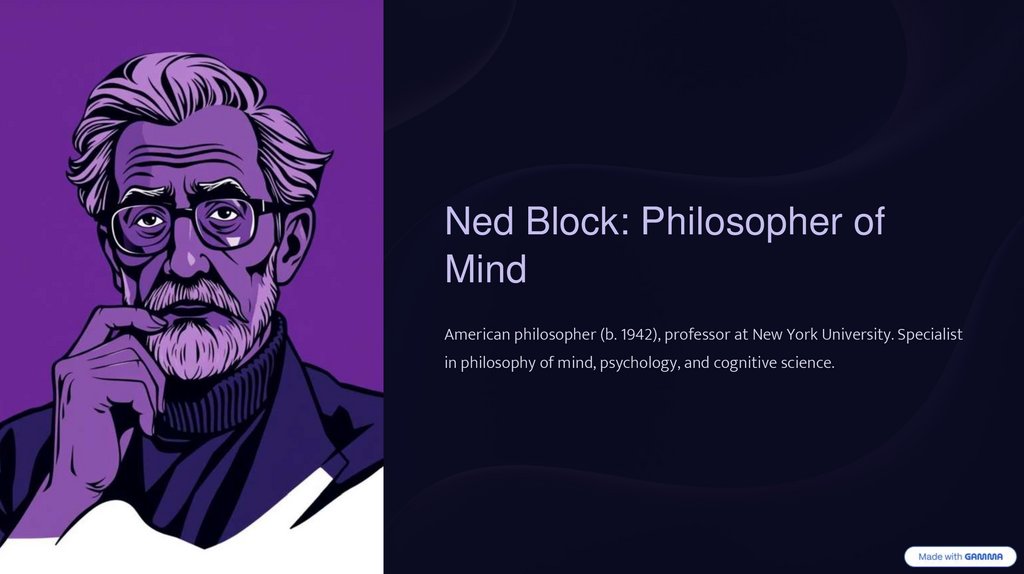
Ned Block: Philosopher of Mind
1.
Ned Block: Philosopher ofMind
American philosopher (b. 1942), professor at New York University. Specialist
in philosophy of mind, psychology, and cognitive science.
2.
Biography: A Foundation in ThoughtBorn in 1942
Academic Roots
Distinguished Professor
A pivotal year, marking the birth of a
Educated at prestigious institutions:
Currently a Professor of Philosophy
United States.
University, shaping his early
University (NYU), a leader in his
profound philosophical voice in the
Stanford University and Harvard
intellectual journey.
and Psychology at New York
fields.
3.
Core Research AreasNed Block's work spans the intricate intersection of philosophy and empirical science, exploring the nature of the mind and
consciousness.
Philosophy of Mind
Philosophy of Psychology
Investigating fundamental questions about mental
Examining the theoretical foundations and implications
phenomena, consciousness, and their relationship to the
physical body.
of psychological research and theories.
Cognitive Science
Psychology & Neuroscience
Contributing to the interdisciplinary study of mind and
Bridging philosophical inquiry with empirical findings
intelligence, encompassing philosophy, psychology, AI,
and neuroscience.
from brain science and behavioral studies.
4.
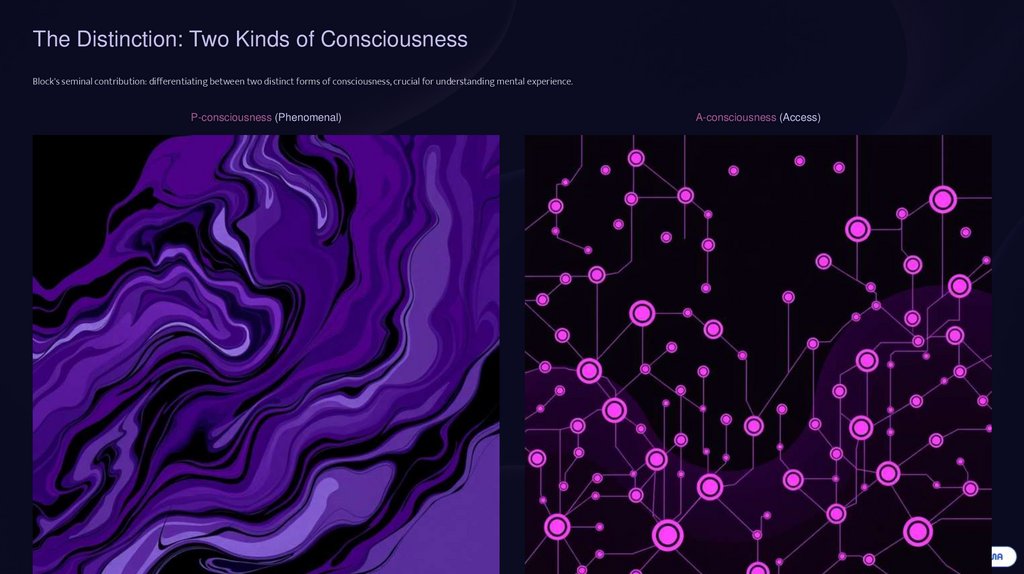
The Distinction: Two Kinds of ConsciousnessBlock's seminal contribution: differentiating between two distinct forms of consciousness, crucial for understanding mental experience.
P-consciousness (Phenomenal)
A-consciousness (Access)
5.
Illustrating P-consciousness vs. A-consciousnessSeeing the Color Red
Saying "This is Red"
Pondering its Meaning
The raw, subjective experience of the
The act of identifying and articulating
Further reflection on the concept of
phenomenal consciousness.
consciousness, as information is
consciousness, involving reasoning
colour red is an instance of
"this is red" engages access
processed for speech.
'red' also falls under access
and cognitive manipulation.
This distinction highlights that while we might access information about our experiences, the subjective feeling itself is a separate,
fundamental aspect of consciousness.
6.
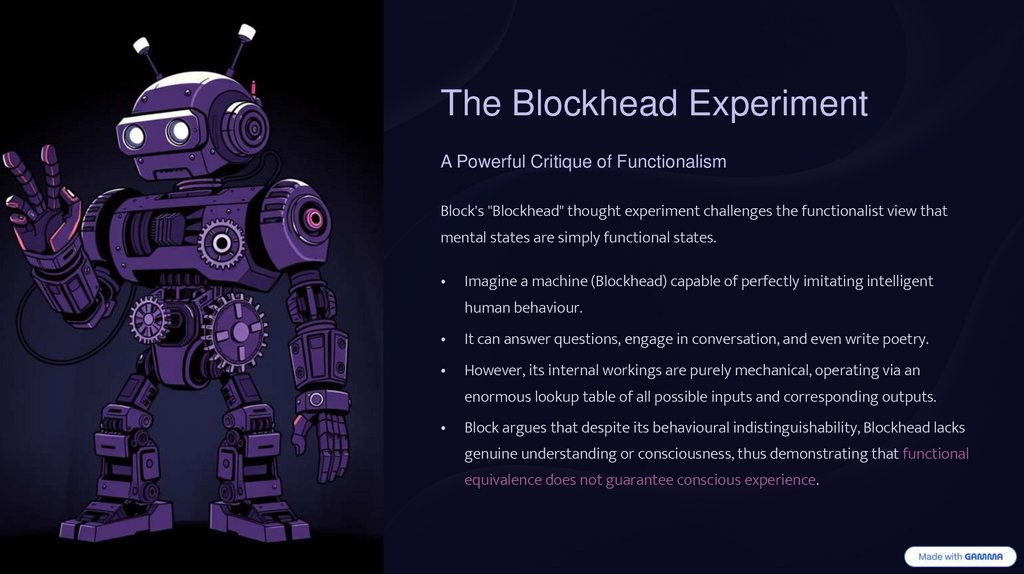
The Blockhead ExperimentA Powerful Critique of Functionalism
Block's "Blockhead" thought experiment challenges the functionalist view that
mental states are simply functional states.
Imagine a machine (Blockhead) capable of perfectly imitating intelligent
It can answer questions, engage in conversation, and even write poetry.
However, its internal workings are purely mechanical, operating via an
Block argues that despite its behavioural indistinguishability, Blockhead lacks
human behaviour.
enormous lookup table of all possible inputs and corresponding outputs.
genuine understanding or consciousness, thus demonstrating that functional
equivalence does not guarantee conscious experience.
7.
Against Reductionism:Consciousness Beyond
Computation
"Consciousness is not reducible to mere computations or neural processes. It
has a subjective, experiential dimension that cannot be fully captured by these
alone."
Ned Block fundamentally challenges the idea that consciousness can be entirely
explained away by reducing it to its physical components or computational
functions.
He contends that while brain processes are essential, they do not fully account
for the qualitative, subjective nature of phenomenal consciousness.
Block emphasizes that reducing consciousness to neural activity alone
overlooks the crucial 'what it's like' aspect of experience.
8.
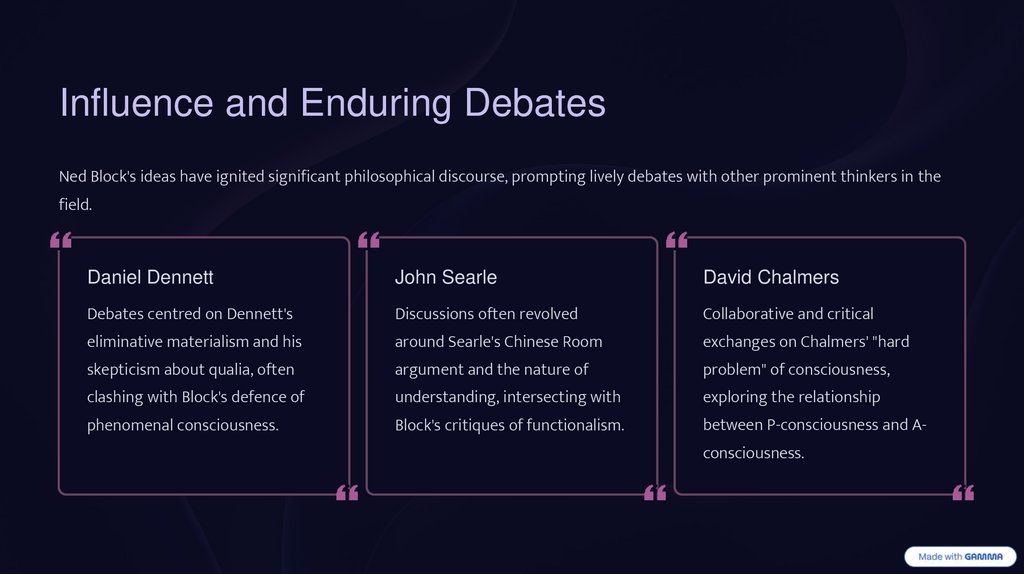
Influence and Enduring DebatesNed Block's ideas have ignited significant philosophical discourse, prompting lively debates with other prominent thinkers in the
field.
Daniel Dennett
John Searle
David Chalmers
Debates centred on Dennett's
Discussions often revolved
Collaborative and critical
skepticism about qualia, often
argument and the nature of
problem" of consciousness,
eliminative materialism and his
clashing with Block's defence of
phenomenal consciousness.
around Searle's Chinese Room
understanding, intersecting with
Block's critiques of functionalism.
exchanges on Chalmers' "hard
exploring the relationship
between P-consciousness and A-
consciousness.
9.
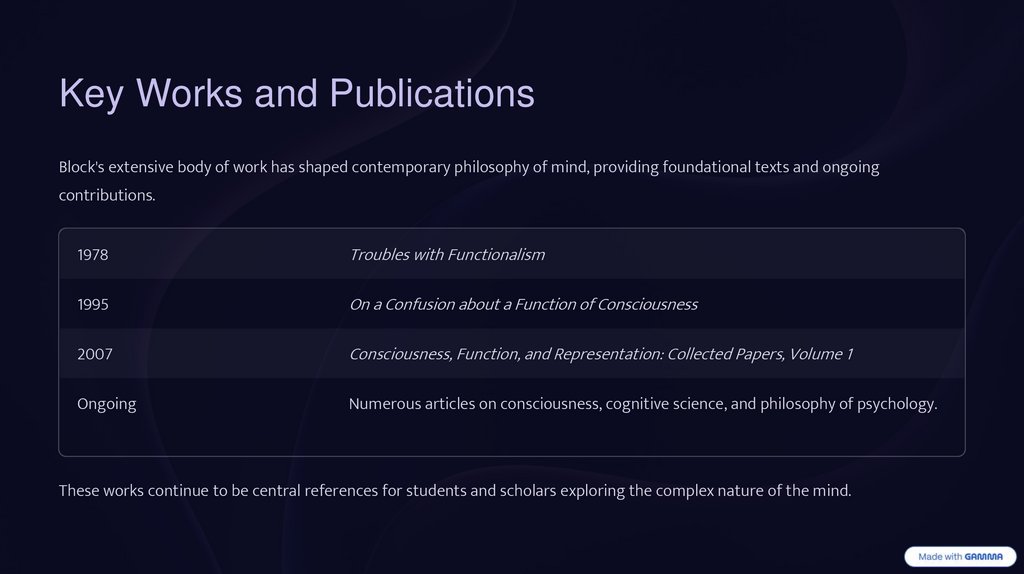
Key Works and PublicationsBlock's extensive body of work has shaped contemporary philosophy of mind, providing foundational texts and ongoing
contributions.
1978
Troubles with Functionalism
1995
On a Confusion about a Function of Consciousness
2007
Consciousness, Function, and Representation: Collected Papers, Volume 1
Ongoing
Numerous articles on consciousness, cognitive science, and philosophy of psychology.
These works continue to be central references for students and scholars exploring the complex nature of the mind.
10.
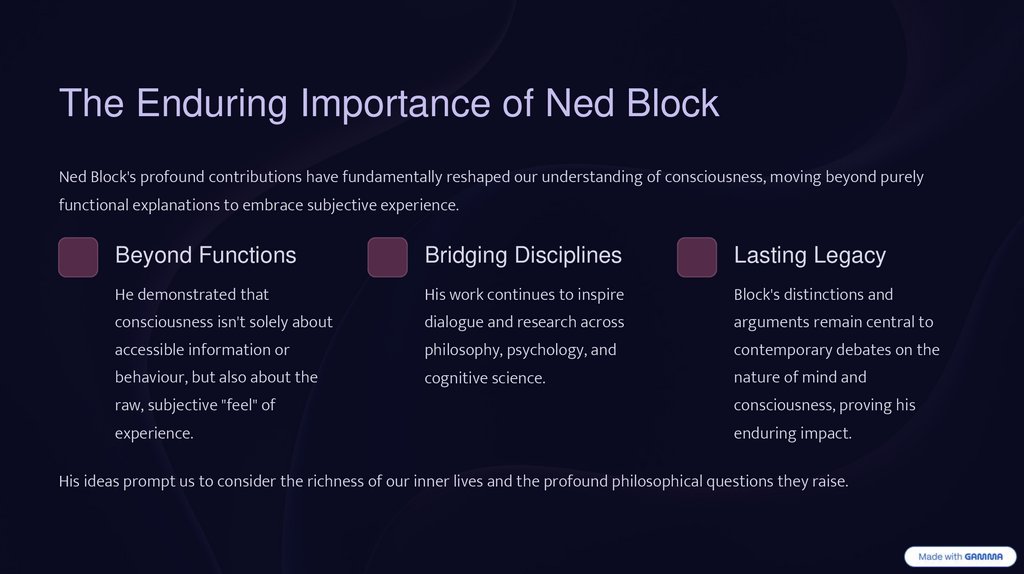
The Enduring Importance of Ned BlockNed Block's profound contributions have fundamentally reshaped our understanding of consciousness, moving beyond purely
functional explanations to embrace subjective experience.
Beyond Functions
Bridging Disciplines
Lasting Legacy
He demonstrated that
His work continues to inspire
Block's distinctions and
accessible information or
philosophy, psychology, and
contemporary debates on the
consciousness isn't solely about
behaviour, but also about the
raw, subjective "feel" of
experience.
dialogue and research across
cognitive science.
arguments remain central to
nature of mind and
consciousness, proving his
enduring impact.
His ideas prompt us to consider the richness of our inner lives and the profound philosophical questions they raise.