 sociology
Similar presentations:






Intercultural communication competence
1. Intercultural communication competence
Sheina Irina Mikhailovna2. Intercultural communication
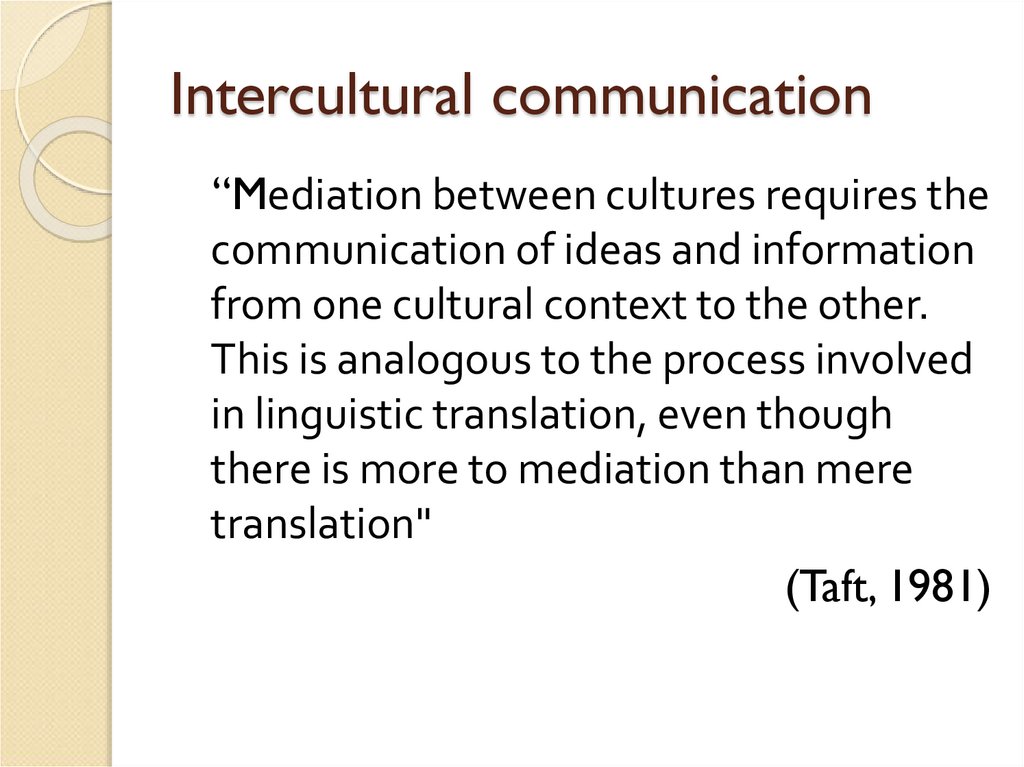
“Mediation between cultures requires thecommunication of ideas and information
from one cultural context to the other.
This is analogous to the process involved
in linguistic translation, even though
there is more to mediation than mere
translation"
(Taft, 1981)
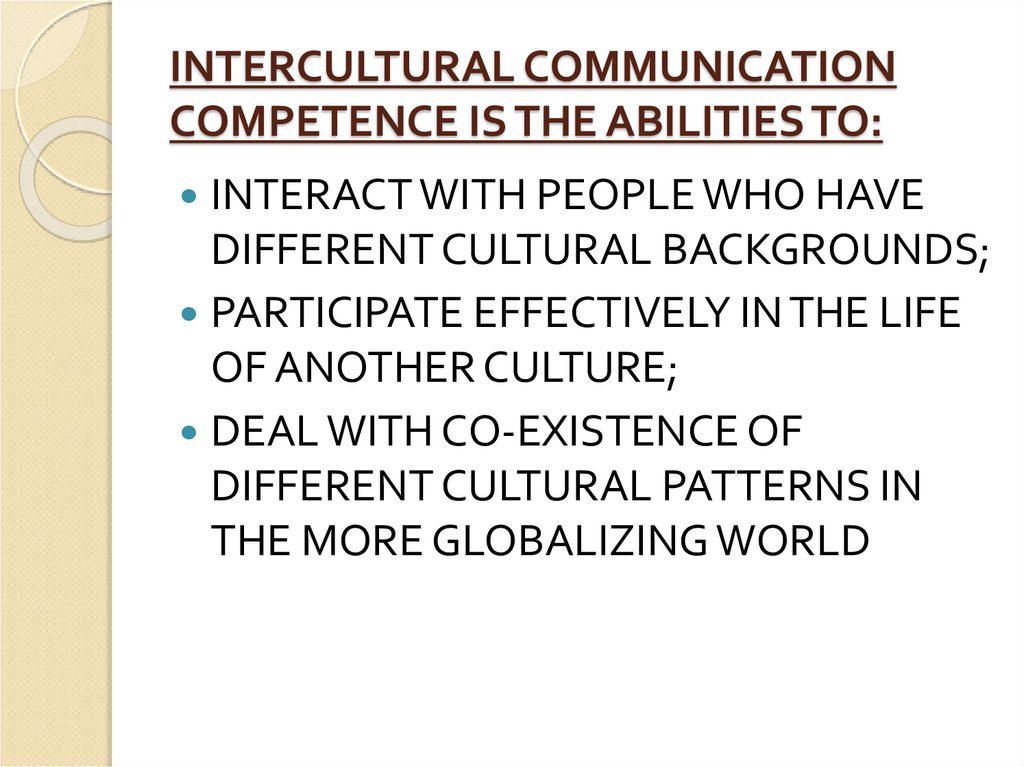
3. INTERCULTURAL COMMUNICATION COMPETENCE IS THE ABILITIES TO:
INTERACT WITH PEOPLE WHO HAVEDIFFERENT CULTURAL BACKGROUNDS;
PARTICIPATE EFFECTIVELY IN THE LIFE
OF ANOTHER CULTURE;
DEAL WITH CO-EXISTENCE OF
DIFFERENT CULTURAL PATTERNS IN
THE MORE GLOBALIZING WORLD
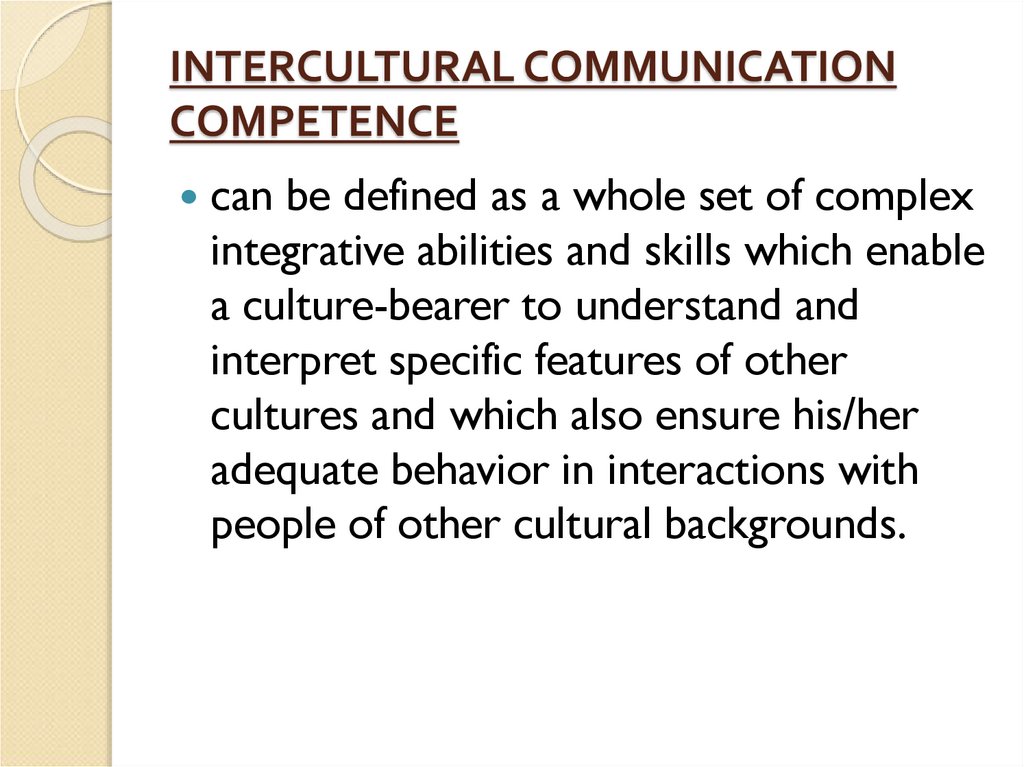
4. INTERCULTURAL COMMUNICATION COMPETENCE
can be defined as a whole set of complexintegrative abilities and skills which enable
a culture-bearer to understand and
interpret specific features of other
cultures and which also ensure his/her
adequate behavior in interactions with
people of other cultural backgrounds.
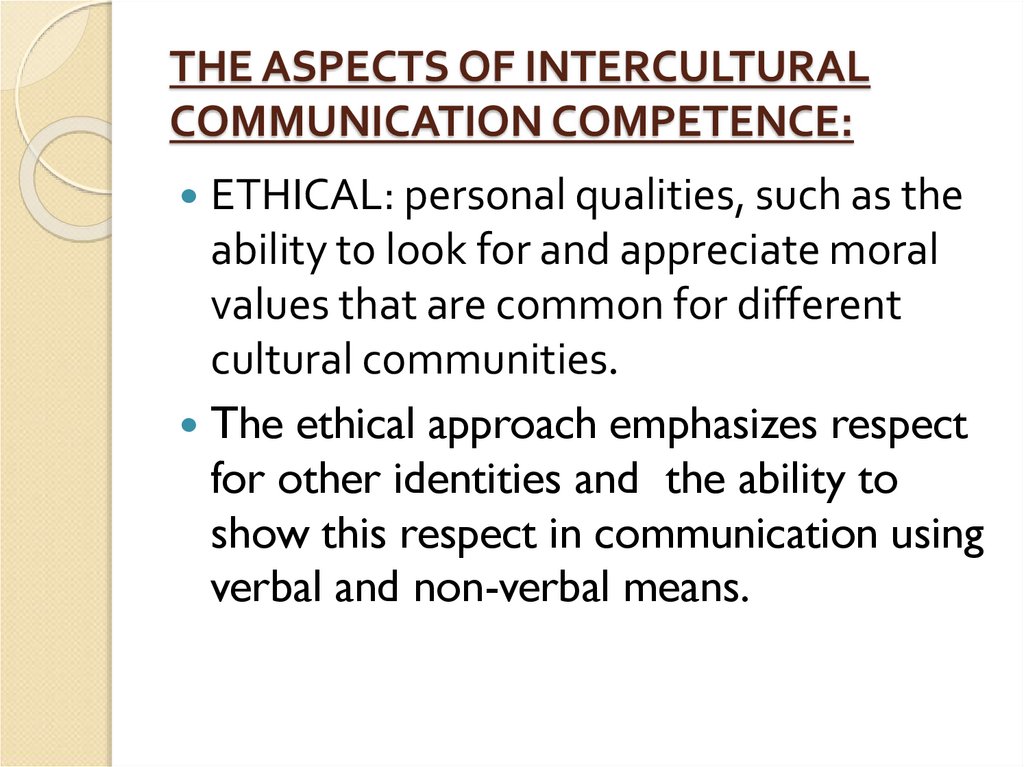
5. THE ASPECTS OF INTERCULTURAL COMMUNICATION COMPETENCE:
ETHICAL: personal qualities, such as theability to look for and appreciate moral
values that are common for different
cultural communities.
The ethical approach emphasizes respect
for other identities and the ability to
show this respect in communication using
verbal and non-verbal means.
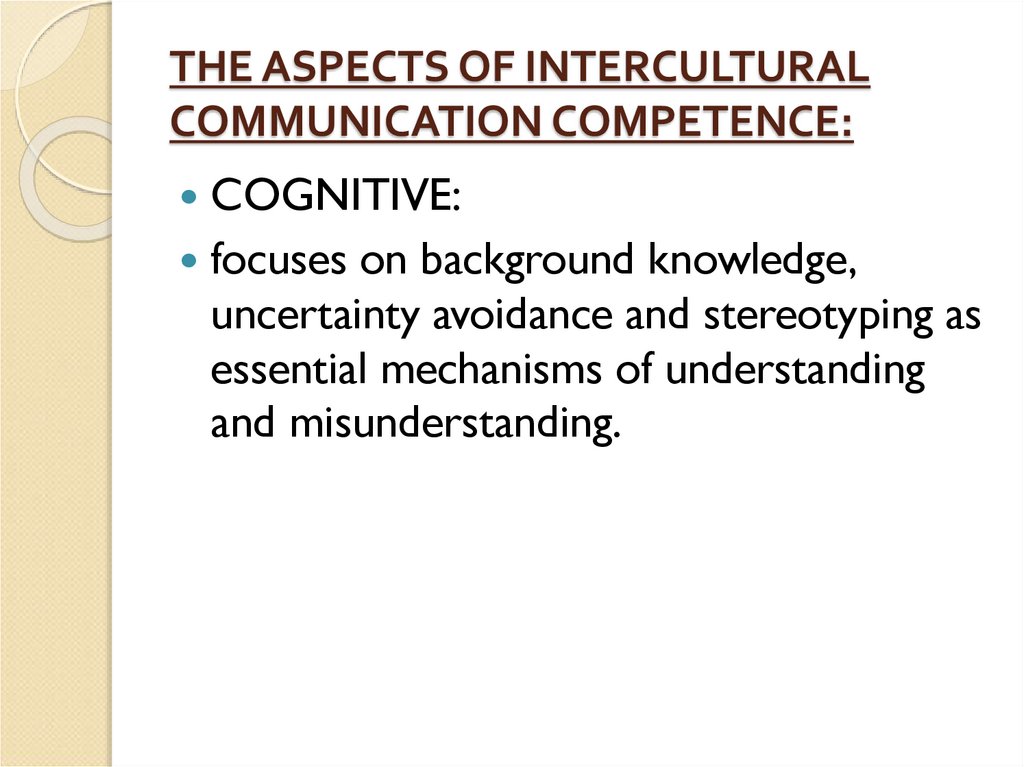
6. THE ASPECTS OF INTERCULTURAL COMMUNICATION COMPETENCE:
COGNITIVE:focuses on background knowledge,
uncertainty avoidance and stereotyping as
essential mechanisms of understanding
and misunderstanding.
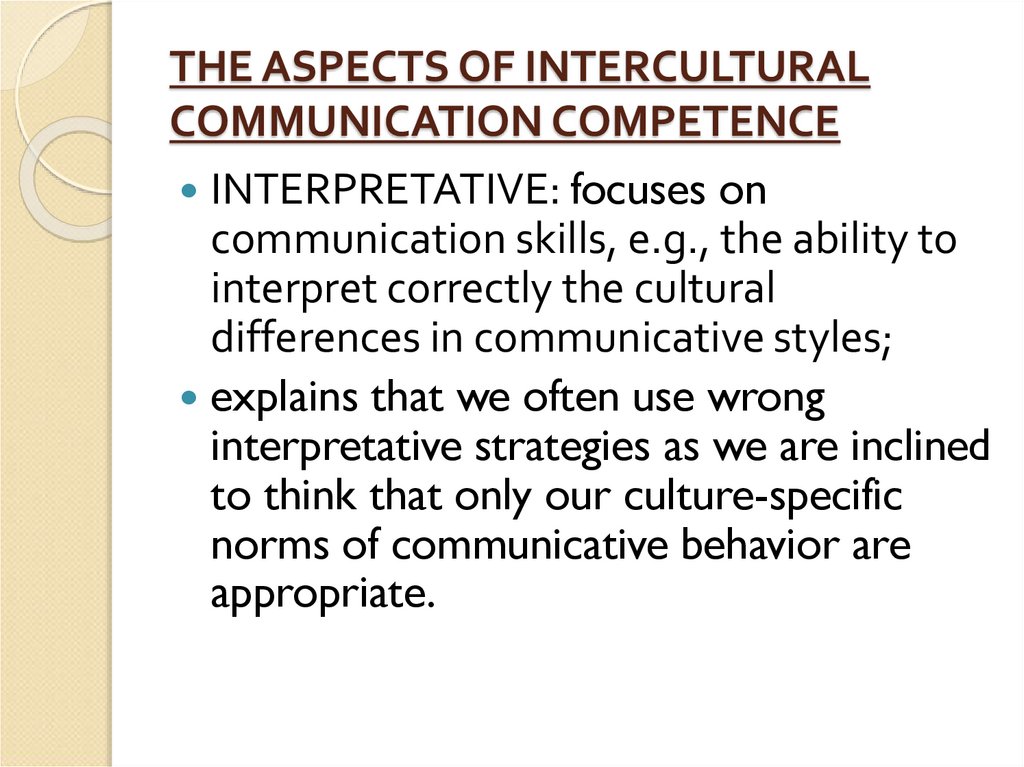
7. THE ASPECTS OF INTERCULTURAL COMMUNICATION COMPETENCE
INTERPRETATIVE: focuses oncommunication skills, e.g., the ability to
interpret correctly the cultural
differences in communicative styles;
explains that we often use wrong
interpretative strategies as we are inclined
to think that only our culture-specific
norms of communicative behavior are
appropriate.
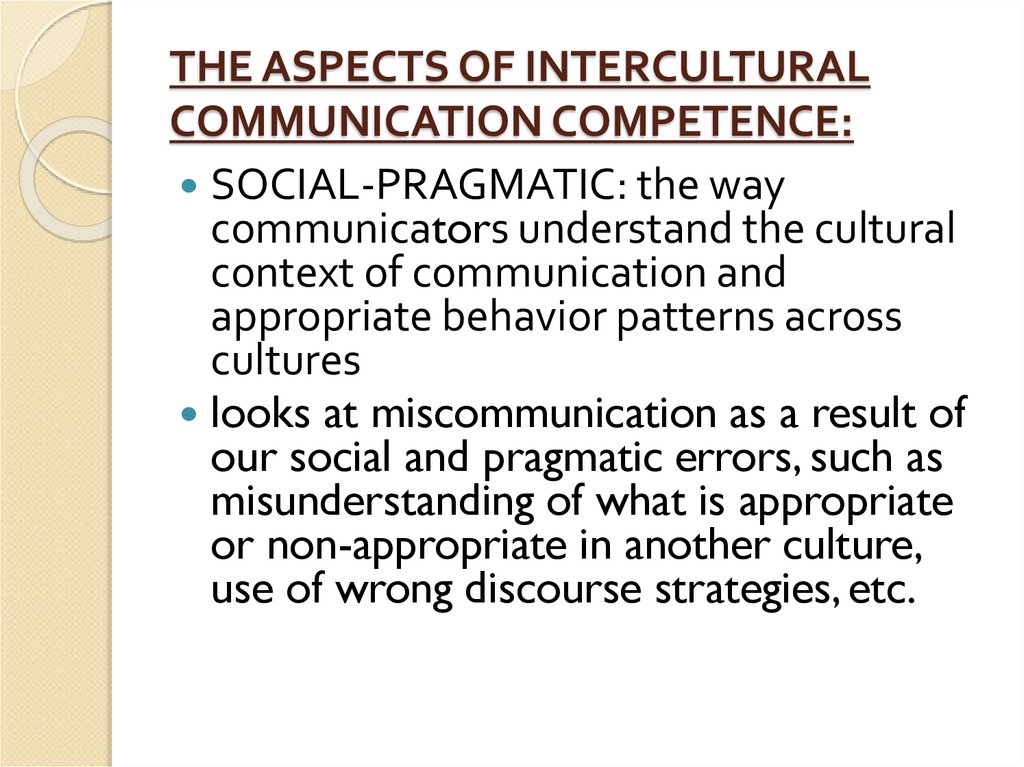
8. THE ASPECTS OF INTERCULTURAL COMMUNICATION COMPETENCE:
SOCIAL-PRAGMATIC: the waycommunicators understand the cultural
context of communication and
appropriate behavior patterns across
cultures
looks at miscommunication as a result of
our social and pragmatic errors, such as
misunderstanding of what is appropriate
or non-appropriate in another culture,
use of wrong discourse strategies, etc.
9. BARRIERS TO IC:
ANXIETY: feeling nervous when youfocus so much on your own feelings that
you do not pay attention to what other
people are telling you.
10. BARRIERS TO IC:
ASSUMING SIMILARITIES INSTEAD OFDIFFERENCES: thinking that a culture is
similar to your own can cause you to
ignore important differences. The best
thing to do is to assume nothing and ask
what customs are.
11. BARRIERS TO IC:
ETHNOCENTRISM: is negatively judginganother culture by your own cultural
standard.
12. BARRIERS TO IC:
STEREOTYPES AND PREJUDICE:stereotypical judgments are made about
others on the basis of their ethnic
membership. When information is
ambiguous, the brain often reaches the
wrong conclusion. What we see is what
we expect to see.
13. BARRIERS TO IC:
LANGUAGE PROBLEMSNON-VERBAL BEHAVIOR
14. ETHICS ACROSS CULTURES (Kale, 1977):
Ethical communicators address people ofother cultures with the same respect they
would like to receive themselves
15. ETHICS ACROSS CULTURES (Kale, 1977):
Ethical communicators seek to describethe world as they perceive it as accurately
as possible. Ethical communicators do
not deliberately deceive or mislead.
16. ETHICS ACROSS CULTURES (Kale, 1977):
Ethical communicators encourage peopleof other cultures to express themselves in
their uniqueness. This principle respects
the right of people to expression
regardless of how popular or unpopular
their ideas might be.
17. ETHICS ACROSS CULTURES (Kale, 1977):
Ethical communicators should emphasizethe commonalities of cultural beliefs
rather than their differences.
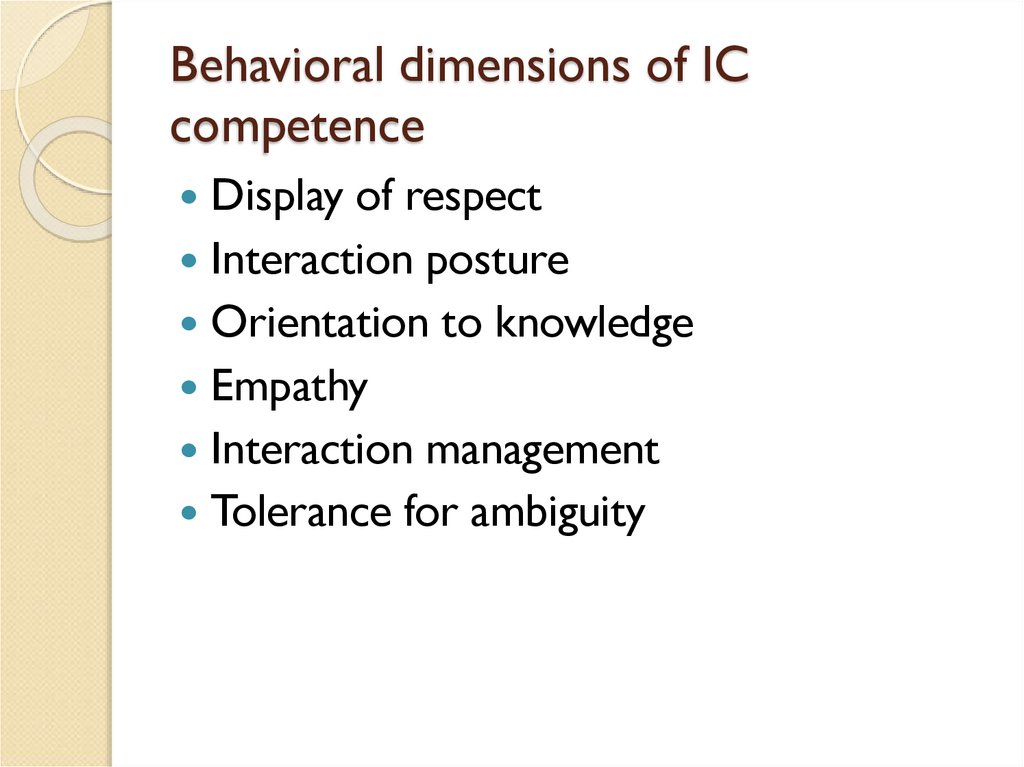
18. Behavioral dimensions of IC competence
Display of respectInteraction posture
Orientation to knowledge
Empathy
Interaction management
Tolerance for ambiguity
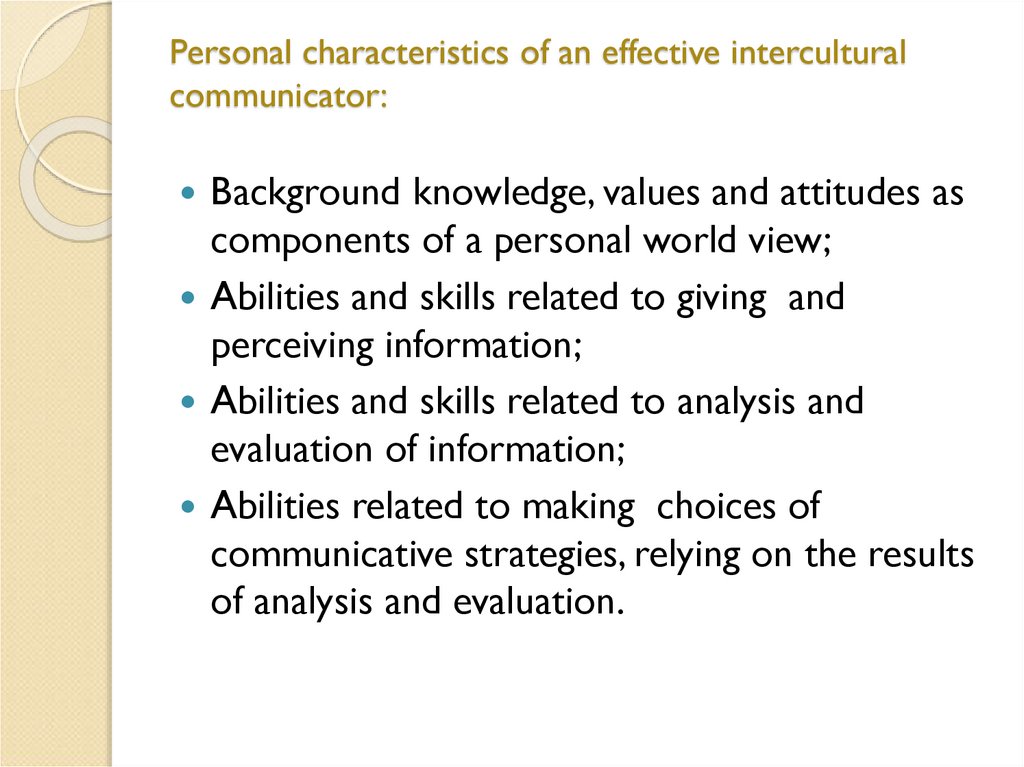
19. Personal characteristics of an effective intercultural communicator:
Background knowledge, values and attitudes ascomponents of a personal world view;
Abilities and skills related to giving and
perceiving information;
Abilities and skills related to analysis and
evaluation of information;
Abilities related to making choices of
communicative strategies, relying on the results
of analysis and evaluation.
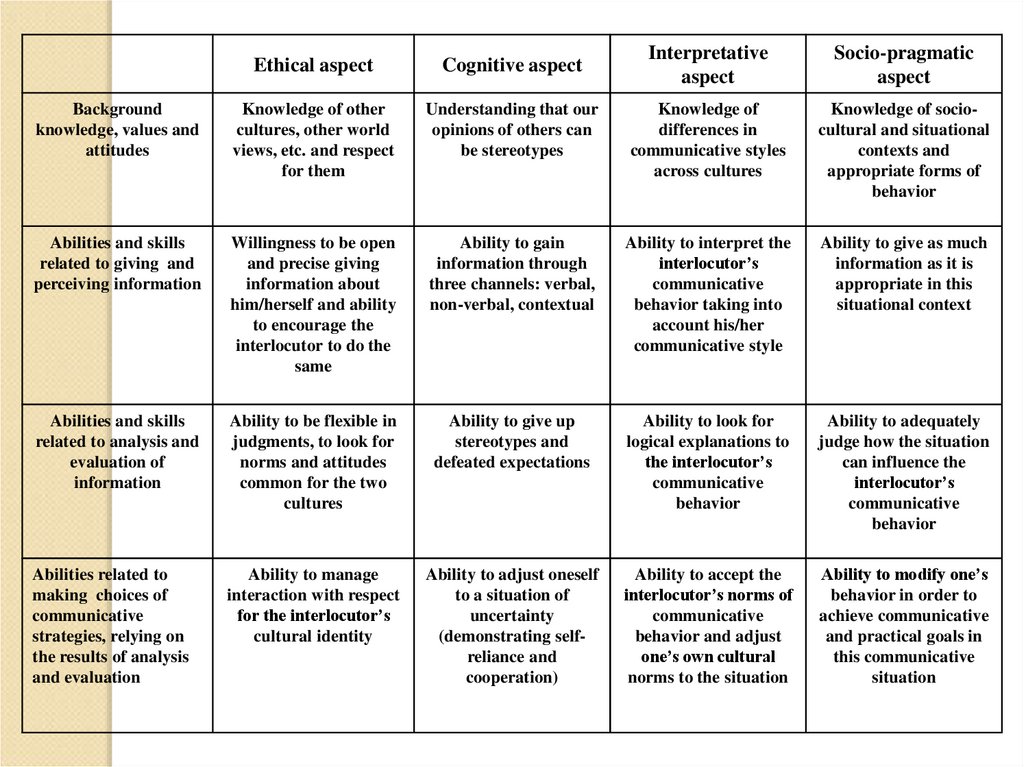
20.
Interpretativeaspect
Socio-pragmatic
aspect
Understanding that our
opinions of others can
be stereotypes
Knowledge of
differences in
communicative styles
across cultures
Knowledge of sociocultural and situational
contexts and
appropriate forms of
behavior
Willingness to be open
and precise giving
information about
him/herself and ability
to encourage the
interlocutor to do the
same
Ability to gain
information through
three channels: verbal,
non-verbal, contextual
Ability to interpret the
interlocutor’s
communicative
behavior taking into
account his/her
communicative style
Ability to give as much
information as it is
appropriate in this
situational context
Abilities and skills
related to analysis and
evaluation of
information
Ability to be flexible in
judgments, to look for
norms and attitudes
common for the two
cultures
Ability to give up
stereotypes and
defeated expectations
Ability to look for
logical explanations to
the interlocutor’s
communicative
behavior
Ability to adequately
judge how the situation
can influence the
interlocutor’s
communicative
behavior
Abilities related to
making choices of
communicative
strategies, relying on
the results of analysis
and evaluation
Ability to manage
interaction with respect
for the interlocutor’s
cultural identity
Ability to adjust oneself
to a situation of
uncertainty
(demonstrating selfreliance and
cooperation)
Ability to accept the
interlocutor’s norms of
communicative
behavior and adjust
one’s own cultural
norms to the situation
Ability to modify one’s
behavior in order to
achieve communicative
and practical goals in
this communicative
situation
Ethical aspect
Cognitive aspect
Background
knowledge, values and
attitudes
Knowledge of other
cultures, other world
views, etc. and respect
for them
Abilities and skills
related to giving and
perceiving information