
 lingvistics
Similar presentations:






Lexicology: The Object and Links with Other Branches of Linguistics
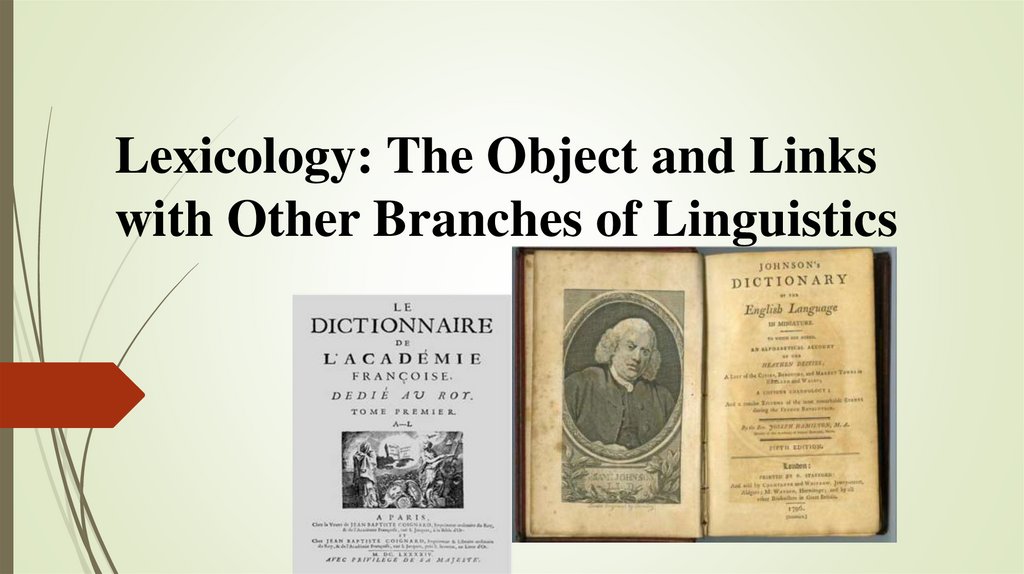
1. Lexicology: The Object and Links with Other Branches of Linguistics
2. Definition of Lexicology
Lexicology – one of the branches of linguistics that deals with differentproperties of words and the vocabulary of a language. Lexicology aims at
studying and systematic description of vocabulary as regards its origin,
development, current use.
The vocabulary of modern English may be subdivided into different strata.
For example:
1) Etimologically the vocabulary falls into the native Anglo-Saxon stock,
different layers of borrowings;
2) Social and stylistic stratification, geographical distribution divide the
vocabulary into varieties (territorial dialects, social dialects, stylistic
diffferentiation into literary (neutral, bookish, standard colloquial) and nonliterary (slang, jargon, professionalisms, vulgarisms).
3. Lexicology as a Wide Area of Knowledge
General Lexicology – the general study of words andvocabulary, irrespective of the specific features of any particular
language.
Special Lexicology – the study of words and vocabulary of a
particular language (English, Russian). Special Lexicology may
be Historical and Descriptive. The evolution of any vocabulary
as well as of its single elements forms the object of Historical
Lexicology. Descriptive Lexicology is concerned with the
lexical system as it exists at the present time.
Contrastive Lexicology – the study aimed at establishing facts
of similarities and differences between both related and unrelated
languages.
4. Links with Other Branches of Linguistics
Phonetics – as it is concerned with the sound-form of the word (net-ten)Grammar – even isolated words bear a definite relation to the
grammatical system of the language as they belong to some part of
speech (pictures-cinema, arms-weapon)
Stylistics – studies many problems treated in lexicology, ex. problems
of meaning, synonymy, differentiation of vocabulary according to the
sphere of communication (my lady, old mare)
The History of a Language – investigates the changes and the
development of the vocabulary of a language (Home Office, Foreign
Office)
Sociolinguistics – investigates the extra-linguistic or social causes of
the changes in the vocabulary of a language (neologisms – phubbing,
avatar, trolling, memes, LOL, geeks)
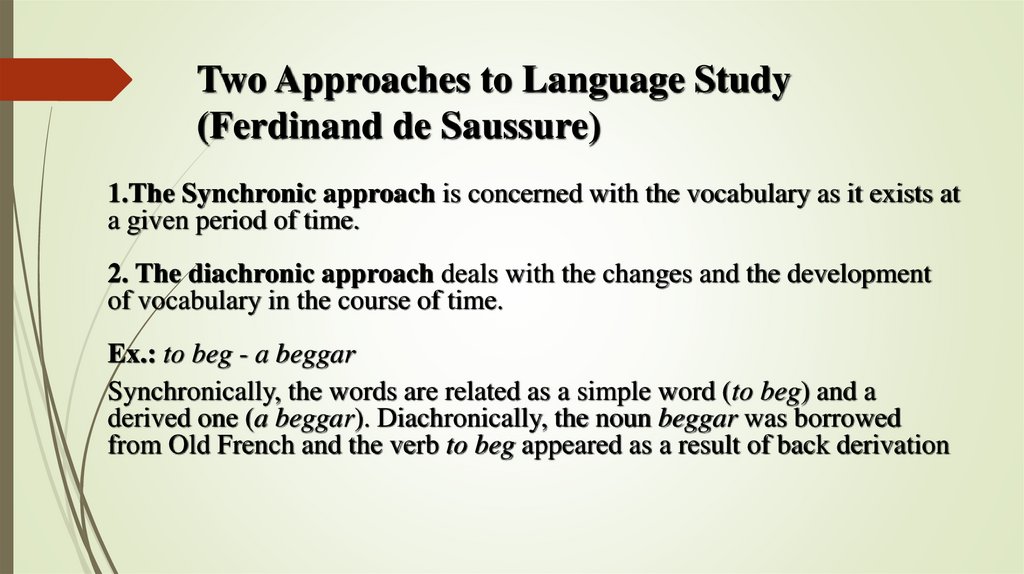
5. Two Approaches to Language Study (Ferdinand de Saussure)
1.The Synchronic approach is concerned with the vocabulary as it exists ata given period of time.
2. The diachronic approach deals with the changes and the development
of vocabulary in the course of time.
Ex.: to beg - a beggar
Synchronically, the words are related as a simple word (to beg) and a
derived one (a beggar). Diachronically, the noun beggar was borrowed
from Old French and the verb to beg appeared as a result of back derivation
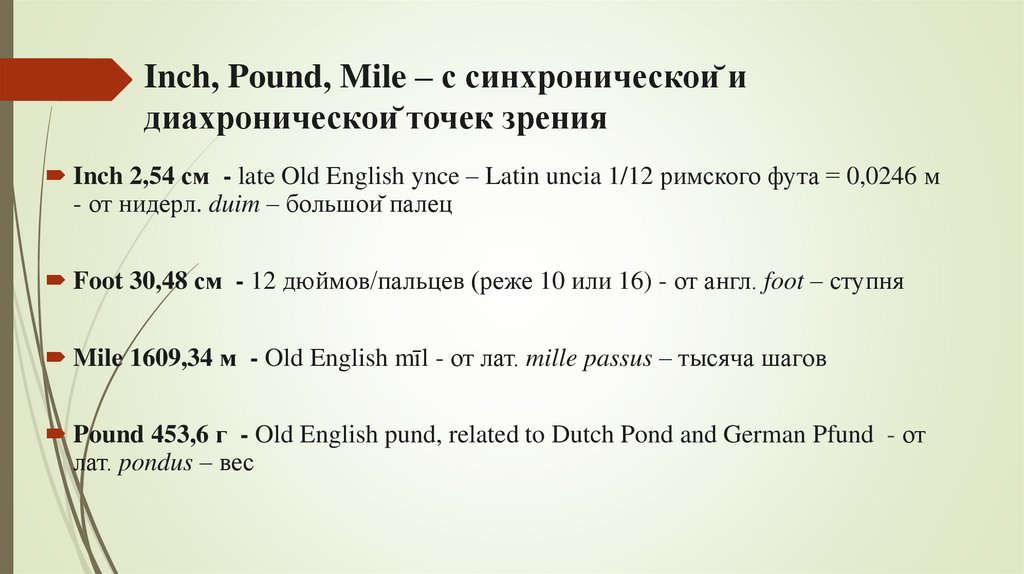
6. Inch, Pound, Mile – с синхронической и диахронической точек зрения
Inch 2,54 см - late Old English ynce – Latin uncia 1/12 римского фута = 0,0246 м- от нидерл. duim – большой палец
Foot 30,48 см - 12 дюймов/пальцев (реже 10 или 16) - от англ. foot – ступня
Mile 1609,34 м - Old English mīl - от лат. mille passus – тысяча шагов
Pound 453,6 г - Old English pund, related to Dutch Pond and German Pfund - от
лат. pondus – вес