
 english
Similar presentations:









English for Academic Purposes B2 level Lesson 1. Introduction to the course. The syllabus discussion
1.
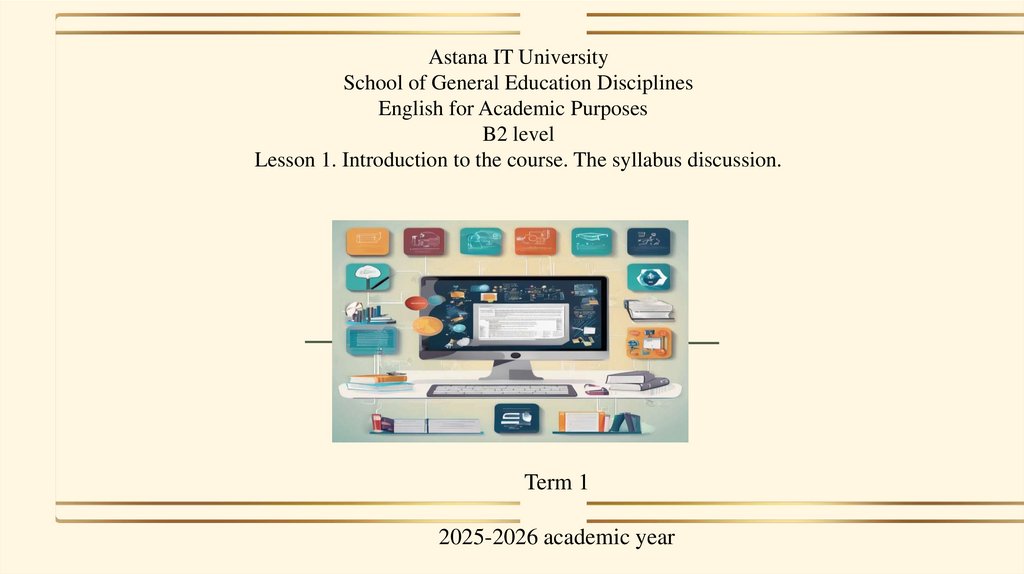
Astana IT UniversitySchool of General Education Disciplines
English for Academic Purposes
B2 level
Lesson 1. Introduction to the course. The syllabus discussion.
Term 1
2025-2026 academic year
2.
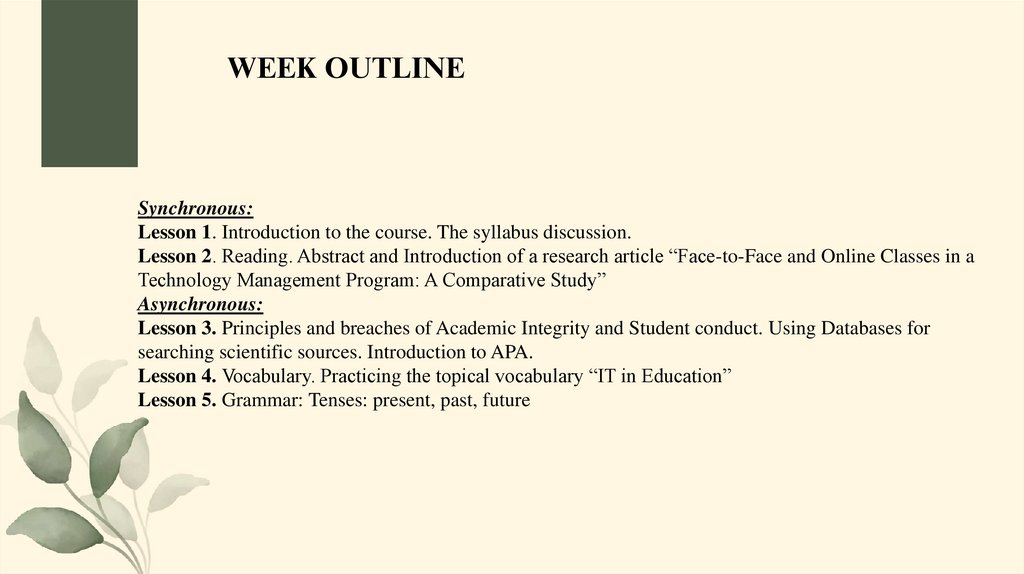
WEEK OUTLINESynchronous:
Lesson 1. Introduction to the course. The syllabus discussion.
Lesson 2. Reading. Abstract and Introduction of a research article “Face-to-Face and Online Classes in a
Technology Management Program: A Comparative Study”
Asynchronous:
Lesson 3. Principles and breaches of Academic Integrity and Student conduct. Using Databases for
searching scientific sources. Introduction to APA.
Lesson 4. Vocabulary. Practicing the topical vocabulary “IT in Education”
Lesson 5. Grammar: Tenses: present, past, future
3.
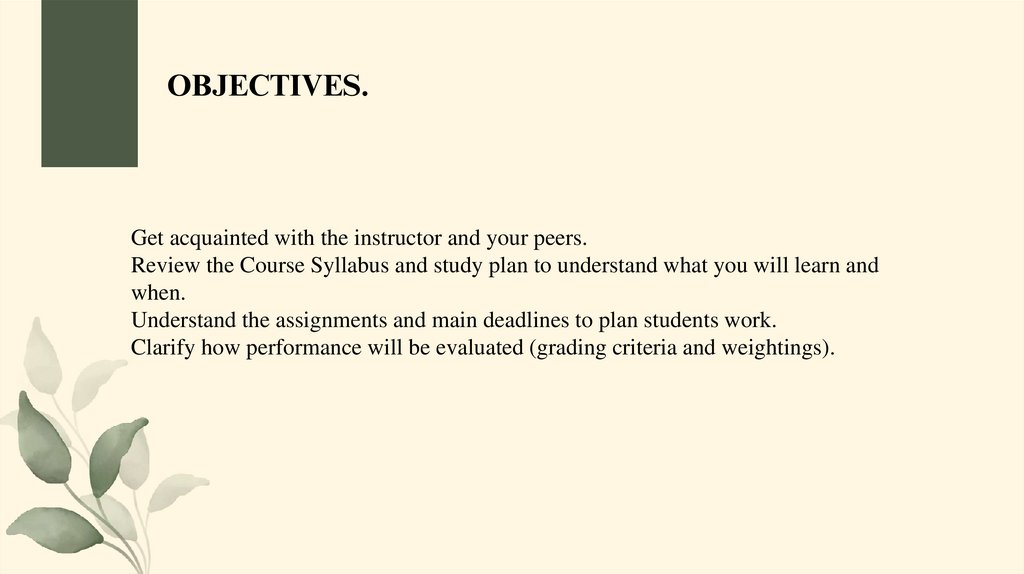
OBJECTIVES.Get acquainted with the instructor and your peers.
Review the Course Syllabus and study plan to understand what you will learn and
when.
Understand the assignments and main deadlines to plan students work.
Clarify how performance will be evaluated (grading criteria and weightings).
4.
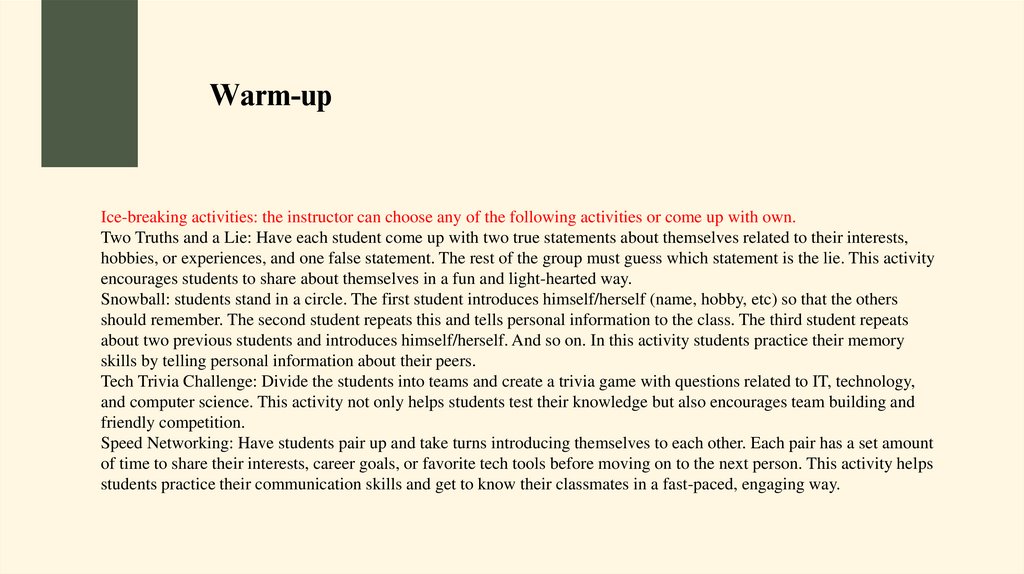
Warm-upIce-breaking activities: the instructor can choose any of the following activities or come up with own.
Two Truths and a Lie: Have each student come up with two true statements about themselves related to their interests,
hobbies, or experiences, and one false statement. The rest of the group must guess which statement is the lie. This activity
encourages students to share about themselves in a fun and light-hearted way.
Snowball: students stand in a circle. The first student introduces himself/herself (name, hobby, etc) so that the others
should remember. The second student repeats this and tells personal information to the class. The third student repeats
about two previous students and introduces himself/herself. And so on. In this activity students practice their memory
skills by telling personal information about their peers.
Tech Trivia Challenge: Divide the students into teams and create a trivia game with questions related to IT, technology,
and computer science. This activity not only helps students test their knowledge but also encourages team building and
friendly competition.
Speed Networking: Have students pair up and take turns introducing themselves to each other. Each pair has a set amount
of time to share their interests, career goals, or favorite tech tools before moving on to the next person. This activity helps
students practice their communication skills and get to know their classmates in a fast-paced, engaging way.
5.
SYLLABUS DISCUSSION6.
Scan the syllabus and answer the questions.What is the overall goal of this course?
How many assessed tasks are there? What are their weights?
What is the course policy?
7.
What is the goal of the course?The course aims to enable students to critically understand and analyze IT-related academic articles, identify key
arguments and supporting evidence, and form well-reasoned, contextually grounded conclusions.
It also emphasizes delivering structured, persuasive spoken contributions as part of the learning process.
8.
What activities will students undertake during the course?Students will:
• engage with IT related topics by evaluating information to form well-supported conclusions, comparing claims and
identifying biases;
• listen to interviews and podcasts and respond critically, contributing thoughtful reflections that move conversations
forward;
• develop speaking skills by actively participating in group work and discussions, debates, role-plays, delivering
structured, evidence-based presentations, and collaborating with peers through providing constructive feedback to
refine ideas and sustain academic dialogue;
• improve grammar and vocabulary through a variety of activities.
9.
What is the structure of the course?The course will be held five times per week, with two synchronous sessions and three asynchronous
sessions during 10 weeks.
The duration of each practical session is 50 minutes.
Students take Midterm Quiz in 5th week and Endterm Quiz in 10th Week.
The Final Exam is taken according to the schedule.
Office hours are held according to the timetable of the instructor.
10.
What strategies help students contribute effectively in every class?• Active engagement is crucial for success.
• Attend at least 70% of classes to receive credit.
• Actively participate in discussions, group works, and role-plays, debates.
• Use laptops and devices only when instructed, misusing of laptops will be treated as a disciplinary
violation.
11.
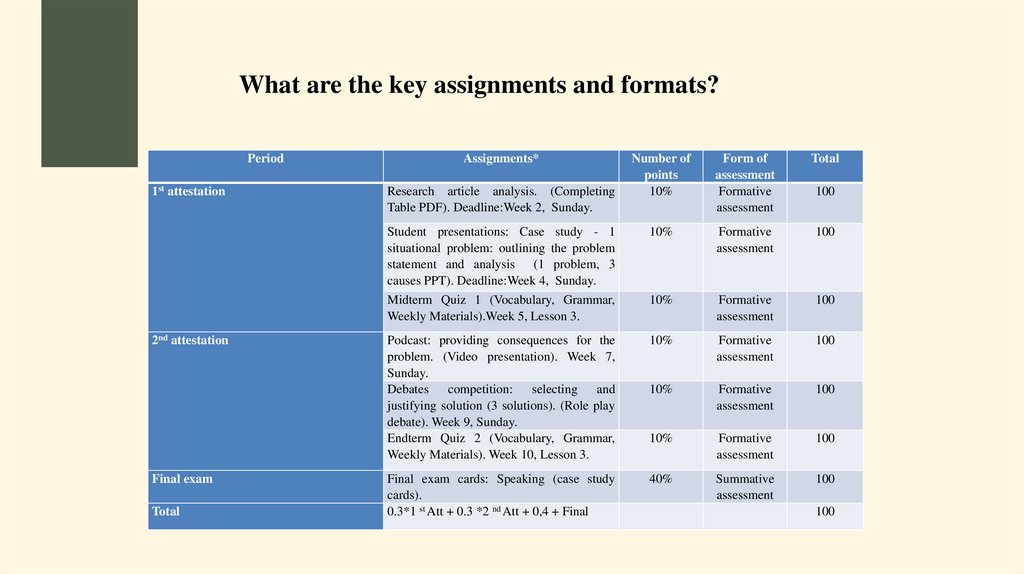
What are the key assignments and formats?Period
1st attestation
2nd attestation
Final exam
Total
Assignments*
Number of
points
10%
Form of
assessment
Formative
assessment
Total
Student presentations: Case study - 1
situational problem: outlining the problem
statement and analysis (1 problem, 3
causes PPT). Deadline:Week 4, Sunday.
Midterm Quiz 1 (Vocabulary, Grammar,
Weekly Materials).Week 5, Lesson 3.
10%
Formative
assessment
100
10%
Formative
assessment
100
Podcast: providing consequences for the
problem. (Video presentation). Week 7,
Sunday.
Debates competition: selecting and
justifying solution (3 solutions). (Role play
debate). Week 9, Sunday.
Endterm Quiz 2 (Vocabulary, Grammar,
Weekly Materials). Week 10, Lesson 3.
10%
Formative
assessment
100
10%
Formative
assessment
100
10%
Formative
assessment
100
Final exam cards: Speaking (case study
cards).
0.3*1 st Att + 0.3 *2 nd Att + 0,4 + Final
40%
Summative
assessment
100
Research article analysis. (Completing
Table PDF). Deadline:Week 2, Sunday.
100
100
12.
What is the Final Exam Policy ?Retaking a passing grade on the final assessment with the aim of improving it during the
same interim assessment period is not allowed
The final grade for the course may be annulled within one month after the exam if a student
is found to have violated the rules of conduct during the exam (use of cell phones and other
helpful materials) based on surveillance camera recordings and the completion of the
appropriate reports. Cancellation reports are not subject to appeal.
13.
What is the attendance expectation for this course, and under whatconditions are absences considered valid?
Students are expected to attend all classes.
Absences are allowed up to 30% of sessions, but only for valid reasons such as illness or
representing the university in official events (e.g., Olympiads, competitions, hackathons).
The school reviews each such absence case individually and may issue an official order if
needed.
14.
What steps should a student take if medical absences exceed theallowed limit, and how is prolonged illness handled?
In case the absence limit is exceeded due to medical reasons, the student is required to
provide a conclusion from the Medical Advisory Committee to arrange an academic leave.
In cases of prolonged illness, each situation is considered individually based on the
submitted medical documentation.
The weekly schedule includes two hours of in-person classes and three hours online.
15.
How are assignments submitted and graded, and what are thepenalties for late submissions?
All assignments must be submitted by the deadlines posted on Moodle.
Late submissions will be penalized by deducting 5% of the total mark for each day of delay.
Assignments submitted after the deadline will be accepted with a grade reduction of -5% for
each day of delay.
Assignments submitted more than 3 days late will not be accepted.
16.
What establishes academic integrity in this course, and what are thepotential consequences of violations?
If students violate the code of honor, such as presenting someone else’s work as their own,
cheating, using unauthorized materials on tests, or falsifying documents or results
disciplinary actions will be taken, up to canceling the assignment or course.
Each student is responsible for their own learning, behavior, and respectful conduct toward
the university community.
17.
What are the course guidelines for using generative AI tools?Submitting AI-generated content without proper attribution constitutes academic
misconduct and may result in disciplinary action.
The use of AI is not recommended. If AI is used to gather materials, student must
provide reliable data and appropriate citations.
The use of AI tools such as ChatGPT, GPT-based chatbots, or other generative models
during midterm, final, and final exams is strictly prohibited.
18.
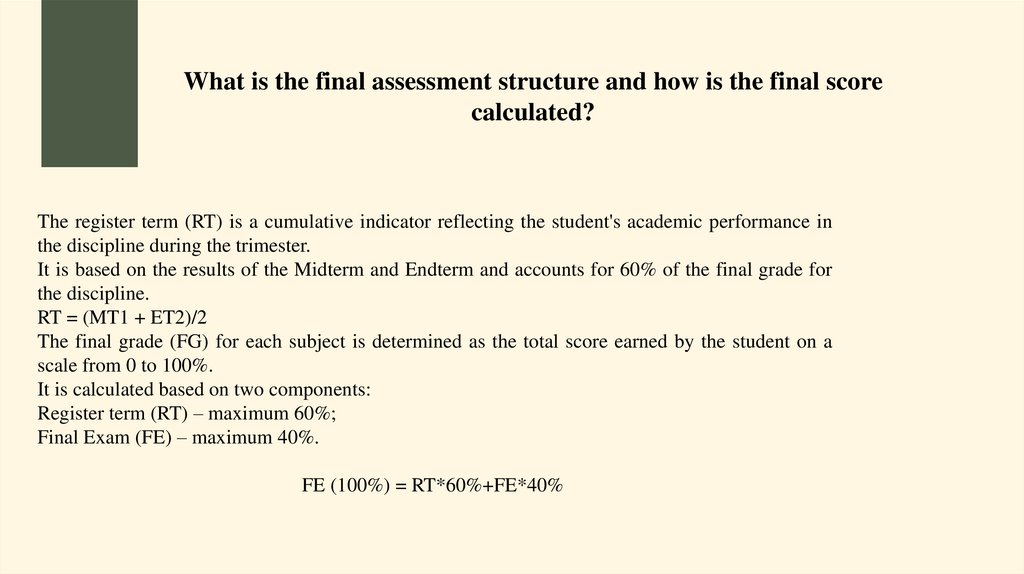
What is the final assessment structure and how is the final scorecalculated?
The register term (RT) is a cumulative indicator reflecting the student's academic performance in
the discipline during the trimester.
It is based on the results of the Midterm and Endterm and accounts for 60% of the final grade for
the discipline.
RT = (MT1 + ET2)/2
The final grade (FG) for each subject is determined as the total score earned by the student on a
scale from 0 to 100%.
It is calculated based on two components:
Register term (RT) – maximum 60%;
Final Exam (FE) – maximum 40%.
FE (100%) = RT*60%+FE*40%
19.
How should students communicate with the instructor, and whencan expect a reply?
Communicate in a professional, course-related manner using only official corporate email.
For correspondence with the instructor, use Microsoft Outlook during working hours on
working days.
The instructor aims to reply within three working days.
20.
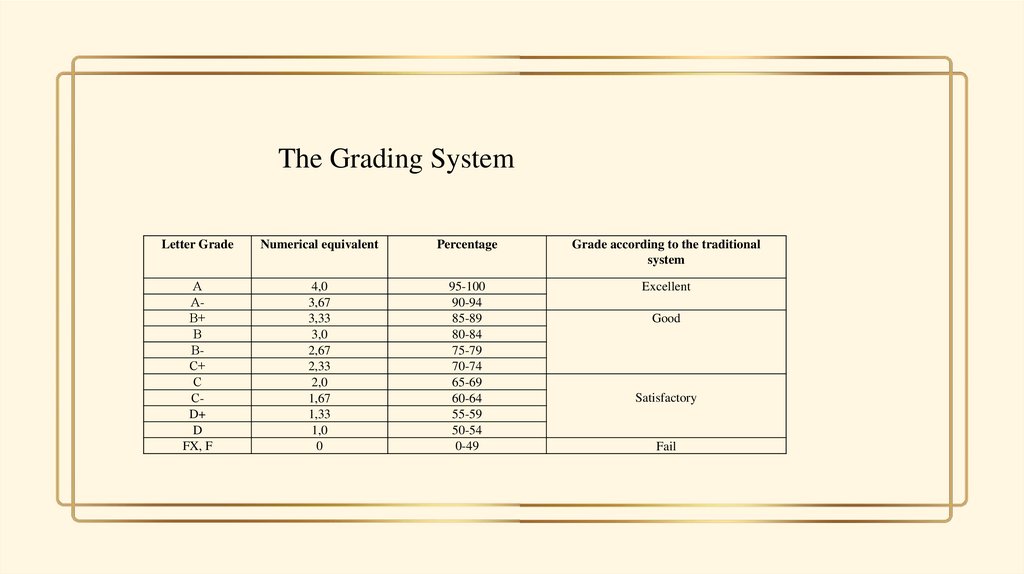
The Grading SystemLetter Grade
Numerical equivalent
Percentage
Grade according to the traditional
system
А
АВ+
В
ВС+
С
СD+
D
FX, F
4,0
3,67
3,33
3,0
2,67
2,33
2,0
1,67
1,33
1,0
0
95-100
90-94
85-89
80-84
75-79
70-74
65-69
60-64
55-59
50-54
0-49
Excellent
Good
Satisfactory
Fail
21.
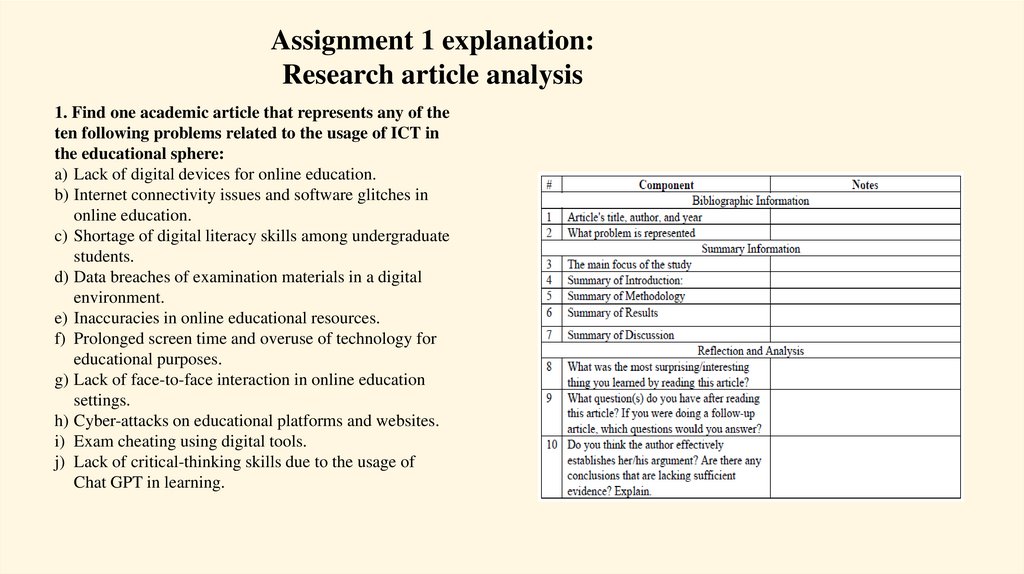
Assignment 1 explanation:Research article analysis
1. Find one academic article that represents any of the
ten following problems related to the usage of ICT in
the educational sphere:
a) Lack of digital devices for online education.
b) Internet connectivity issues and software glitches in
online education.
c) Shortage of digital literacy skills among undergraduate
students.
d) Data breaches of examination materials in a digital
environment.
e) Inaccuracies in online educational resources.
f) Prolonged screen time and overuse of technology for
educational purposes.
g) Lack of face-to-face interaction in online education
settings.
h) Cyber-attacks on educational platforms and websites.
i) Exam cheating using digital tools.
j) Lack of critical-thinking skills due to the usage of
Chat GPT in learning.
22.
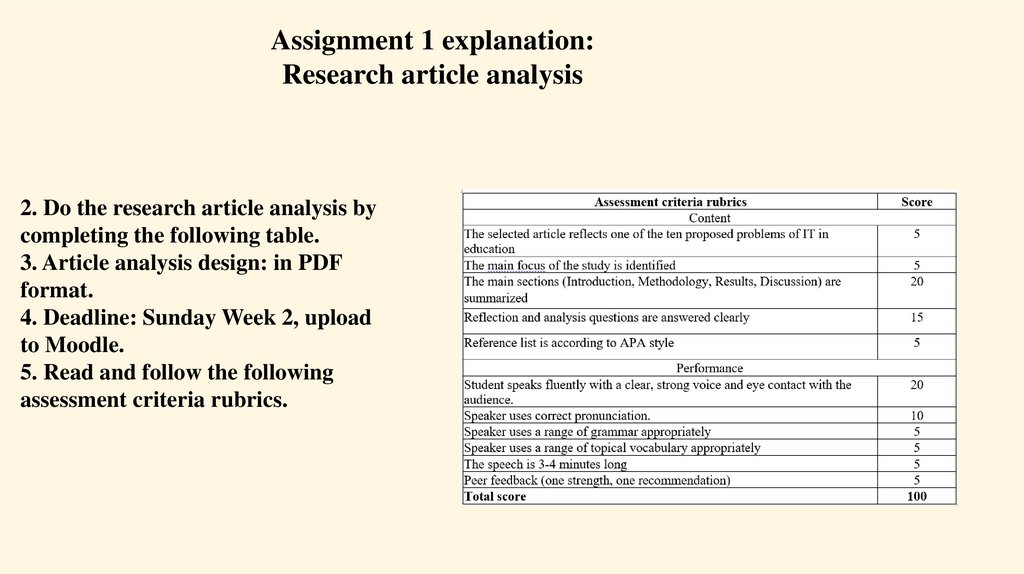
Assignment 1 explanation:Research article analysis
2. Do the research article analysis by
completing the following table.
3. Article analysis design: in PDF
format.
4. Deadline: Sunday Week 2, upload
to Moodle.
5. Read and follow the following
assessment criteria rubrics.
23.
Recommendations:• Engage actively and complete all assignments on time
• Use course resources to deepen your understanding
• Prepare thoroughly for midterm, endterm and final assessments