 culturology
Similar presentations:



Crafting Effective User Stories and Acceptance Criteria in Bangalore
1.
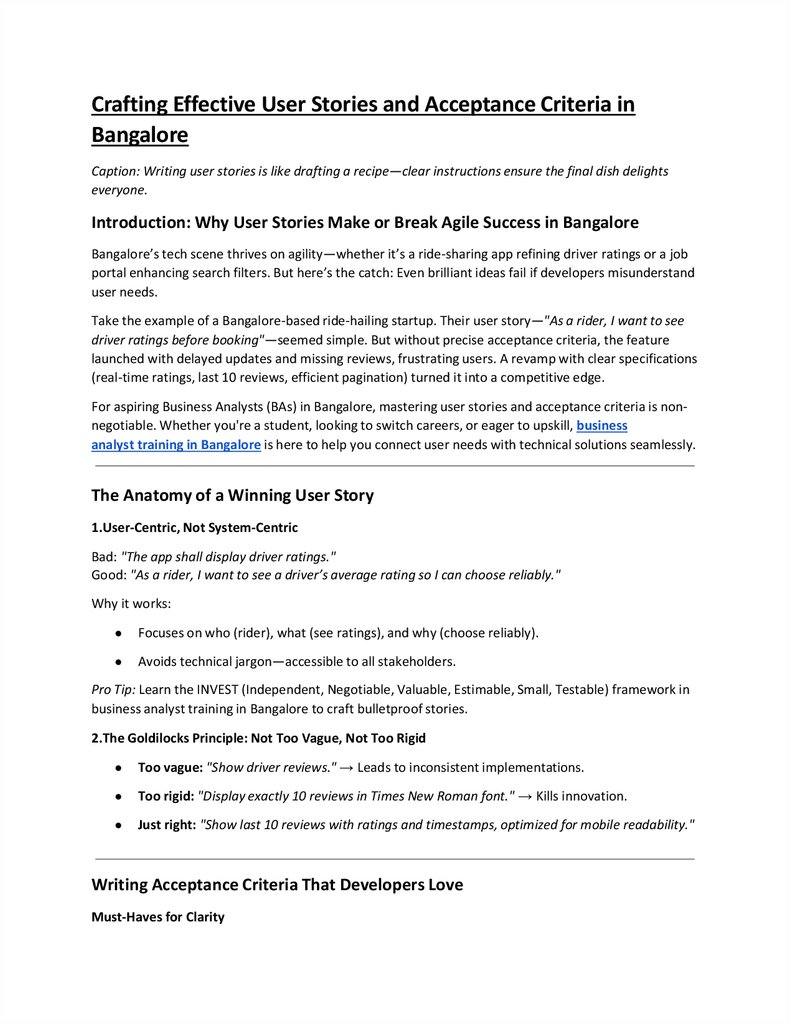
Crafting Effective User Stories and Acceptance Criteria inBangalore
Caption: Writing user stories is like drafting a recipe—clear instructions ensure the final dish delights
everyone.
Introduction: Why User Stories Make or Break Agile Success in Bangalore
Bangalore’s tech scene thrives on agility—whether it’s a ride-sharing app refining driver ratings or a job
portal enhancing search filters. But here’s the catch: Even brilliant ideas fail if developers misunderstand
user needs.
Take the example of a Bangalore-based ride-hailing startup. Their user story—"As a rider, I want to see
driver ratings before booking"—seemed simple. But without precise acceptance criteria, the feature
launched with delayed updates and missing reviews, frustrating users. A revamp with clear specifications
(real-time ratings, last 10 reviews, efficient pagination) turned it into a competitive edge.
For aspiring Business Analysts (BAs) in Bangalore, mastering user stories and acceptance criteria is nonnegotiable. Whether you're a student, looking to switch careers, or eager to upskill, business
analyst training in Bangalore is here to help you connect user needs with technical solutions seamlessly.
The Anatomy of a Winning User Story
1.User-Centric, Not System-Centric
Bad: "The app shall display driver ratings."
Good: "As a rider, I want to see a driver’s average rating so I can choose reliably."
Why it works:
Focuses on who (rider), what (see ratings), and why (choose reliably).
Avoids technical jargon—accessible to all stakeholders.
Pro Tip: Learn the INVEST (Independent, Negotiable, Valuable, Estimable, Small, Testable) framework in
business analyst training in Bangalore to craft bulletproof stories.
2.The Goldilocks Principle: Not Too Vague, Not Too Rigid
Too vague: "Show driver reviews." → Leads to inconsistent implementations.
Too rigid: "Display exactly 10 reviews in Times New Roman font." → Kills innovation.
Just right: "Show last 10 reviews with ratings and timestamps, optimized for mobile readability."
Writing Acceptance Criteria That Developers Love
Must-Haves for Clarity
2.
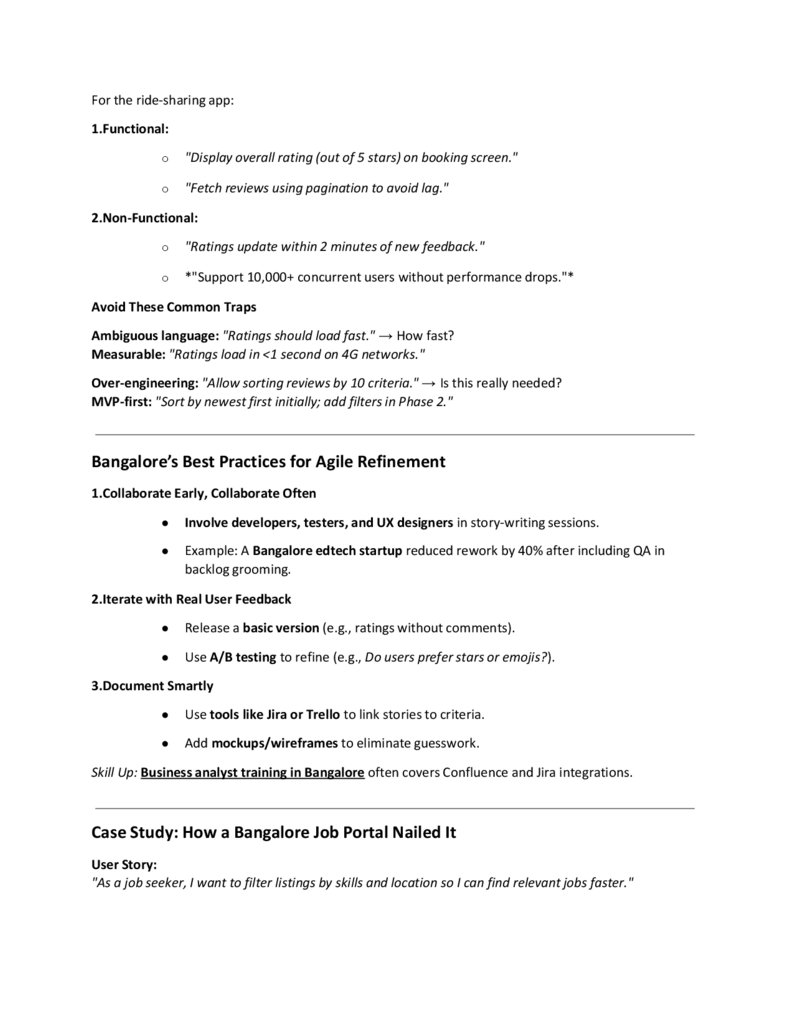
For the ride-sharing app:1.Functional:
o
"Display overall rating (out of 5 stars) on booking screen."
o
"Fetch reviews using pagination to avoid lag."
2.Non-Functional:
o
"Ratings update within 2 minutes of new feedback."
o
*"Support 10,000+ concurrent users without performance drops."*
Avoid These Common Traps
Ambiguous language: "Ratings should load fast." → How fast?
Measurable: "Ratings load in <1 second on 4G networks."
Over-engineering: "Allow sorting reviews by 10 criteria." → Is this really needed?
MVP-first: "Sort by newest first initially; add filters in Phase 2."
Bangalore’s Best Practices for Agile Refinement
1.Collaborate Early, Collaborate Often
Involve developers, testers, and UX designers in story-writing sessions.
Example: A Bangalore edtech startup reduced rework by 40% after including QA in
backlog grooming.
2.Iterate with Real User Feedback
Release a basic version (e.g., ratings without comments).
Use A/B testing to refine (e.g., Do users prefer stars or emojis?).
3.Document Smartly
Use tools like Jira or Trello to link stories to criteria.
Add mockups/wireframes to eliminate guesswork.
Skill Up: Business analyst training in Bangalore often covers Confluence and Jira integrations.
Case Study: How a Bangalore Job Portal Nailed It
User Story:
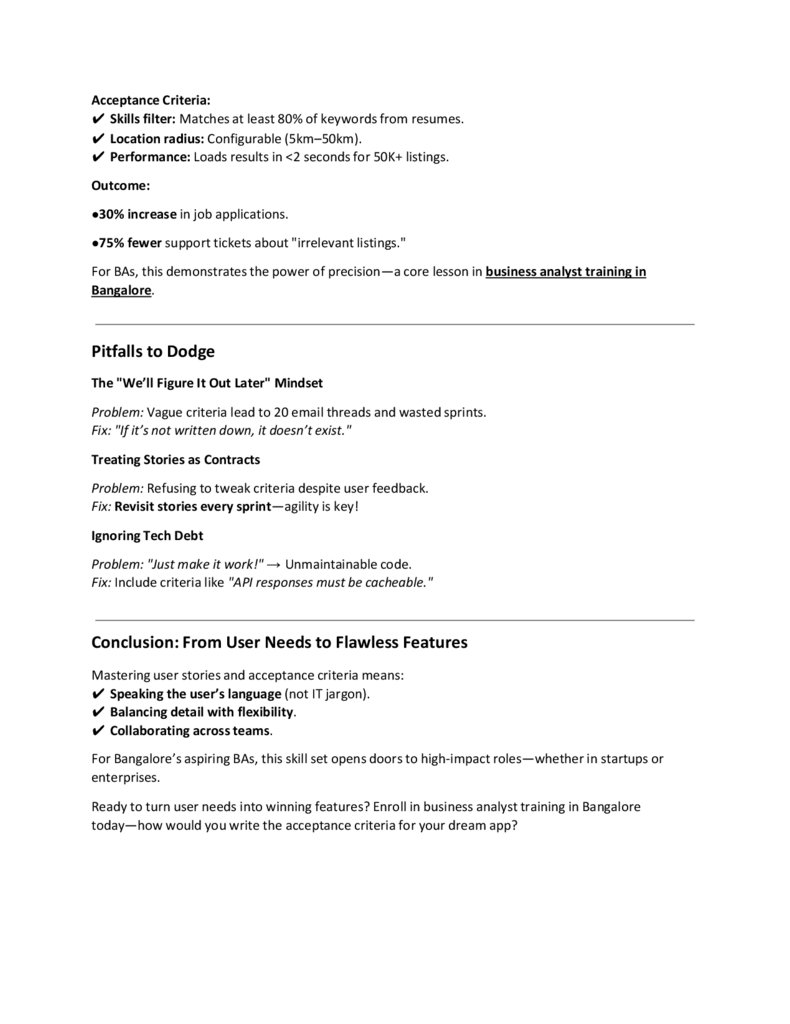
"As a job seeker, I want to filter listings by skills and location so I can find relevant jobs faster."
3.
Acceptance Criteria:✔ Skills filter: Matches at least 80% of keywords from resumes.
✔ Location radius: Configurable (5km–50km).
✔ Performance: Loads results in <2 seconds for 50K+ listings.
Outcome:
●30% increase in job applications.
●75% fewer support tickets about "irrelevant listings."
For BAs, this demonstrates the power of precision—a core lesson in business analyst training in
Bangalore.
Pitfalls to Dodge
The "We’ll Figure It Out Later" Mindset
Problem: Vague criteria lead to 20 email threads and wasted sprints.
Fix: "If it’s not written down, it doesn’t exist."
Treating Stories as Contracts
Problem: Refusing to tweak criteria despite user feedback.
Fix: Revisit stories every sprint—agility is key!
Ignoring Tech Debt
Problem: "Just make it work!" → Unmaintainable code.
Fix: Include criteria like "API responses must be cacheable."
Conclusion: From User Needs to Flawless Features
Mastering user stories and acceptance criteria means:
✔ Speaking the user’s language (not IT jargon).
✔ Balancing detail with flexibility.
✔ Collaborating across teams.
For Bangalore’s aspiring BAs, this skill set opens doors to high-impact roles—whether in startups or
enterprises.
Ready to turn user needs into winning features? Enroll in business analyst training in Bangalore
today—how would you write the acceptance criteria for your dream app?