



 sociology
Similar presentations:

The Need to Justify Our Actions: The Costs and Benefits of Dissonance Reduction. Chapter 6
1.
Chapter 6The Need to Justify
Our Actions:
The Costs and Benefits of
Dissonance Reduction
Slides prepared by JoNell Strough, Ph.D. & Philip Lemaster, M.A.
West Virginia University
Social Psychology, Eighth Edition
Elliot Aronson | Timothy D. Wilson | Robin M. Akert
©2013 Pearson Education, Inc.
All Rights Reserved.
2. This multimedia product and its contents are protected under copyright law. The following are prohibited by law: any public
performance or display,including transmission of any image over a network; preparation of any
derivative work, including the extraction, in whole or in part, of any images;
any rental, lease, or lending of the program.
Social Psychology, Eighth Edition
Elliot Aronson | Timothy D. Wilson | Robin M. Akert
©2013 Pearson Education, Inc.
All Rights Reserved.
3. Multimedia Directory
Slide 15Slide 26
Slide 45
Slide 51
Dissonance Reduction Video
Lowballing Video
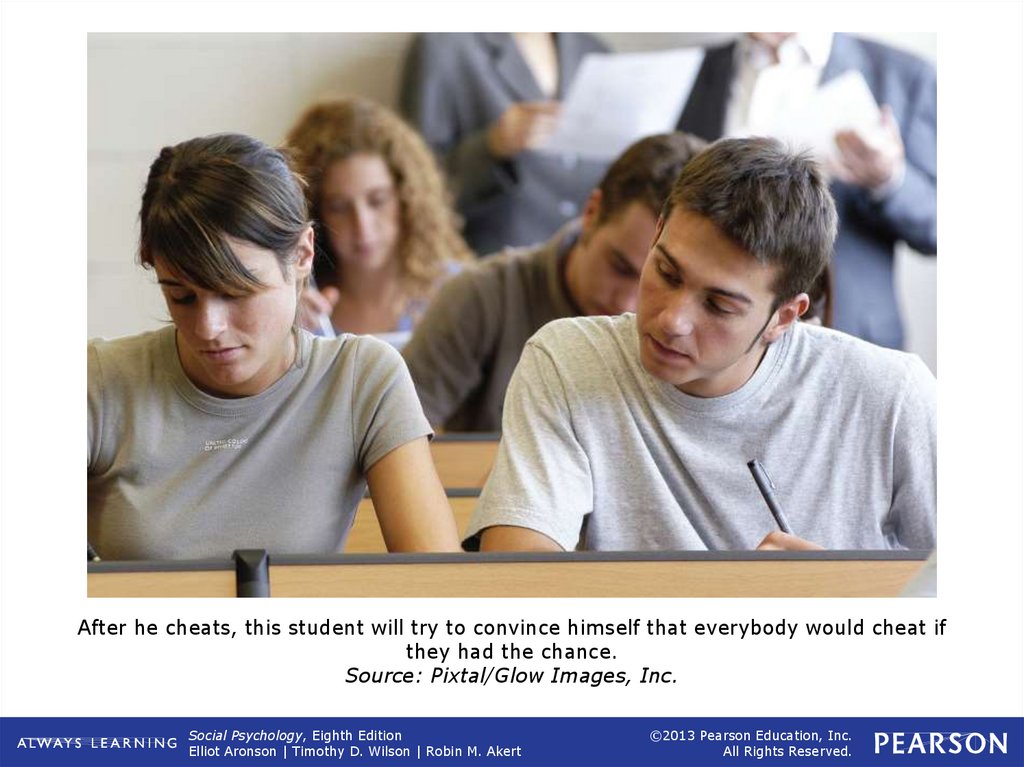
Hazing Video
External Justification Video
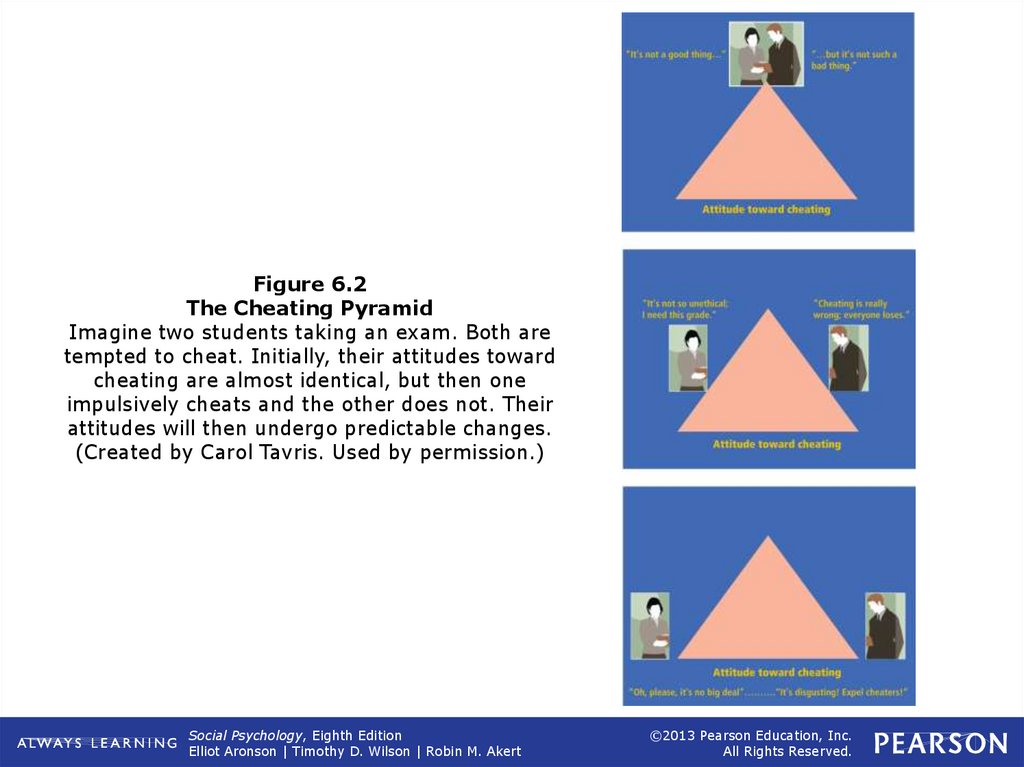
Social Psychology, Eighth Edition
Elliot Aronson | Timothy D. Wilson | Robin M. Akert
©2013 Pearson Education, Inc.
All Rights Reserved.
4. Heaven’s Gate Cult
• Believed that a space ship was comingto transport them
– Needed to rid selves of “current containers”
(own body)
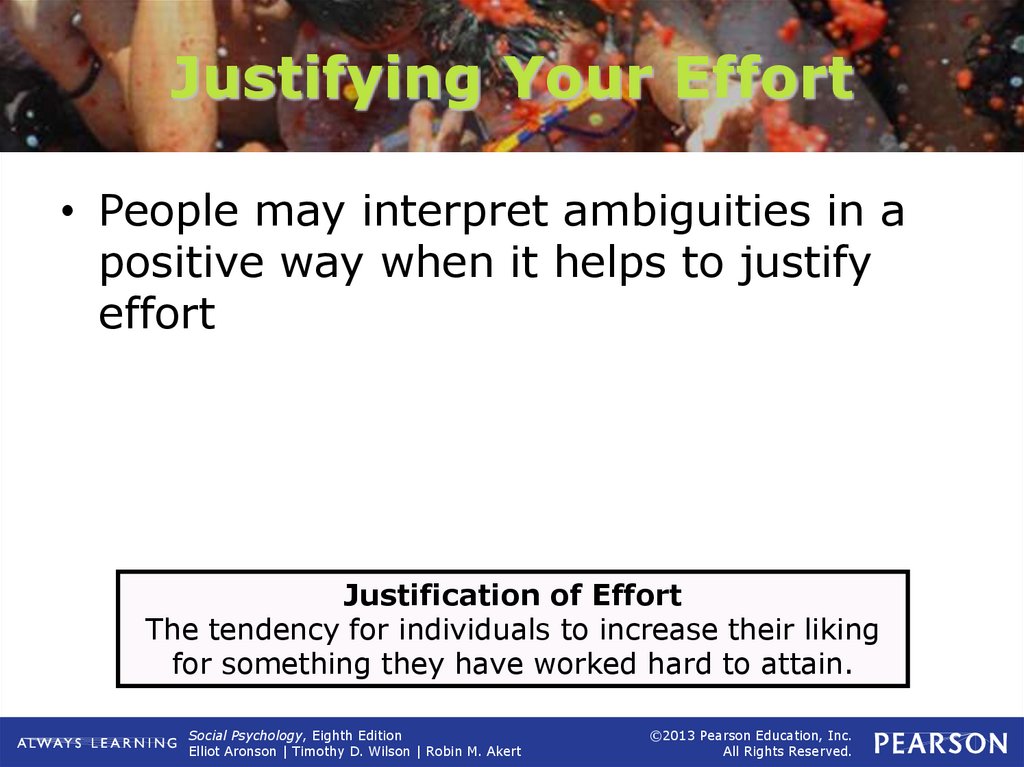
– Spaceship failed to appear behind HaleBopp Comet
– Continued with plan anyway
• Mass suicide
• Extreme example of Need to Justify
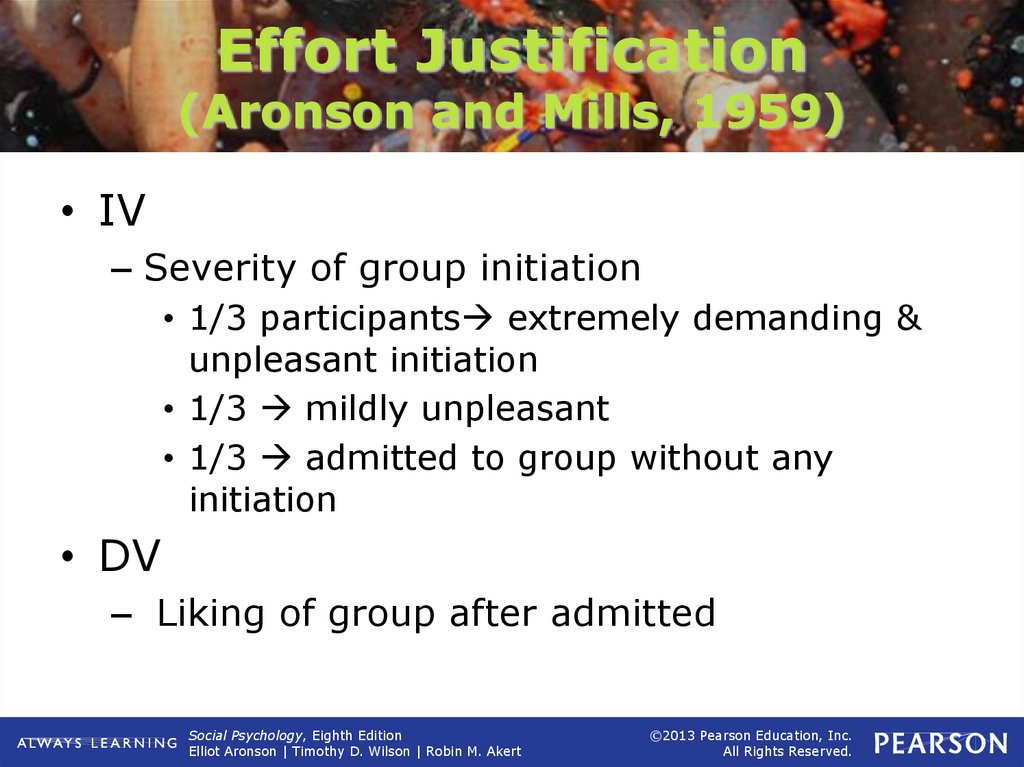
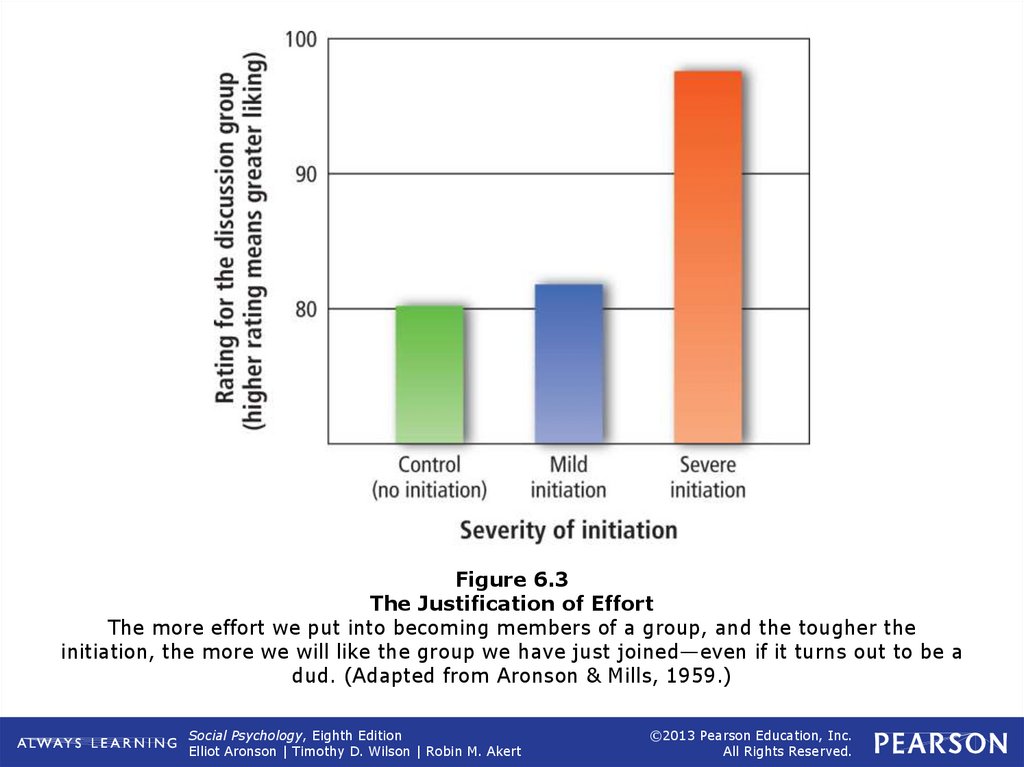
Actions
Social Psychology, Eighth Edition
Elliot Aronson | Timothy D. Wilson | Robin M. Akert
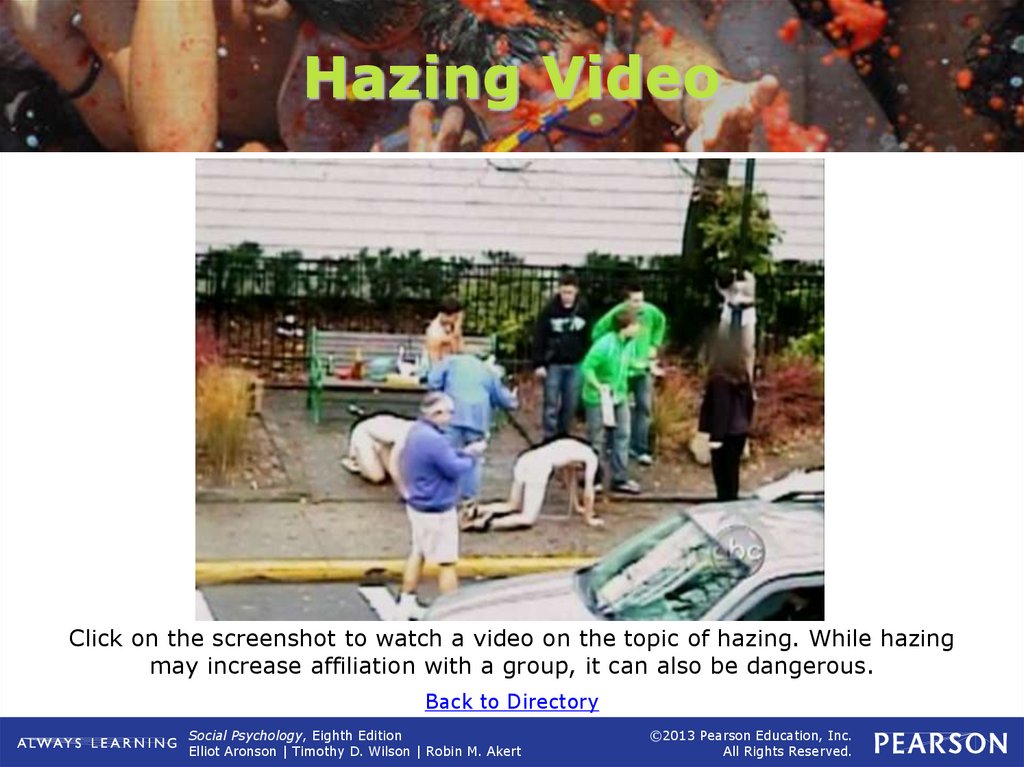
©2013 Pearson Education, Inc.
All Rights Reserved.
5. Maintaining a Stable, Positive Self-Image
• As humans, we strive to maintain afavorable view of ourselves
• When confronted with unfavorable view
of self
– Experience discomfort
Social Psychology, Eighth Edition
Elliot Aronson | Timothy D. Wilson | Robin M. Akert
©2013 Pearson Education, Inc.
All Rights Reserved.
6. The Theory of Cognitive Dissonance
• Feeling of discomfort caused byperforming an action that runs counter
to one’s customary (typically positive)
conception of oneself is referred to as
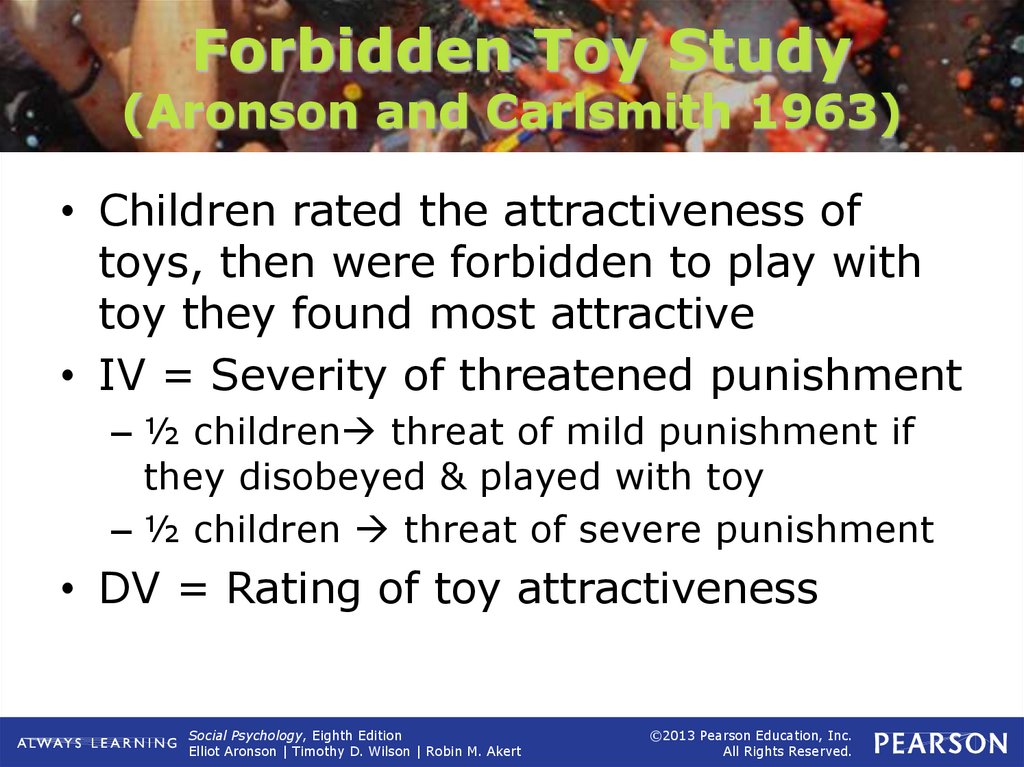
cognitive dissonance.
Social Psychology, Eighth Edition
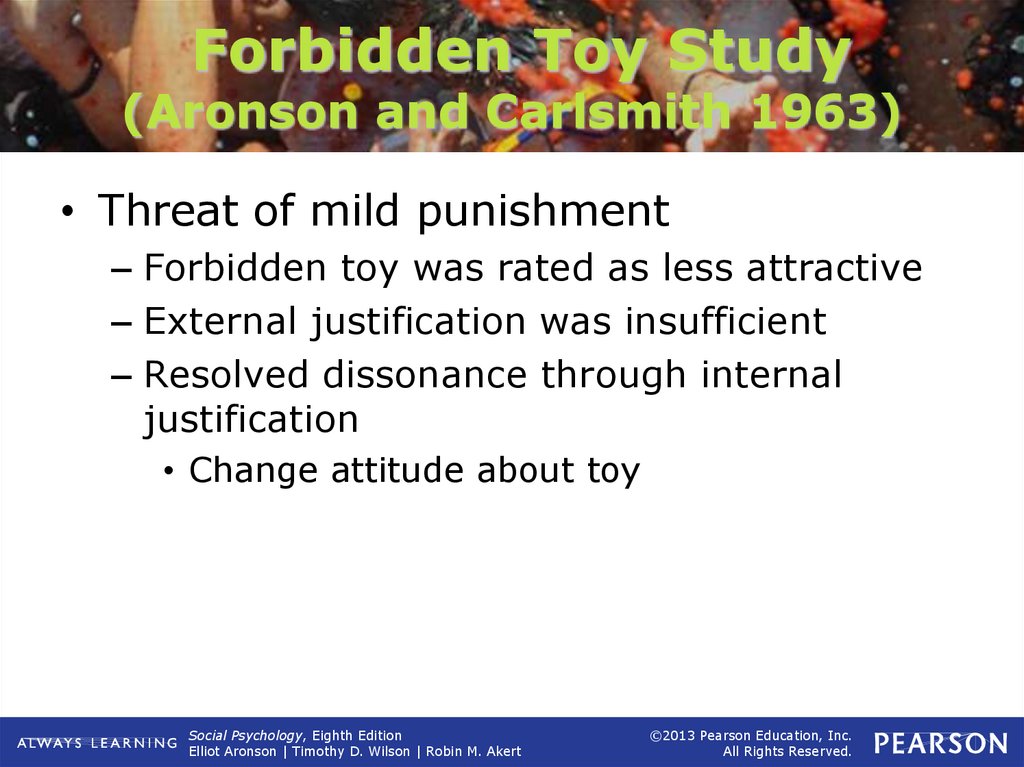
Elliot Aronson | Timothy D. Wilson | Robin M. Akert
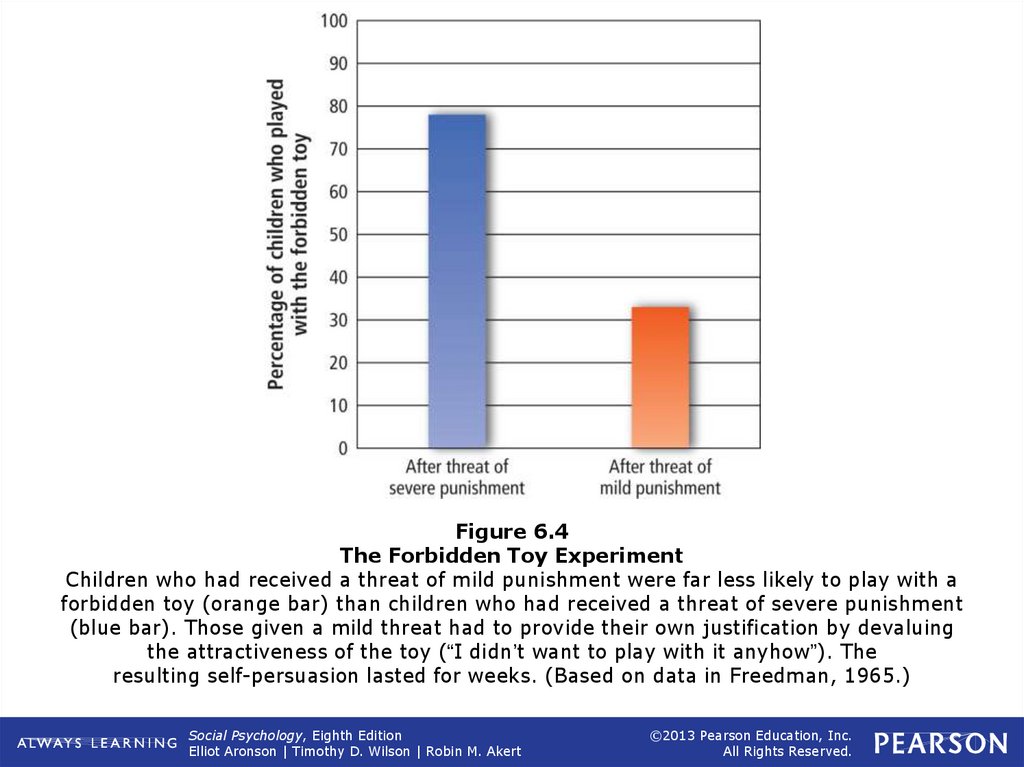
©2013 Pearson Education, Inc.
All Rights Reserved.
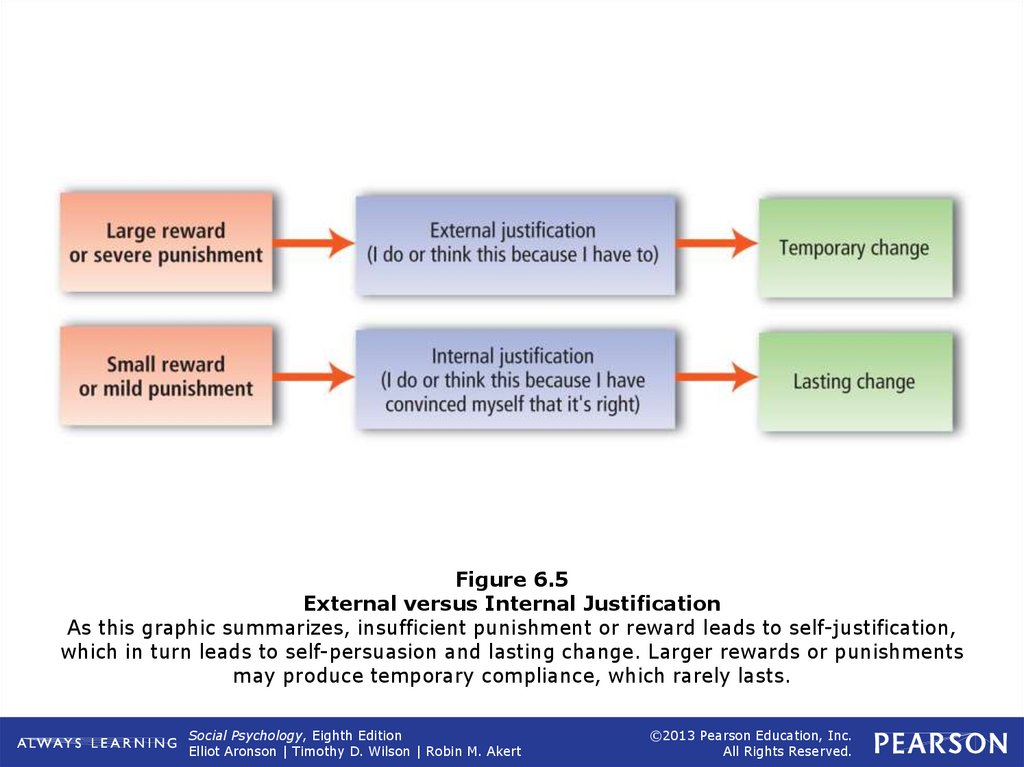
7. The Theory of Cognitive Dissonance (Festinger, 1957)
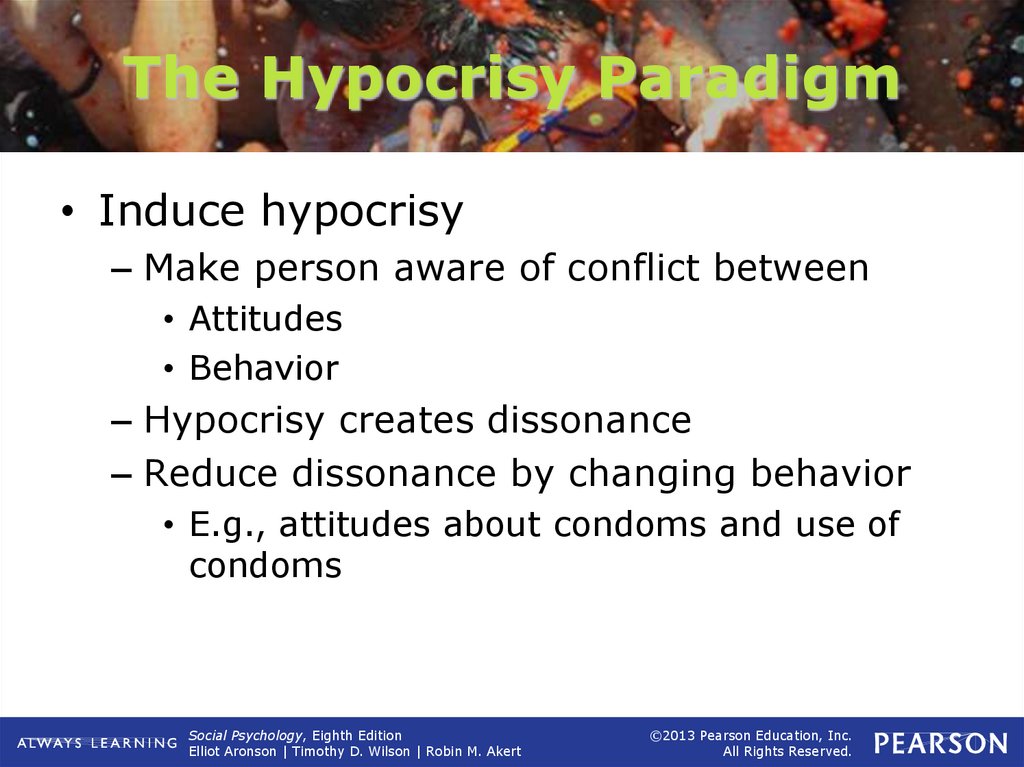
• Important and provocative socialpsychological theory
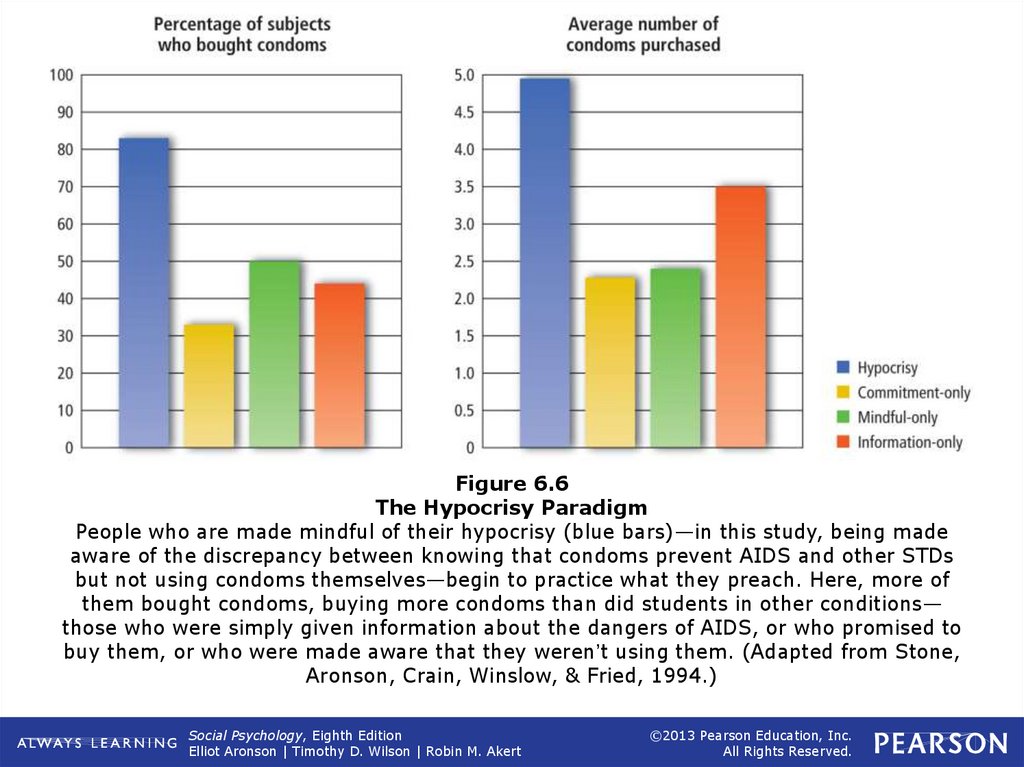
• Threats to self-image
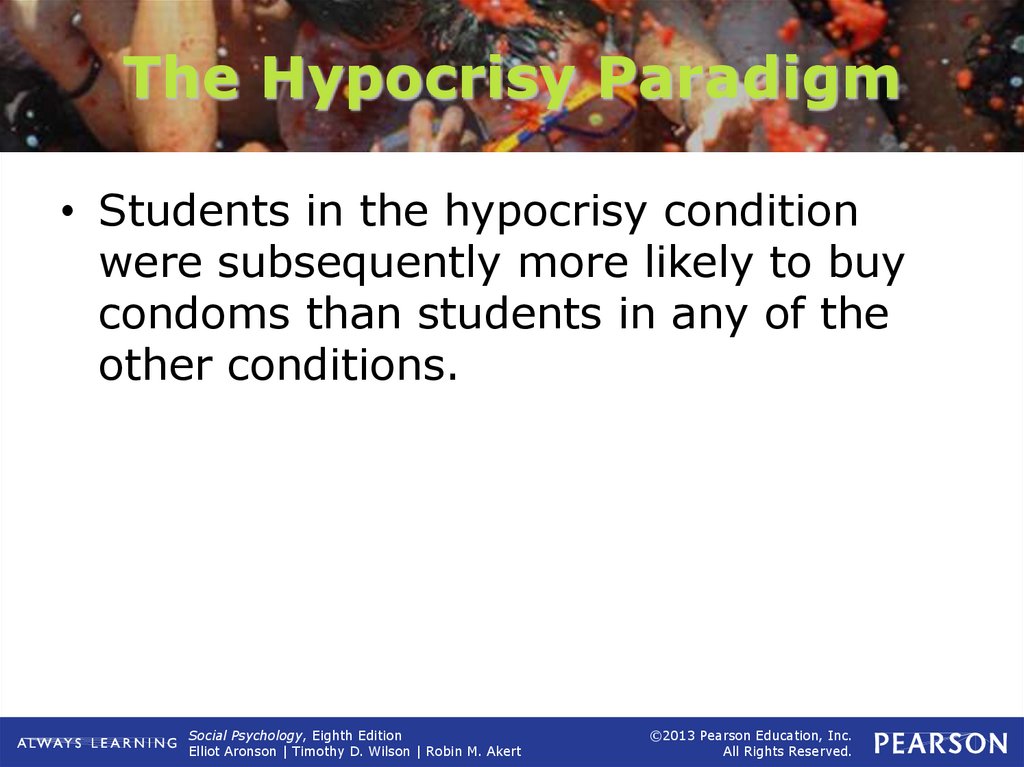
– Induces powerful, upsetting dissonance
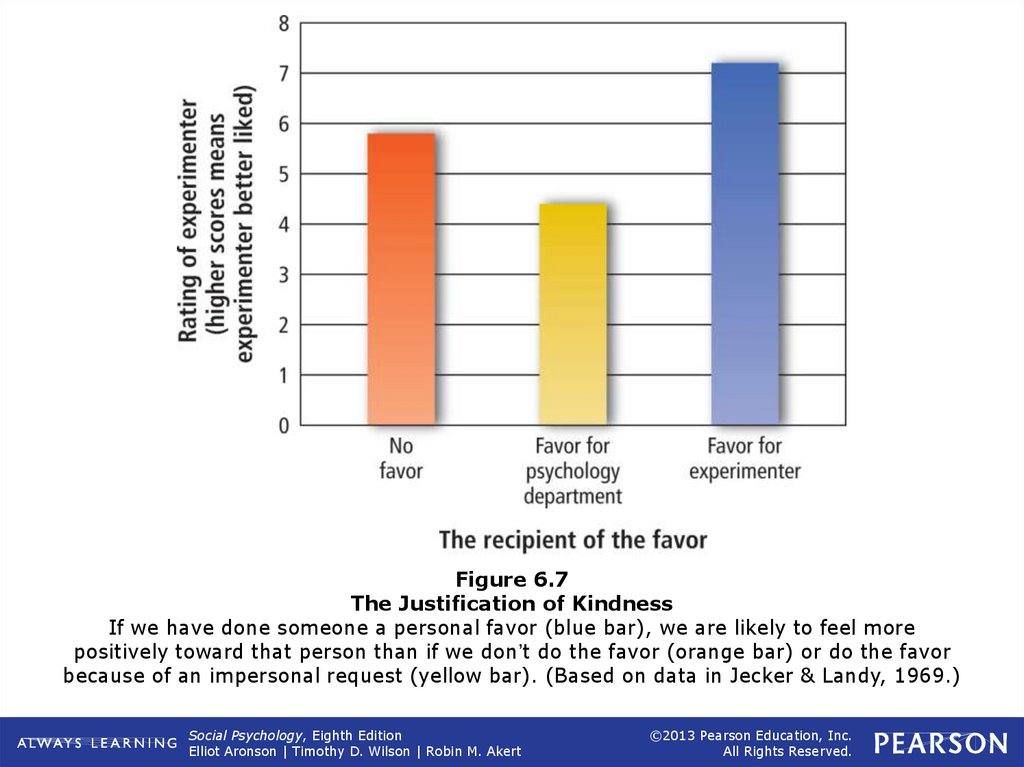
Social Psychology, Eighth Edition
Elliot Aronson | Timothy D. Wilson | Robin M. Akert
©2013 Pearson Education, Inc.
All Rights Reserved.
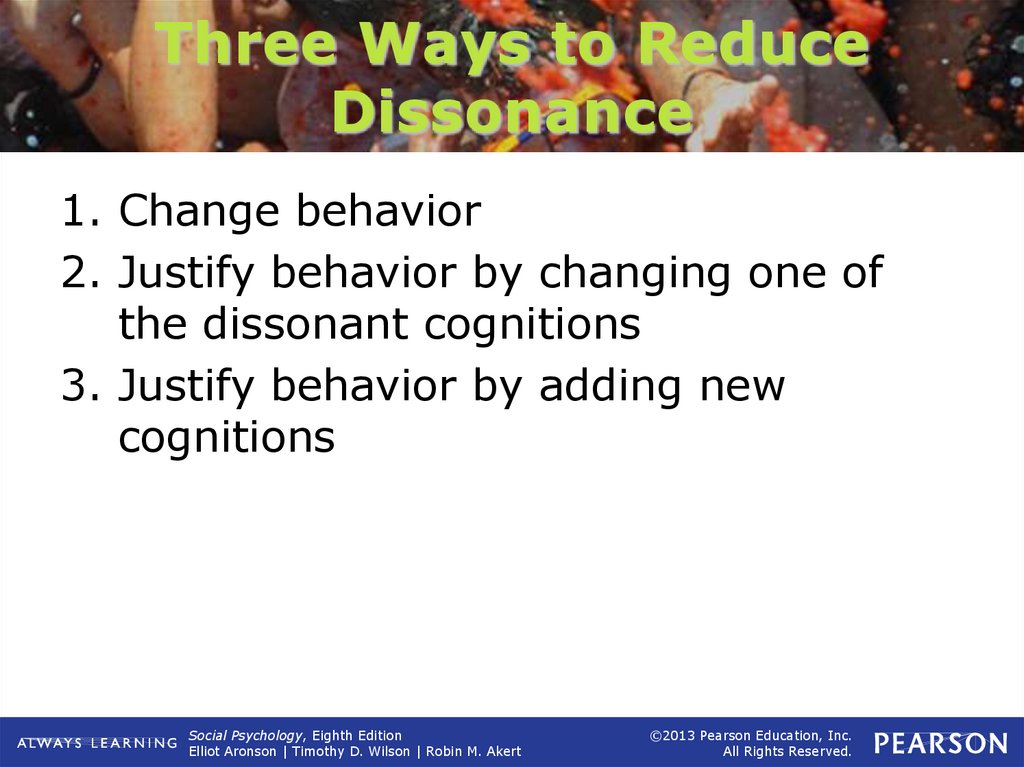
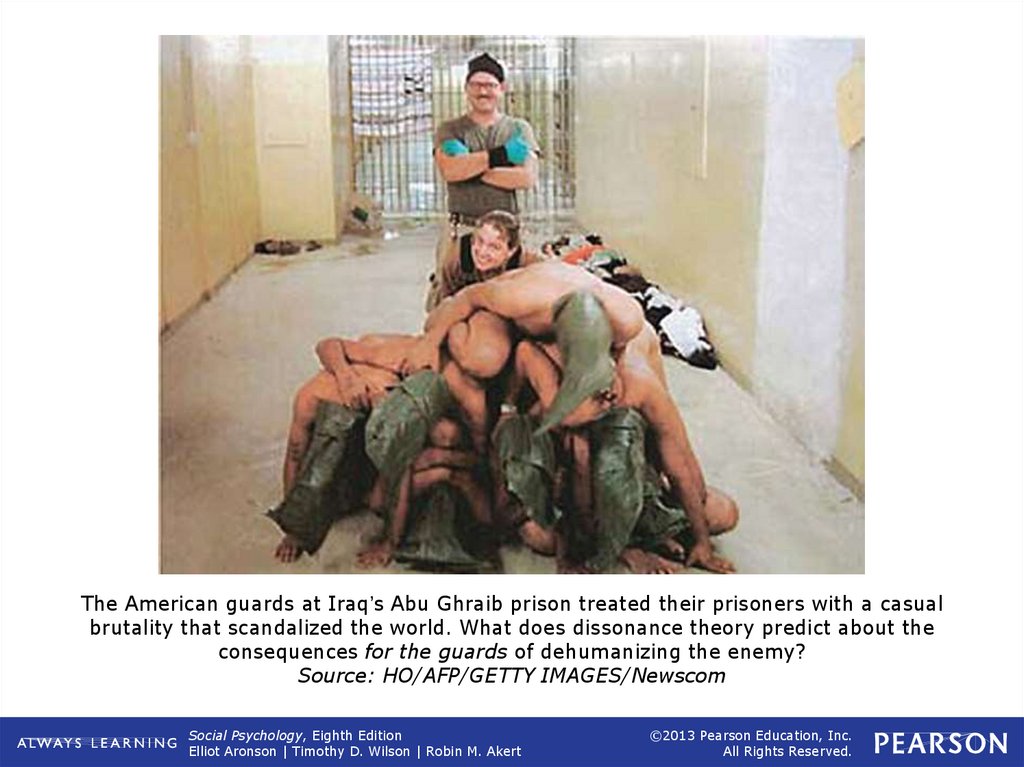
8. Three Ways to Reduce Dissonance
1. Change behavior2. Justify behavior by changing one of
the dissonant cognitions
3. Justify behavior by adding new
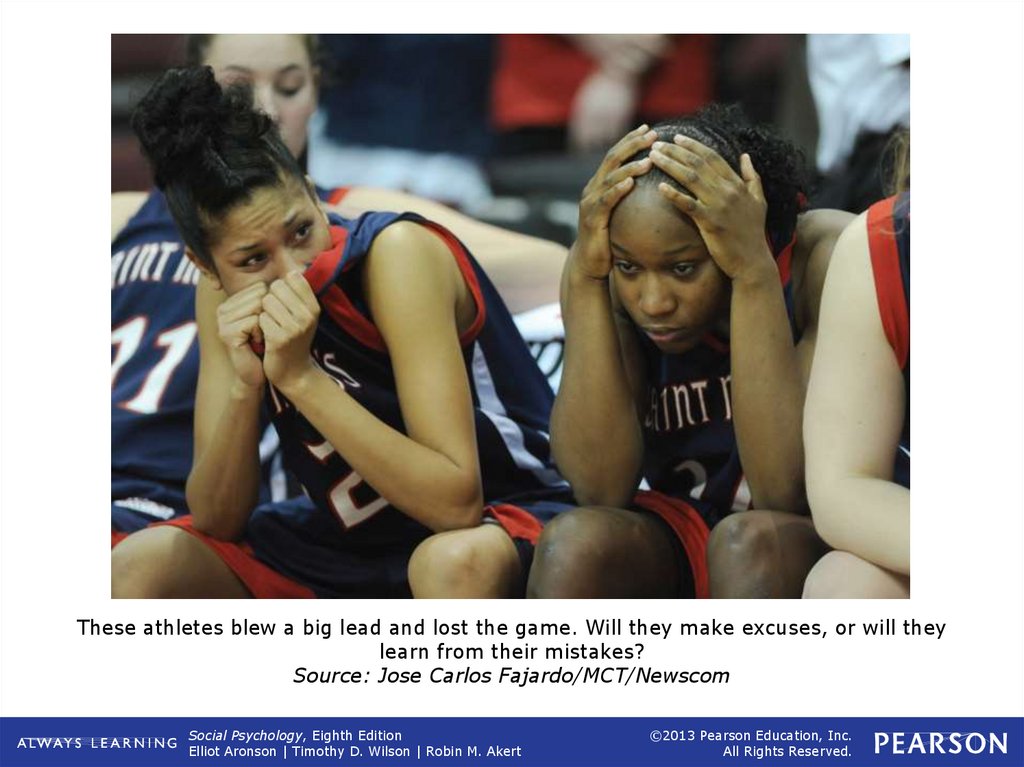
cognitions
Social Psychology, Eighth Edition
Elliot Aronson | Timothy D. Wilson | Robin M. Akert
©2013 Pearson Education, Inc.
All Rights Reserved.
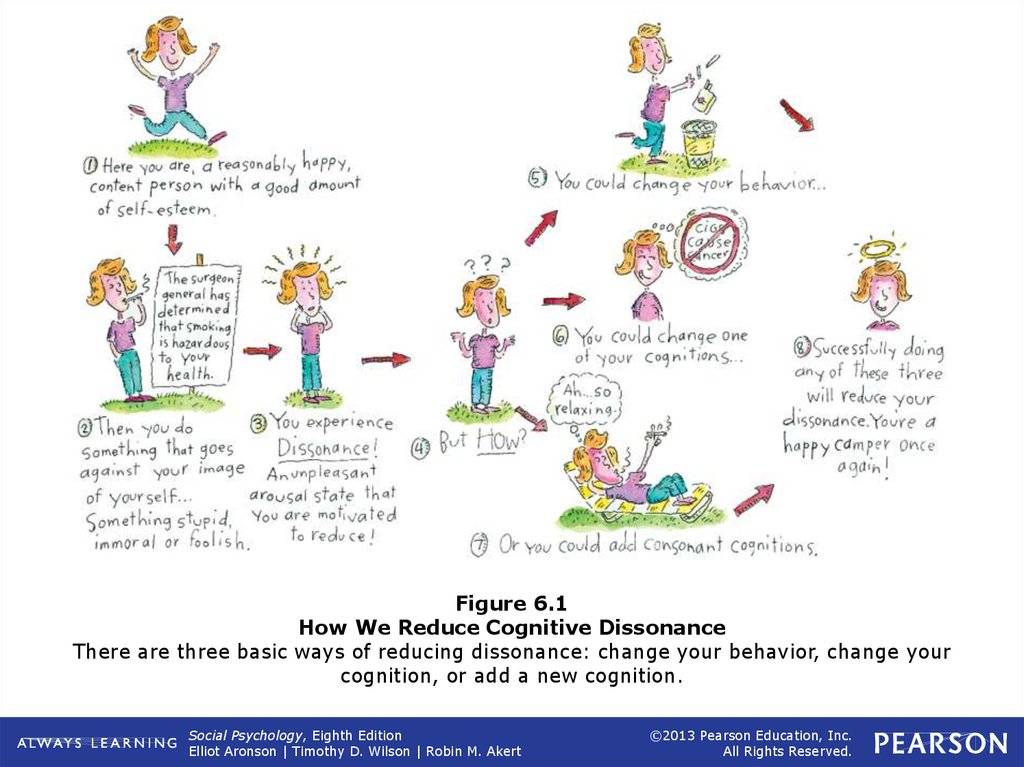
9. Figure 6.1 How We Reduce Cognitive Dissonance There are three basic ways of reducing dissonance: change your behavior, change
yourcognition, or add a new cognition.
Social Psychology, Eighth Edition
Elliot Aronson | Timothy D. Wilson | Robin M. Akert
©2013 Pearson Education, Inc.
All Rights Reserved.
10. Self-Affirmation
• Bolster the self-concept• Reducing dissonance by adding a
cognition about other positive
attributes
– E.g., smoker who fails to quit
• Not very smart of me to be smoking, but,
I’m really a very good mathematician!
Social Psychology, Eighth Edition
Elliot Aronson | Timothy D. Wilson | Robin M. Akert
©2013 Pearson Education, Inc.
All Rights Reserved.
11. Impact Bias
• The tendency to overestimate theintensity and duration of our emotional
reactions to future negative events.
Social Psychology, Eighth Edition
Elliot Aronson | Timothy D. Wilson | Robin M. Akert
©2013 Pearson Education, Inc.
All Rights Reserved.
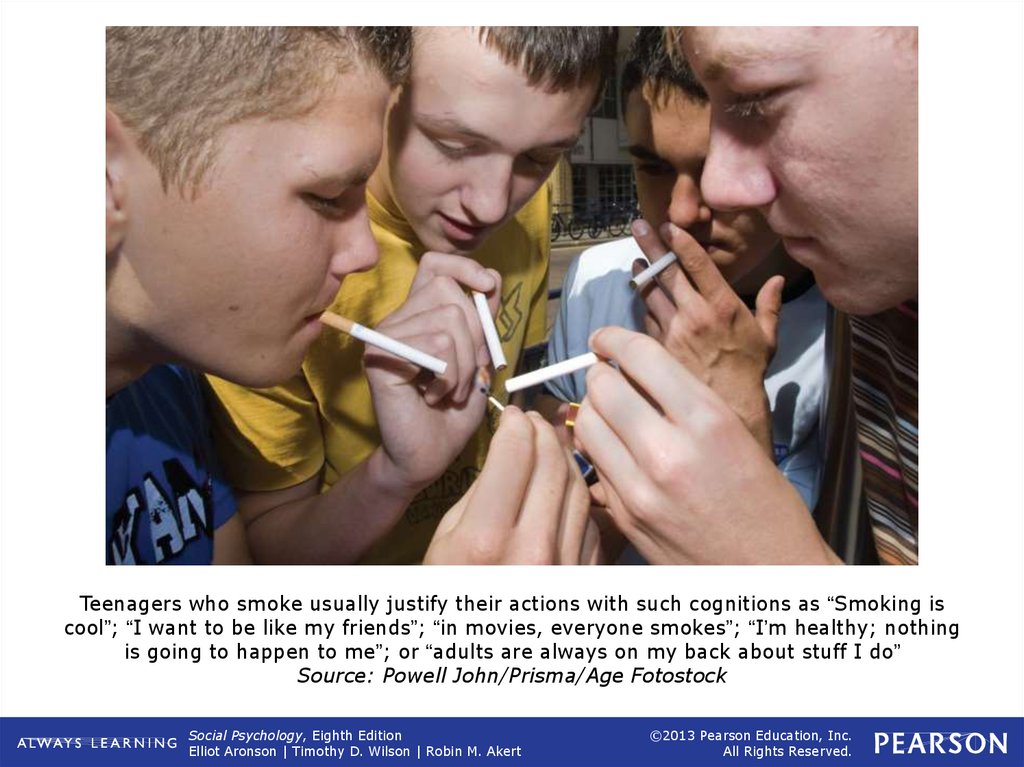
12. Teenagers who smoke usually justify their actions with such cognitions as “Smoking is cool”; “I want to be like my friends”;
“in movies, everyone smokes”; “I’m healthy; nothingis going to happen to me”; or “adults are always on my back about stuff I do”
Source: Powell John/Prisma/Age Fotostock
Social Psychology, Eighth Edition
Elliot Aronson | Timothy D. Wilson | Robin M. Akert
©2013 Pearson Education, Inc.
All Rights Reserved.
13. Why We Overestimate the Pain of Disappointment
• Why does impact bias occur?– Process of reducing dissonance is largely
unconscious
Social Psychology, Eighth Edition
Elliot Aronson | Timothy D. Wilson | Robin M. Akert
©2013 Pearson Education, Inc.
All Rights Reserved.
14. Self-Esteem and Cognitive Dissonance
• High self-esteem– Strive to keep behavior consonant with
view of self
• Work harder to reduce dissonance than
people with average self-esteem
Social Psychology, Eighth Edition
Elliot Aronson | Timothy D. Wilson | Robin M. Akert
©2013 Pearson Education, Inc.
All Rights Reserved.
15. Dissonance Reduction Video
Click on the screenshot to watch Dr. Tavris discuss how dissonance reductionis often oriented toward protecting self-esteem.
Back to Directory
Social Psychology, Eighth Edition
Elliot Aronson | Timothy D. Wilson | Robin M. Akert
©2013 Pearson Education, Inc.
All Rights Reserved.
16. Rational Behavior Versus Rationalizing Behavior
• Need to maintain our self-esteem– Associated with rationalizing instead of
rational thought
• Process information so that it fits with preexisting beliefs
Social Psychology, Eighth Edition
Elliot Aronson | Timothy D. Wilson | Robin M. Akert
©2013 Pearson Education, Inc.
All Rights Reserved.
17. Decisions, Decisions, Decisions
• Every time we make a decision, weexperience dissonance.
– Chosen alternative has some negative
aspects
– Rejected alternative has some positive
aspects
Social Psychology, Eighth Edition
Elliot Aronson | Timothy D. Wilson | Robin M. Akert
©2013 Pearson Education, Inc.
All Rights Reserved.
18. Once he is hooked on getting a truck, this young man will reason that “it certainly would be safer than a small car, and
besides, the price of gasoline is bound to drop by the timeI’m 40.”
Source: Jeremy Woodhouse/Blend Images/Age Fotostock
Social Psychology, Eighth Edition
Elliot Aronson | Timothy D. Wilson | Robin M. Akert
©2013 Pearson Education, Inc.
All Rights Reserved.
19. Postdecision Dissonance
• Dissonance aroused after making adecision, typically reduced by
enhancing the attractiveness of the
chosen alternative and devaluating the
rejected alternatives.
Social Psychology, Eighth Edition
Elliot Aronson | Timothy D. Wilson | Robin M. Akert
©2013 Pearson Education, Inc.
All Rights Reserved.
20. Reducing Post-Decision Dissonance
• Distort likes and dislikes– Downplay
• Negative aspects of chosen alternative
• Positive aspects of rejected alternative
Social Psychology, Eighth Edition
Elliot Aronson | Timothy D. Wilson | Robin M. Akert
©2013 Pearson Education, Inc.
All Rights Reserved.
21. Permanence and Importance of Decision
• More important decisions = Moredissonance
• Greater permanence = More
dissonance
– Permanence of decision
• How difficult it is to revoke
Social Psychology, Eighth Edition
Elliot Aronson | Timothy D. Wilson | Robin M. Akert
©2013 Pearson Education, Inc.
All Rights Reserved.
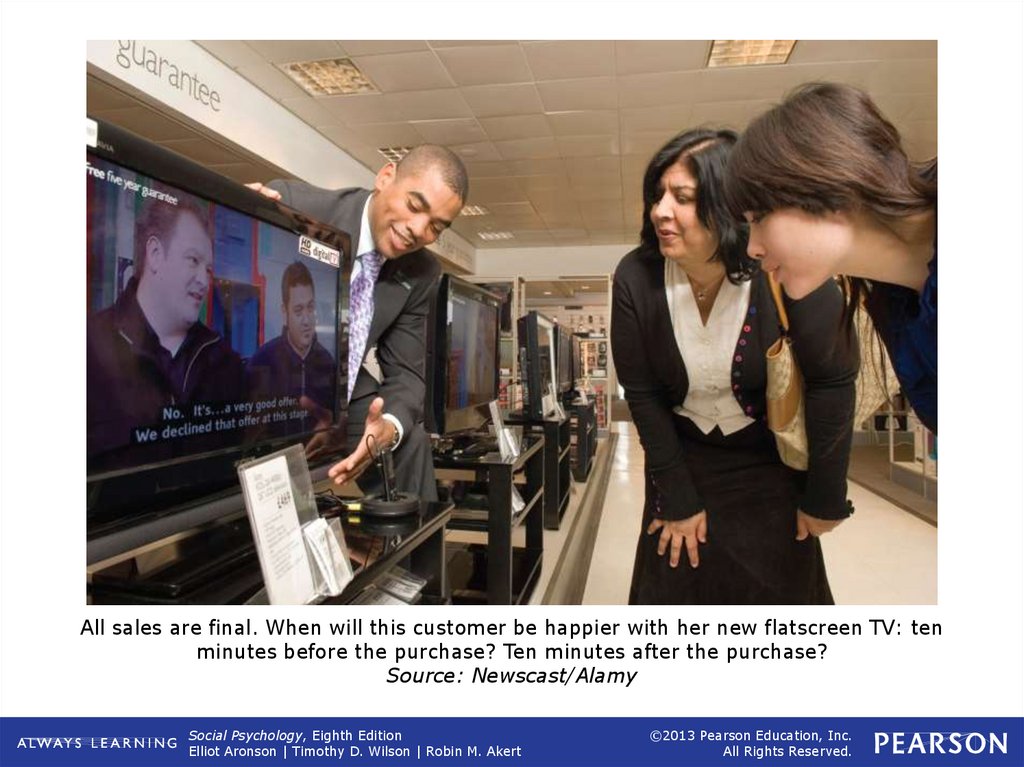
22. All sales are final. When will this customer be happier with her new flatscreen TV: ten minutes before the purchase? Ten
minutes after the purchase?Source: Newscast/Alamy
Social Psychology, Eighth Edition
Elliot Aronson | Timothy D. Wilson | Robin M. Akert
©2013 Pearson Education, Inc.
All Rights Reserved.
23. Creating the Illusion of Irrevocability
• When decisions are permanent(irrevocable)
– Dissonance increases
– Motivation to reduce dissonance increases
Social Psychology, Eighth Edition
Elliot Aronson | Timothy D. Wilson | Robin M. Akert
©2013 Pearson Education, Inc.
All Rights Reserved.
24. Creating the Illusion of Irrevocability
• Lowballing– An unscrupulous strategy whereby a
salesperson induces a customer to agree to
purchase a product at a very low cost,
subsequently claims it was an error, and
then raises the price.
– Frequently, the customer will agree to
make the purchase at the inflated price.
Social Psychology, Eighth Edition
Elliot Aronson | Timothy D. Wilson | Robin M. Akert
©2013 Pearson Education, Inc.
All Rights Reserved.
25. Creating the Illusion of Irrevocability
• Create illusion of irrevocability toinduce motivation to reduce
dissonance!
Social Psychology, Eighth Edition
Elliot Aronson | Timothy D. Wilson | Robin M. Akert
©2013 Pearson Education, Inc.
All Rights Reserved.
26. Lowballing Video
Click on the screenshot to watch Dr. Cialdini briefly explain how car salesmenuse lowballing to increase their sales.
Back to Directory
Social Psychology, Eighth Edition
Elliot Aronson | Timothy D. Wilson | Robin M. Akert
©2013 Pearson Education, Inc.
All Rights Reserved.
27. The Decision to Behave Immorally
• When is it okay to lie to a friend?• When is an act of stealing, and when is
it borrowing?
Social Psychology, Eighth Edition
Elliot Aronson | Timothy D. Wilson | Robin M. Akert
©2013 Pearson Education, Inc.
All Rights Reserved.
28. After he cheats, this student will try to convince himself that everybody would cheat if they had the chance. Source:
Pixtal/Glow Images, Inc.Social Psychology, Eighth Edition
Elliot Aronson | Timothy D. Wilson | Robin M. Akert
©2013 Pearson Education, Inc.
All Rights Reserved.
29. The Decision to Behave Immorally
• Moral dilemmas– Implications for self-esteem
• Dissonance reduction
– People may behave either more ethically or
less ethically in the future
Social Psychology, Eighth Edition
Elliot Aronson | Timothy D. Wilson | Robin M. Akert
©2013 Pearson Education, Inc.
All Rights Reserved.
30. The Decision to Behave Immorally
• Example—Cheating on a test– Dissonance
• Positive view of self inconsistent with
dishonest behavior
– How to reduce dissonance?
• Change attitude about cheating
– “Not a big deal, everyone does it”
– Future behavior—less ethical
Social Psychology, Eighth Edition
Elliot Aronson | Timothy D. Wilson | Robin M. Akert
©2013 Pearson Education, Inc.
All Rights Reserved.
31. Figure 6.2 The Cheating Pyramid Imagine two students taking an exam. Both are tempted to cheat. Initially, their attitudes
towardcheating are almost identical, but then one
impulsively cheats and the other does not. Their
attitudes will then undergo predictable changes.
(Created by Carol Tavris. Used by permission.)
Social Psychology, Eighth Edition
Elliot Aronson | Timothy D. Wilson | Robin M. Akert
©2013 Pearson Education, Inc.
All Rights Reserved.
32. The Decision to Behave Immorally
• Example—Cheating on a test– Change behavior
• Do not ever cheat again
• Future behavior—more ethical
Social Psychology, Eighth Edition
Elliot Aronson | Timothy D. Wilson | Robin M. Akert
©2013 Pearson Education, Inc.
All Rights Reserved.
33. The Decision to Behave Immorally
• Example—Decide NOT to cheat– Post-decision dissonance
• “Would have received better grade if
cheated”
– Reducing dissonance
• Change attitude
– To justify giving up a good grade, you
convince yourself that cheating is even worse
than you previously felt it was
• Attitude becomes more extreme
Social Psychology, Eighth Edition
Elliot Aronson | Timothy D. Wilson | Robin M. Akert
©2013 Pearson Education, Inc.
All Rights Reserved.
34. Dissonance Reduction and Personal Values (Mills, 1958)
• Measured 6th graders attitudes aboutcheating
• Gave opportunity to cheat in a game
– Easy to cheat
– Cheating almost necessary to win
– Believed cheating could not be detected
Social Psychology, Eighth Edition
Elliot Aronson | Timothy D. Wilson | Robin M. Akert
©2013 Pearson Education, Inc.
All Rights Reserved.
35. Dissonance Reduction and Personal Values (Mills, 1958)
• Cheaters– Became more lenient toward cheating
• Noncheaters
– Became less lenient toward cheating
Social Psychology, Eighth Edition
Elliot Aronson | Timothy D. Wilson | Robin M. Akert
©2013 Pearson Education, Inc.
All Rights Reserved.
36. Dissonance, Culture, and the Brain
• Dissonant information– Reasoning circuits of brain shut down
• Dissonance is reduced
– Emotion circuits activated
• Primates also show changes in what is
valued after making a decision
Social Psychology, Eighth Edition
Elliot Aronson | Timothy D. Wilson | Robin M. Akert
©2013 Pearson Education, Inc.
All Rights Reserved.
37. Dissonance and Culture
• Process of dissonance reduction– Culturally universal
• Content of dissonance reduction
– Cultural differences
• What thoughts are added, changed differ by
culture
Social Psychology, Eighth Edition
Elliot Aronson | Timothy D. Wilson | Robin M. Akert
©2013 Pearson Education, Inc.
All Rights Reserved.
38. Justifying Your Effort
• Example– Suppose you expend a great deal of effort
to get into a particular club and it turns out
to be a totally worthless organization
• How would you reduce this dissonance?
• How would you justify your behavior?
Social Psychology, Eighth Edition
Elliot Aronson | Timothy D. Wilson | Robin M. Akert
©2013 Pearson Education, Inc.
All Rights Reserved.
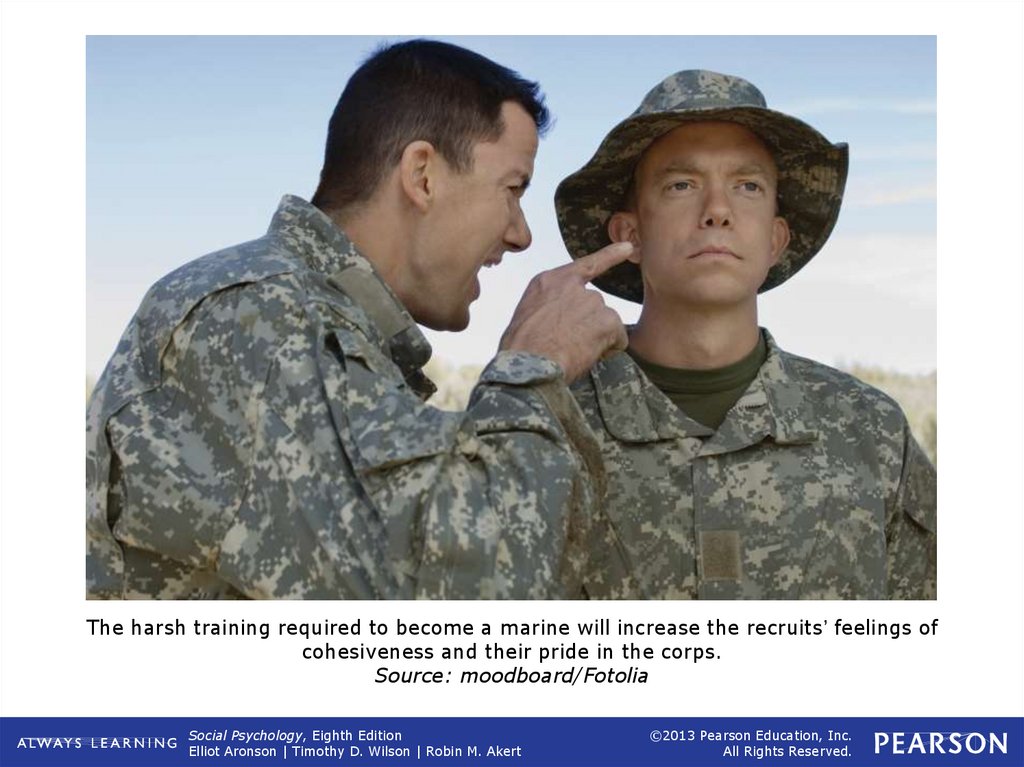
39. The harsh training required to become a marine will increase the recruits’ feelings of cohesiveness and their pride in the
corps.Source: moodboard/Fotolia
Social Psychology, Eighth Edition
Elliot Aronson | Timothy D. Wilson | Robin M. Akert
©2013 Pearson Education, Inc.
All Rights Reserved.
40. Justifying Your Effort
• People may interpret ambiguities in apositive way when it helps to justify
effort
Justification of Effort
The tendency for individuals to increase their liking
for something they have worked hard to attain.
Social Psychology, Eighth Edition
Elliot Aronson | Timothy D. Wilson | Robin M. Akert
©2013 Pearson Education, Inc.
All Rights Reserved.
41. Effort Justification (Aronson and Mills, 1959)
• Cover story– College students volunteered to join a
group that would be meeting regularly to
discuss various aspects of the psychology
of sex
Social Psychology, Eighth Edition
Elliot Aronson | Timothy D. Wilson | Robin M. Akert
©2013 Pearson Education, Inc.
All Rights Reserved.
42. Effort Justification (Aronson and Mills, 1959)
• IV– Severity of group initiation
• 1/3 participants extremely demanding &
unpleasant initiation
• 1/3 mildly unpleasant
• 1/3 admitted to group without any
initiation
• DV
– Liking of group after admitted
Social Psychology, Eighth Edition
Elliot Aronson | Timothy D. Wilson | Robin M. Akert
©2013 Pearson Education, Inc.
All Rights Reserved.
43. Effort Justification (Aronson and Mills, 1959)
• Mild initiation or no effort less likingof group
• Severe initiation more liking of group
Social Psychology, Eighth Edition
Elliot Aronson | Timothy D. Wilson | Robin M. Akert
©2013 Pearson Education, Inc.
All Rights Reserved.
44. Figure 6.3 The Justification of Effort The more effort we put into becoming members of a group, and the tougher the initiation,
the more we will like the group we have just joined—even if it turns out to be adud. (Adapted from Aronson & Mills, 1959.)
Social Psychology, Eighth Edition
Elliot Aronson | Timothy D. Wilson | Robin M. Akert
©2013 Pearson Education, Inc.
All Rights Reserved.
45. Hazing Video
Click on the screenshot to watch a video on the topic of hazing. While hazingmay increase affiliation with a group, it can also be dangerous.
Back to Directory
Social Psychology, Eighth Edition
Elliot Aronson | Timothy D. Wilson | Robin M. Akert
©2013 Pearson Education, Inc.
All Rights Reserved.
46. The Psychology of Insufficient Justification
• Example– If you tell a friend that you like her ugly
dress very much, do you experience much
dissonance?
• Many thoughts are consonant (consistent)
with having told lie
– E.g., it is important not to cause pain to
people, not hurt feelings
Social Psychology, Eighth Edition
Elliot Aronson | Timothy D. Wilson | Robin M. Akert
©2013 Pearson Education, Inc.
All Rights Reserved.
47. The Psychology of Insufficient Justification
• Believing it is important not to causepain to people you like provides ample
external justification for having told
lie
External Justification
A reason or an explanation for dissonant personal
behavior that resides outside the individual. E.g., in
order to receive a large reward or avoid a severe
punishment.
Social Psychology, Eighth Edition
Elliot Aronson | Timothy D. Wilson | Robin M. Akert
©2013 Pearson Education, Inc.
All Rights Reserved.
48. The Psychology of Insufficient Justification
• What if there is no good externaljustification for lying?
Social Psychology, Eighth Edition
Elliot Aronson | Timothy D. Wilson | Robin M. Akert
©2013 Pearson Education, Inc.
All Rights Reserved.
49. The Psychology of Insufficient Justification
• Internal Justification– The reduction of dissonance by changing
something about oneself.
– E.g., one’s attitude or behavior
Social Psychology, Eighth Edition
Elliot Aronson | Timothy D. Wilson | Robin M. Akert
©2013 Pearson Education, Inc.
All Rights Reserved.
50. The Psychology of Insufficient Justification
• If there is insufficient externaljustification for counterattitudinal
advocacy, the attempt to reduce
dissonance may result in attitude
change!
Counterattitudinal Advocacy
Stating an opinion or attitude that runs counter to
one’s private belief or attitude.
Social Psychology, Eighth Edition
Elliot Aronson | Timothy D. Wilson | Robin M. Akert
©2013 Pearson Education, Inc.
All Rights Reserved.
51. External Justification Video
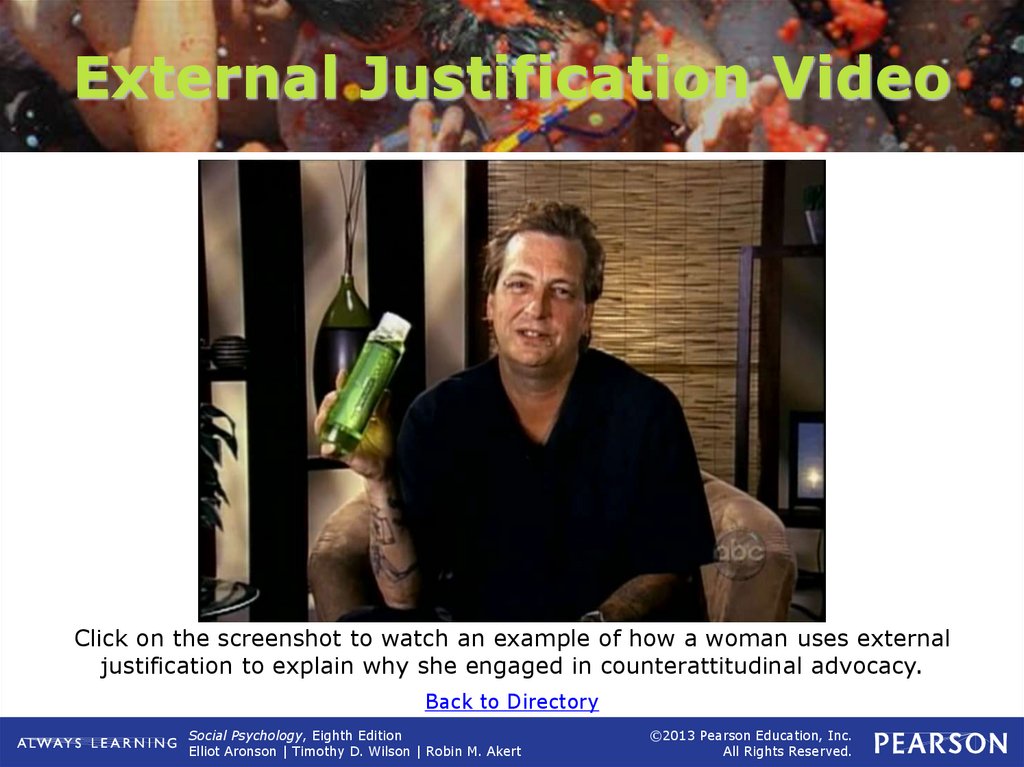
Click on the screenshot to watch an example of how a woman uses externaljustification to explain why she engaged in counterattitudinal advocacy.
Back to Directory
Social Psychology, Eighth Edition
Elliot Aronson | Timothy D. Wilson | Robin M. Akert
©2013 Pearson Education, Inc.
All Rights Reserved.
52. Festinger and Carlsmith (1958)
• Cover story– The effect of “interest instructions” on
performance on a boring task
Social Psychology, Eighth Edition
Elliot Aronson | Timothy D. Wilson | Robin M. Akert
©2013 Pearson Education, Inc.
All Rights Reserved.
53. Festinger and Carlsmith (1958)
• IV = $ for telling a lie– $ 20.00 large external justification
“sufficient”
– $ 1.00, small external justification
“insufficient”
– control no $, no lie
• DV = enjoyment of the task
Social Psychology, Eighth Edition
Elliot Aronson | Timothy D. Wilson | Robin M. Akert
©2013 Pearson Education, Inc.
All Rights Reserved.
54. Festinger and Carlsmith (1958)
• Students paid $20 for lying—for sayingthat the tasks had been enjoyable
– Rated the task as dull and boring
– $20 was sufficient external justification for
lying
• $20 reduced dissonance between positive
view of self (honest person) & behavior
(lying)
– Lied because was paid to do so
Social Psychology, Eighth Edition
Elliot Aronson | Timothy D. Wilson | Robin M. Akert
©2013 Pearson Education, Inc.
All Rights Reserved.
55. Festinger and Carlsmith (1958)
• Students paid only $1 for lying (sayingthe boring task was fun)
– Rated the task as significantly more
enjoyable
– External justification was insufficient
– Reduced dissonance via internal
justification
• Changed attitude about task
• Believed the lie they told
Social Psychology, Eighth Edition
Elliot Aronson | Timothy D. Wilson | Robin M. Akert
©2013 Pearson Education, Inc.
All Rights Reserved.
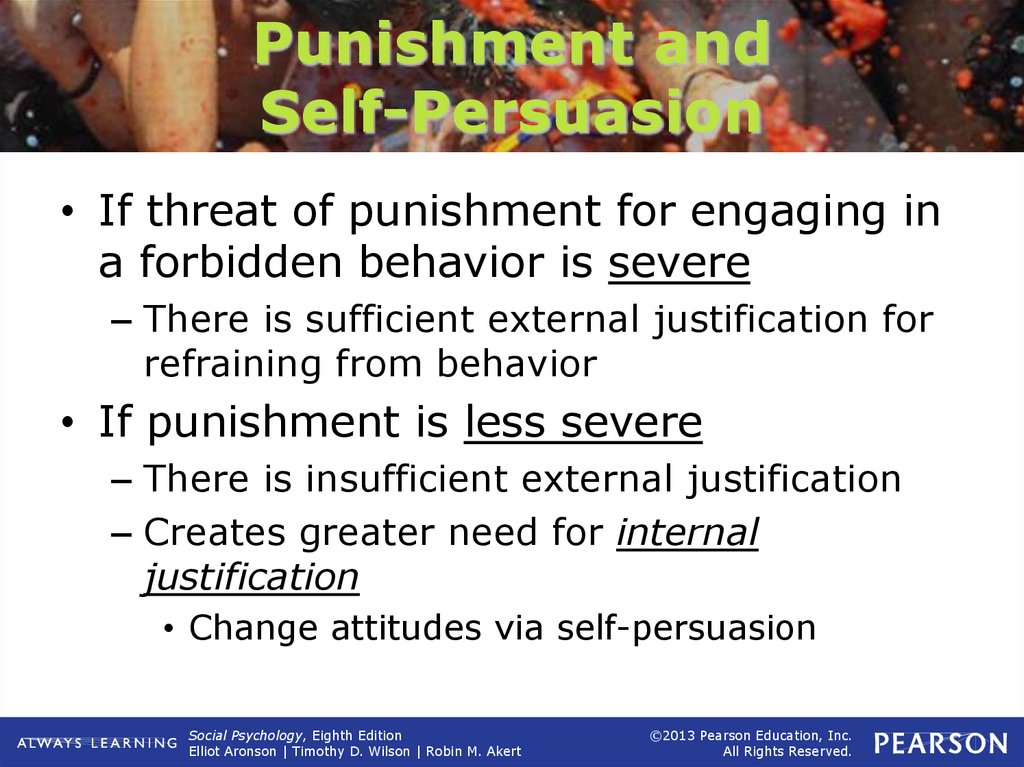
56. Punishment and Self-Persuasion
• If threat of punishment for engaging ina forbidden behavior is severe
– There is sufficient external justification for
refraining from behavior
• If punishment is less severe
– There is insufficient external justification
– Creates greater need for internal
justification
• Change attitudes via self-persuasion
Social Psychology, Eighth Edition
Elliot Aronson | Timothy D. Wilson | Robin M. Akert
©2013 Pearson Education, Inc.
All Rights Reserved.
57. Punishment and Self-Persuasion
• Insufficient Punishment– The dissonance aroused when individuals
lack sufficient external justification for
having resisted a desired activity or object,
usually resulting in individuals’ devaluing
the forbidden activity or object.
.
Social Psychology, Eighth Edition
Elliot Aronson | Timothy D. Wilson | Robin M. Akert
©2013 Pearson Education, Inc.
All Rights Reserved.
58. Punishment and Self-Persuasion
• When external justification for resistingan object or activity is insufficient:
– Dissonance is aroused
– Reduce dissonance by
• Self-persuasion
– E.g., devaluing forbidden activity or object
Social Psychology, Eighth Edition
Elliot Aronson | Timothy D. Wilson | Robin M. Akert
©2013 Pearson Education, Inc.
All Rights Reserved.
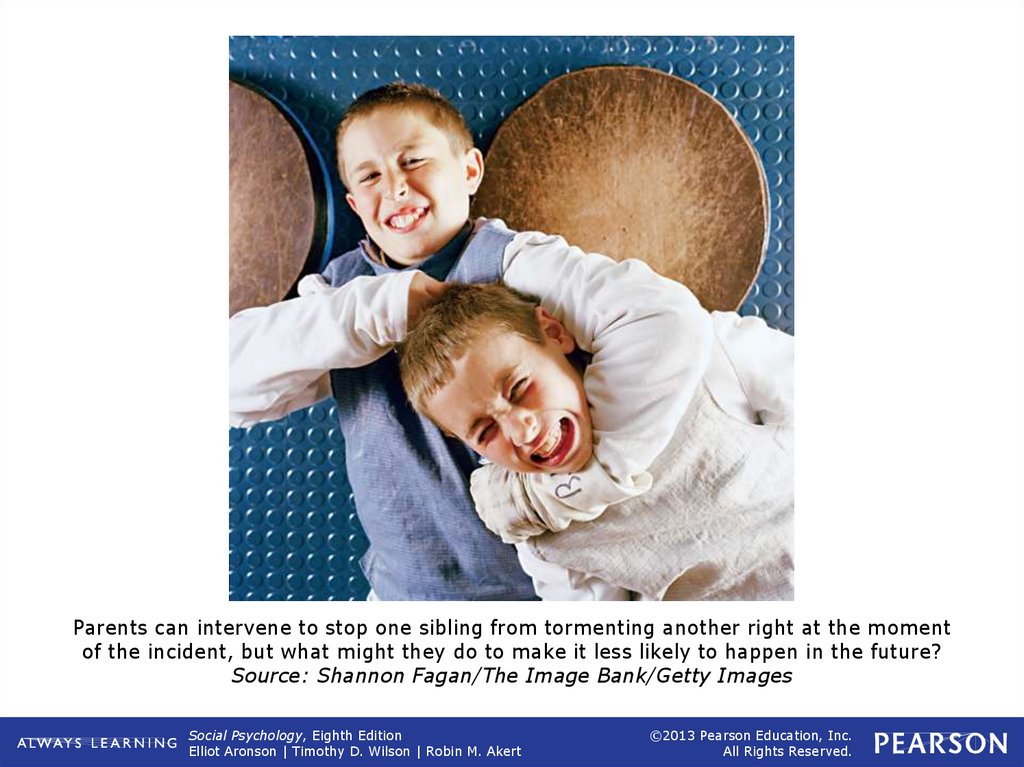
59. Parents can intervene to stop one sibling from tormenting another right at the moment of the incident, but what might they do
to make it less likely to happen in the future?Source: Shannon Fagan/The Image Bank/Getty Images
Social Psychology, Eighth Edition
Elliot Aronson | Timothy D. Wilson | Robin M. Akert
©2013 Pearson Education, Inc.
All Rights Reserved.
60. Forbidden Toy Study (Aronson and Carlsmith 1963)
• Children rated the attractiveness oftoys, then were forbidden to play with
toy they found most attractive
• IV = Severity of threatened punishment
– ½ children threat of mild punishment if
they disobeyed & played with toy
– ½ children threat of severe punishment
• DV = Rating of toy attractiveness
Social Psychology, Eighth Edition
Elliot Aronson | Timothy D. Wilson | Robin M. Akert
©2013 Pearson Education, Inc.
All Rights Reserved.
61. Forbidden Toy Study (Aronson and Carlsmith 1963)
• Threat of severe punishment– Forbidden toy remained highly attractive
• No change in attitude
• Had sufficient external justification for
resisting toy
Social Psychology, Eighth Edition
Elliot Aronson | Timothy D. Wilson | Robin M. Akert
©2013 Pearson Education, Inc.
All Rights Reserved.
62. Forbidden Toy Study (Aronson and Carlsmith 1963)
• Threat of mild punishment– Forbidden toy was rated as less attractive
– External justification was insufficient
– Resolved dissonance through internal
justification
• Change attitude about toy
Social Psychology, Eighth Edition
Elliot Aronson | Timothy D. Wilson | Robin M. Akert
©2013 Pearson Education, Inc.
All Rights Reserved.
63. Figure 6.4 The Forbidden Toy Experiment Children who had received a threat of mild punishment were far less likely to play with
aforbidden toy (orange bar) than children who had received a threat of severe punishment
(blue bar). Those given a mild threat had to provide their own justification by devaluing
the attractiveness of the toy (“I didn’t want to play with it anyhow”). The
resulting self-persuasion lasted for weeks. (Based on data in Freedman, 1965.)
Social Psychology, Eighth Edition
Elliot Aronson | Timothy D. Wilson | Robin M. Akert
©2013 Pearson Education, Inc.
All Rights Reserved.
64. Punishment and Self-Persuasion
• Self-Persuasion– A long-lasting form of attitude change that
results from attempts at self-justification.
Social Psychology, Eighth Edition
Elliot Aronson | Timothy D. Wilson | Robin M. Akert
©2013 Pearson Education, Inc.
All Rights Reserved.
65. Figure 6.5 External versus Internal Justification As this graphic summarizes, insufficient punishment or reward leads to
self-justification,which in turn leads to self-persuasion and lasting change. Larger rewards or punishments
may produce temporary compliance, which rarely lasts.
Social Psychology, Eighth Edition
Elliot Aronson | Timothy D. Wilson | Robin M. Akert
©2013 Pearson Education, Inc.
All Rights Reserved.
66. The Hypocrisy Paradigm
• Induce hypocrisy– Make person aware of conflict between
• Attitudes
• Behavior
– Hypocrisy creates dissonance
– Reduce dissonance by changing behavior
• E.g., attitudes about condoms and use of
condoms
Social Psychology, Eighth Edition
Elliot Aronson | Timothy D. Wilson | Robin M. Akert
©2013 Pearson Education, Inc.
All Rights Reserved.
67. Figure 6.6 The Hypocrisy Paradigm People who are made mindful of their hypocrisy (blue bars)—in this study, being made aware of
the discrepancy between knowing that condoms prevent AIDS and other STDsbut not using condoms themselves—begin to practice what they preach. Here, more of
them bought condoms, buying more condoms than did students in other conditions—
those who were simply given information about the dangers of AIDS, or who promised to
buy them, or who were made aware that they weren’t using them. (Adapted from Stone,
Aronson, Crain, Winslow, & Fried, 1994.)
Social Psychology, Eighth Edition
Elliot Aronson | Timothy D. Wilson | Robin M. Akert
©2013 Pearson Education, Inc.
All Rights Reserved.
68. The Hypocrisy Paradigm
• Students in the hypocrisy conditionwere subsequently more likely to buy
condoms than students in any of the
other conditions.
Social Psychology, Eighth Edition
Elliot Aronson | Timothy D. Wilson | Robin M. Akert
©2013 Pearson Education, Inc.
All Rights Reserved.
69. Justifying Acts of Kindness
• Dissonance theory predicts that whenwe dislike someone, if we do them a
favor, we will like them more
– Behavior is dissonant with attitude
– Change attitude about person to resolve
dissonance
• “The Ben Franklin Effect”
Social Psychology, Eighth Edition
Elliot Aronson | Timothy D. Wilson | Robin M. Akert
©2013 Pearson Education, Inc.
All Rights Reserved.
70. Figure 6.7 The Justification of Kindness If we have done someone a personal favor (blue bar), we are likely to feel more
positively toward that person than if we don’t do the favor (orange bar) or do the favorbecause of an impersonal request (yellow bar). (Based on data in Jecker & Landy, 1969.)
Social Psychology, Eighth Edition
Elliot Aronson | Timothy D. Wilson | Robin M. Akert
©2013 Pearson Education, Inc.
All Rights Reserved.
71. Justifying Cruelty
• Cruel behavior is dissonant with view ofself as a decent human being
– Resolve dissonance by changing thoughts
about victim
• Davis and Jones (1960)
– Participants told a young man
(confederate) they thought he was shallow,
untrustworthy, boring.
Social Psychology, Eighth Edition
Elliot Aronson | Timothy D. Wilson | Robin M. Akert
©2013 Pearson Education, Inc.
All Rights Reserved.
72. Justifying Cruelty
• Participants convinced themselves– They didn't like the victim
– He deserved to be hurt
Social Psychology, Eighth Edition
Elliot Aronson | Timothy D. Wilson | Robin M. Akert
©2013 Pearson Education, Inc.
All Rights Reserved.
73. The American guards at Iraq’s Abu Ghraib prison treated their prisoners with a casual brutality that scandalized the world.
What does dissonance theory predict about theconsequences for the guards of dehumanizing the enemy?
Source: HO/AFP/GETTY IMAGES/Newscom
Social Psychology, Eighth Edition
Elliot Aronson | Timothy D. Wilson | Robin M. Akert
©2013 Pearson Education, Inc.
All Rights Reserved.
74. Dissonance and the Iraq War
• President Bush’s decision to initiate a“preemptive” war against Iraq was
dissonant with:
– The fact that Iraq not involved in 9/11
attack on USA
– Iraq not an immediate threat to USA
Social Psychology, Eighth Edition
Elliot Aronson | Timothy D. Wilson | Robin M. Akert
©2013 Pearson Education, Inc.
All Rights Reserved.
75. Dissonance and the Iraq War
• To resolve dissonance– Search for evidence consonant with
decision to start war
• Try to find WMD (Weapons of Mass
Destruction)
• However, WMD not found
• Dissonance reduction unsuccessful
Social Psychology, Eighth Edition
Elliot Aronson | Timothy D. Wilson | Robin M. Akert
©2013 Pearson Education, Inc.
All Rights Reserved.
76. Dissonance and the Iraq War
• Resolve dissonance by addingcognitions
– Change reason (justification) for war
• Operation “Iraqi Freedom”
– Instead of preemptive strike to protect USA
from WMD
Social Psychology, Eighth Edition
Elliot Aronson | Timothy D. Wilson | Robin M. Akert
©2013 Pearson Education, Inc.
All Rights Reserved.
77. These athletes blew a big lead and lost the game. Will they make excuses, or will they learn from their mistakes? Source: Jose
Carlos Fajardo/MCT/NewscomSocial Psychology, Eighth Edition
Elliot Aronson | Timothy D. Wilson | Robin M. Akert
©2013 Pearson Education, Inc.
All Rights Reserved.
78. Summary and Review
• Cognitive Dissonance– Self-affirmation and self-esteem
– Post-decision dissonance
• Self-Justification
– Justification of Effort
• Insufficient and sufficient external
justification
– Hypocrisy Paradigm
• Dissonance, Kindness, and Cruelty
Social Psychology, Eighth Edition
Elliot Aronson | Timothy D. Wilson | Robin M. Akert
©2013 Pearson Education, Inc.
All Rights Reserved.