




 law
lawSimilar presentations:









Understanding Estoppel in International Law
1. Understanding Estoppel in International Law
Understanding Estoppel in International LawConcept, Legal Basis, and Application
Student Name: Marchuk Leonid Konstantinovich
2. Purpose & Relevance
Purpose & Relevance(Problem Statement): Ensuring stability & predictability in a complex
world requires understanding estoppel.
(Research Purpose): To comprehensively analyze the concept,
application, and influence of estoppel within international law.
(Relevance): Understanding the institute of estoppel is vital for legal
professionals navigating international issues.
3. Research Objectives & Tasks
Research Objectives & Tasks(Tasks):
Examine the historical development of estoppel.
Define estoppel, its legal foundations, and applications.
Analyze its use in public and private international law.
Assess its impact on the Russian legal framework.
My research aims to analyze both the theory and practical application of estoppel in international law,
paying close attention to its impact on the Russian legal system. To achieve this, I’ll be doing several things:
First, I will examine historical development of the institute of estoppel, then I will define the institute of
estoppel, its legal foundations, and applications. Then, I will analyze its use in public and private international
law. Finally, I will assess its impact on the Russian legal framework
4. What is Estoppel?
Imagine you make a promise to someone, and they relyon that promise. Estoppel is a legal principle that says
you can’t then break that promise or deny what you said
if it would be unfair to the other person. It’s about
holding people accountable for their words and actions
and promoting fairness in legal interactions.
5. Historical roots
Estoppel isn’t a new idea. It started with the Romans inthe nemo potest venire contra factum proprium principle.
This means you can’t go against your own actions. The
English further developed the concept and nowadays you
can encounter the application of estoppel in many legal
systems worldwide
6. Key Elements of Estoppel
For estoppel to apply, there are a few key things needed.First, someone has to make a clear statement or take a
specific
action.
Second,
another
party
must reasonably believe that statement or action and act
based on it. Finally, that other party would suffer harm or
damage if the first party was allowed to change their
mind. The key is that the reliance has to be reasonable
and cause real harm
7. Estoppel in International Law
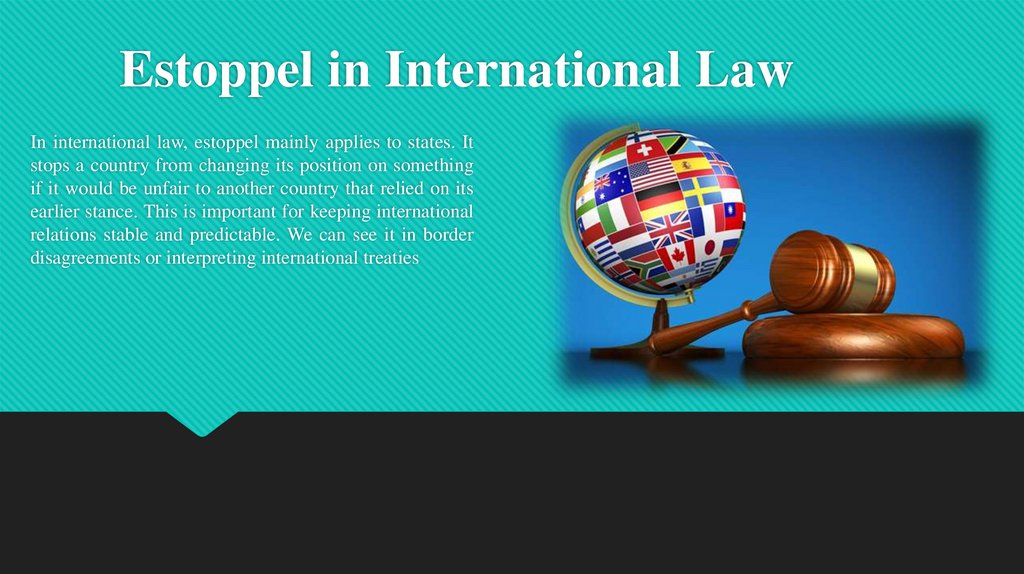
In international law, estoppel mainly applies to states. Itstops a country from changing its position on something
if it would be unfair to another country that relied on its
earlier stance. This is important for keeping international
relations stable and predictable. We can see it in border
disagreements or interpreting international treaties
8. Case
For example, in the Eastern Greenland case, Norway, ineffect, promised Denmark to not encroach on Eastern
Greenland territories. Norway could not go back on their
word, as Denmark based their actions on these
guarantees
9. Estoppel in International Commercial Arbitration
Estoppel in InternationalCommercial Arbitration
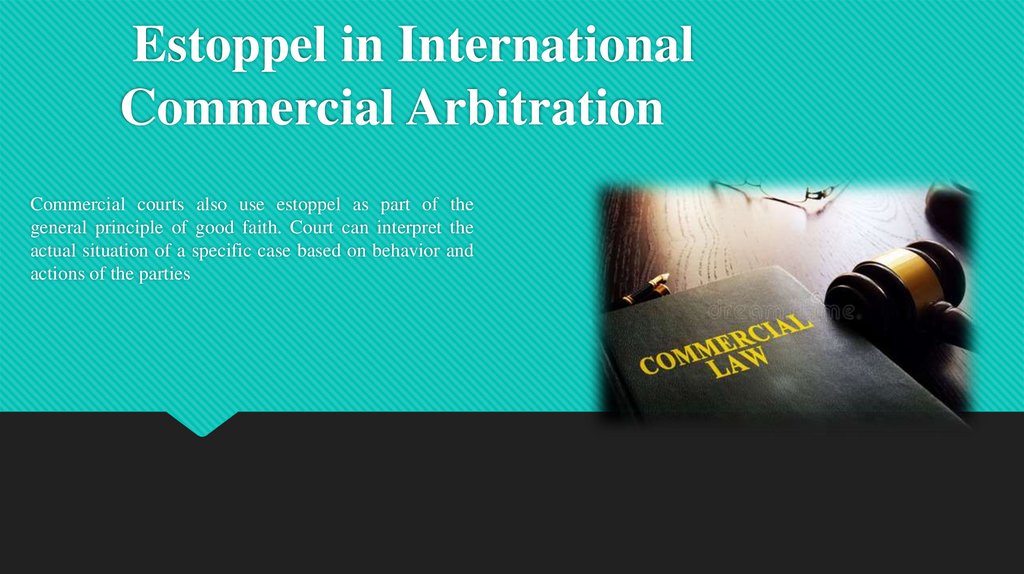
Commercial courts also use estoppel as part of the
general principle of good faith. Court can interpret the
actual situation of a specific case based on behavior and
actions of the parties
10. Conclusion
In conclusion, estoppel is a very important concept thatis a vital principle of fairness in international law. It
helps for responsible behaviour and actions of states and
persons. Thanks for your attention!