 english
Similar presentations:



Trial Lesson
1.
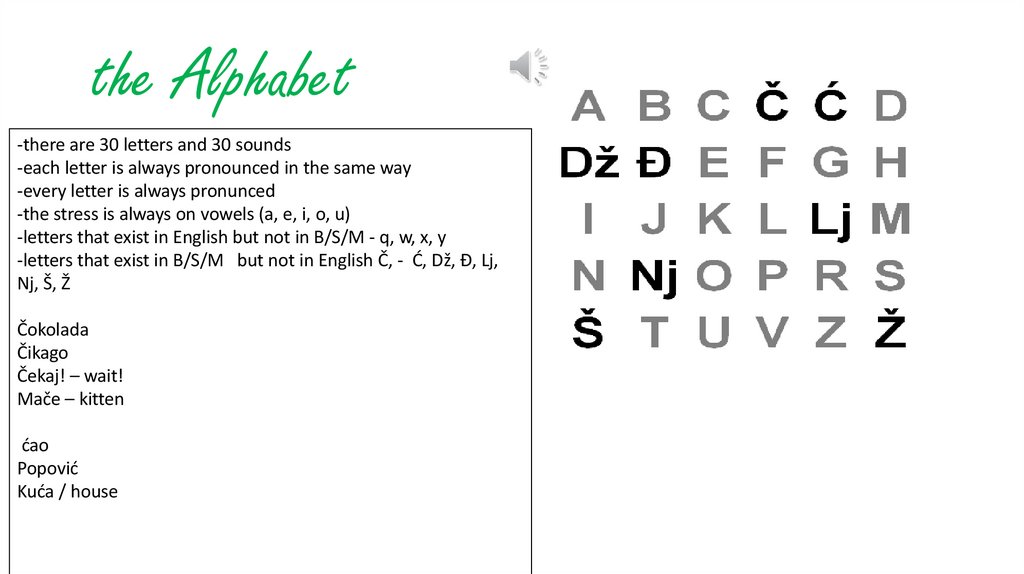
the Alphabet-there are 30 letters and 30 sounds
-each letter is always pronounced in the same way
-every letter is always pronunced
-the stress is always on vowels (a, e, i, o, u)
-letters that exist in English but not in B/S/M - q, w, x, y
-letters that exist in B/S/M but not in English Č, - Ć, Dž, Đ, Lj,
Nj, Š, Ž
Čokolada
Čikago
Čekaj! – wait!
Mače – kitten
ćao
Popović
Kuća / house
2.
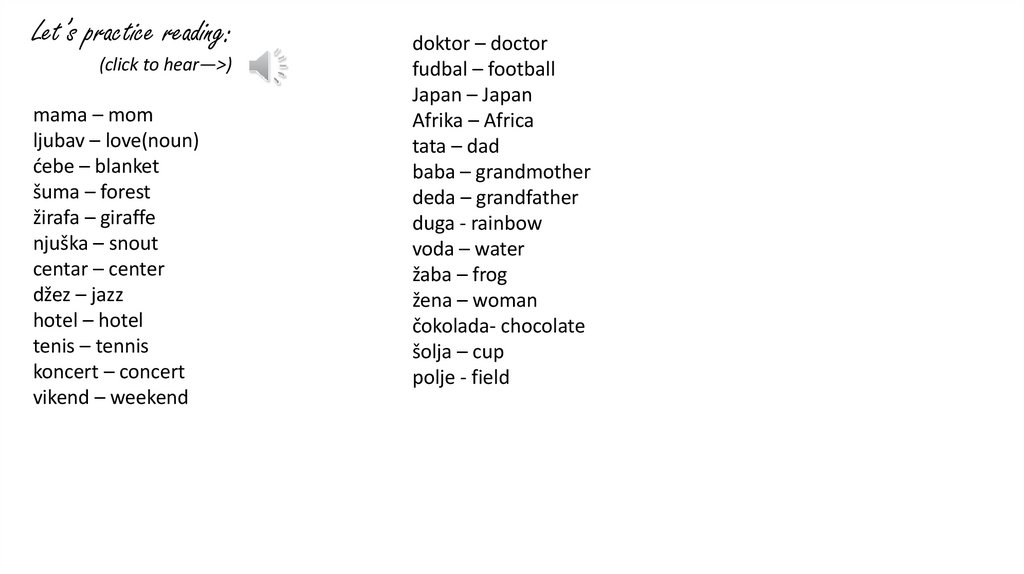
Let’s practice reading:(click to hear—>)
mama – mom
ljubav – love(noun)
ćebe – blanket
šuma – forest
žirafa – giraffe
njuška – snout
centar – center
džez – jazz
hotel – hotel
tenis – tennis
koncert – concert
vikend – weekend
doktor – doctor
fudbal – football
Japan – Japan
Afrika – Africa
tata – dad
baba – grandmother
deda – grandfather
duga - rainbow
voda – water
žaba – frog
žena – woman
čokolada- chocolate
šolja – cup
polje - field
3. Personal pronouns
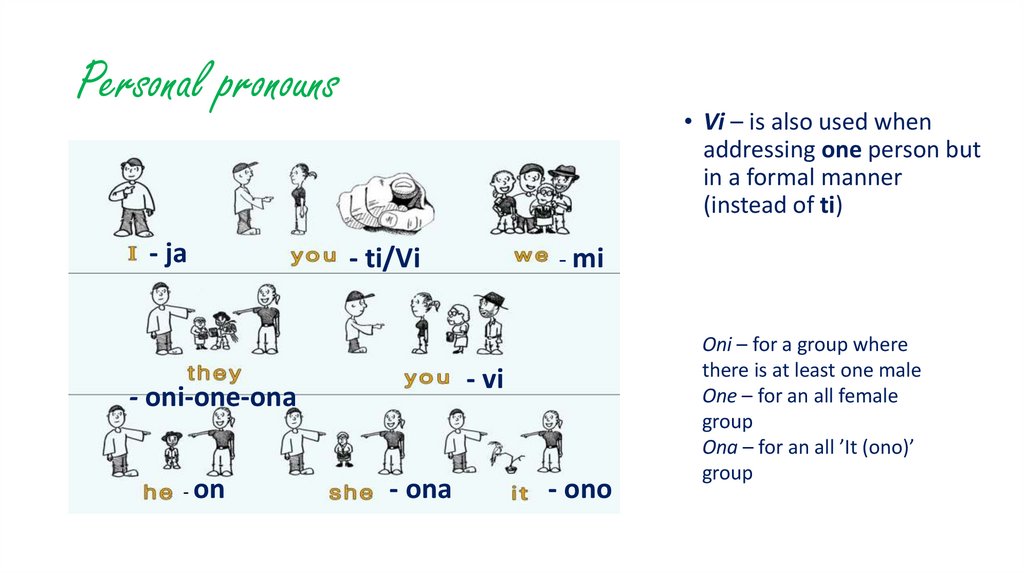
- ja• Vi – is also used when
addressing one person but
in a formal manner
(instead of ti)
- ti/Vi
- vi
- oni-one-ona
- on
- mi
- ona
- ono
Oni – for a group where
there is at least one male
One – for an all female
group
Ona – for an all ’It (ono)’
group
4.
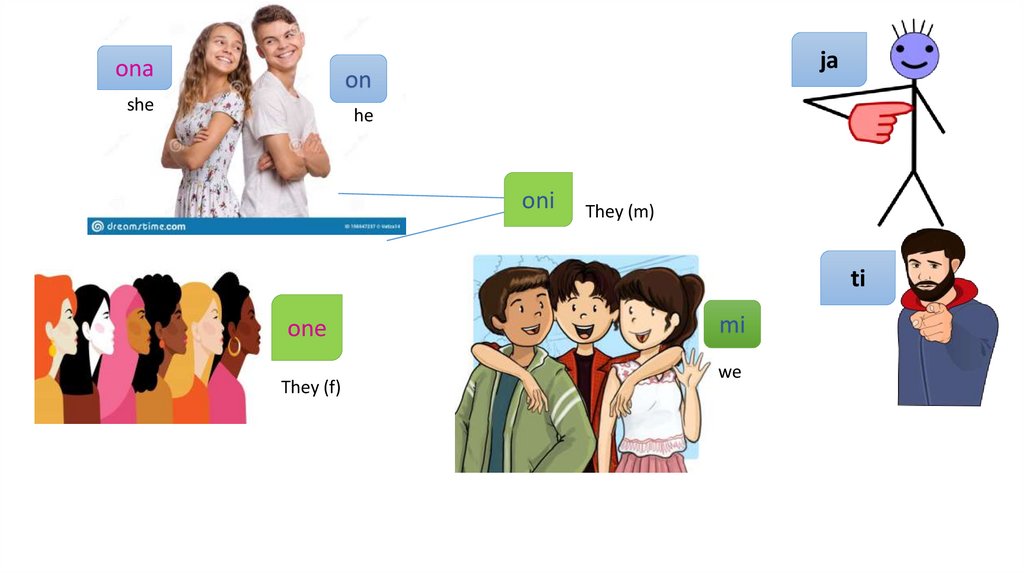
onaja
on
she
he
oni
They (m)
ti
one
They (f)
mi
we
5.
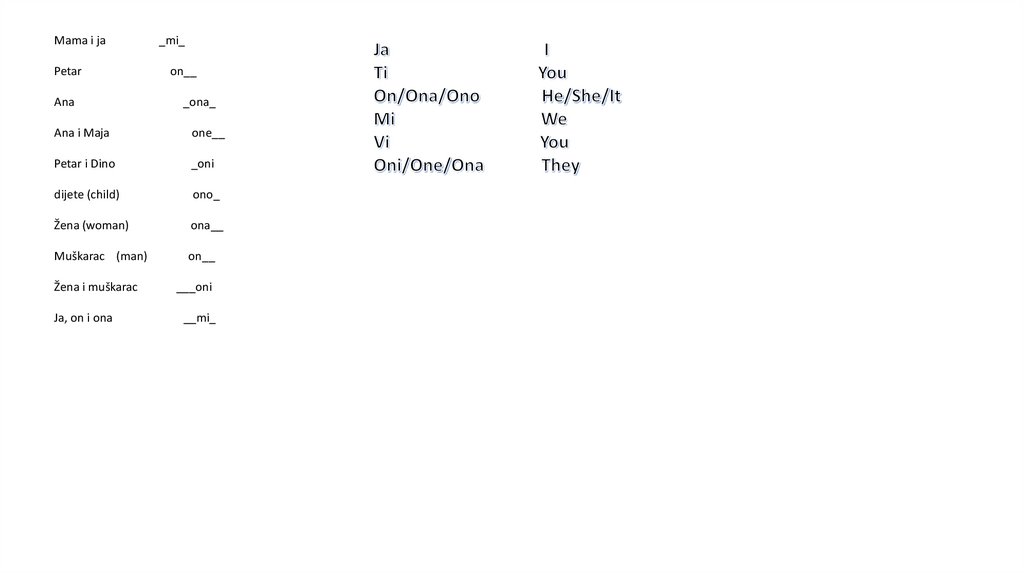
Mama i jaPetar
_mi_
on__
Ana
_ona_
Ana i Maja
one__
Petar i Dino
_oni
dijete (child)
ono_
Žena (woman)
ona__
Muškarac (man)
on__
Žena i muškarac
___oni
Ja, on i ona
__mi_
6.
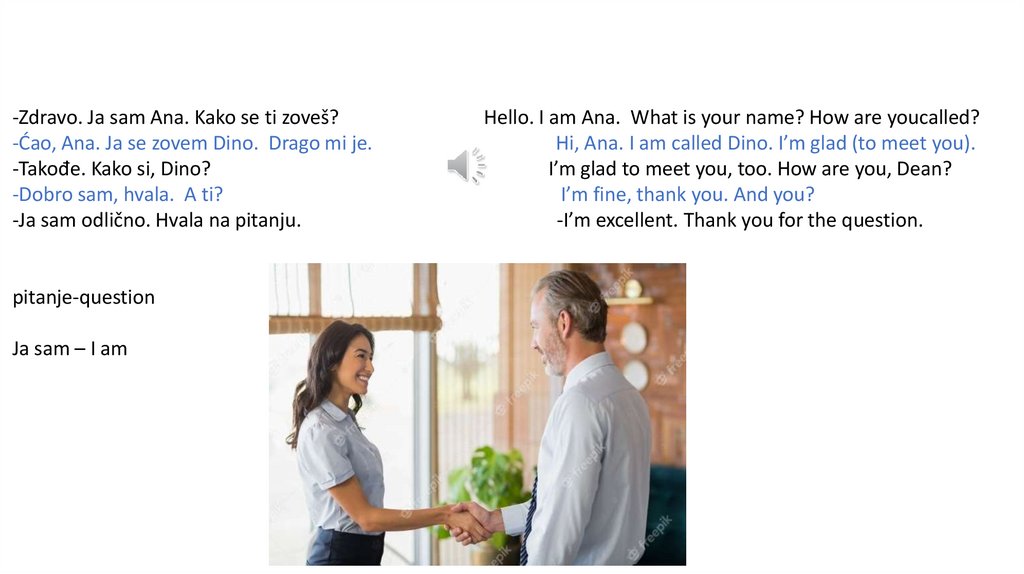
-Zdravo. Ja sam Ana. Kako se ti zoveš?-Ćao, Ana. Ja se zovem Dino. Drago mi je.
-Takođe. Kako si, Dino?
-Dobro sam, hvala. A ti?
-Ja sam odlično. Hvala na pitanju.
pitanje-question
Ja sam – I am
Hello. I am Ana. What is your name? How are youcalled?
Hi, Ana. I am called Dino. I’m glad (to meet you).
I’m glad to meet you, too. How are you, Dean?
I’m fine, thank you. And you?
-I’m excellent. Thank you for the question.
7.
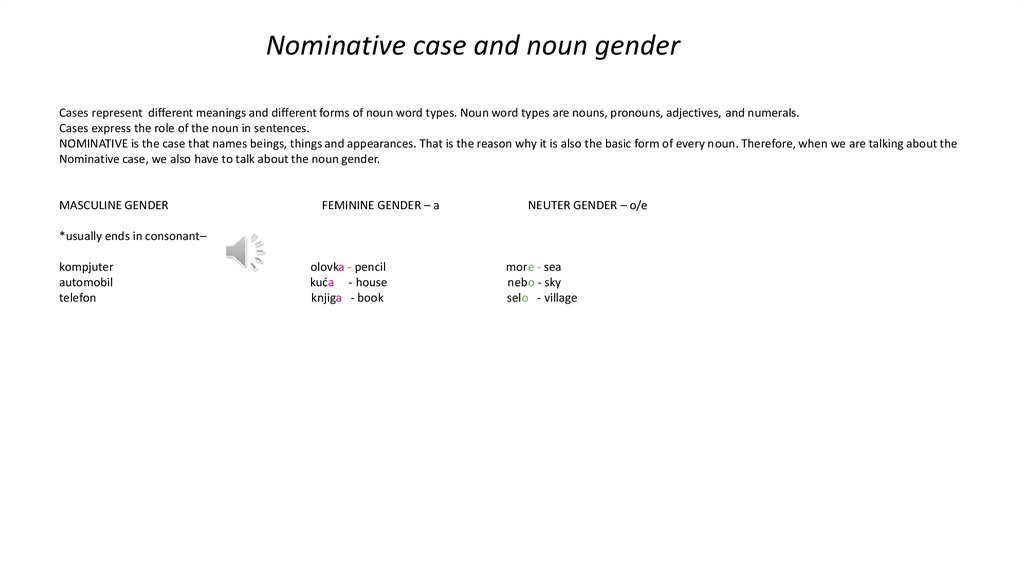
Nominative case and noun genderCases represent different meanings and different forms of noun word types. Noun word types are nouns, pronouns, adjectives, and numerals.
Cases express the role of the noun in sentences.
NOMINATIVE is the case that names beings, things and appearances. That is the reason why it is also the basic form of every noun. Therefore, when we are talking about the
Nominative case, we also have to talk about the noun gender.
MASCULINE GENDER
FEMININE GENDER – a
NEUTER GENDER – o/e
*usually ends in consonant–
kompjuter
automobil
telefon
olovka - pencil
kuća - house
knjiga - book
more - sea
nebo - sky
selo - village
8.
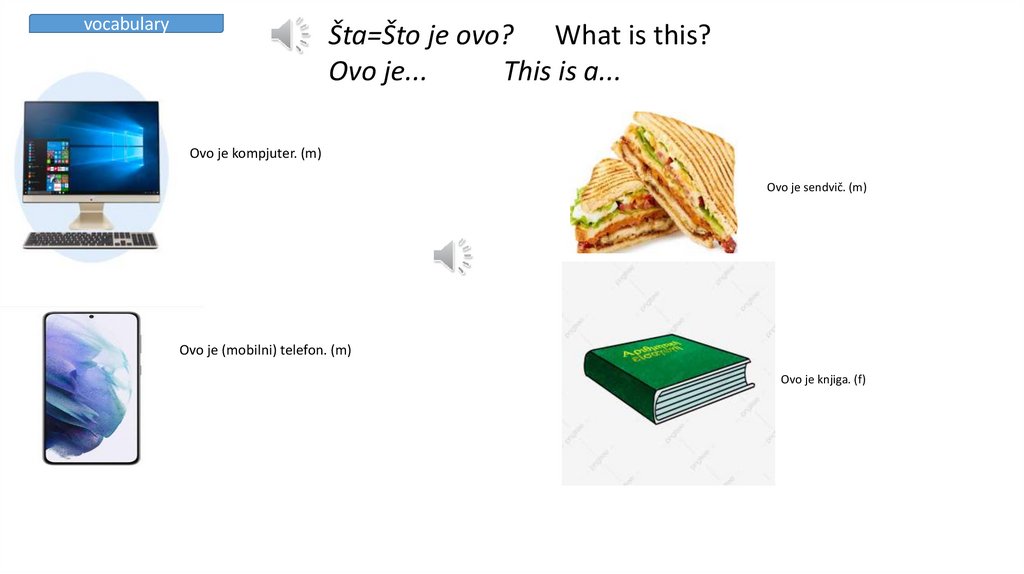
vocabularyŠta=Što je ovo? What is this?
Ovo je...
This is a...
Ovo je kompjuter. (m)
Ovo je sendvič. (m)
Ovo je (mobilni) telefon. (m)
Ovo je knjiga. (f)
9.
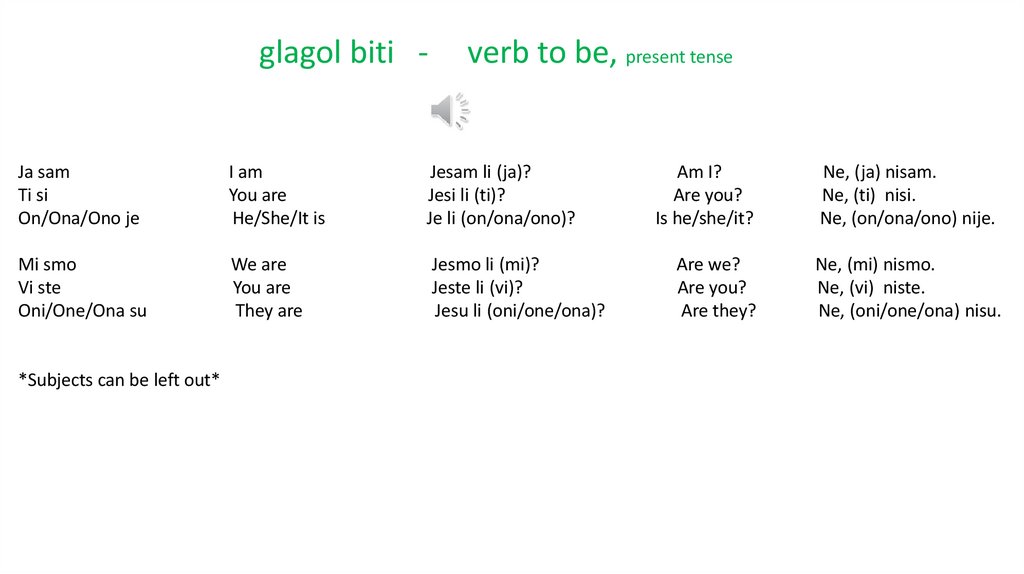
glagol biti -verb to be, present tense
Ja sam
Ti si
On/Ona/Ono je
I am
You are
He/She/It is
Jesam li (ja)?
Jesi li (ti)?
Je li (on/ona/ono)?
Mi smo
Vi ste
Oni/One/Ona su
We are
You are
They are
Jesmo li (mi)?
Jeste li (vi)?
Jesu li (oni/one/ona)?
*Subjects can be left out*
Am I?
Are you?
Is he/she/it?
Ne, (ja) nisam.
Ne, (ti) nisi.
Ne, (on/ona/ono) nije.
Are we?
Are you?
Are they?
Ne, (mi) nismo.
Ne, (vi) niste.
Ne, (oni/one/ona) nisu.
10.
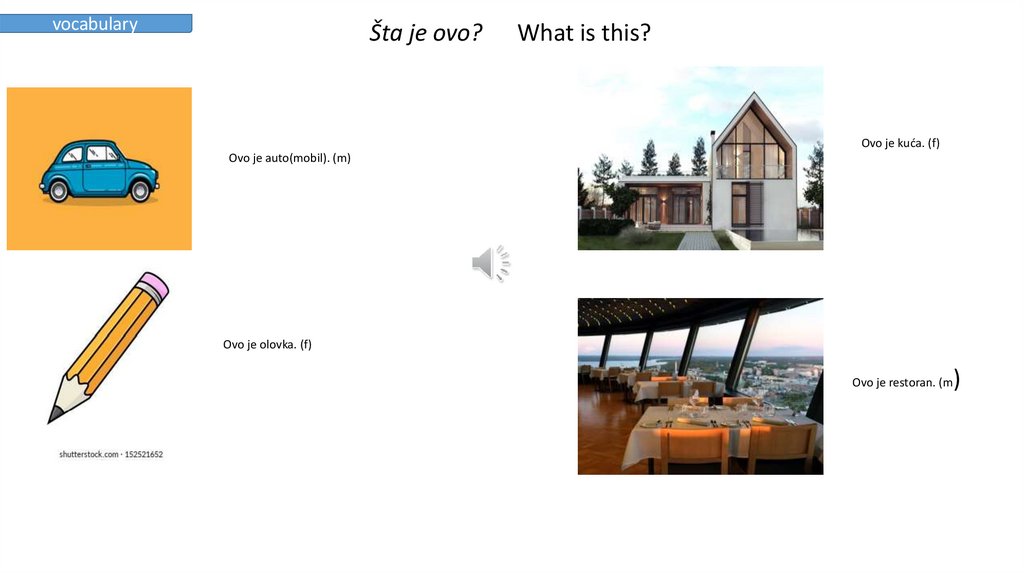
vocabularyŠta je ovo?
What is this?
Ovo je kuća. (f)
Ovo je auto(mobil). (m)
Ovo je olovka. (f)
Ovo je restoran. (m
)
11.
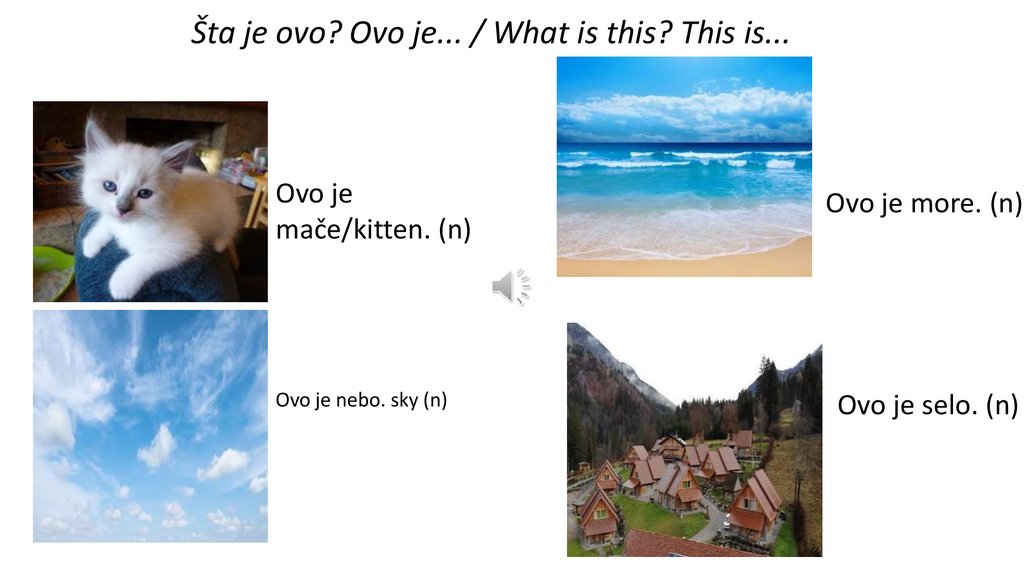
Šta je ovo? Ovo je... / What is this? This is...Ovo je
mače/kitten. (n)
Ovo je more. (n)
Ovo je nebo. sky (n)
Ovo je selo. (n)
12.
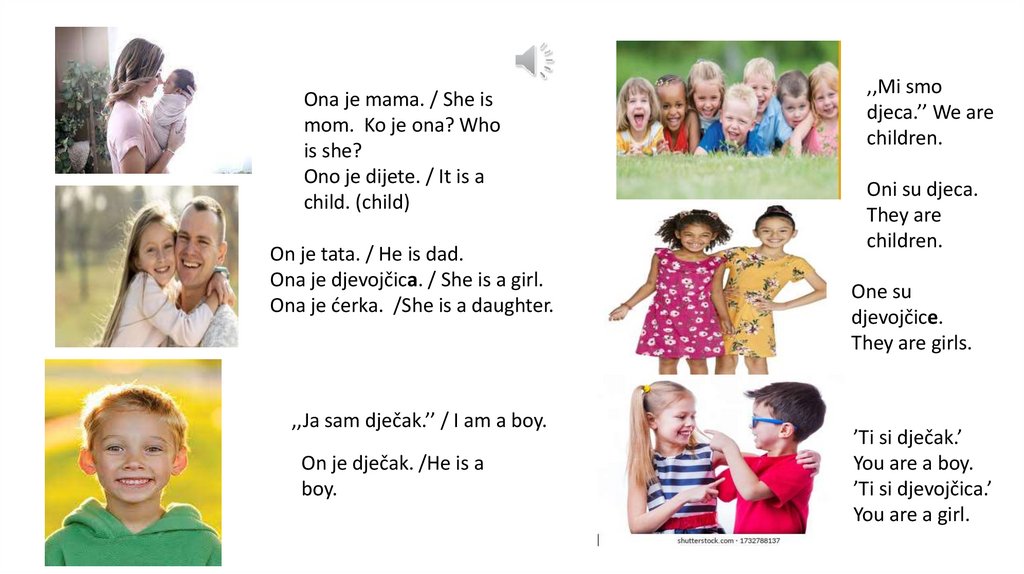
Ona je mama. / She ismom. Ko je ona? Who
is she?
Ono je dijete. / It is a
child. (child)
On je tata. / He is dad.
Ona je djevojčica. / She is a girl.
Ona je ćerka. /She is a daughter.
,,Ja sam dječak.’’ / I am a boy.
On je dječak. /He is a
boy.
,,Mi smo
djeca.’’ We are
children.
Oni su djeca.
They are
children.
One su
djevojčice.
They are girls.
’Ti si dječak.’
You are a boy.
’Ti si djevojčica.’
You are a girl.
13.
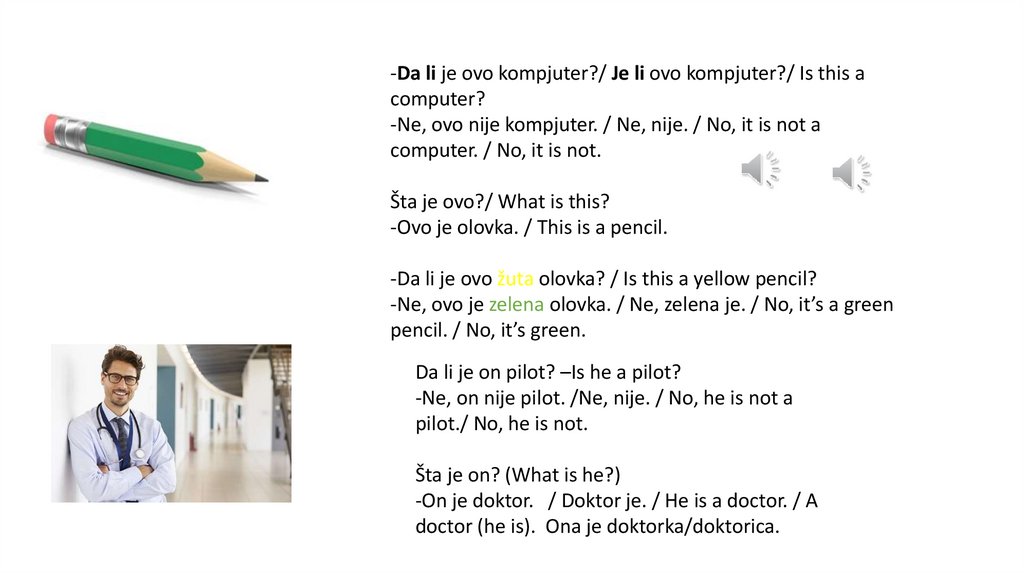
-Da li je ovo kompjuter?/ Je li ovo kompjuter?/ Is this acomputer?
-Ne, ovo nije kompjuter. / Ne, nije. / No, it is not a
computer. / No, it is not.
Šta je ovo?/ What is this?
-Ovo je olovka. / This is a pencil.
-Da li je ovo žuta olovka? / Is this a yellow pencil?
-Ne, ovo je zelena olovka. / Ne, zelena je. / No, it’s a green
pencil. / No, it’s green.
Da li je on pilot? –Is he a pilot?
-Ne, on nije pilot. /Ne, nije. / No, he is not a
pilot./ No, he is not.
Šta je on? (What is he?)
-On je doktor. / Doktor je. / He is a doctor. / A
doctor (he is). Ona je doktorka/doktorica.
14.
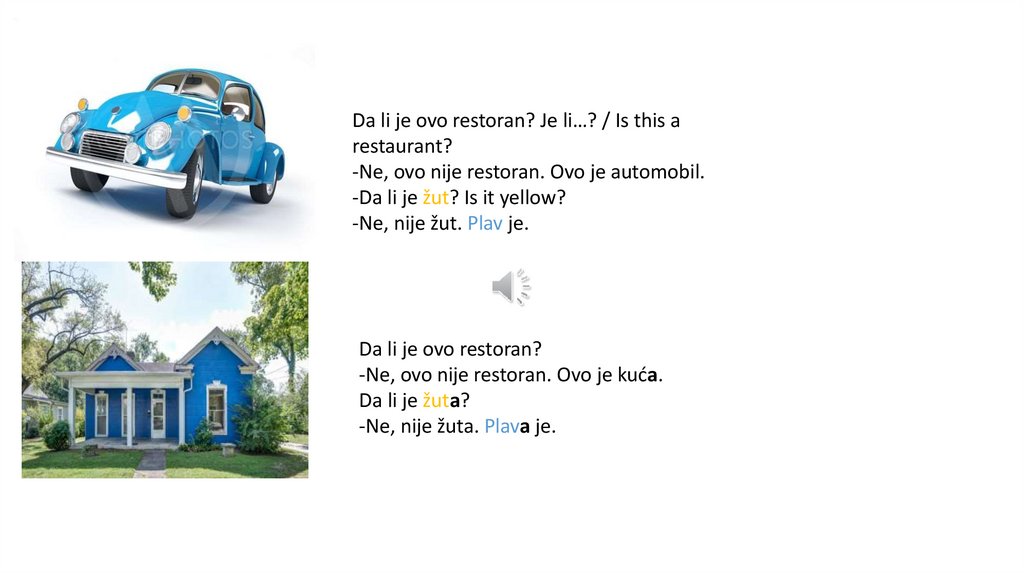
Da li je ovo restoran? Je li…? / Is this arestaurant?
-Ne, ovo nije restoran. Ovo je automobil.
-Da li je žut? Is it yellow?
-Ne, nije žut. Plav je.
Da li je ovo restoran?
-Ne, ovo nije restoran. Ovo je kuća.
Da li je žuta?
-Ne, nije žuta. Plava je.