 programming
Similar presentations:




The future of information systems and programming
1. The future of information systems and programming
ГОСУДАРСТВЕННОЕ АВТОНОМНОЕ ПРОФЕССИОНАЛЬНОЕ ОБРАЗОВАТЕЛЬНОЕУЧРЕЖДЕНИЕ СВЕРДЛОВСКОЙ ОБЛАСТИ
«СЛОБОДО-ТУРИНСКИЙ АГРАРНО-ЭКОНОМИЧЕСКИЙ ТЕХНИКУМ
ИМЕНИ А.Ю. БОРОВИКОВА»
THE FUTURE OF INFORMATION SYSTEMS
AND PROGRAMMING
Выполнил: Яровиков Алексей
1 курс
Группа: 124 ИС
Преподаватель:
Берсенева Виктория Владимировна
2. Purpose: to study the impact of information systems and programming on the FUTURE of humanity
PURPOSE: TO STUDY THE IMPACT OF INFORMATION SYSTEMSAND PROGRAMMING ON THE FUTURE OF HUMANITY
TASKS:
To study information about the world and society before embracing IT technologies of
humanity's industries from our days
To explore the development of information systems and programming technologies
To predict the further development and impact of information systems on the human
future
3. Introduction
INTRODUCTIONRelevance of the topic:
We live in the digital age. And if you want to find yourself in the future, learn programming
now. And even if you don't choose a career as a programmer, you will develop logic, learn to
think analytically and find solutions to difficult tasks.
Information technology has become the foundation of modern life, and the profession of a
programmer is one of the most sought-after. IT technologies are penetrating into all spheres
of life, creating new opportunities and causing changes in existing processes. Studying the
impact of programming technologies on the world is an urgent task today, because it allows
us to understand how these changes affect us and our environment.
4. What are Information Systems and programming?
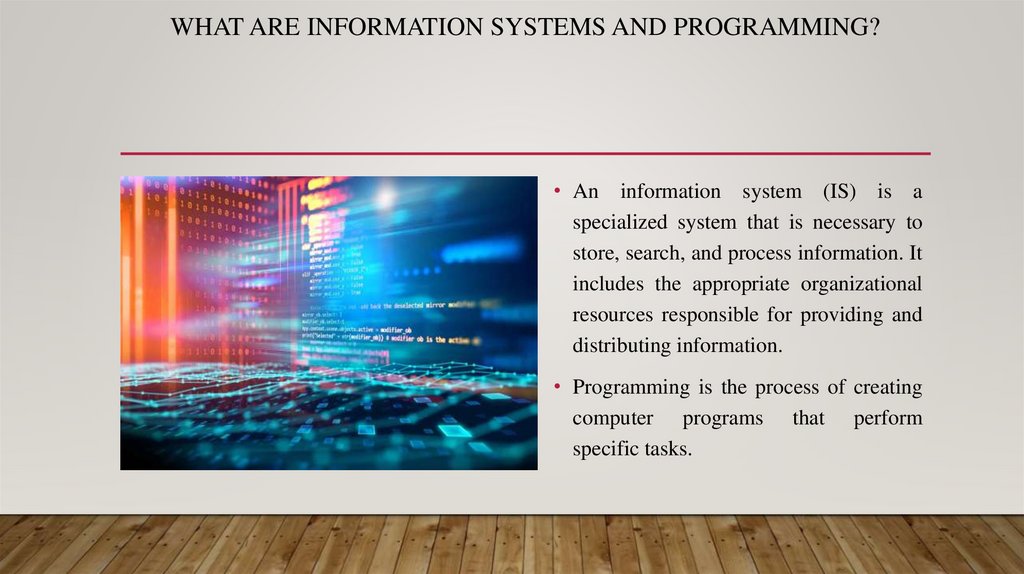
WHAT ARE INFORMATION SYSTEMS AND PROGRAMMING?• An information system (IS) is a
specialized system that is necessary to
store, search, and process information. It
includes the appropriate organizational
resources responsible for providing and
distributing information.
• Programming is the process of creating
computer programs that perform
specific tasks.
5. The world and society before the introduction of IT technologies
THE WORLD AND SOCIETY BEFORE THE INTRODUCTION OF ITTECHNOLOGIES
Before the introduction of information systems and programming, society and the world
went through several information revolutions:
The first information revolution was associated with the advent of writing. It gave people
the opportunity to accumulate and spread knowledge.
The second information revolution (the middle of the 16th century) was associated with
printing. It became possible to make information massively accessible, and not just save
it. Literacy has become a phenomenon that has engulfed the broad masses of the people.
The third information revolution (the end of the 19th century) was caused by the great
progress of communications. The telegraph, telephone, and radio made it possible to
quickly transmit information over long distances.
6. The world and society before the introduction of IT technologies
THE WORLD AND SOCIETY BEFORE THE INTRODUCTION OF ITTECHNOLOGIES
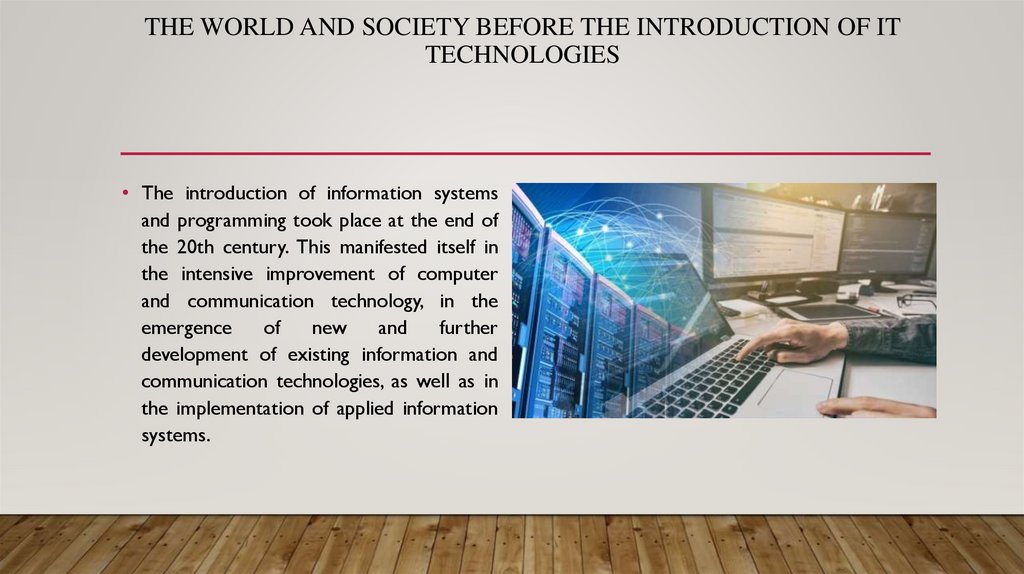
• The introduction of information systems
and programming took place at the end of
the 20th century. This manifested itself in
the intensive improvement of computer
and communication technology, in the
emergence
of
new
and
further
development of existing information and
communication technologies, as well as in
the implementation of applied information
systems.
7. The development of information systems can be considered through several stages:
THE DEVELOPMENT OF INFORMATION SYSTEMS CAN BECONSIDERED THROUGH SEVERAL STAGES:
• "Manual" information technology (until the second half of the 19th century). Tools: pen, inkwell, ledger. The
form of information transmission is mail.
• "Mechanical" information technology (since the end of the 19th century). Tools: typewriter, telephone,
phonograph. Information is transmitted using advanced postal communication, and a search is underway for
convenient means of presenting and transmitting information.
• The third stage in the development of information technology (since the late 1940s) began with the creation of
the first computers. During this period, the development of automated information technologies began, using
magnetic and optical media, silicon.
• The sixth stage of the evolution of information technology (since the advent of the microprocessor and personal
computer). The main criterion for the functioning of information technologies was their use for the
formalization of knowledge and implementation in all spheres of human activity.
8. The development of programming technologies can be viewed in a historical context:
THE DEVELOPMENT OF PROGRAMMING TECHNOLOGIES CAN BEVIEWED IN A HISTORICAL CONTEXT:
«Spontaneous» programming (from the advent of the first
computing machines until the mid-1960s). During this period, there
were practically no formulated technologies, and programming was
essentially an art.
In the 1980s–1990s, a qualitative leap in software development
technologies occurred: the focus of technological solutions shifted
to creating tools for user interaction with computers during the
development of software products. An important place in IT was
taken by knowledge representation and processing, leading to the
creation of knowledge bases and expert systems.
At the current stage, development environments and visual
programming systems for creating programs in high-level
languages are being developed: Turbo Pascal, Delphi, Visual Basic,
C++ Builder, and so on.
9. Some predictions for the further development of information systems and their impact on the future of humanity:
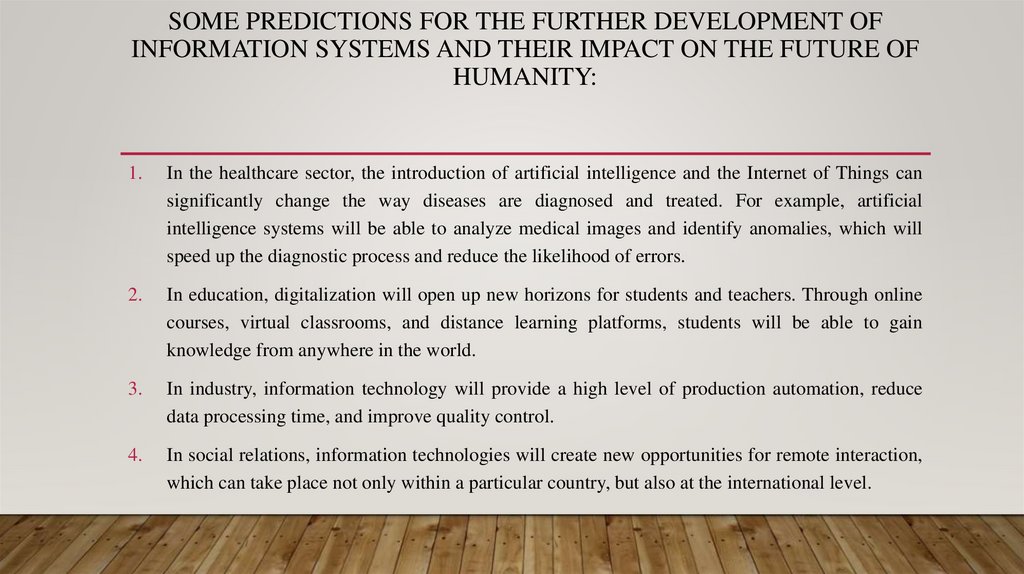
SOME PREDICTIONS FOR THE FURTHER DEVELOPMENT OFINFORMATION SYSTEMS AND THEIR IMPACT ON THE FUTURE OF
HUMANITY:
1.
In the healthcare sector, the introduction of artificial intelligence and the Internet of Things can
significantly change the way diseases are diagnosed and treated. For example, artificial
intelligence systems will be able to analyze medical images and identify anomalies, which will
speed up the diagnostic process and reduce the likelihood of errors.
2.
In education, digitalization will open up new horizons for students and teachers. Through online
courses, virtual classrooms, and distance learning platforms, students will be able to gain
knowledge from anywhere in the world.
3.
In industry, information technology will provide a high level of production automation, reduce
data processing time, and improve quality control.
4.
In social relations, information technologies will create new opportunities for remote interaction,
which can take place not only within a particular country, but also at the international level.
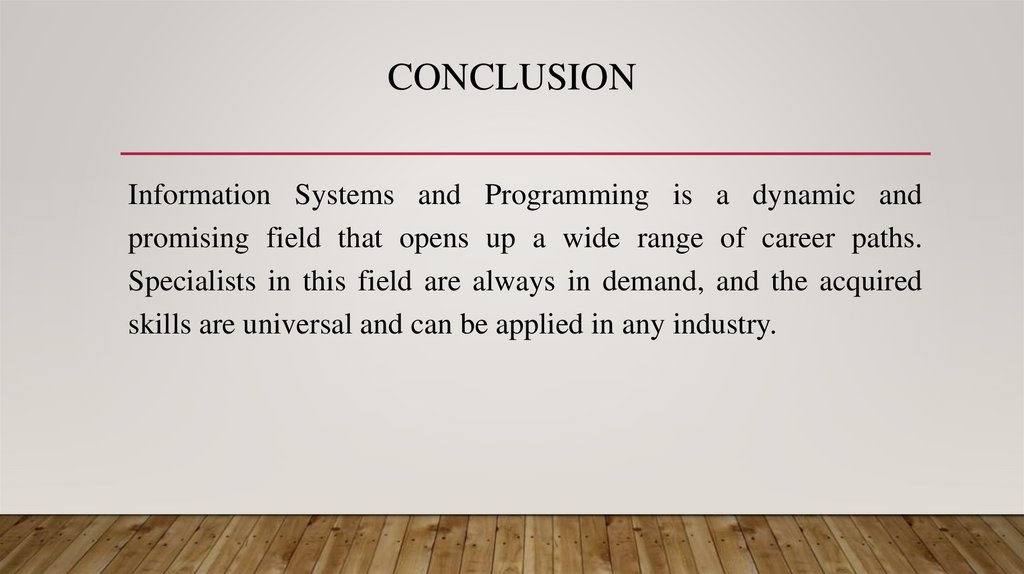
10. Conclusion
CONCLUSIONInformation Systems and Programming is a dynamic and
promising field that opens up a wide range of career paths.
Specialists in this field are always in demand, and the acquired
skills are universal and can be applied in any industry.
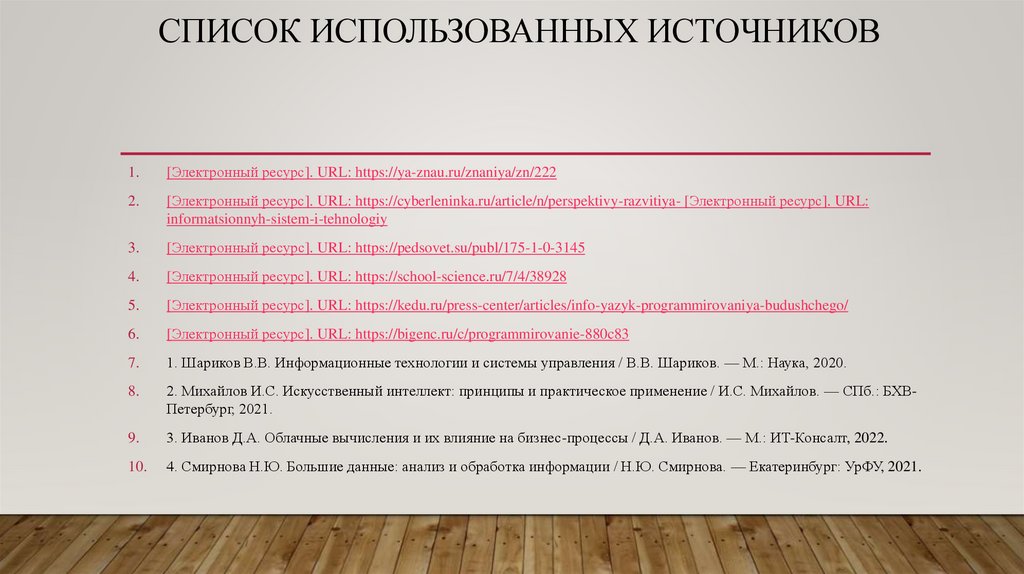
11. Список использованных источников
СПИСОК ИСПОЛЬЗОВАННЫХ ИСТОЧНИКОВ1.
[Электронный ресурс]. URL: https://ya-znau.ru/znaniya/zn/222
2.
[Электронный ресурс]. URL: https://cyberleninka.ru/article/n/perspektivy-razvitiya- [Электронный ресурс]. URL:
informatsionnyh-sistem-i-tehnologiy
3.
[Электронный ресурс]. URL: https://pedsovet.su/publ/175-1-0-3145
4.
[Электронный ресурс]. URL: https://school-science.ru/7/4/38928
5.
[Электронный ресурс]. URL: https://kedu.ru/press-center/articles/info-yazyk-programmirovaniya-budushchego/
6.
[Электронный ресурс]. URL: https://bigenc.ru/c/programmirovanie-880c83
7.
1. Шариков В.В. Информационные технологии и системы управления / В.В. Шариков. — М.: Наука, 2020.
8.
2. Михайлов И.С. Искусственный интеллект: принципы и практическое применение / И.С. Михайлов. — СПб.: БХВПетербург, 2021.
9.
3. Иванов Д.А. Облачные вычисления и их влияние на бизнес-процессы / Д.А. Иванов. — М.: ИТ-Консалт, 2022.
10.
4. Смирнова Н.Ю. Большие данные: анализ и обработка информации / Н.Ю. Смирнова. — Екатеринбург: УрФУ, 2021.