
 english
Similar presentations:





Прямая и косвенная речь
1.
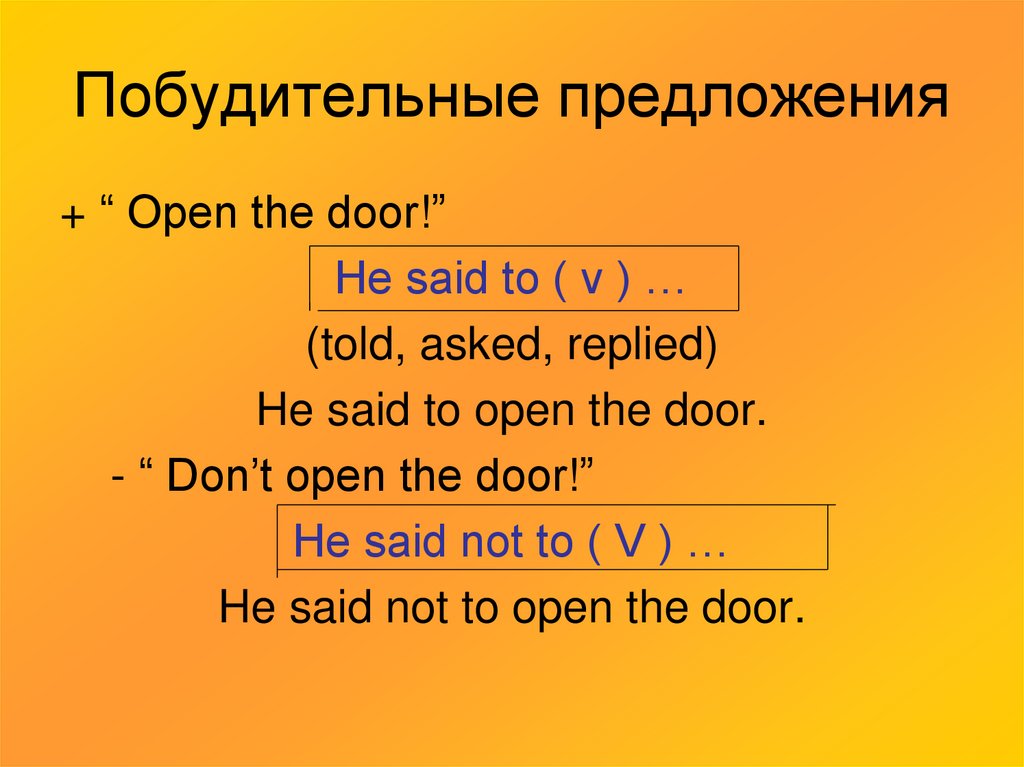
2. Побудительные предложения
+ “ Open the door!”He said to ( v ) …
(told, asked, replied)
He said to open the door.
- “ Don’t open the door!”
He said not to ( V ) …
He said not to open the door.
3.
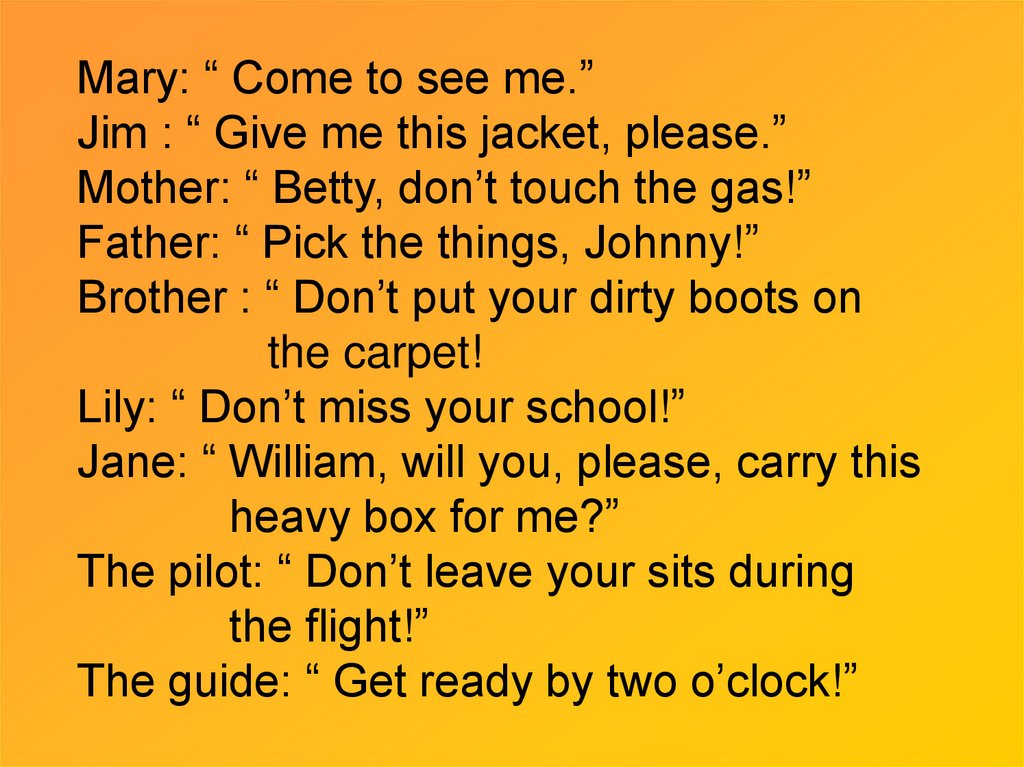
Mary: “ Come to see me.”Jim : “ Give me this jacket, please.”
Mother: “ Betty, don’t touch the gas!”
Father: “ Pick the things, Johnny!”
Brother : “ Don’t put your dirty boots on
the carpet!
Lily: “ Don’t miss your school!”
Jane: “ William, will you, please, carry this
heavy box for me?”
The pilot: “ Don’t leave your sits during
the flight!”
The guide: “ Get ready by two o’clock!”
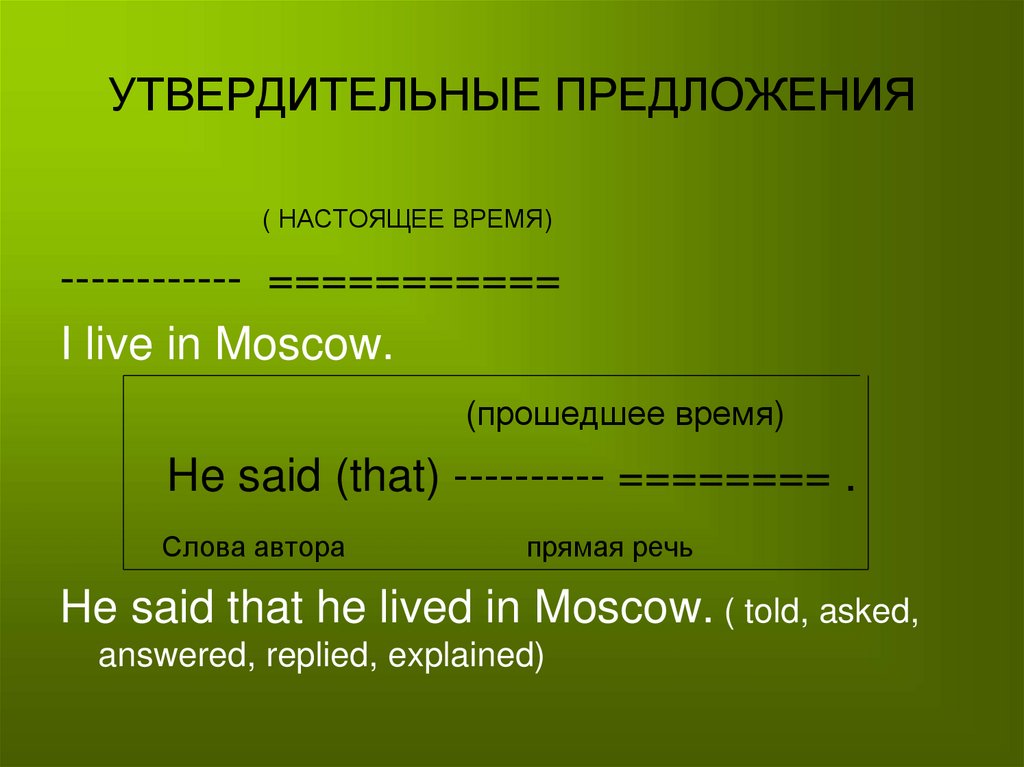
4. УТВЕРДИТЕЛЬНЫЕ ПРЕДЛОЖЕНИЯ
( НАСТОЯЩЕЕ ВРЕМЯ)------------ ===========
I live in Moscow.
(прошедшее время)
He said (that) ---------- ======== .
Слова автора
прямая речь
He said that he lived in Moscow. ( told, asked,
answered, replied, explained)
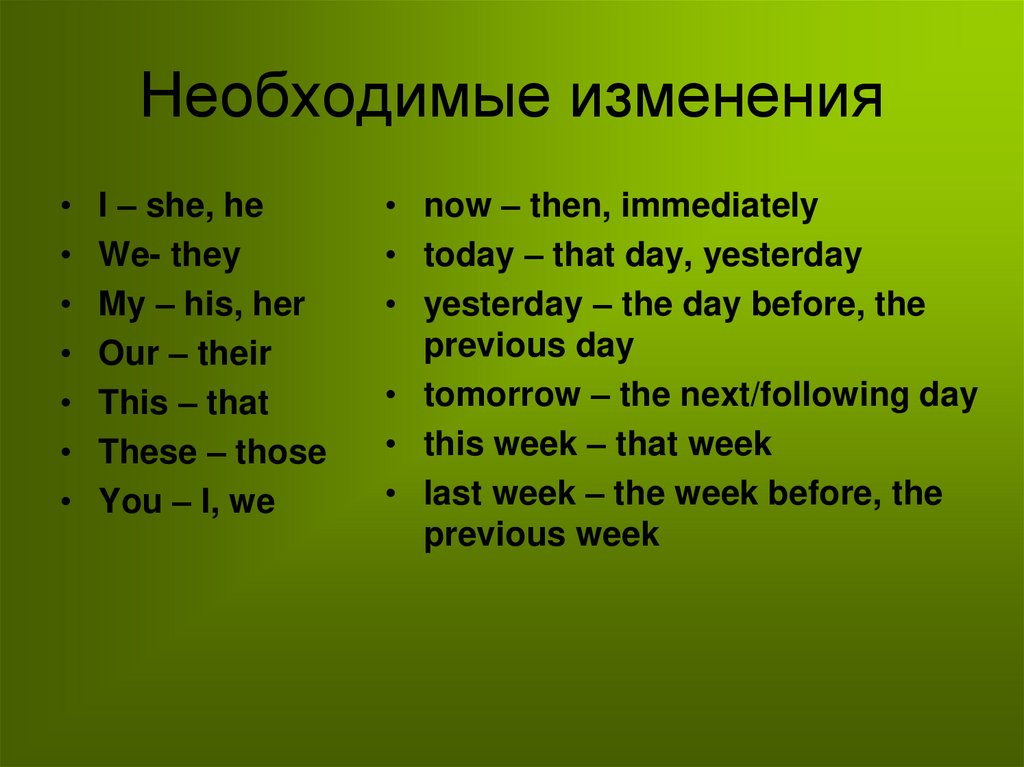
5. Необходимые изменения
I – she, he
We- they
My – his, her
Our – their
This – that
These – those
You – I, we
• now – then, immediately
• today – that day, yesterday
• yesterday – the day before, the
previous day
• tomorrow – the next/following day
• this week – that week
• last week – the week before, the
previous week
6.
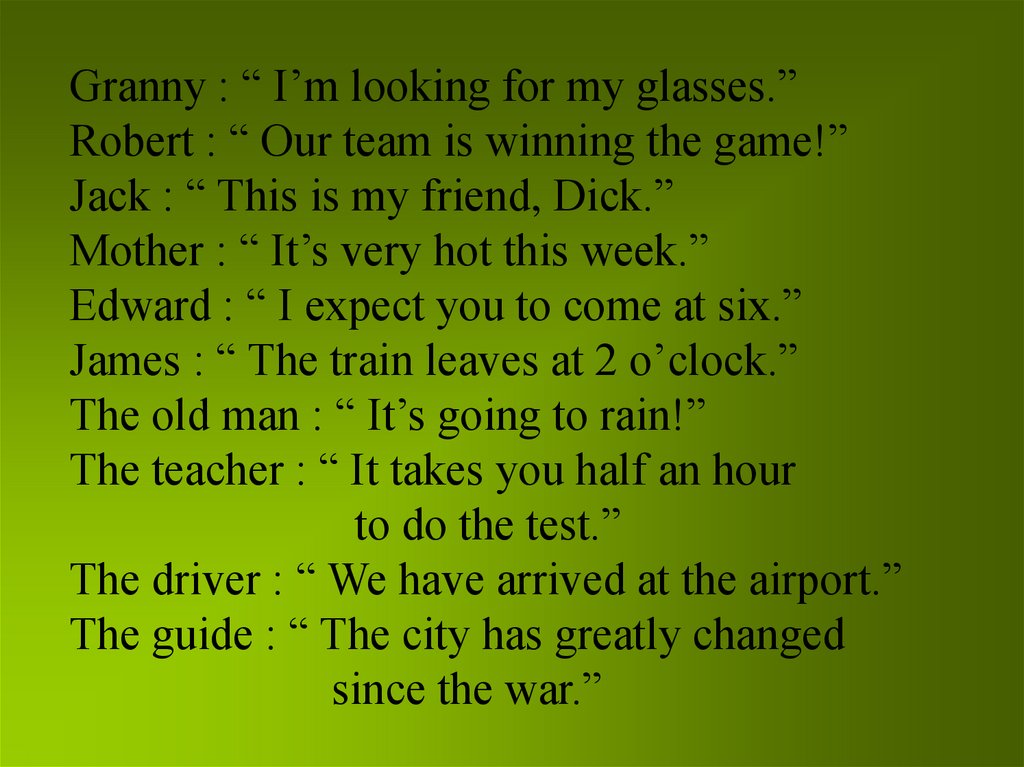
Granny : “ I’m looking for my glasses.”Robert : “ Our team is winning the game!”
Jack : “ This is my friend, Dick.”
Mother : “ It’s very hot this week.”
Edward : “ I expect you to come at six.”
James : “ The train leaves at 2 o’clock.”
The old man : “ It’s going to rain!”
The teacher : “ It takes you half an hour
to do the test.”
The driver : “ We have arrived at the airport.”
The guide : “ The city has greatly changed
since the war.”
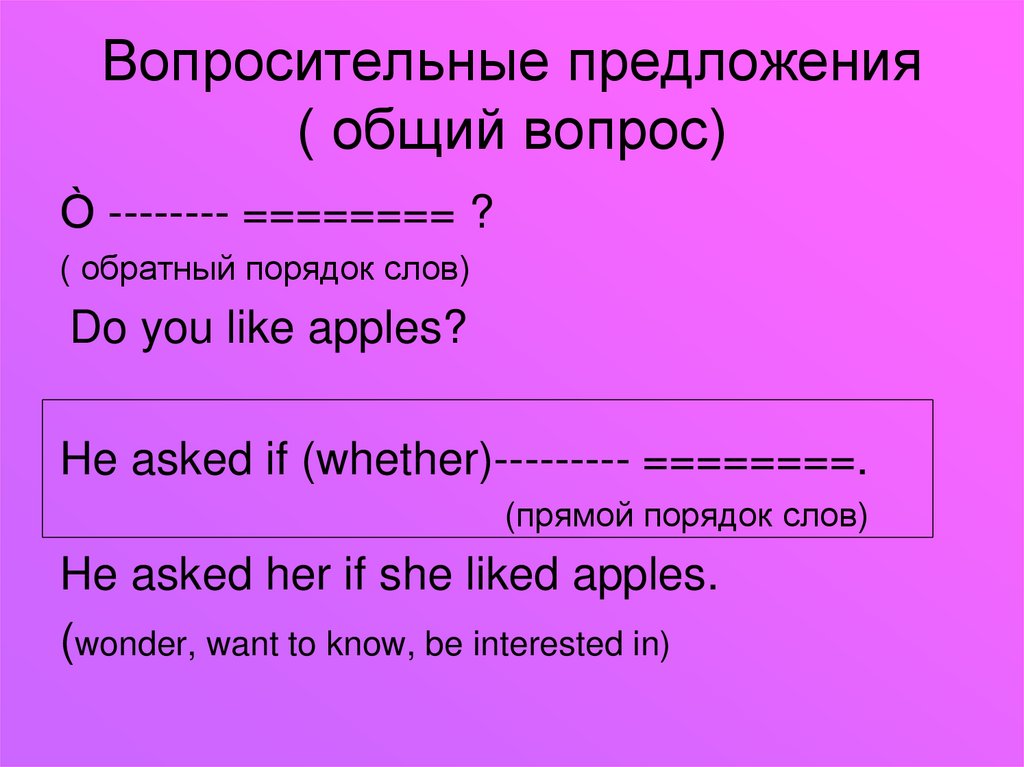
7. Вопросительные предложения ( общий вопрос)
Ò -------- ======== ?( обратный порядок слов)
Do you like apples?
He asked if (whether)--------- ========.
(прямой порядок слов)
He asked her if she liked apples.
(wonder, want to know, be interested in)
8.
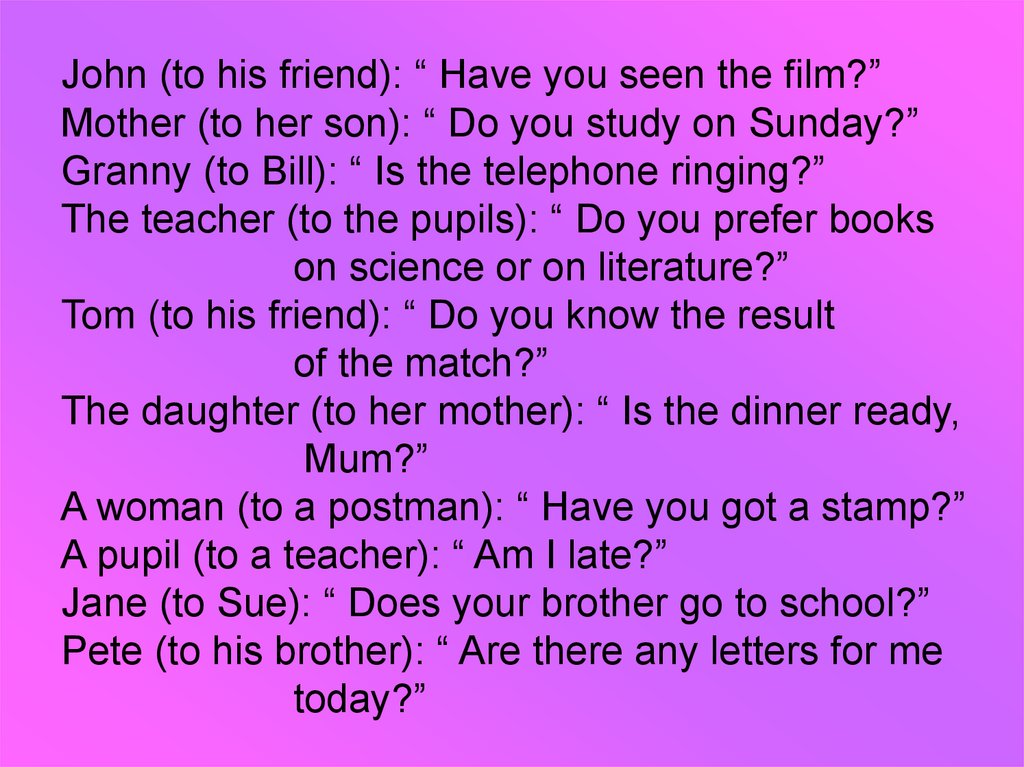
John (to his friend): “ Have you seen the film?”Mother (to her son): “ Do you study on Sunday?”
Granny (to Bill): “ Is the telephone ringing?”
The teacher (to the pupils): “ Do you prefer books
on science or on literature?”
Tom (to his friend): “ Do you know the result
of the match?”
The daughter (to her mother): “ Is the dinner ready,
Mum?”
A woman (to a postman): “ Have you got a stamp?”
A pupil (to a teacher): “ Am I late?”
Jane (to Sue): “ Does your brother go to school?”
Pete (to his brother): “ Are there any letters for me
today?”
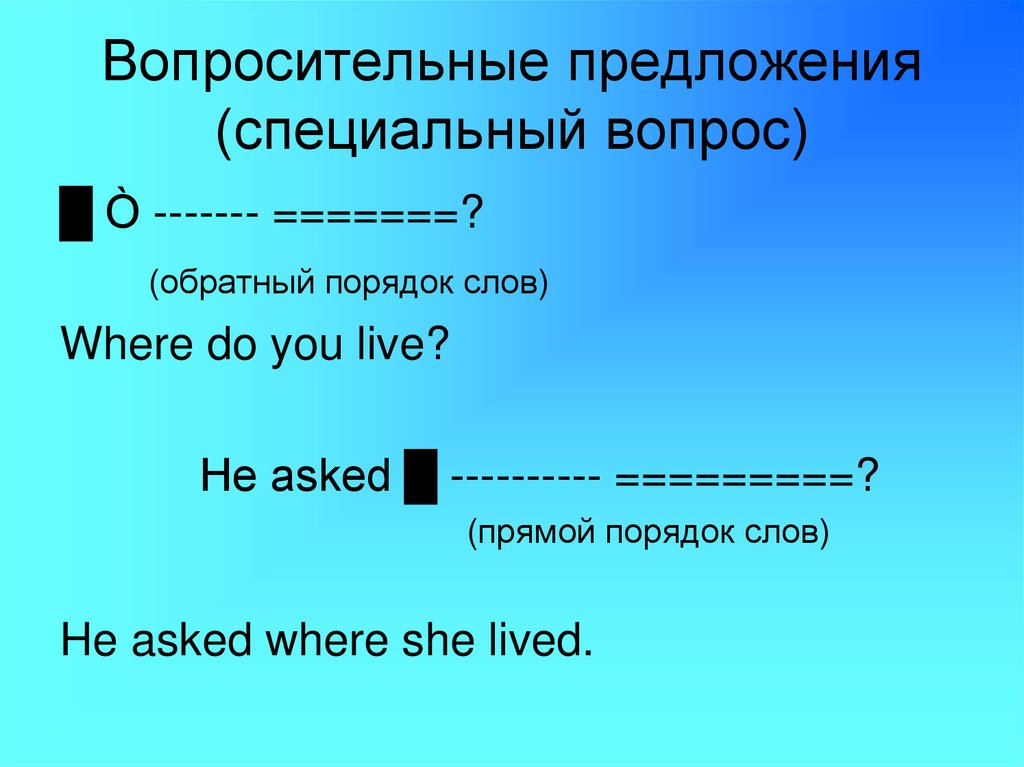
9. Вопросительные предложения (специальный вопрос)
█ Ò ------- =======?(обратный порядок слов)
Where do you live?
He asked █ ---------- =========?
(прямой порядок слов)
He asked where she lived.
10.
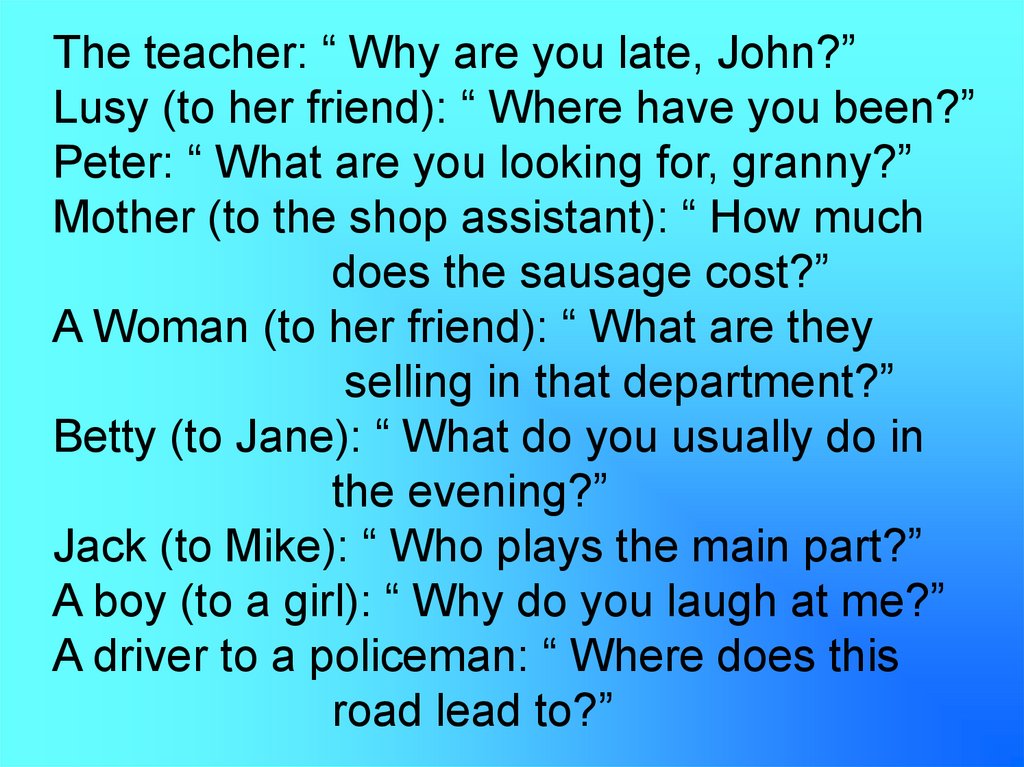
The teacher: “ Why are you late, John?”Lusy (to her friend): “ Where have you been?”
Peter: “ What are you looking for, granny?”
Mother (to the shop assistant): “ How much
does the sausage cost?”
A Woman (to her friend): “ What are they
selling in that department?”
Betty (to Jane): “ What do you usually do in
the evening?”
Jack (to Mike): “ Who plays the main part?”
A boy (to a girl): “ Why do you laugh at me?”
A driver to a policeman: “ Where does this
road lead to?”
11.
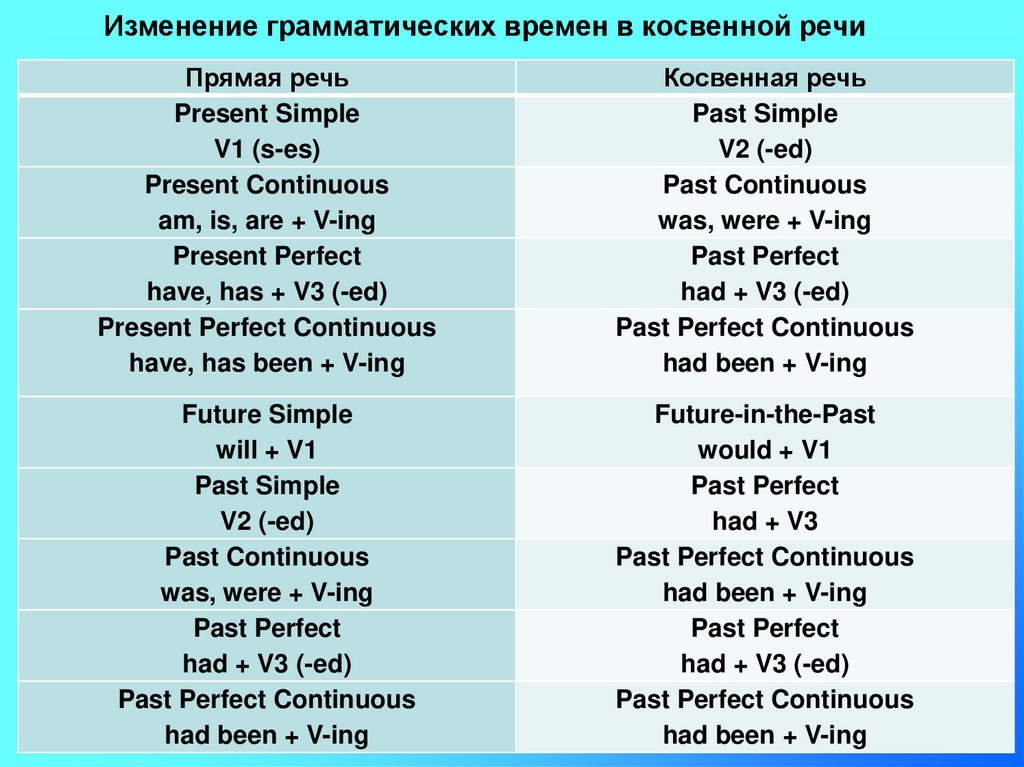
Изменение грамматических времен в косвенной речиПрямая речь
Present Simple
V1 (s-es)
Present Continuous
am, is, are + V-ing
Present Perfect
have, has + V3 (-ed)
Present Perfect Continuous
have, has been + V-ing
Косвенная речь
Past Simple
V2 (-ed)
Past Continuous
was, were + V-ing
Past Perfect
had + V3 (-ed)
Past Perfect Continuous
had been + V-ing
Future Simple
will + V1
Past Simple
V2 (-ed)
Past Continuous
was, were + V-ing
Past Perfect
had + V3 (-ed)
Past Perfect Continuous
had been + V-ing
Future-in-the-Past
would + V1
Past Perfect
had + V3
Past Perfect Continuous
had been + V-ing
Past Perfect
had + V3 (-ed)
Past Perfect Continuous
had been + V-ing
12.
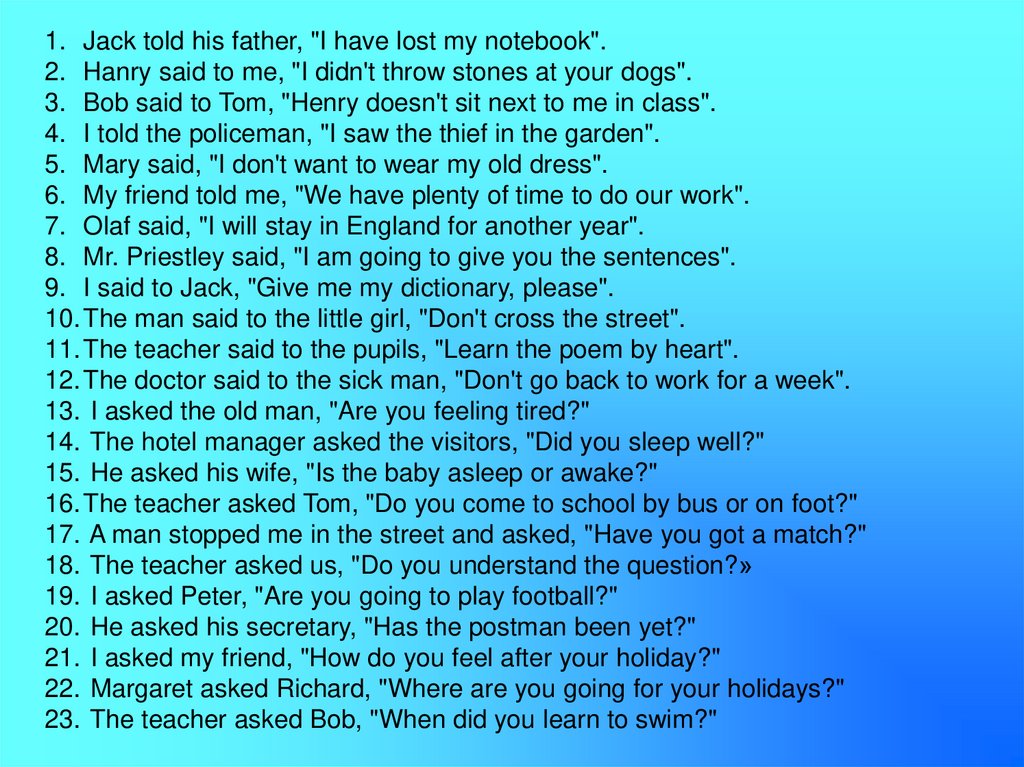
1. Jack told his father, "I have lost my notebook".2. Hanry said to me, "I didn't throw stones at your dogs".
3. Bob said to Tom, "Henry doesn't sit next to me in class".
4. I told the policeman, "I saw the thief in the garden".
5. Mary said, "I don't want to wear my old dress".
6. My friend told me, "We have plenty of time to do our work".
7. Olaf said, "I will stay in England for another year".
8. Mr. Priestley said, "I am going to give you the sentences".
9. I said to Jack, "Give me my dictionary, please".
10. The man said to the little girl, "Don't cross the street".
11. The teacher said to the pupils, "Learn the poem by heart".
12. The doctor said to the sick man, "Don't go back to work for a week".
13. I asked the old man, "Are you feeling tired?"
14. The hotel manager asked the visitors, "Did you sleep well?"
15. He asked his wife, "Is the baby asleep or awake?"
16. The teacher asked Tom, "Do you come to school by bus or on foot?"
17. A man stopped me in the street and asked, "Have you got a match?"
18. The teacher asked us, "Do you understand the question?»
19. I asked Peter, "Are you going to play football?"
20. He asked his secretary, "Has the postman been yet?"
21. I asked my friend, "How do you feel after your holiday?"
22. Margaret asked Richard, "Where are you going for your holidays?"
23. The teacher asked Bob, "When did you learn to swim?"