



 english
Similar presentations:



Stylistic Analysis of Research Articles
1. Stylistic Analysis of Research Articles
2. Introduction
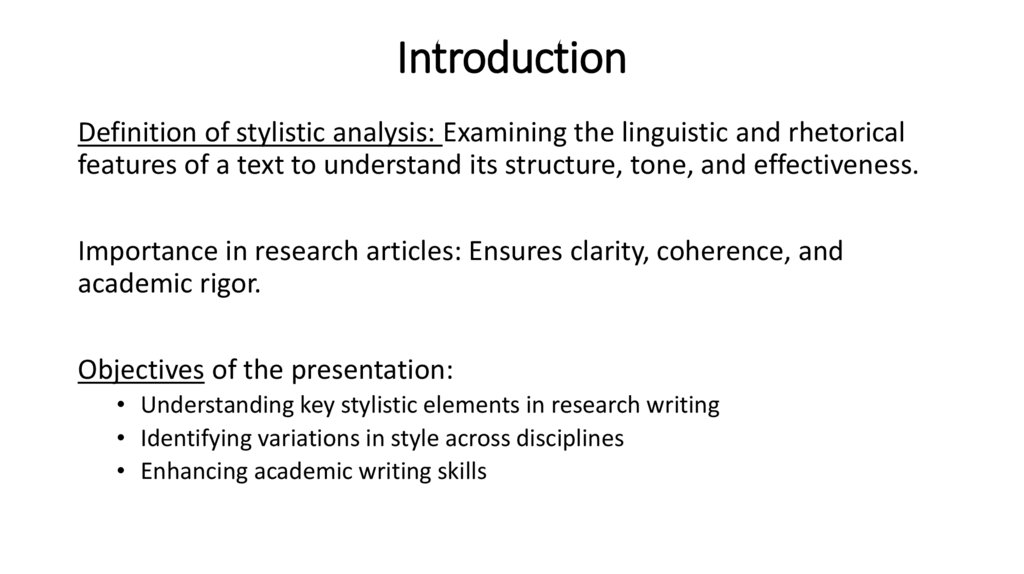
Definition of stylistic analysis: Examining the linguistic and rhetoricalfeatures of a text to understand its structure, tone, and effectiveness.
Importance in research articles: Ensures clarity, coherence, and
academic rigor.
Objectives of the presentation:
• Understanding key stylistic elements in research writing
• Identifying variations in style across disciplines
• Enhancing academic writing skills
3. Key Stylistic Features of Research Articles
Formal Tone: Objective and impersonal language.Precision & Clarity: Avoiding ambiguity and vague expressions.
Conciseness: Eliminating redundant words and unnecessary
complexity.
Use of Passive Voice: Common in scientific writing to emphasize results
rather than the researcher.
Hedging: Expressions like "it is suggested that" or "the results indicate"
to show caution.
4. Structural Components and Their Stylistic Features
Title: Concise, informative, and includes key terms.Abstract: Summarizes research concisely using precise language.
Introduction: Uses rhetorical strategies to engage readers and define
research scope.
Literature Review: Balanced use of paraphrasing, citations, and critical
analysis.
Methodology: Technical, precise, and highly structured.
Results & Discussion: Objective data presentation with analytical insights.
Conclusion: Summarizes findings and suggests future research directions
5. Variations in Stylistic Features Across Disciplines
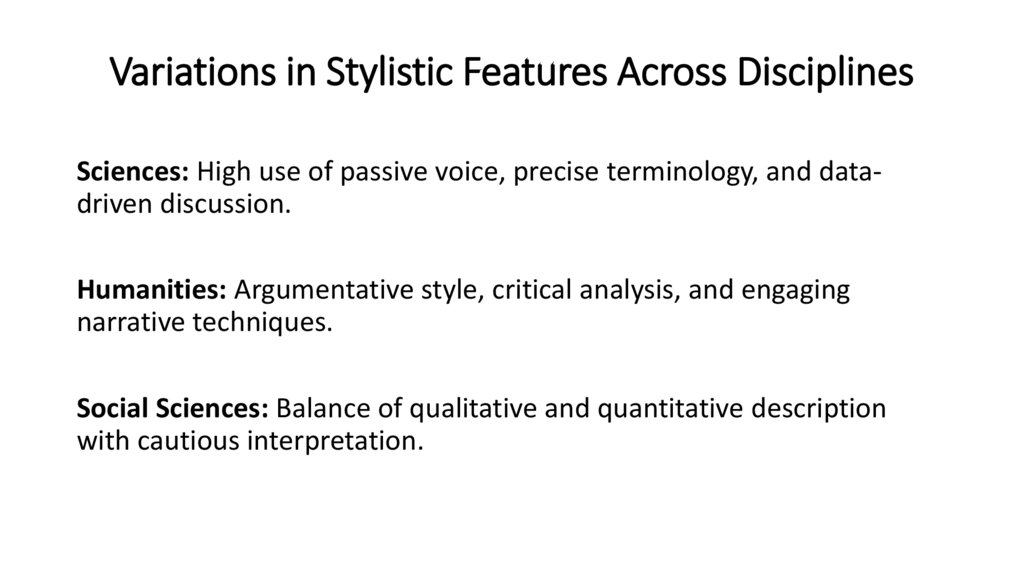
Sciences: High use of passive voice, precise terminology, and datadriven discussion.Humanities: Argumentative style, critical analysis, and engaging
narrative techniques.
Social Sciences: Balance of qualitative and quantitative description
with cautious interpretation.
6. Common Stylistic Mistakes in Research Articles
Excessive Jargon: Overuse of technical terms that hindercomprehension.
Wordiness: Using unnecessarily long sentences and redundant phrases.
Informal Language: Avoiding contractions, colloquialisms, and personal
pronouns.
Overuse of Passive Voice: Can make writing unclear if not balanced
properly.
Lack of Cohesion: Poor transitions between ideas affecting readability.