
 english
Similar presentations:

Modern English Lexicology. Etymological Survey of the English Word-Stock
1. MODERN ENGLISH LEXICOLOGY
Etymological Survey of theEnglish Word-Stock
2.
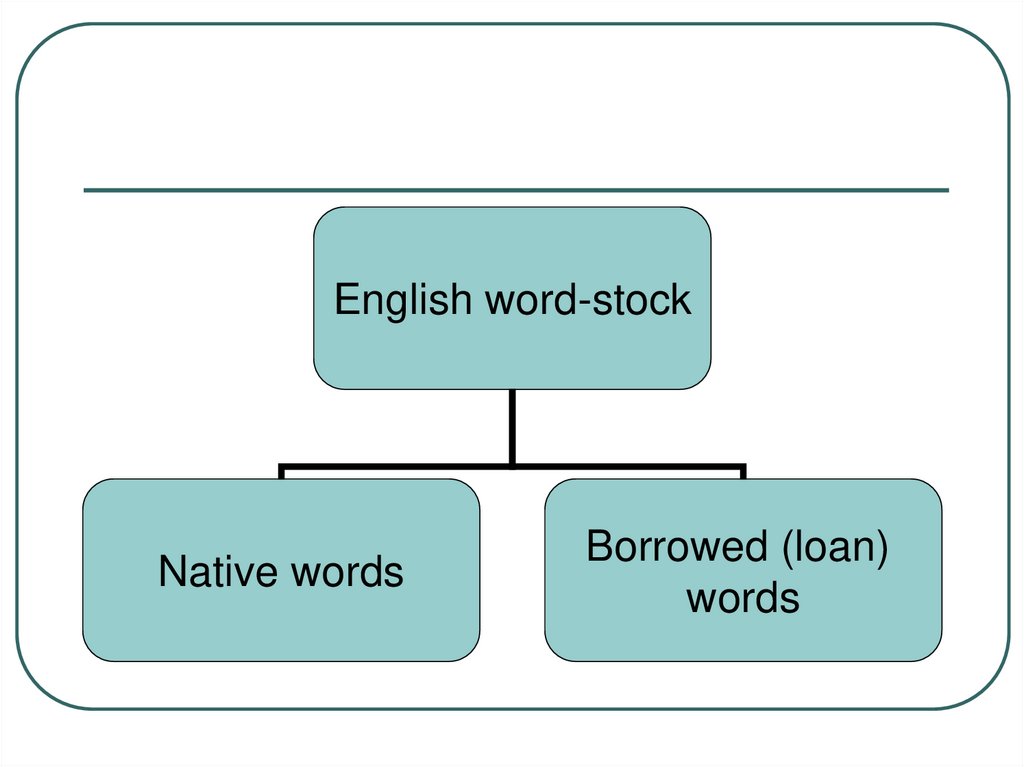
English word-stockNative words
Borrowed (loan)
words
3. Words of native origin
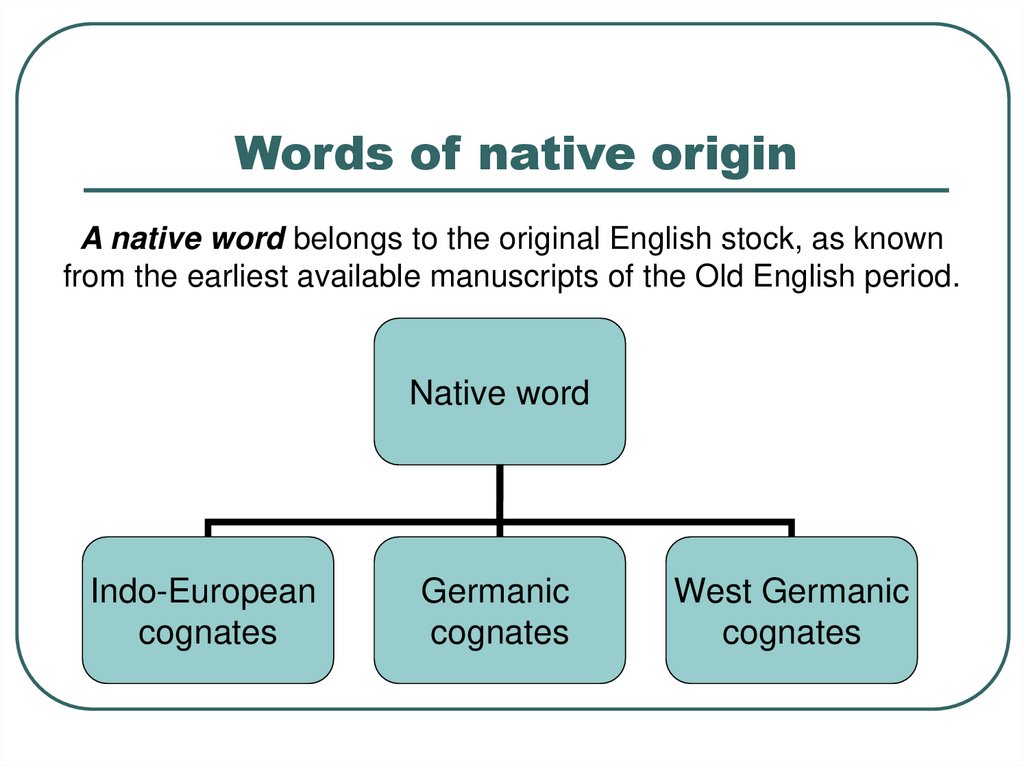
A native word belongs to the original English stock, as knownfrom the earliest available manuscripts of the Old English period.
Native word
Indo-European
cognates
Germanic
cognates
West Germanic
cognates
4. Basic semantic groups of native words
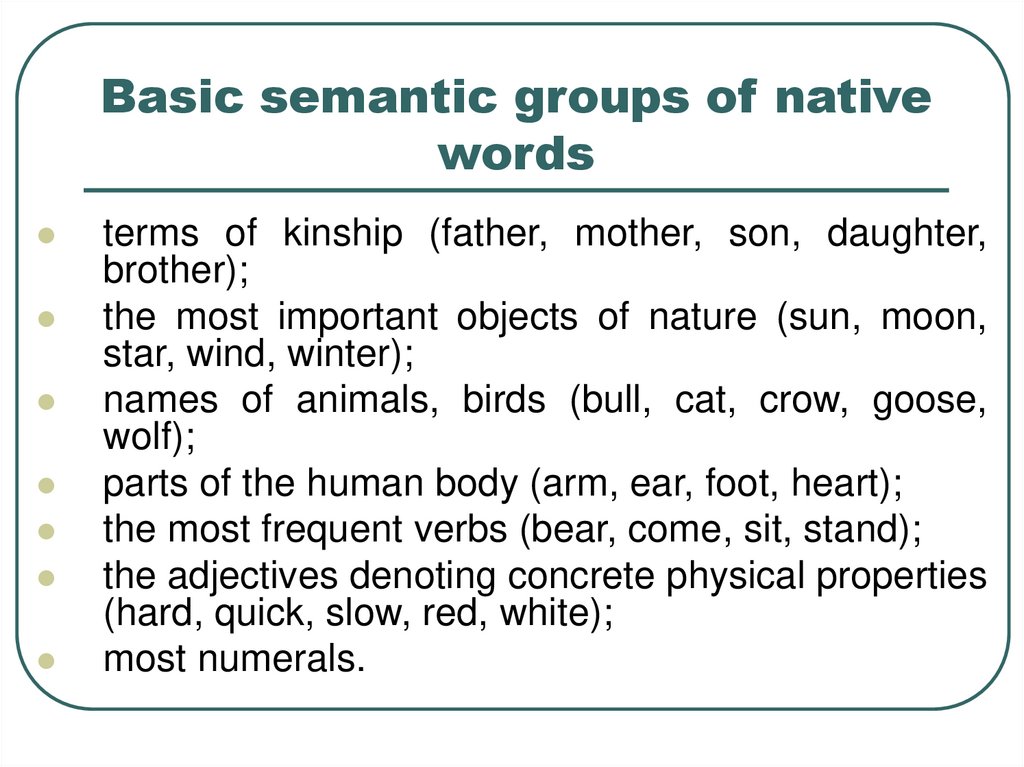
terms of kinship (father, mother, son, daughter,brother);
the most important objects of nature (sun, moon,
star, wind, winter);
names of animals, birds (bull, cat, crow, goose,
wolf);
parts of the human body (arm, ear, foot, heart);
the most frequent verbs (bear, come, sit, stand);
the adjectives denoting concrete physical properties
(hard, quick, slow, red, white);
most numerals.
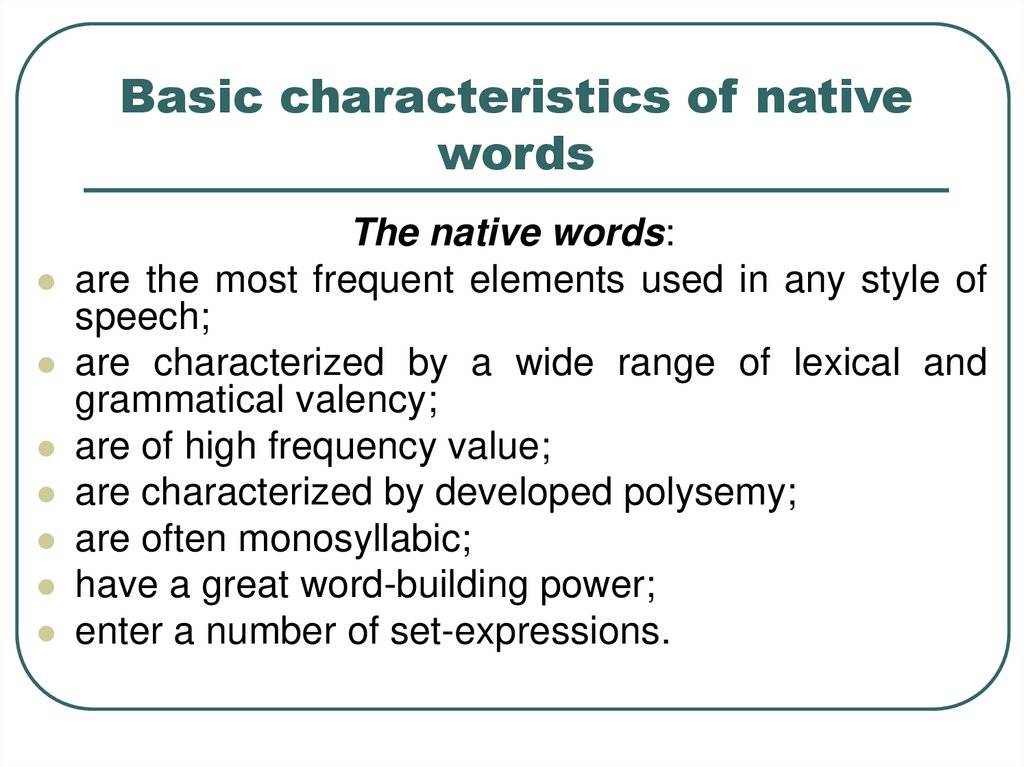
5. Basic characteristics of native words
The native words:are the most frequent elements used in any style of
speech;
are characterized by a wide range of lexical and
grammatical valency;
are of high frequency value;
are characterized by developed polysemy;
are often monosyllabic;
have a great word-building power;
enter a number of set-expressions.
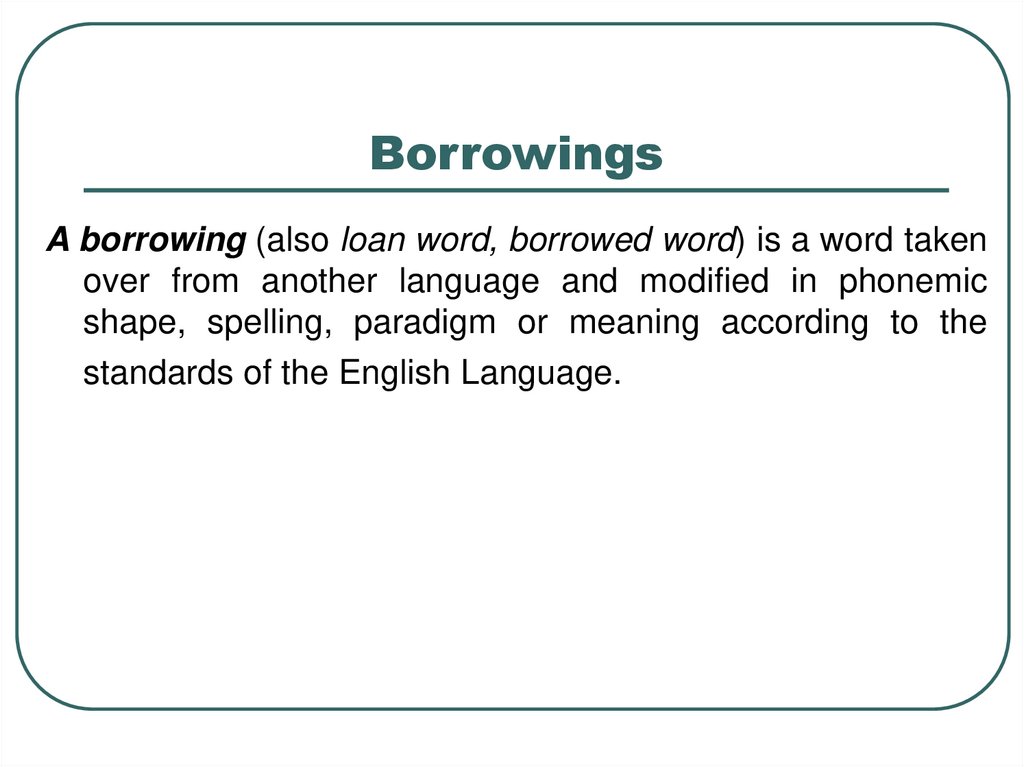
6. Borrowings
A borrowing (also loan word, borrowed word) is a word takenover from another language and modified in phonemic
shape, spelling, paradigm or meaning according to the
standards of the English Language.
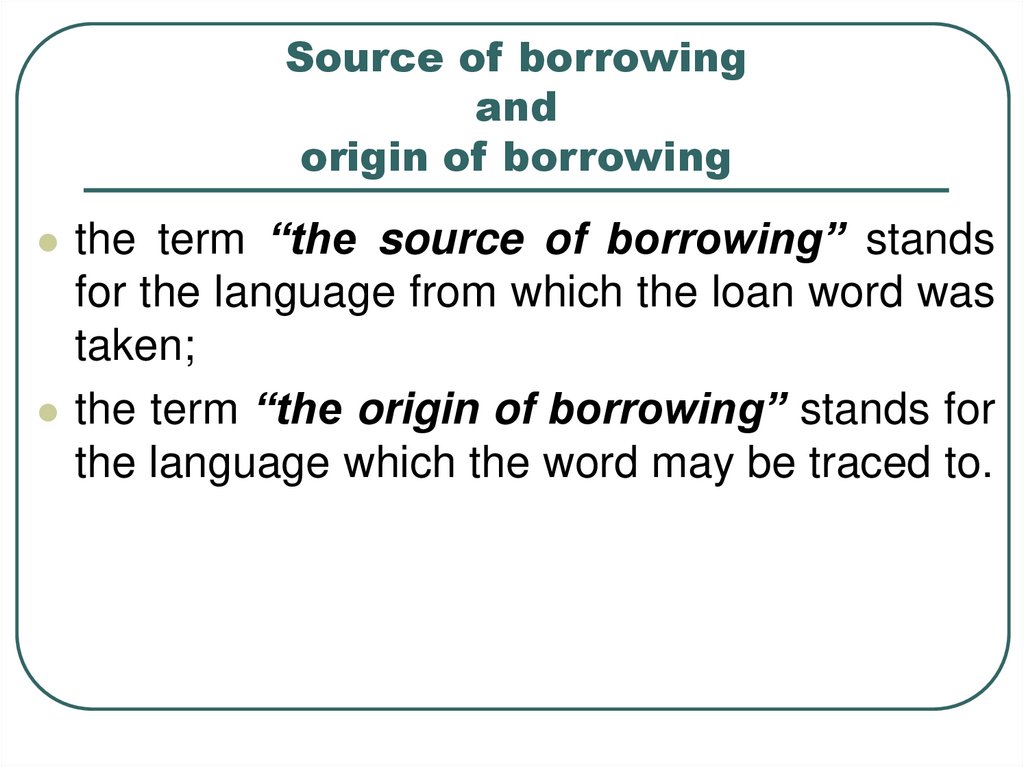
7. Source of borrowing and origin of borrowing
the term “the source of borrowing” standsfor the language from which the loan word was
taken;
the term “the origin of borrowing” stands for
the language which the word may be traced to.
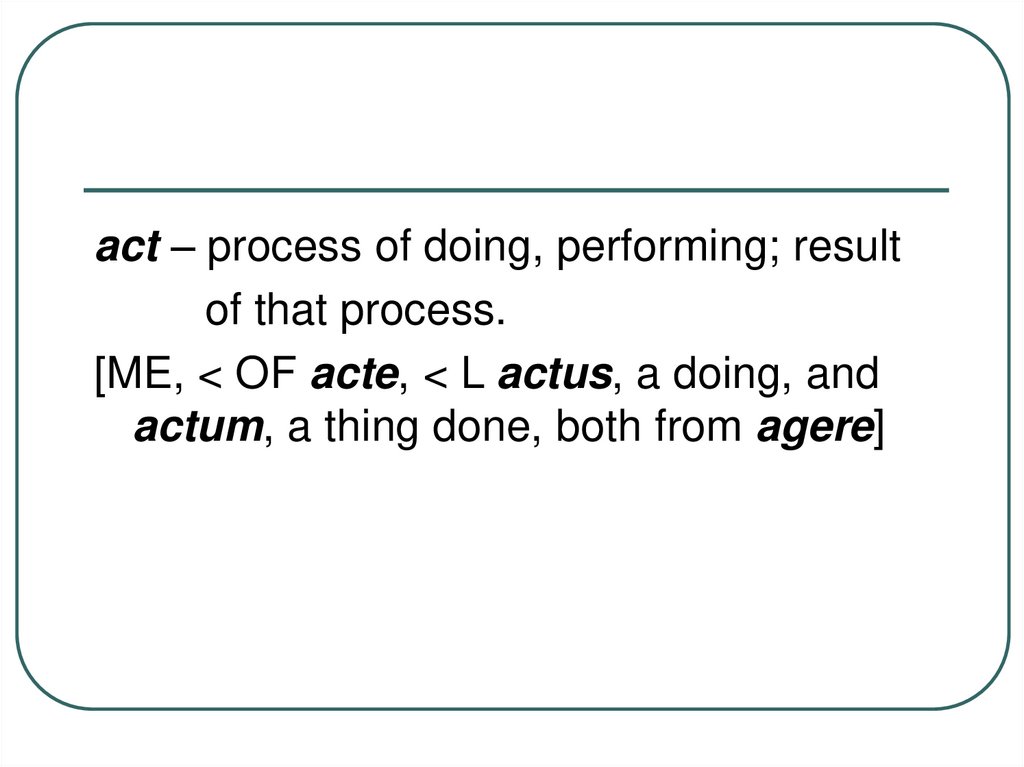
8.
act – process of doing, performing; resultof that process.
[ME, < OF acte, < L actus, a doing, and
actum, a thing done, both from agere]
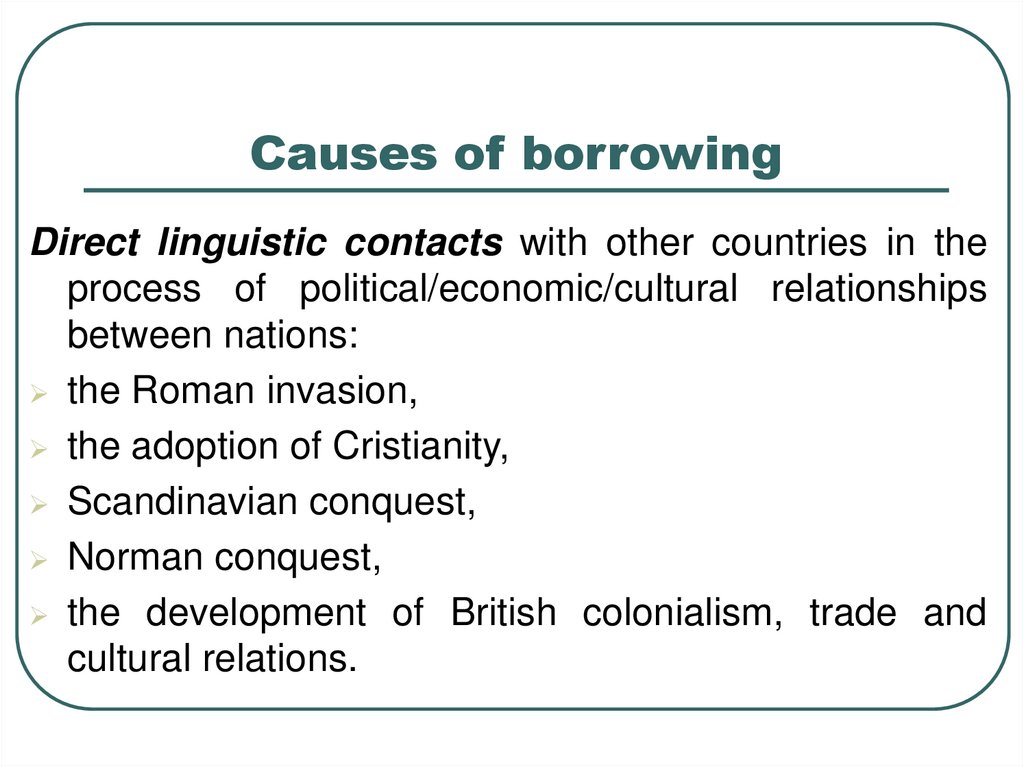
9. Causes of borrowing
Direct linguistic contacts with other countries in theprocess of political/economic/cultural relationships
between nations:
the Roman invasion,
the adoption of Cristianity,
Scandinavian conquest,
Norman conquest,
the development of British colonialism, trade and
cultural relations.
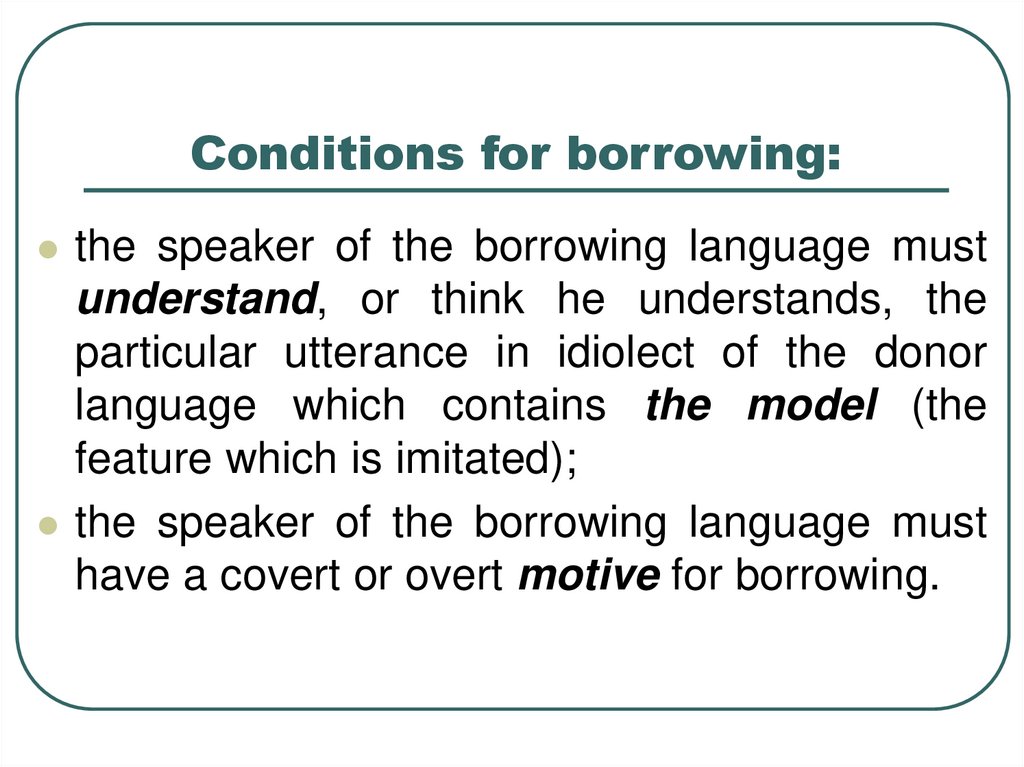
10. Conditions for borrowing:
the speaker of the borrowing language mustunderstand, or think he understands, the
particular utterance in idiolect of the donor
language which contains the model (the
feature which is imitated);
the speaker of the borrowing language must
have a covert or overt motive for borrowing.
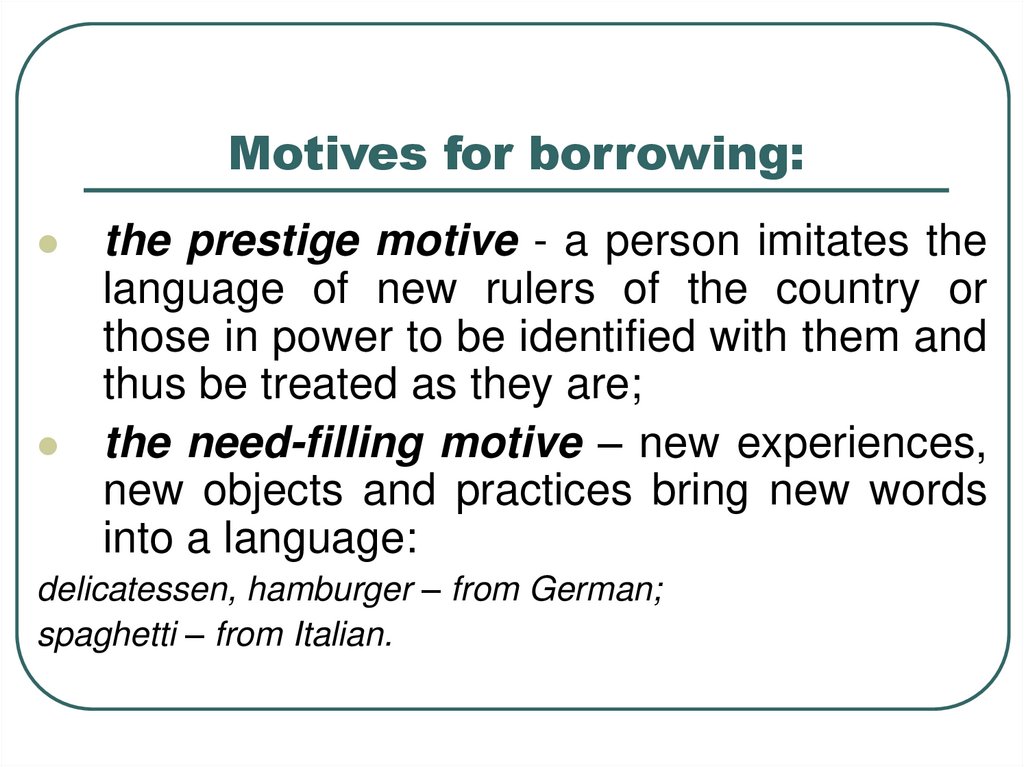
11. Motives for borrowing:
the prestige motive - a person imitates thelanguage of new rulers of the country or
those in power to be identified with them and
thus be treated as they are;
the need-filling motive – new experiences,
new objects and practices bring new words
into a language:
delicatessen, hamburger – from German;
spaghetti – from Italian.
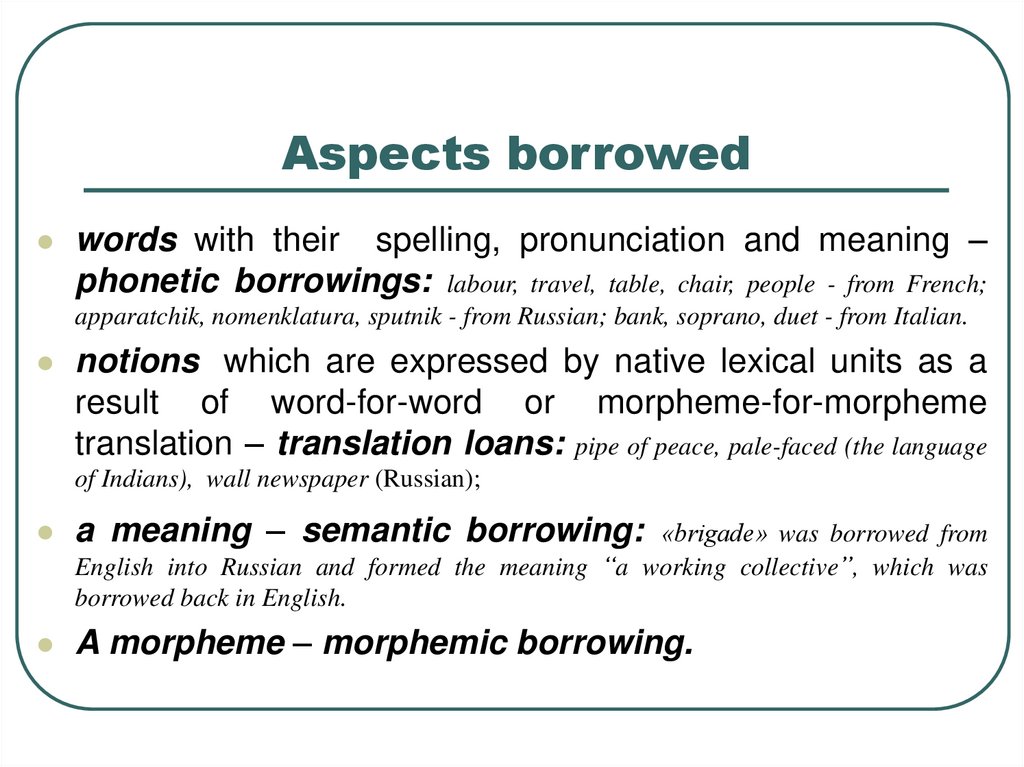
12. Aspects borrowed
words with their spelling, pronunciation and meaning –phonetic borrowings: labour, travel, table, chair, people - from French;
apparatchik, nomenklatura, sputnik - from Russian; bank, soprano, duet - from Italian.
notions which are expressed by native lexical units as a
result of word-for-word or morpheme-for-morpheme
translation – translation loans: pipe of peace, pale-faced (the language
of Indians), wall newspaper (Russian);
a meaning – semantic borrowing: «brigade» was borrowed from
English into Russian and formed the meaning “a working collective”, which was
borrowed back in English.
A morpheme – morphemic borrowing.
13. Etymological doublets
Etymological doublets are words borrowed twice from the samelanguage. As a result, a language has two different words with different
spellings and meanings but historically coming back to one and the
same word:
Latino-French doublets
Latin
English from Latin
English from French
uncia
inch
ounce
moneta
mint
money
camera
camera
chamber
Franco-French doublets
Norman
Paris
canal
channel
captain
chieftain
catch
chaise
14. Assimilation of borrowing
Assimilation of a loan word is a partial or totalconformation to the phonetical, graphical and
morphological standards of the receiving
language and its semantic system.
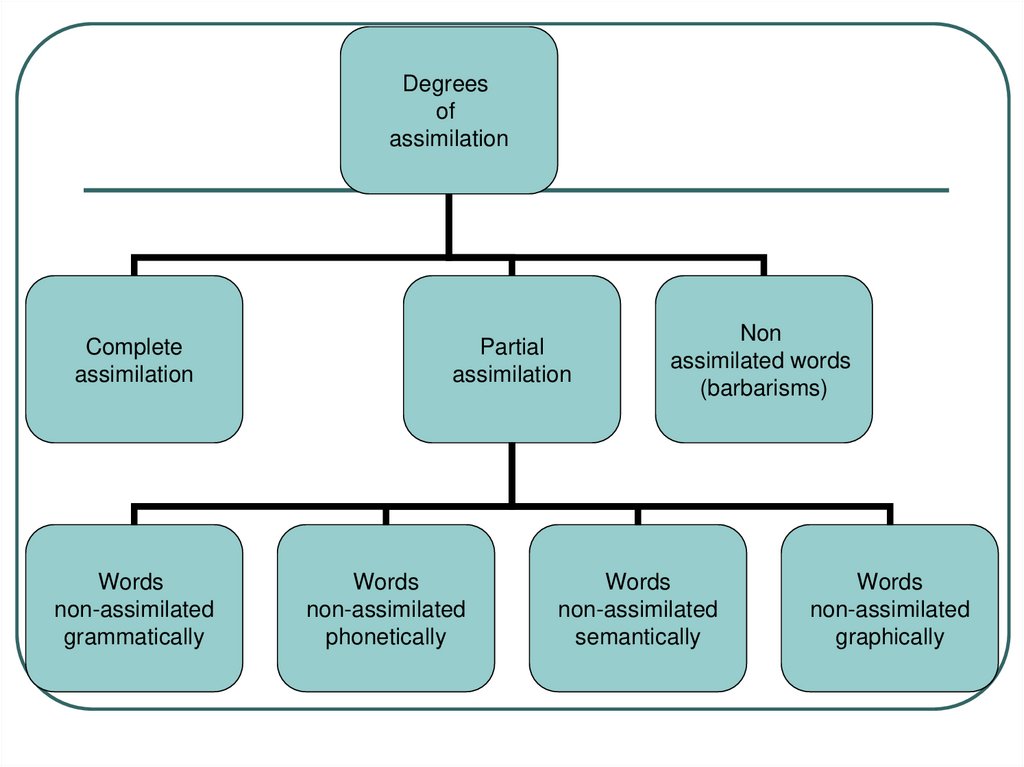
15.
Degreesof
assimilation
Complete
assimilation
Words
non-assimilated
grammatically
Partial
assimilation
Words
non-assimilated
phonetically
Non
assimilated words
(barbarisms)
Words
non-assimilated
semantically
Words
non-assimilated
graphically
16. The degree of assimilation depends on:
what group of languages the word was borrowed from;whether the word was borrowed orally or in the written form;
how often the borrowing is used in the language;
how long the word lives in the language.
17. Borrowings influence on:
the semantic structure of English words;the lexical territorial divergence of the English
vocabulary;
the semantic and stylistic features of the
English vocabulary;
the word-structure, word-clusters and the
system of word-building;
the phonetic structure of words and the sound
system.