





 physics
Similar presentations:






Simulation pp and dd scattering and performance of Beam-Beam Counter of the Spin Physics Detector
1.
Simulation pp and dd scattering and performanceof Beam–Beam Counter of the Spin Physics Detector
A.A Terekhin et al.
Joint Institute for Nuclear Research, Dubna, Russia
SPD Collaboration Meeting
April 2025
1
2. BBC - detector
BBC - detector
TDR design 2023
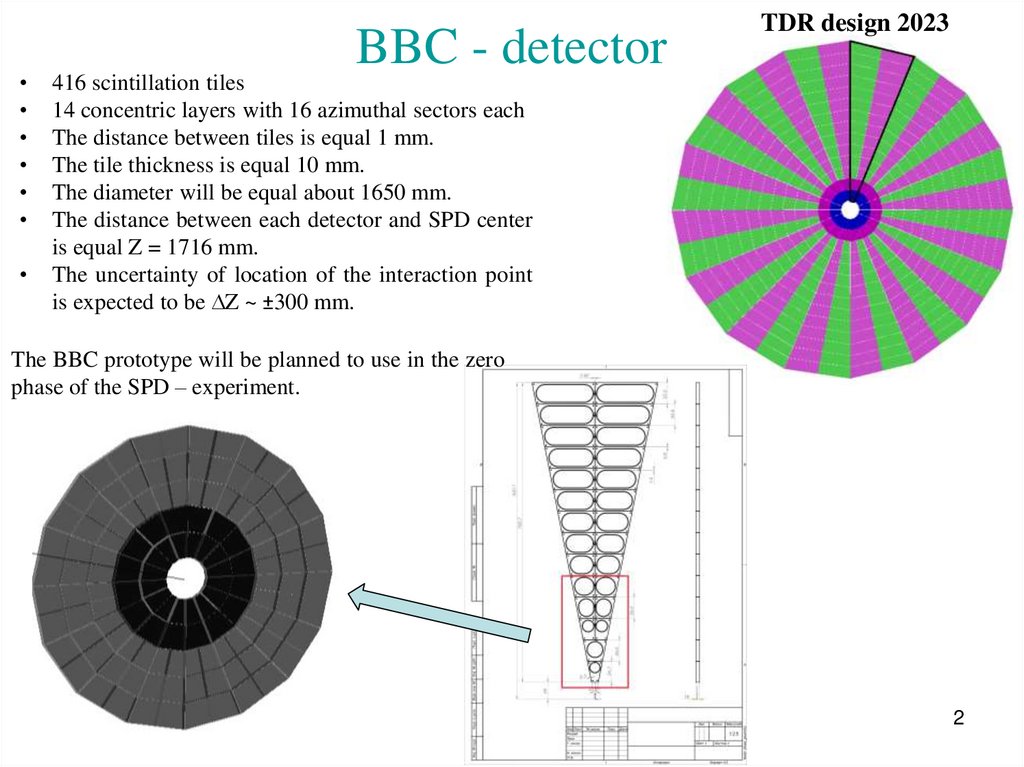
416 scintillation tiles
14 concentric layers with 16 azimuthal sectors each
The distance between tiles is equal 1 mm.
The tile thickness is equal 10 mm.
The diameter will be equal about 1650 mm.
The distance between each detector and SPD center
is equal Z = 1716 mm.
The uncertainty of location of the interaction point
is expected to be DZ ~ ±300 mm.
The BBC prototype will be planned to use in the zero
phase of the SPD – experiment.
2
3.
PP – elastic scattering selectionElastic scattering of protons can be used for polarimetry control of the colliding beams. Also elastically
scattered protons have large momentum and therefore small rotation angle D in the magnetic field.
Preliminary analysis shows [1] that the elastic scattering plays a significant role at the energies √s < 10
GeV. The comparison of the proton and pion analyzing powers AN [2] show that the behavior of AeffN is
dominated by the AprotonN. Therefore, the selection of the elastic channel is of interest to estimate its
contribution to the behavior of AeffN. The timing information for each hit in the kinematically
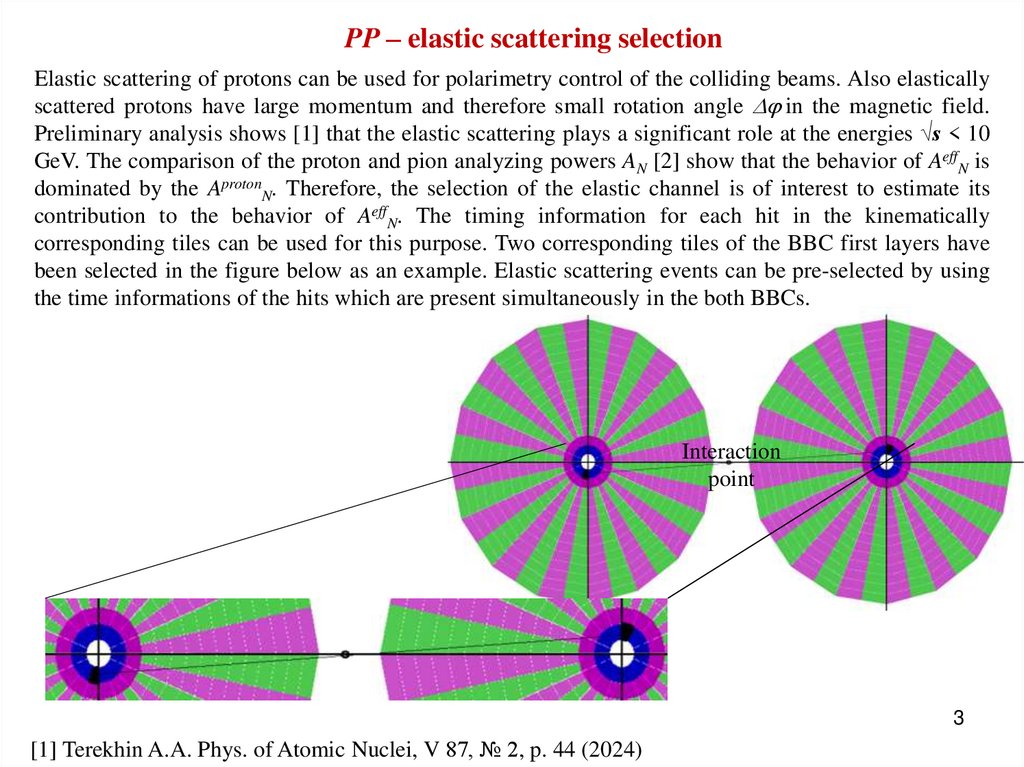
corresponding tiles can be used for this purpose. Two corresponding tiles of the BBC first layers have
been selected in the figure below as an example. Elastic scattering events can be pre-selected by using
the time informations of the hits which are present simultaneously in the both BBCs.
Interaction
point
3
[1] Terekhin A.A. Phys. of Atomic Nuclei, V 87, № 2, p. 44 (2024)
4.
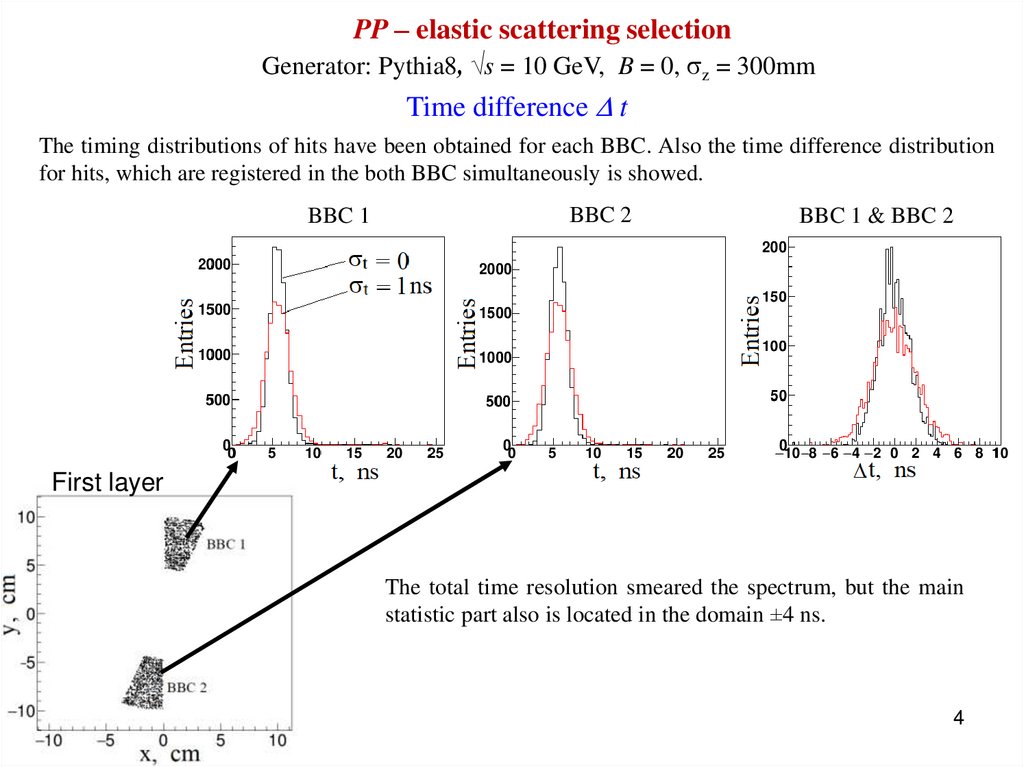
PP – elastic scattering selectionGenerator: Pythia8, √s = 10 GeV, B = 0, sz = 300mm
Time difference D t
The timing distributions of hits have been obtained for each BBC. Also the time difference distribution
for hits, which are registered in the both BBC simultaneously is showed.
BBC 1
BBC 2
BBC 1 & BBC 2
First layer
The total time resolution smeared the spectrum, but the main
statistic part also is located in the domain ±4 ns.
4
5.
PP – elastic scattering selectionComparison of the time – distribution at B = 0 and B = 1T
The timing distributions of hits for different BBC-layer have been obtained at B = 0 and B = 1T.
BBC 1
Tiles of the layer № 1
BBC 2
BBC 1 & BBC 2
Nint (Nint) – total
selected events in the
i-layer, i = 1…5
Tiles of the layer № 5
! The magnetic field role to the elastic scattering events selection increases with the
BBC-layers increasing.
5
6.
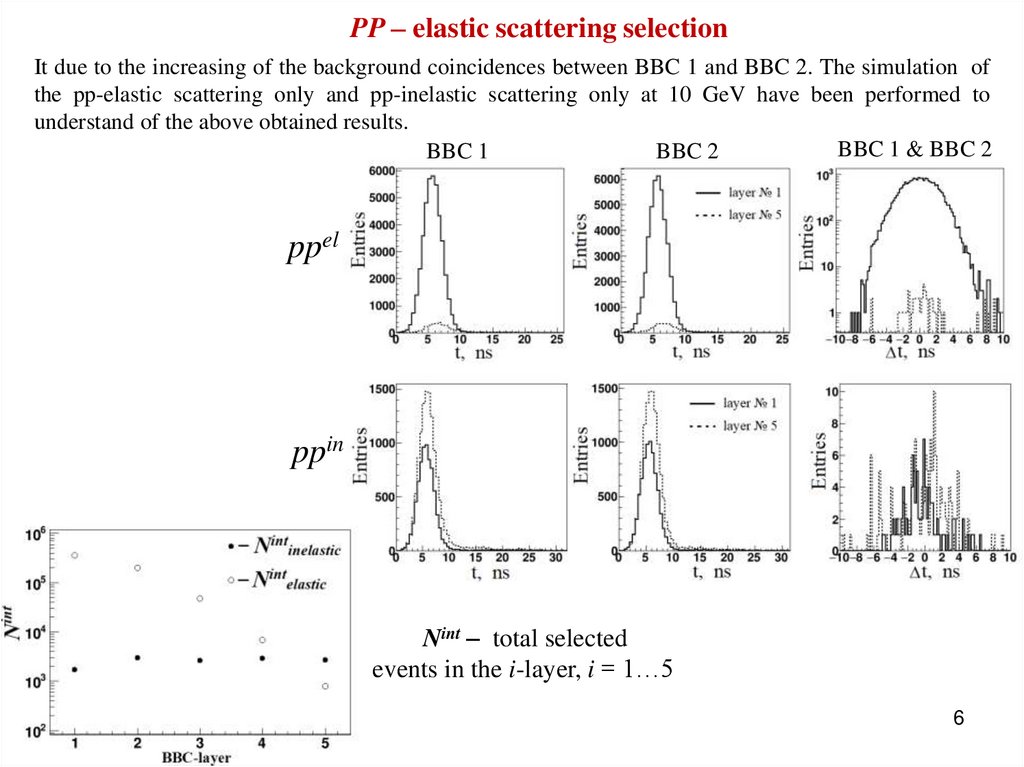
PP – elastic scattering selectionIt due to the increasing of the background coincidences between BBC 1 and BBC 2. The simulation of
the pp-elastic scattering only and pp-inelastic scattering only at 10 GeV have been performed to
understand of the above obtained results.
BBC 1 & BBC 2
BBC 1
BBC 2
ppel
ppin
Nint – total selected
events in the i-layer, i = 1…5
6
7.
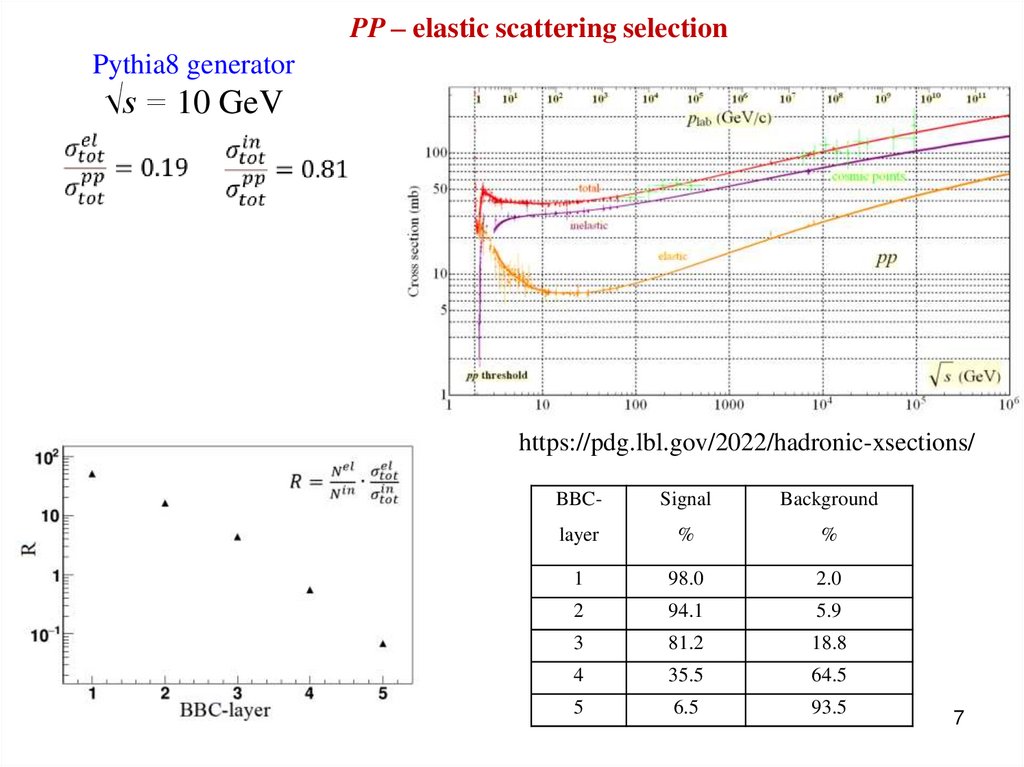
PP – elastic scattering selectionPythia8 generator
√s = 10 GeV
https://pdg.lbl.gov/2022/hadronic-xsections/
BBC-
Signal
Background
layer
%
%
1
98.0
2.0
2
94.1
5.9
3
81.2
18.8
4
35.5
64.5
5
6.5
93.5
7
8.
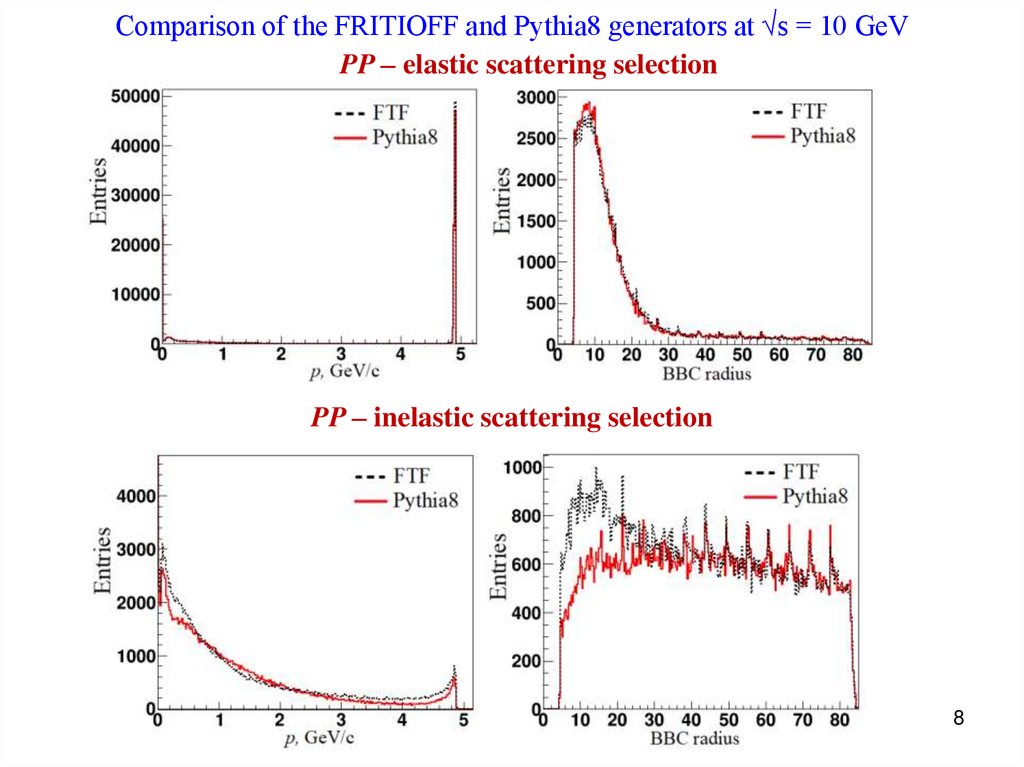
Comparison of the FRITIOFF and Pythia8 generators at √s = 10 GeVPP – elastic scattering selection
PP – inelastic scattering selection
8
9.
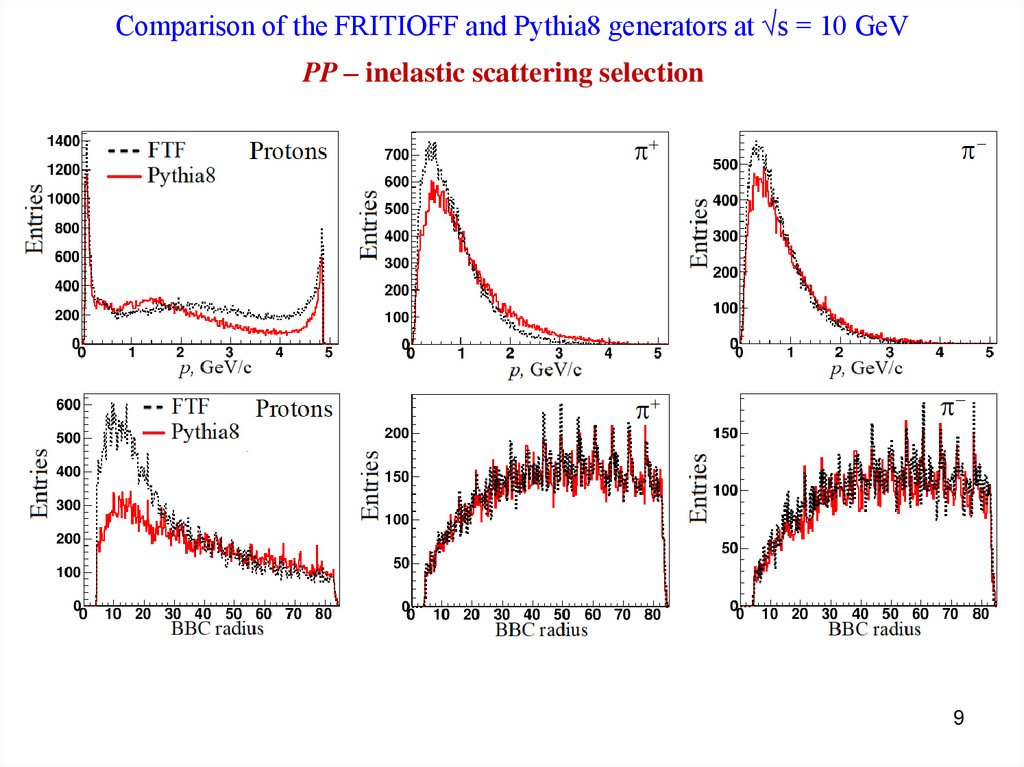
Comparison of the FRITIOFF and Pythia8 generators at √s = 10 GeVPP – inelastic scattering selection
9
10.
PP – elastic scattering selectionFRITIOFF generator, √s = 6 and 10 GeV
√s = 10 GeV
√s = 6 GeV
√s = 6 GeV
BBC-
Signal
Background
BBC-
Signal
Background
layer
1
2
3
4
5
%
92.5
84.4
67.2
38.0
7.3
%
7.5
15.6
32.8
62.0
92.6
layer
1
2
3
4
5
%
98.0
94.7
90.9
84.4
61.5
%
2.0
5.3
9.1
15.6
38.5
10
11.
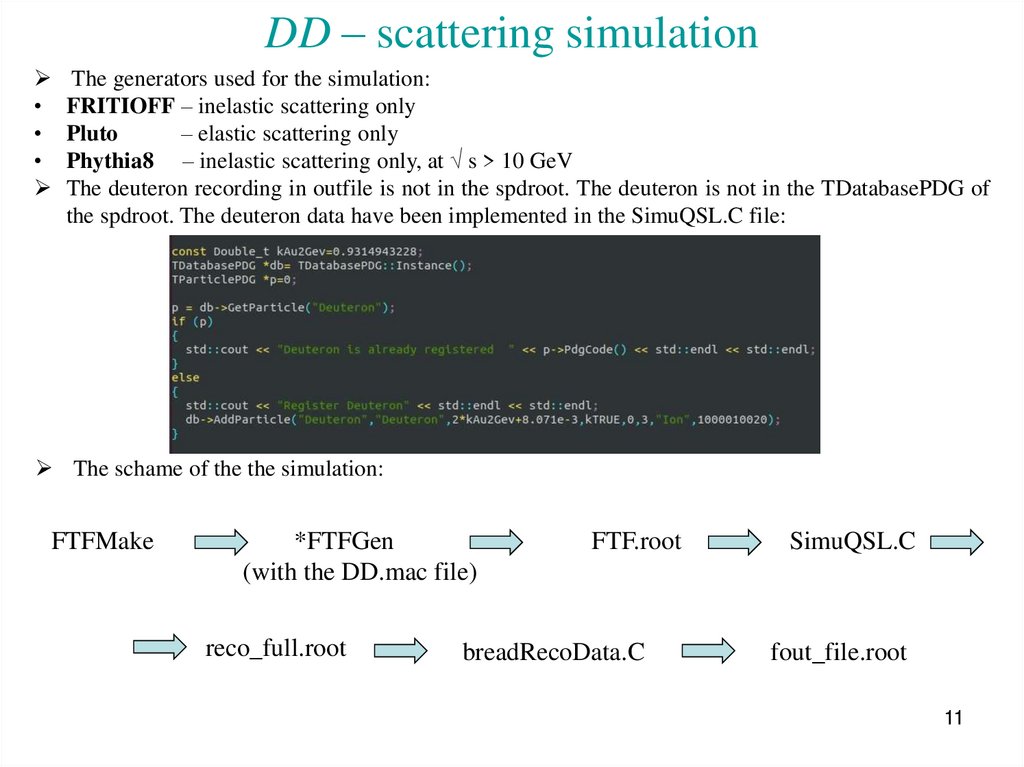
DD – scattering simulationThe generators used for the simulation:
• FRITIOFF – inelastic scattering only
• Pluto
– elastic scattering only
• Phythia8 – inelastic scattering only, at √ s > 10 GeV
The deuteron recording in outfile is not in the spdroot. The deuteron is not in the TDatabasePDG of
the spdroot. The deuteron data have been implemented in the SimuQSL.C file:
The schame of the the simulation:
FTFMake
*FTFGen
(with the DD.mac file)
reco_full.root
FTF.root
breadRecoData.C
SimuQSL.C
fout_file.root
11
12.
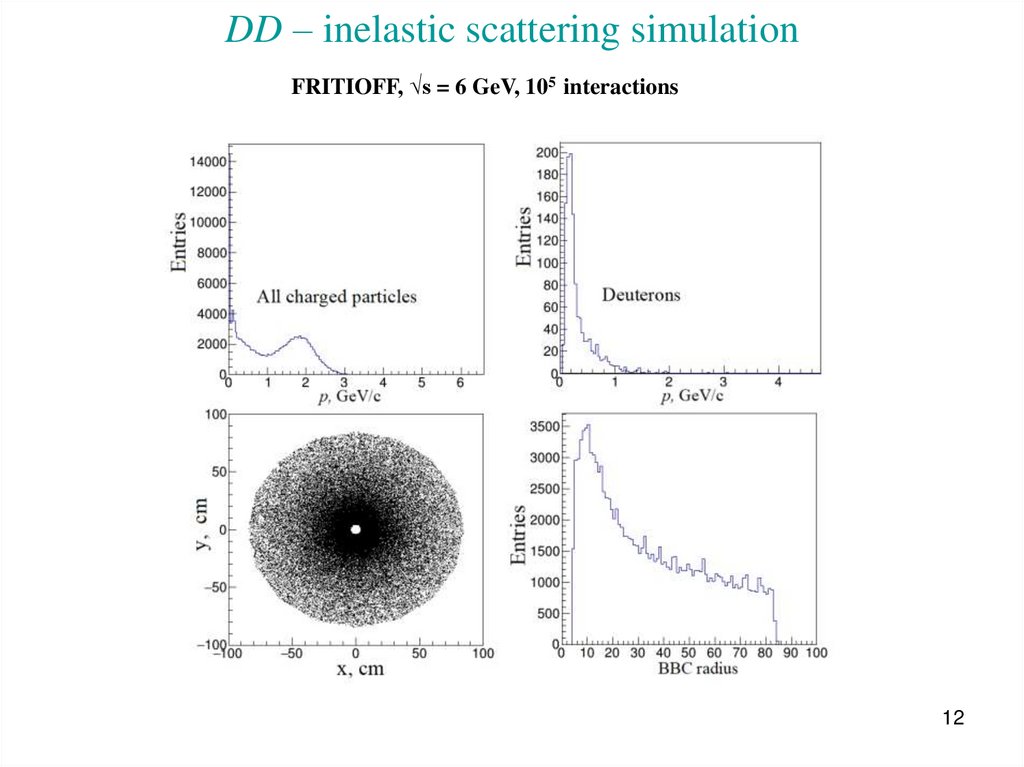
DD – inelastic scattering simulationFRITIOFF, √s = 6 GeV, 105 interactions
12
13.
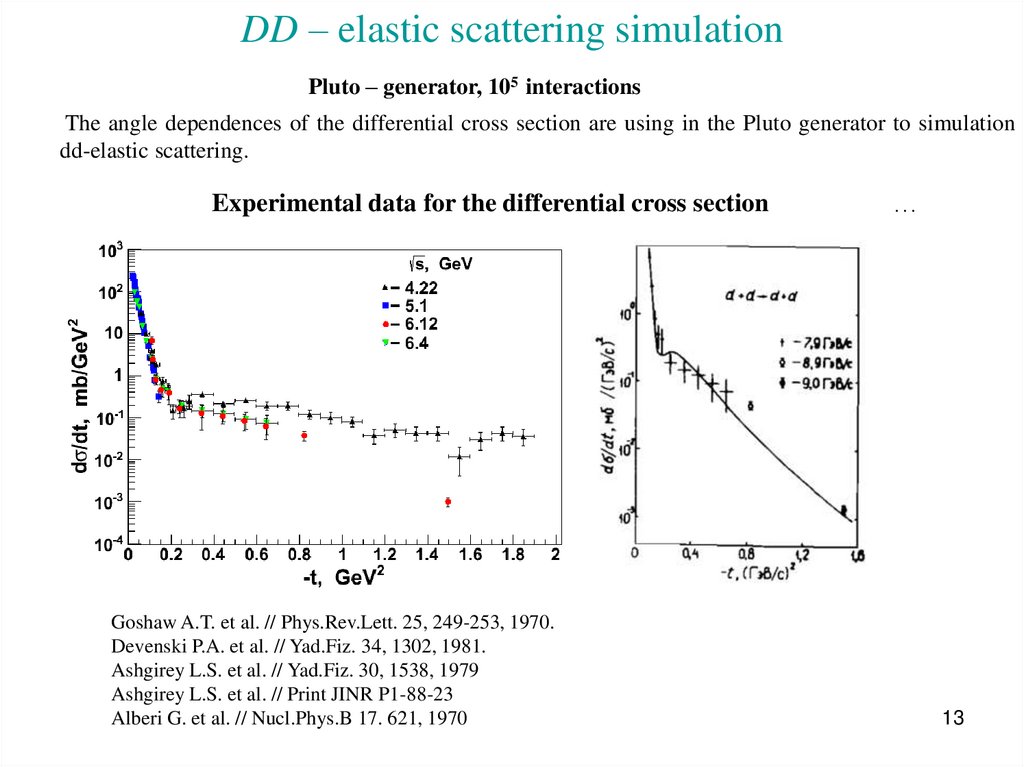
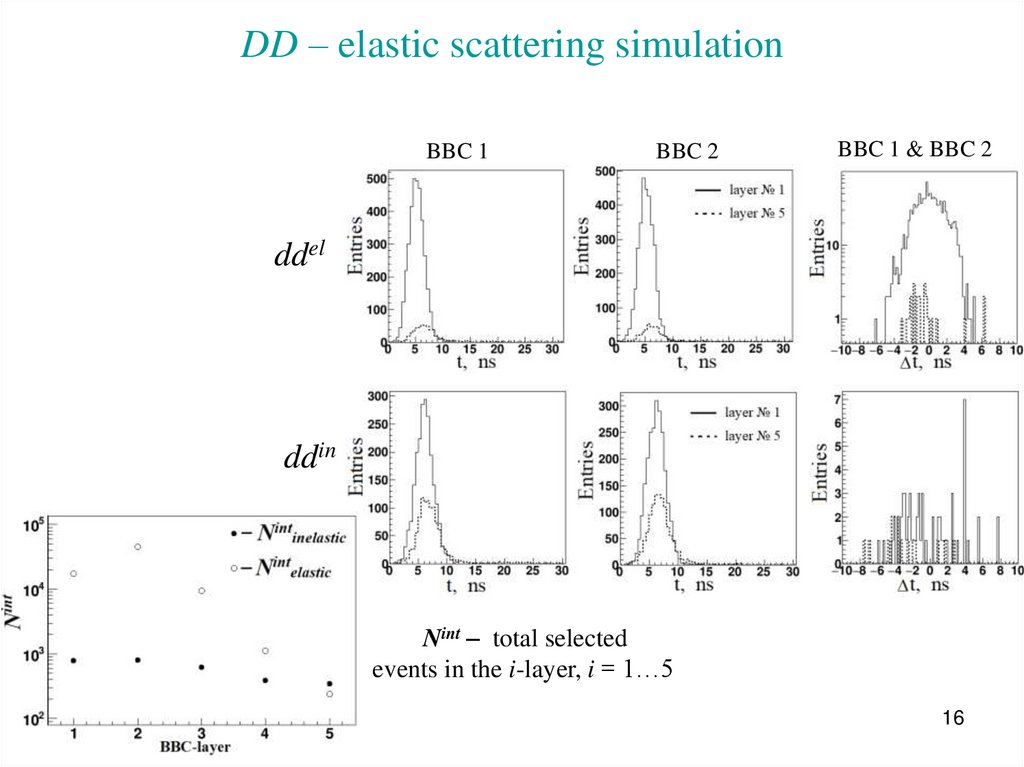
DD – elastic scattering simulationPluto – generator, 105 interactions
The angle dependences of the differential cross section are using in the Pluto generator to simulation
dd-elastic scattering.
Experimental data for the differential cross section
Goshaw A.T. et al. // Phys.Rev.Lett. 25, 249-253, 1970.
Devenski P.A. et al. // Yad.Fiz. 34, 1302, 1981.
Ashgirey L.S. et al. // Yad.Fiz. 30, 1538, 1979
Ashgirey L.S. et al. // Print JINR P1-88-23
Alberi G. et al. // Nucl.Phys.B 17. 621, 1970
…
13
14.
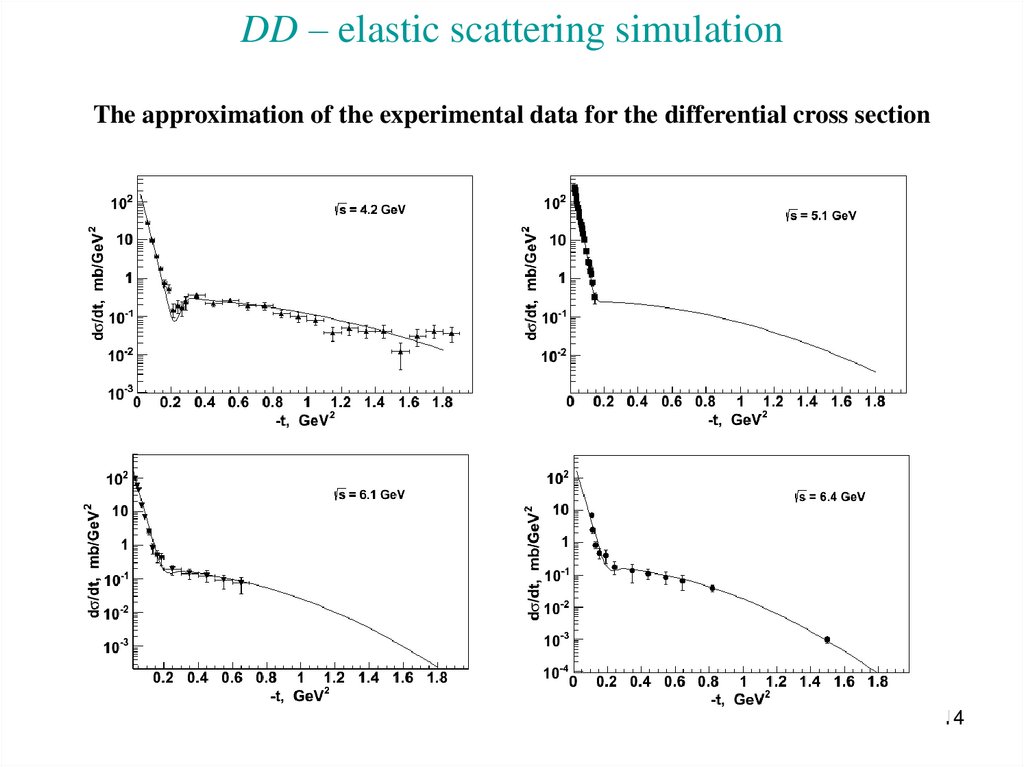
DD – elastic scattering simulationThe approximation of the experimental data for the differential cross section
14
15.
DD – elastic scattering simulationPluto, √s = 6.1 GeV, 105 interactions
The Pluto generator have been implementation as external generator in the spdroot. The simulation
schame:
dd_elastic_PlutoAngular.C
DD_Pluto.root
SimuQSL.C
…
15
16.
DD – elastic scattering simulationBBC 1
BBC 2
BBC 1 & BBC 2
ddel
ddin
Nint – total selected
events in the i-layer, i = 1…5
16
17.
DD – scattering simulation√s = 6 GeV
pp
pd
dd
≈ 40 mb
≈ 80 mb
≈ 160 mb
≈ 8.7 mb
≈ 9 mb
≈ 11 mb ?
0.22
0.11
0.07 ?
Phys.Rev.C 41 (1990) 180-192
BBC-
Signal / Background
layer
1
2
3
4
5
1.6
4.1
1.1
0.21
0.05
[1] https://pdg.lbl.gov/2022/hadronic-xsections/
[2] Phys.Rev.C 41 (1990) 180-192
17
18.
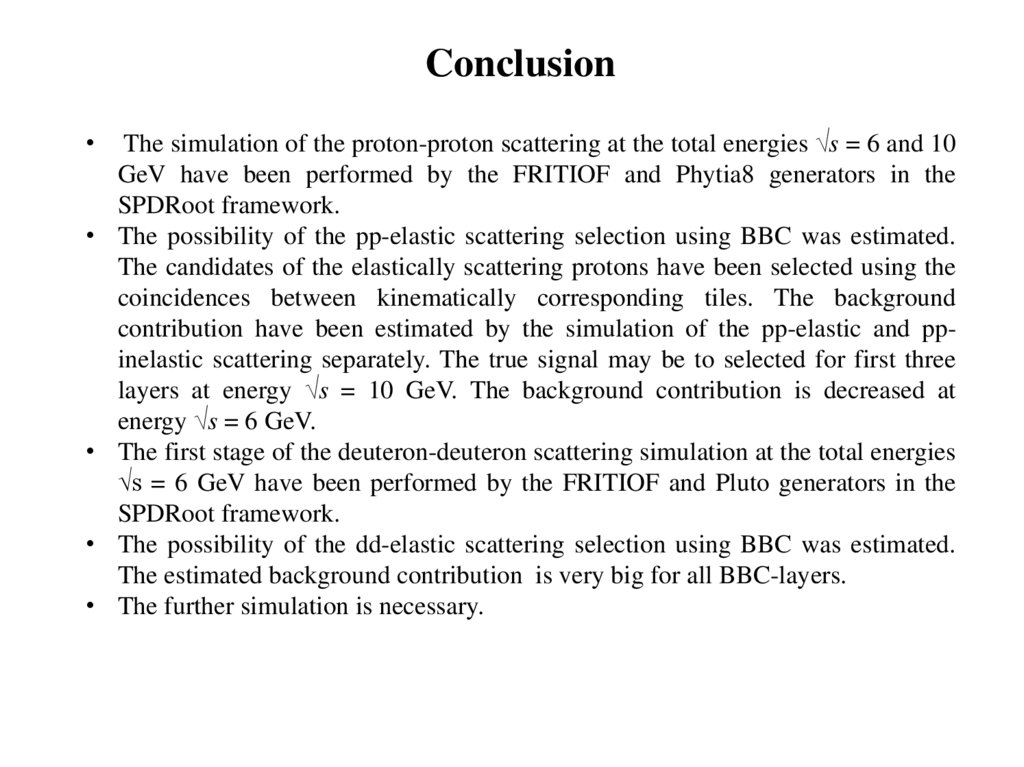
ConclusionThe simulation of the proton-proton scattering at the total energies √s = 6 and 10
GeV have been performed by the FRITIOF and Phytia8 generators in the
SPDRoot framework.
The possibility of the pp-elastic scattering selection using BBC was estimated.
The candidates of the elastically scattering protons have been selected using the
coincidences between kinematically corresponding tiles. The background
contribution have been estimated by the simulation of the pp-elastic and ppinelastic scattering separately. The true signal may be to selected for first three
layers at energy √s = 10 GeV. The background contribution is decreased at
energy √s = 6 GeV.
The first stage of the deuteron-deuteron scattering simulation at the total energies
√s = 6 GeV have been performed by the FRITIOF and Pluto generators in the
SPDRoot framework.
The possibility of the dd-elastic scattering selection using BBC was estimated.
The estimated background contribution is very big for all BBC-layers.
The further simulation is necessary.
19. Thank you for attention!
1920.
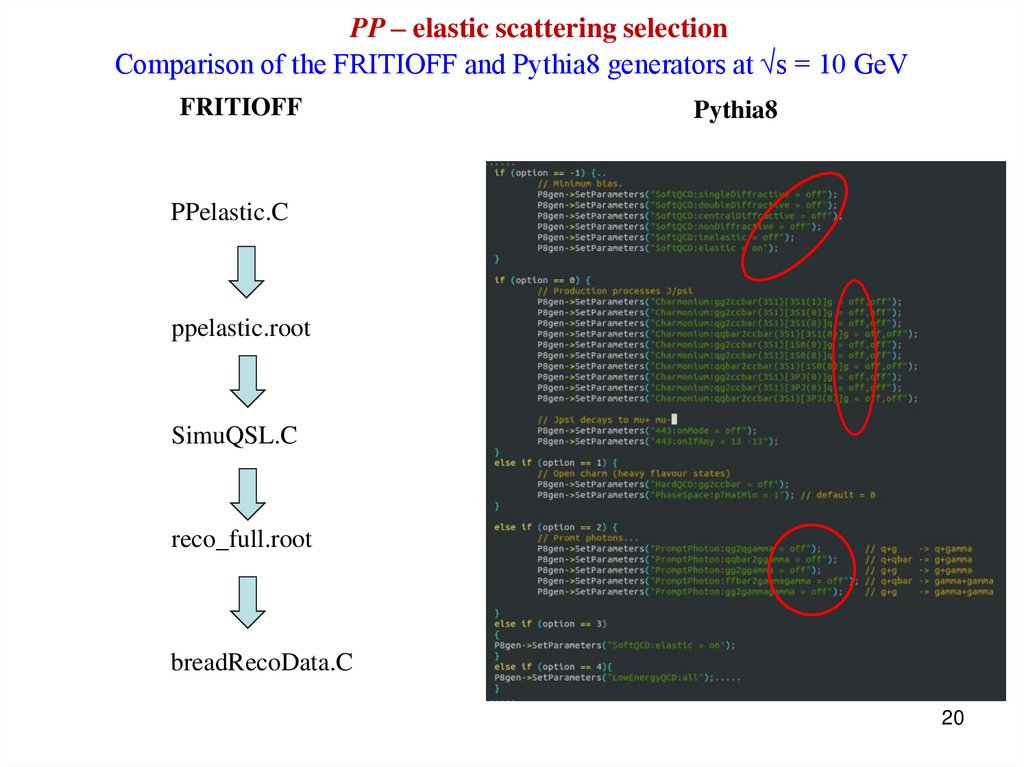
PP – elastic scattering selectionComparison of the FRITIOFF and Pythia8 generators at √s = 10 GeV
FRITIOFF
Pythia8
PPelastic.C
ppelastic.root
SimuQSL.C
reco_full.root
breadRecoData.C
20
21.
PP – inelastic scattering selectionComparison of the FRITIOFF and Pythia8 generators at √s = 10 GeV
FRITIOFF
Pythia8
FTFMake
*FTFGen
(with the PP.mac file)
FTF.root
SimuQSL.C
reco_full.root
breadRecoData.C
21