




 english
Similar presentations:





Listening Strategies
1. LISTENING STRATEGIES How to prepare for the National Exam Part B2: Focus on Listening How to improve your listening skill
2. AIMS OF THE SESSION
To give a brief overview of thelistening test.
To look at the types of tasks you are
asked to do in the test.
To offer useful tips that can help you
develop successful test-taking
strategies
To suggest possible resources
3.
Additionally, this session providesexamination strategies telling you what to
expect and how to best succeed in the test.
A step-by-step guidance on specific
question types that appear in the listening
test
How to approach each question type
4. General Listening Strategies
First, develop general strategies for listening. Thesestrategies should be thoroughly mastered so that
during the actual exam you are fully prepared for
each section and can focus entirely on listening
Practice: the listening skill can only be improve
through extensive practice. Take every opportunity to
listen to English whenever and wherever you can.
Expand your vocabulary on a wide range of topics:
be aware that the listening part of the final test can
cover any topic considered to be within the grasp of a
well-educated person
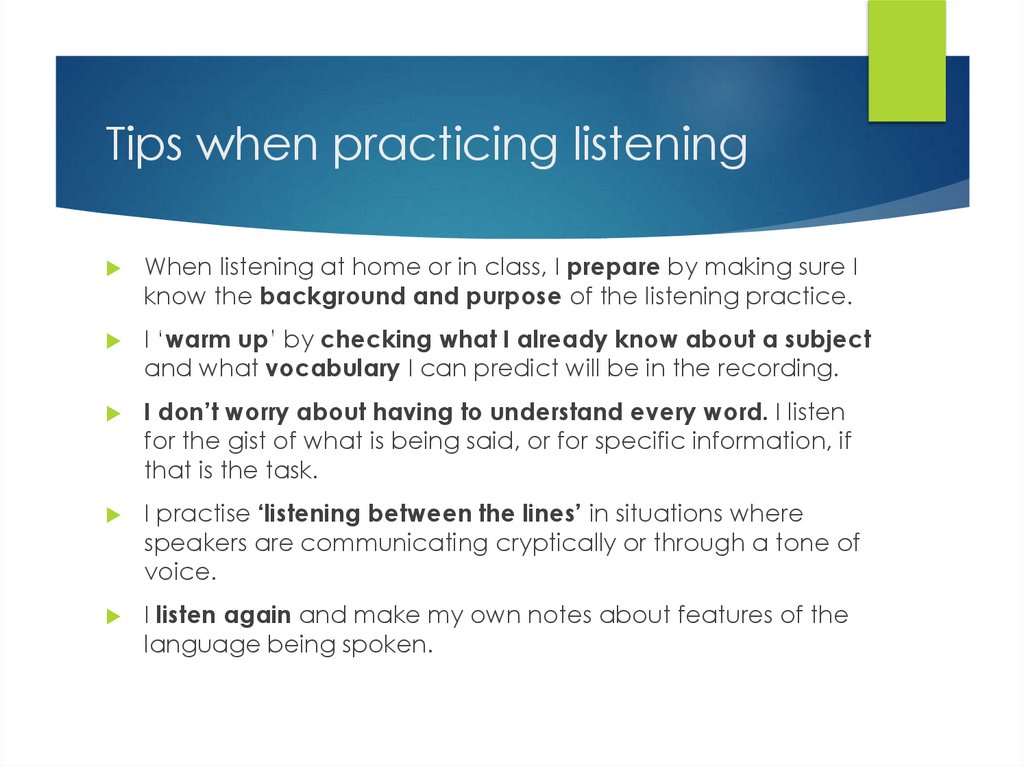
5. Tips when practicing listening
When listening at home or in class, I prepare by making sure Iknow the background and purpose of the listening practice.
I ‘warm up’ by checking what I already know about a subject
and what vocabulary I can predict will be in the recording.
I don’t worry about having to understand every word. I listen
for the gist of what is being said, or for specific information, if
that is the task.
I practise ‘listening between the lines’ in situations where
speakers are communicating cryptically or through a tone of
voice.
I listen again and make my own notes about features of the
language being spoken.
6. Regularly self–assess your progression
It is a good idea to spend some time reviewing whycertain answers are the correct ones. For this reason I
suggest you approach this part in the following
manner:
1. first do the “test”. Do NOT check the key
2. after you have finished listening check your
answers using the answer key.
3.then learn from the “test”: focus on
understanding why certain answers are the
correct ones
7.
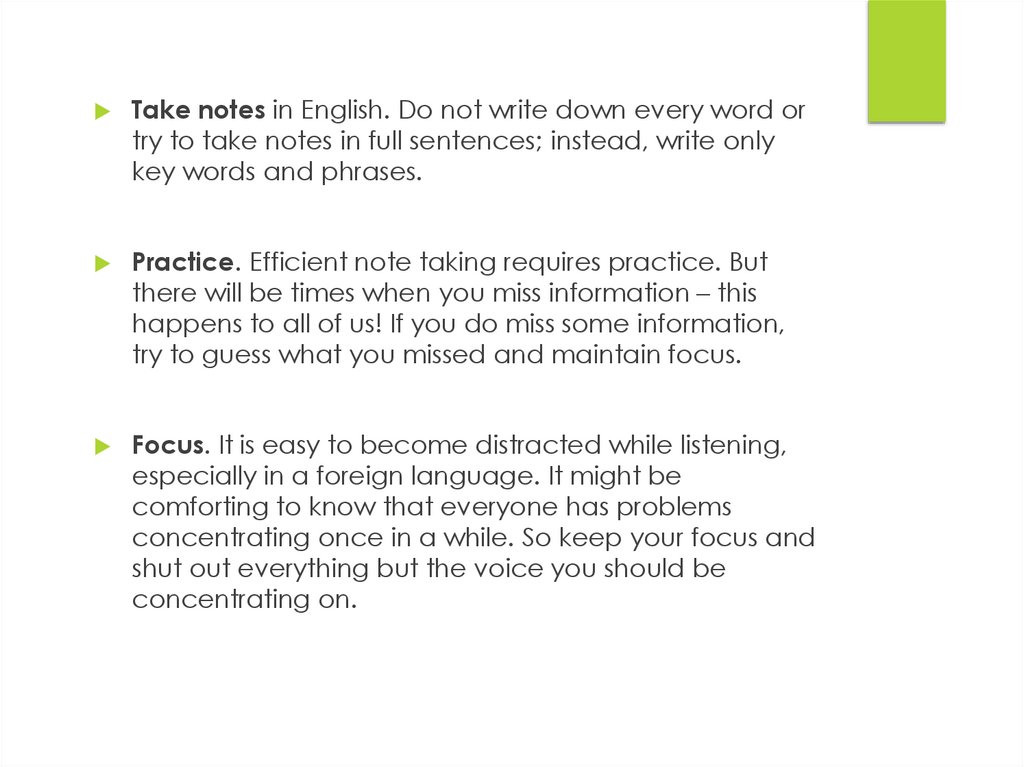
Take notes in English. Do not write down every word ortry to take notes in full sentences; instead, write only
key words and phrases.
Practice. Efficient note taking requires practice. But
there will be times when you miss information – this
happens to all of us! If you do miss some information,
try to guess what you missed and maintain focus.
Focus. It is easy to become distracted while listening,
especially in a foreign language. It might be
comforting to know that everyone has problems
concentrating once in a while. So keep your focus and
shut out everything but the voice you should be
concentrating on.
8. Predicting answers
Prediction. Before listening, read the questions or the tasks,and try to predict the kind of information you are listening for
and what the answers will be. This will help you focus your
mind as your read the questions before you hear the
recording and enable you to make better guesses.
To score well in the Listening Test you need to develop the
ability to think ahead. The more effectively you can predict,
the quicker your mind will form the correct word associations,
and the better you will be able to work out the meaning of
what you hear.
Ask yourself questions like: What is the topic of this particular
section? What is the function of the answer? For instance, is it a
comparison, a list, an instruction, a question?
You can predict the type of information required but also
synonyms and paragraphing that might be used
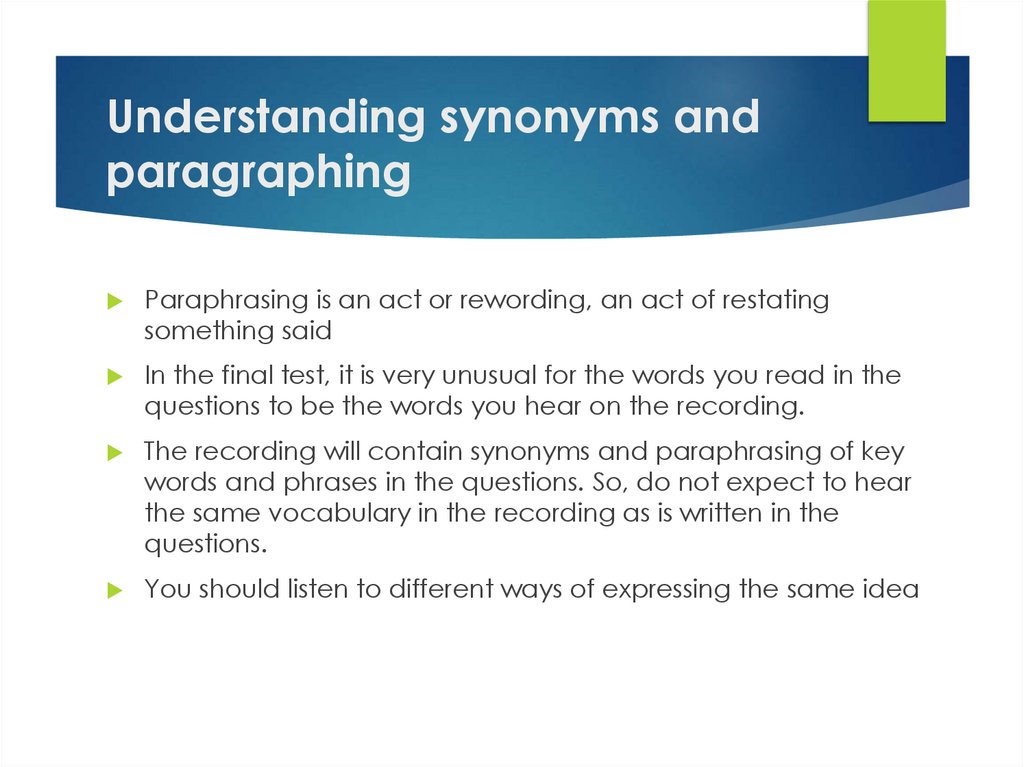
9. Understanding synonyms and paragraphing
Paraphrasing is an act or rewording, an act of restatingsomething said
In the final test, it is very unusual for the words you read in the
questions to be the words you hear on the recording.
The recording will contain synonyms and paraphrasing of key
words and phrases in the questions. So, do not expect to hear
the same vocabulary in the recording as is written in the
questions.
You should listen to different ways of expressing the same idea
10.
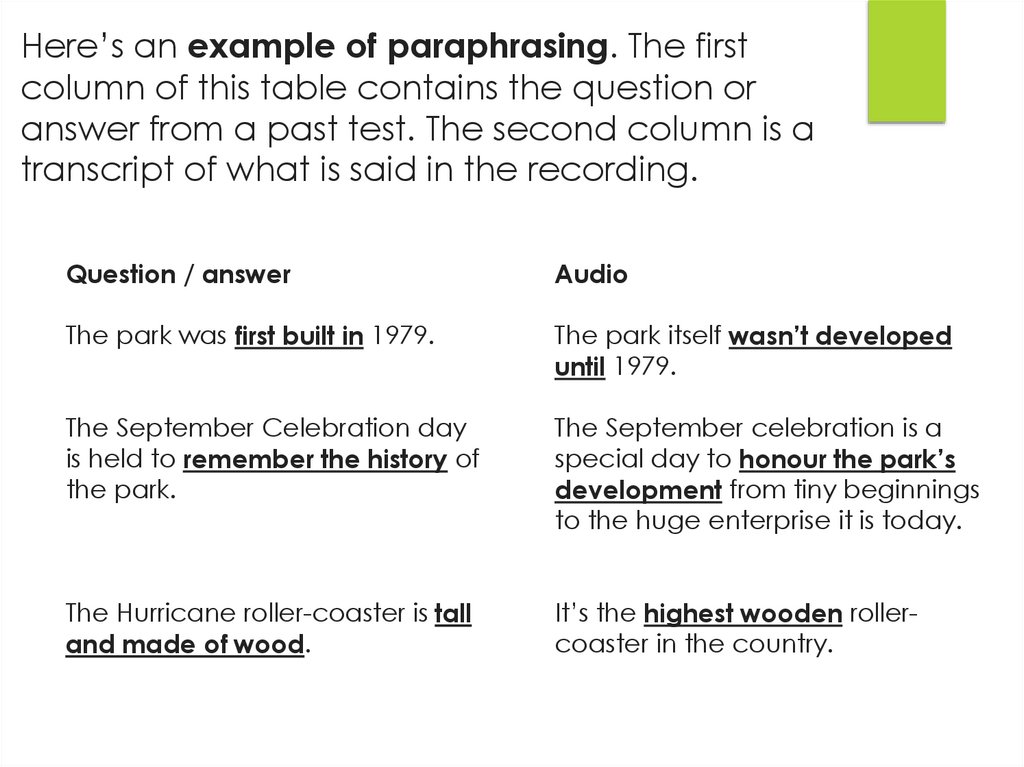
Here’s an example of paraphrasing. The firstcolumn of this table contains the question or
answer from a past test. The second column is a
transcript of what is said in the recording.
Question / answer
Audio
The park was first built in 1979.
The park itself wasn’t developed
until 1979.
The September Celebration day
is held to remember the history of
the park.
The September celebration is a
special day to honour the park’s
development from tiny beginnings
to the huge enterprise it is today.
The Hurricane roller-coaster is tall
and made of wood.
It’s the highest wooden rollercoaster in the country.
11. No surprises – Know your test Listening test format Listening strategies – Mid-Term Test/Final Test in Listening No Surprises –
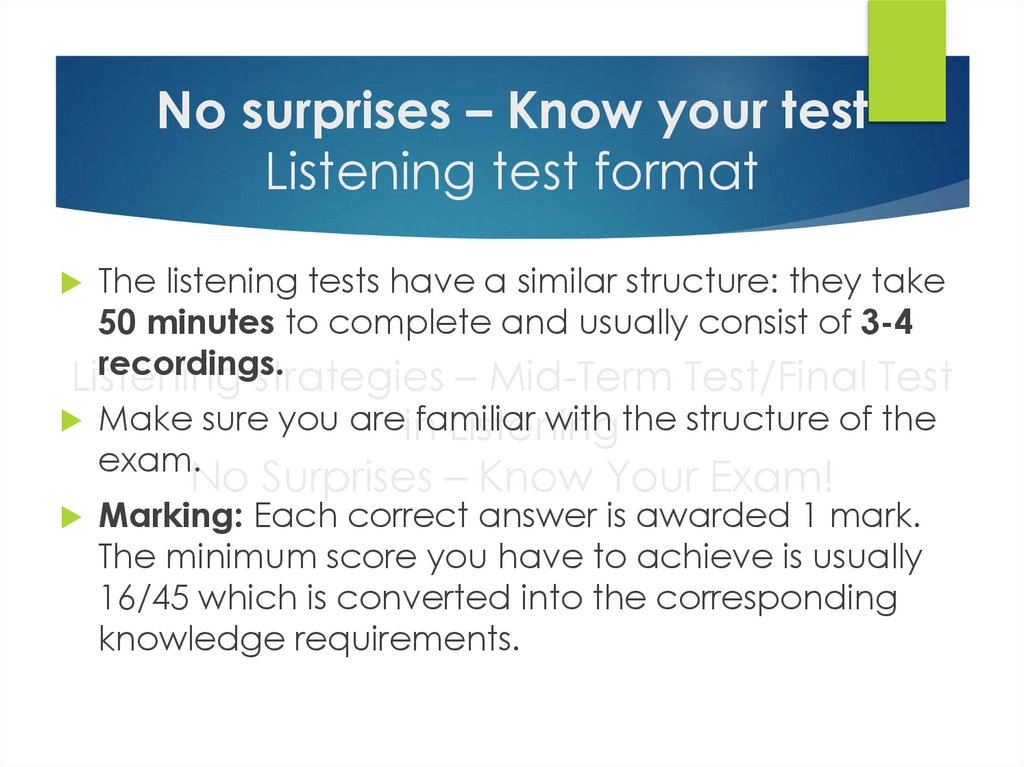
No surprises – Know your testListening test format
The listening tests have a similar structure: they take
50 minutes to complete and usually consist of 3-4
recordings.
Listening
strategies – Mid-Term Test/Final Test
Make sure you arein
familiar
with the structure of the
Listening
exam.
No Surprises – Know Your Exam!
Marking: Each correct answer is awarded 1 mark.
The minimum score you have to achieve is usually
16/45 which is converted into the corresponding
knowledge requirements.
12. Skills Assessed
The Listening test is designed toassess your ability to:
understand main ideas
understand detailed factual information
recognise the opinions and attitudes of speakers
recognise the purpose of the communication
follow the development of ideas or arguments
13. You Only Listen Once
You Only Listen OnceYou Only Listen Once - with one
exception. Find out how many times
you will hear the recording (check the
instructions). It will affect the way you
listen.
Here is a tip to doing well with just one
listening: When you do practice test,
listen only once. Get used to it.
14. Think In English
Many students of English often tryand translate everything in their
heads.
Don’t do it. On the listening exam
you won’t have time to translate.
15. READ THE INSTRUCTIONS CAREFULLY
Read the headline – can help you make predictionsRead/Listen carefully to the instructions because they tell
you what to do, what kind of answer to give. For instance, if
the instructions say “Read through questions 1 to 4” or
“Now, answer questions 1-4”, you should focus on that and
nothing else.
students who don’t read or listen to the instructions carefully
may believe they are saving time, but the instructions
contain vital information which must be understood in order
to answer correctly.
Find out how many times you will hear the recording
(usually clearly written with capital letters: ONCE or TWICE)
16. Read the question carefully and use keywords to find answers
Read the question carefully; make sure youunderstand the question before the listening begins.
Focus on keywords and the question words: is it
When?, where?, why? How long? How much?
Keywords: The keywords or key phrases in the
questions help you in your search for right answers.
On the test paper, underline keywords. Prepare to
listen for those exact words and their synonyms.
There may be more than one keyword or keyword phrase in a question, and they can be
placed before or after the answer.
17. Take notes while listening
Take short notes as you listenIn most of the cases you will only hear the
recording once, so you must listen carefully
and take notes as you go. Note down the
main ideas and as much supporting detail as
you can. Learn to condense your notes into
keywords and shorthand.
18. Answer the Question
Only write what is necessary /asked for - do not mentionthings which are beside the point.
Make sure your answer matches the question. check it
against the question and make sure that you didn’t
misread the question, and the answer choice DOES
answer the question posed.
Focus on understanding what is said - not on grammar
and spelling!
19. KNOW WHEN TO MOVE ON TO THE NEXT QUESTION
Most of the sections are divided into small parts (usually 3-4questions each), and you are not told when the next question
comes. When the passage is being played, you should:
- be aware of the content of the next question... as you listen for the
answer to the current question.
If you do not think ahead to the next question, and you miss an
answer, you might be unable to keep up with the tape. You could
still be waiting for an answer that has already been given.
Listen for the question topic keywords/ key phrases, any marker
words/phrases (see next slide), and the changes in the speaker's
inflexion or pitch, to help you recognise when the questions
change.
20. Marker words/phrases can tell you when the topic/questions is changing.
Listen for marker words/phrases so that you know tomove on to the next question.
e.g. - And now (we will)... - Now tell me,... - Next, I'd
like to...
Finally, can you tell us ... - Right, so the first thing ... - To
start with ...
- Before I move on to ... - I'd like now to move on to ... One more thing ...
- And what about...? - Well, that's about it, except for ...
21. FOCUS
Focus on the question - don’t get distracted by all thatother language going around. Keep your eyes on the
question. When you’ve heard the answer to that
question, write down the answer, move straight to the
next question and pay attention to that and that alone.
When given the opportunity to listen to something twice,
it's advisable to formulate an opinion after the first
listening, and then on the second listening, verify that
your initial guess was correct. It's crucial to actively listen
during the second time and not assume that your initial
response was correct.
22.
Check It Twice, Be Precise!Little mistakes can count big. A few silly mistakes
can be the difference between passing and failing
the test.
If there's time at the end, check again your answers
and see if they make sense.
Don’t panic: If you miss something during the exam,
don’t panic, just keep going and try to focus on the
rest of the exam. Don’t tune out.