
 english
Similar presentations:








Basic word order
1. BASIC WORD ORDER
SubjectThe person, place, or thing that
the sentence is about
The dog
Verb
Action or state of being
eats
I like animals.
I like animals, but Molly prefers plants.
I like animals because they are cute.
I like animals because they are cute, so I work at an animal shelter.
Object
The noun or nouns that receives the
action of the verb or is affected by the
action of the verb
popcorn.
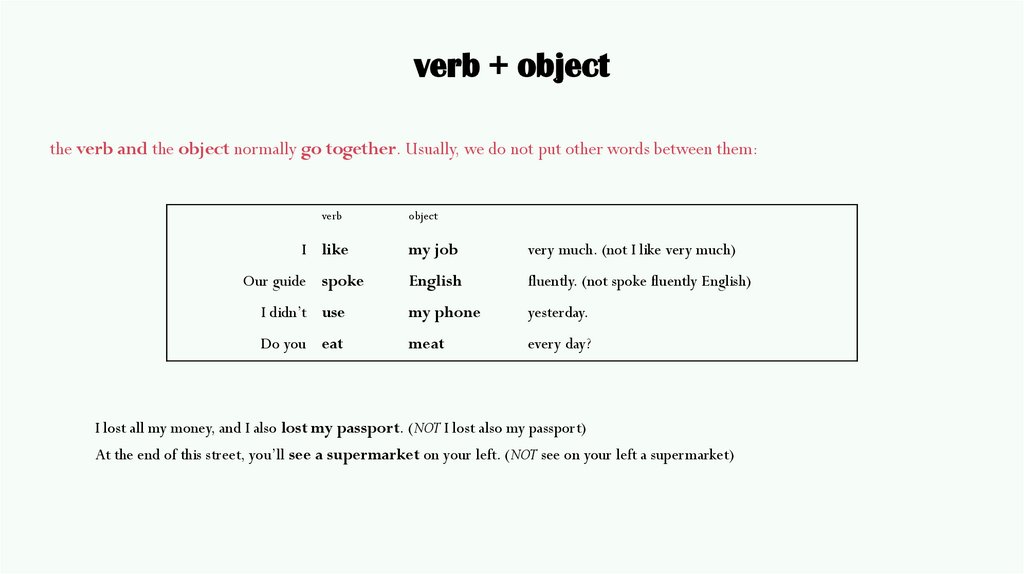
2. verb + object
the verb and the object normally go together. Usually, we do not put other words between them:verb
I like
object
my job
very much. (not I like very much)
Our guide spoke
English
fluently. (not spoke fluently English)
I didn’t use
my phone
yesterday.
Do you eat
meat
every day?
I lost all my money, and I also lost my passport. (NOT I lost also my passport)
At the end of this street, you’ll see a supermarket on your left. (NOT see on your left a supermarket)
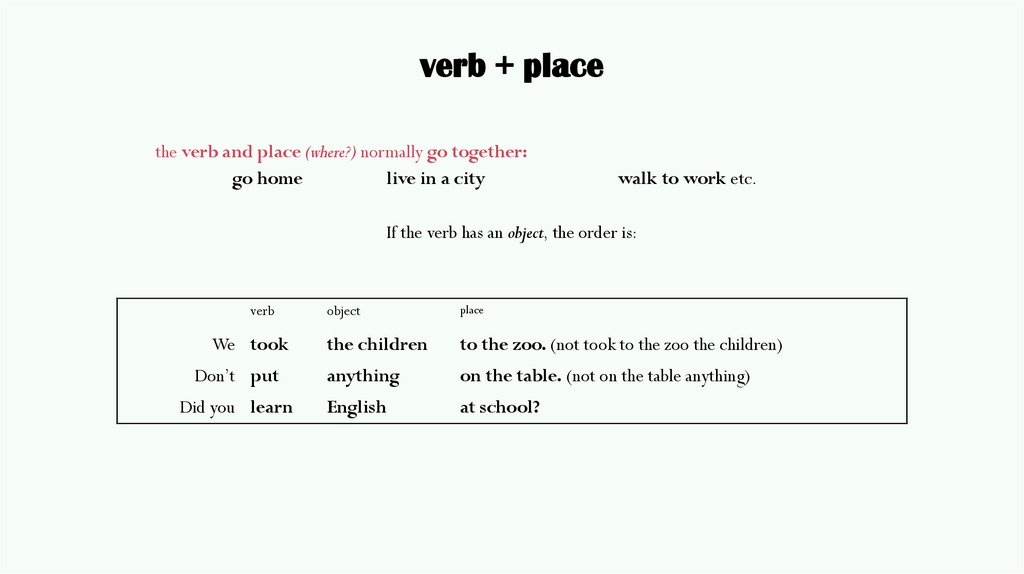
3. verb + place
the verb and place (where?) normally go together:go home
live in a city
walk to work etc.
If the verb has an object, the order is:
object
place
the children
to the zoo. (not took to the zoo the children)
Don’t put
anything
on the table. (not on the table anything)
Did you learn
English
at school?
verb
We took
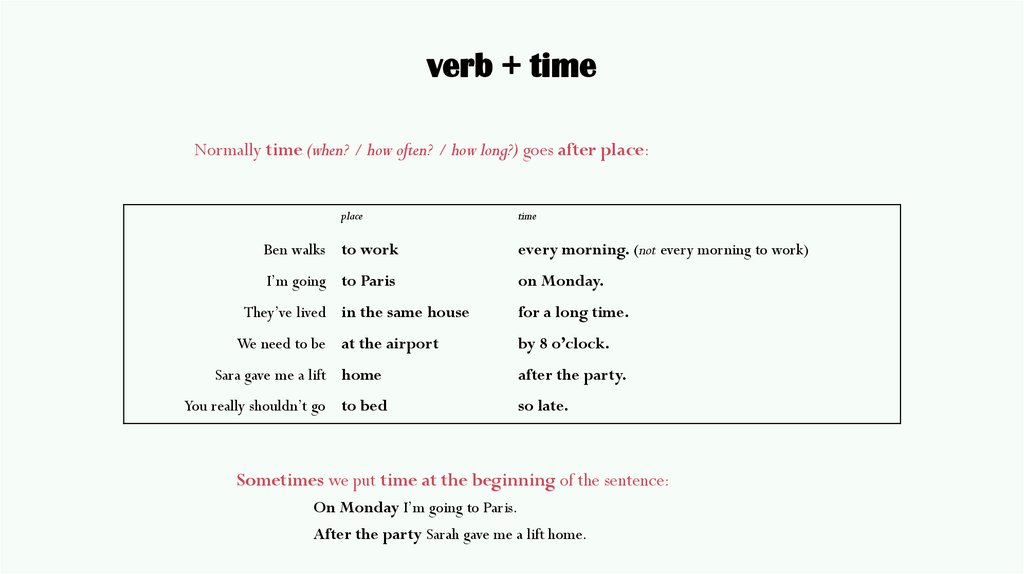
4. verb + time
Normally time (when? / how often? / how long?) goes after place:place
time
Ben walks to work
every morning. (not every morning to work)
I’m going to Paris
on Monday.
They’ve lived in the same house
for a long time.
We need to be at the airport
by 8 o’clock.
Sara gave me a lift home
You really shouldn’t go to bed
after the party.
so late.
Sometimes we put time at the beginning of the sentence:
On Monday I’m going to Paris.
After the party Sarah gave me a lift home.
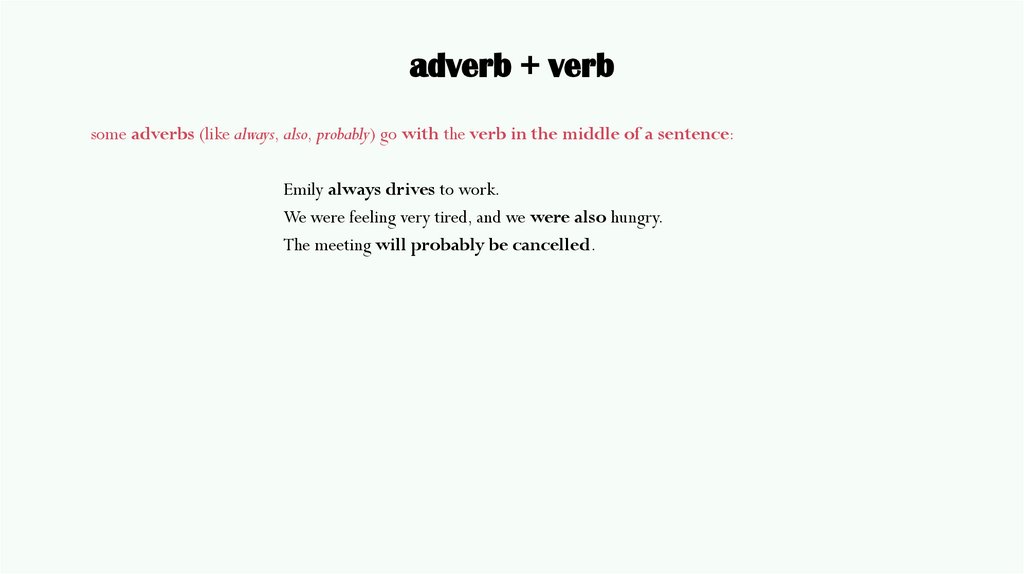
5.
adverb + verbsome adverbs (like always, also, probably) go with the verb in the middle of a sentence:
Emily always drives to work.
We were feeling very tired, and we were also hungry.
The meeting will probably be cancelled.
6.
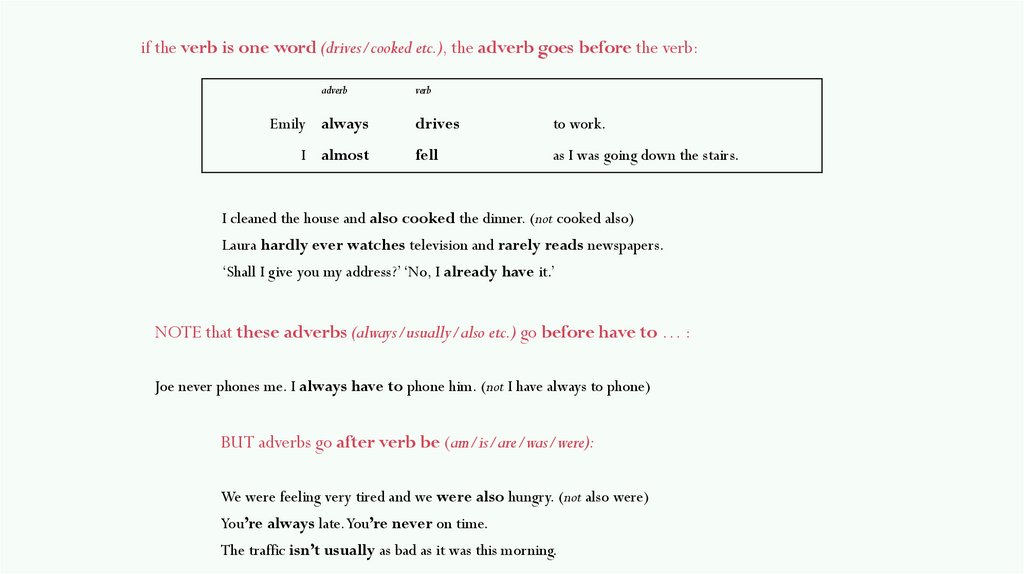
if the verb is one word (drives/cooked etc.), the adverb goes before the verb:adverb
Emily always
I almost
verb
drives
to work.
fell
as I was going down the stairs.
I cleaned the house and also cooked the dinner. (not cooked also)
Laura hardly ever watches television and rarely reads newspapers.
‘Shall I give you my address?’ ‘No, I already have it.’
NOTE that these adverbs (always/usually/also etc.) go before have to … :
Joe never phones me. I always have to phone him. (not I have always to phone)
BUT adverbs go after verb be (am/is/are/was/were):
We were feeling very tired and we were also hungry. (not also were)
You’re always late.You’re never on time.
The traffic isn’t usually as bad as it was this morning.
7.
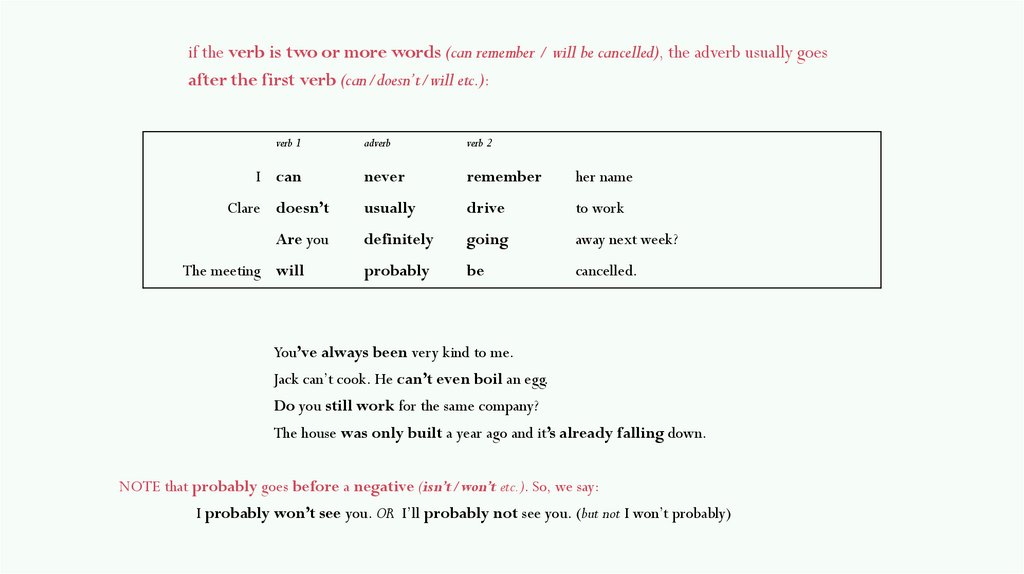
if the verb is two or more words (can remember / will be cancelled), the adverb usually goesafter the first verb (can/doesn’t/will etc.):
verb 1
adverb
verb 2
I can
never
remember
her name
Clare doesn’t
usually
drive
to work
definitely
going
away next week?
probably
be
cancelled.
Are you
The meeting will
You’ve always been very kind to me.
Jack can’t cook. He can’t even boil an egg.
Do you still work for the same company?
The house was only built a year ago and it’s already falling down.
NOTE that probably goes before a negative (isn’t/won’t etc.). So, we say:
I probably won’t see you. OR I’ll probably not see you. (but not I won’t probably)
8.
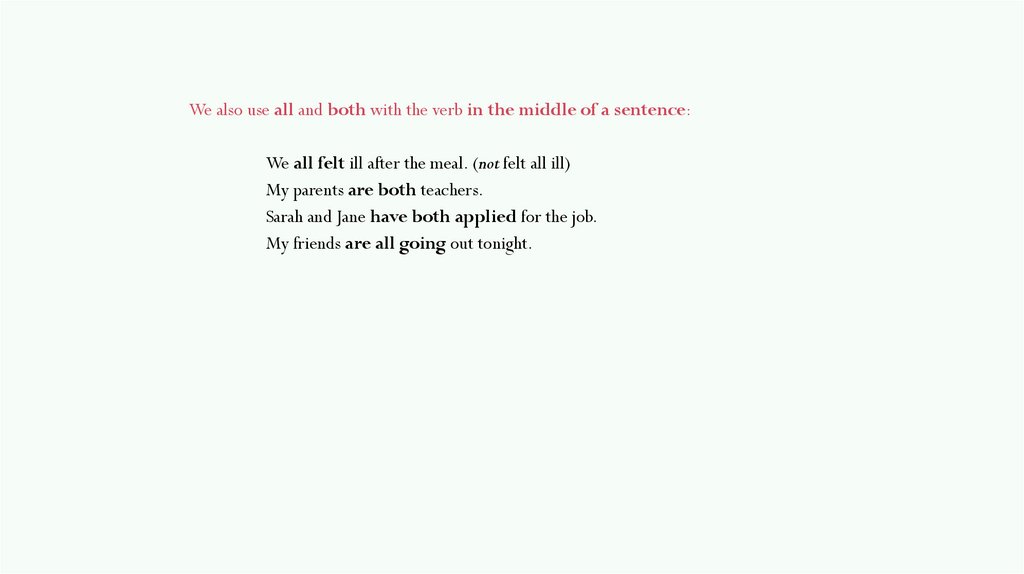
We also use all and both with the verb in the middle of a sentence:We all felt ill after the meal. (not felt all ill)
My parents are both teachers.
Sarah and Jane have both applied for the job.
My friends are all going out tonight.