 english
Similar presentations:






Flow charts.Recycling
1.
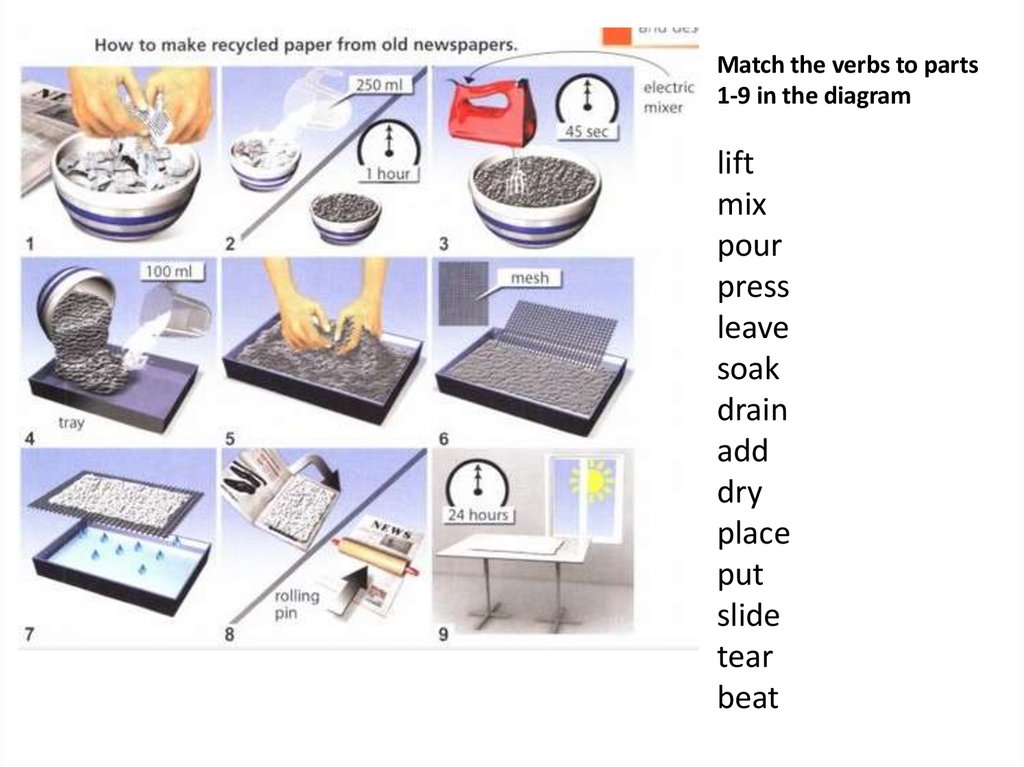
Match the verbs to parts1-9 in the diagram
lift
mix
pour
press
leave
soak
drain
add
dry
place
put
slide
tear
beat
2.
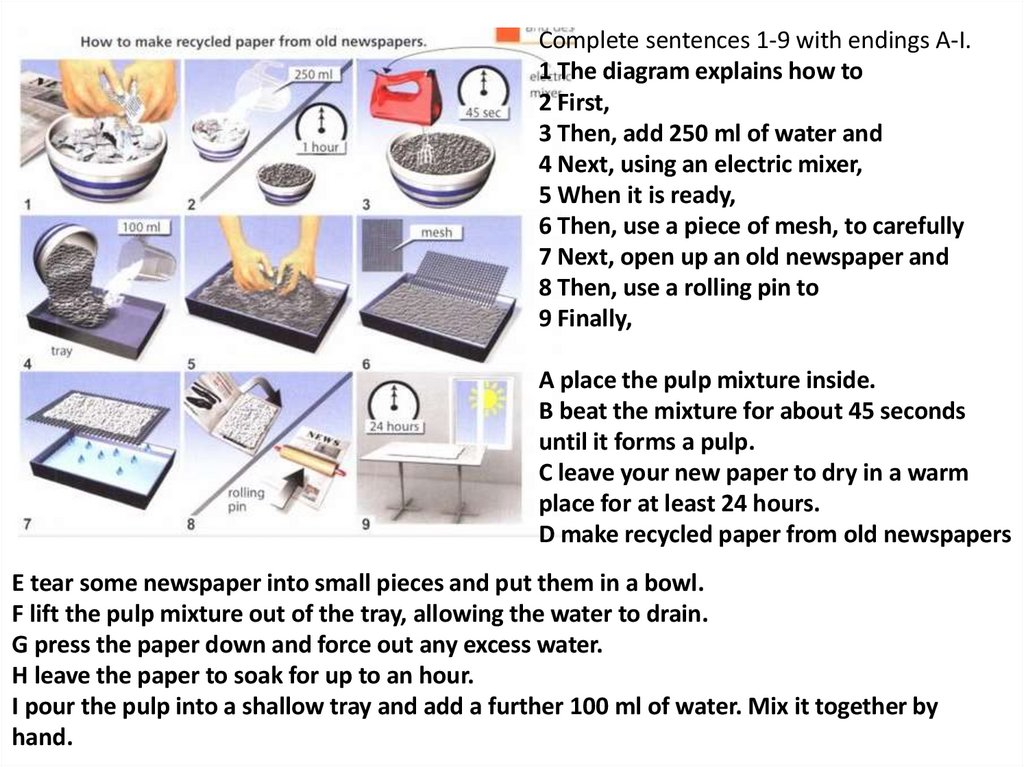
Complete sentences 1-9 with endings A-I.1 The diagram explains how to
2 First,
3 Then, add 250 ml of water and
4 Next, using an electric mixer,
5 When it is ready,
6 Then, use a piece of mesh, to carefully
7 Next, open up an old newspaper and
8 Then, use a rolling pin to
9 Finally,
A place the pulp mixture inside.
B beat the mixture for about 45 seconds
until it forms a pulp.
C leave your new paper to dry in a warm
place for at least 24 hours.
D make recycled paper from old newspapers
E tear some newspaper into small pieces and put them in a bowl.
F lift the pulp mixture out of the tray, allowing the water to drain.
G press the paper down and force out any excess water.
H leave the paper to soak for up to an hour.
I pour the pulp into a shallow tray and add a further 100 ml of water. Mix it together by
hand.
3.
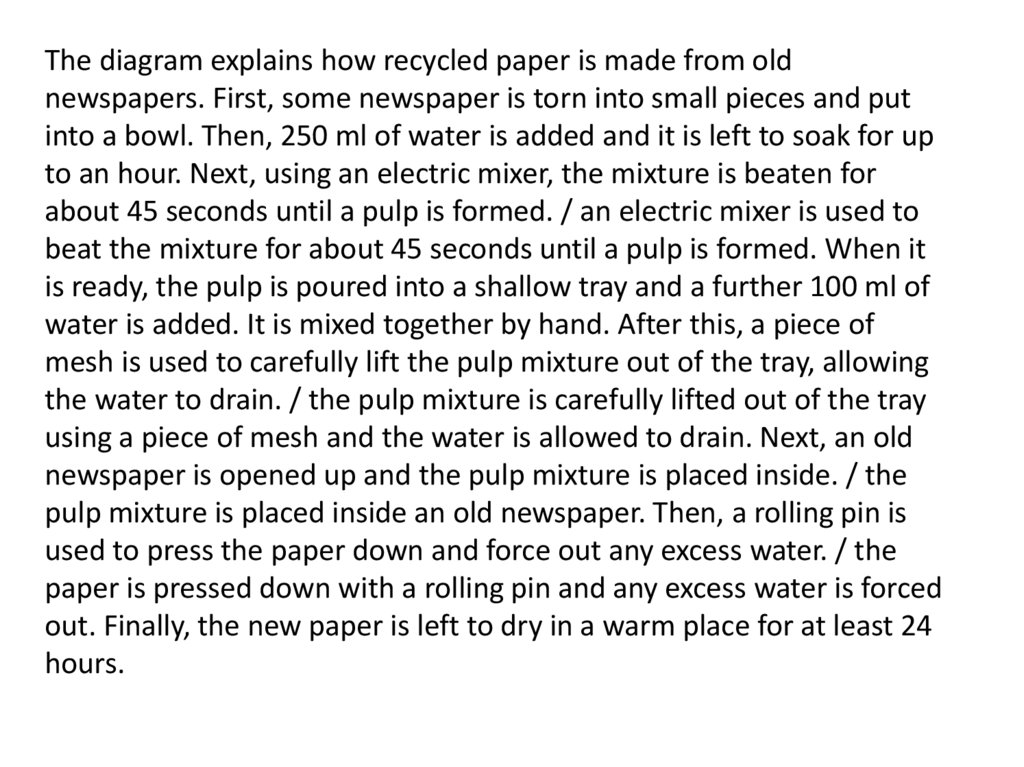
The diagram explains how recycled paper is made from oldnewspapers. First, some newspaper is torn into small pieces and put
into a bowl. Then, 250 ml of water is added and it is left to soak for up
to an hour. Next, using an electric mixer, the mixture is beaten for
about 45 seconds until a pulp is formed. / an electric mixer is used to
beat the mixture for about 45 seconds until a pulp is formed. When it
is ready, the pulp is poured into a shallow tray and a further 100 ml of
water is added. It is mixed together by hand. After this, a piece of
mesh is used to carefully lift the pulp mixture out of the tray, allowing
the water to drain. / the pulp mixture is carefully lifted out of the tray
using a piece of mesh and the water is allowed to drain. Next, an old
newspaper is opened up and the pulp mixture is placed inside. / the
pulp mixture is placed inside an old newspaper. Then, a rolling pin is
used to press the paper down and force out any excess water. / the
paper is pressed down with a rolling pin and any excess water is forced
out. Finally, the new paper is left to dry in a warm place for at least 24
hours.
4.
5.
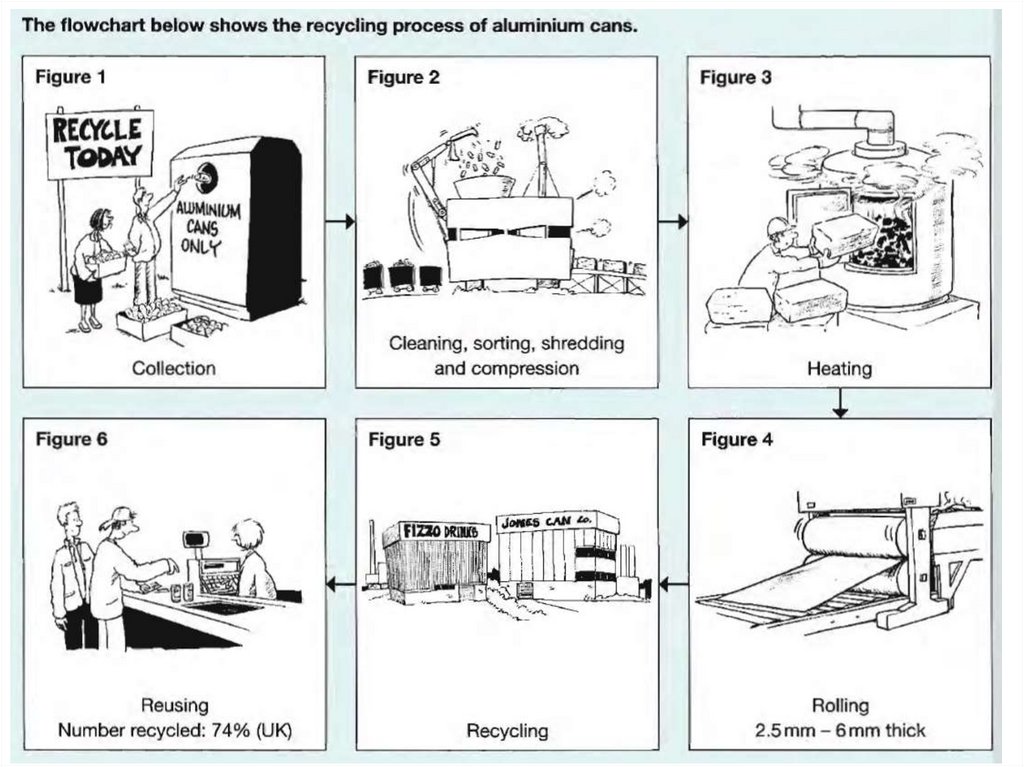
The flowchart shows how aluminium cans are recycled. First, thecans need to be taken to special collection centres instead of
being thrown away with the normal refuse. The cans are collected
from here and taken to a factory where they are first sorted and
then cleaned. Next, the cans are shredded and crushed in a
special machine until they form one solid block. The metal is then
heated to a high enough temperature to allow the aluminium to
melt. It is then rolled out flat to a thickness of between 2.5 mm
and 6 mm, depending on what it is going to be used for. The
aluminium is now ready to be recycled into new packaging, such
as drink containers. Finally, the new cans are delivered to a soft
drinks factory where they are filled. The cans can now be sold to
the public and reused. In the UK, 74 per cent of all aluminium
cans that are sold are recycled.