









 lingvistics
Similar presentations:





Lecture 7. Frame semantics
1. LECTURE 7 . FRAME SEMANTICS
LECTURE7.FRAME SEMANTICS
1 What is a semantic frame? Word meanings denote parts of
frames.
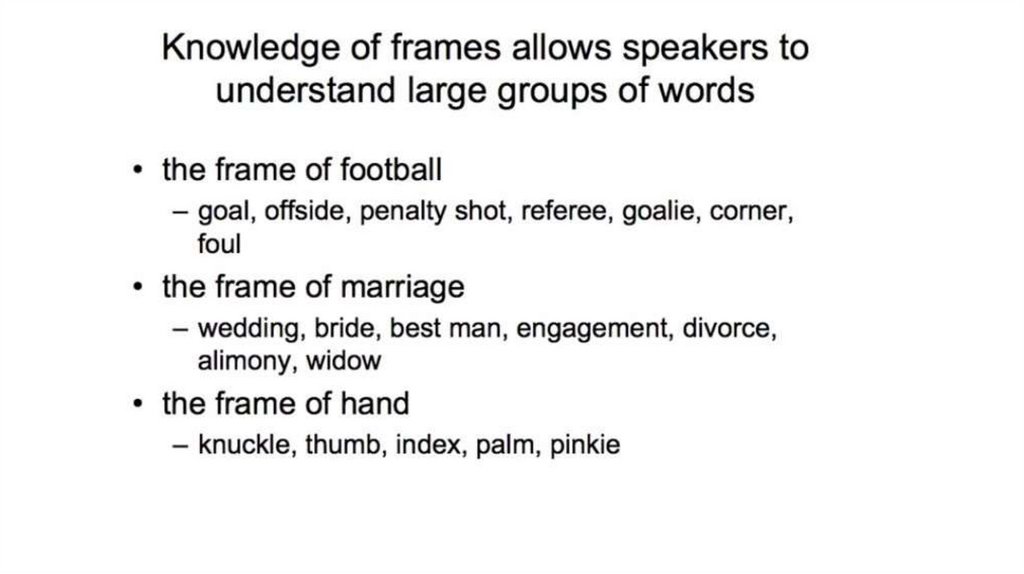
2 Knowledge of frames allows people to understand words.
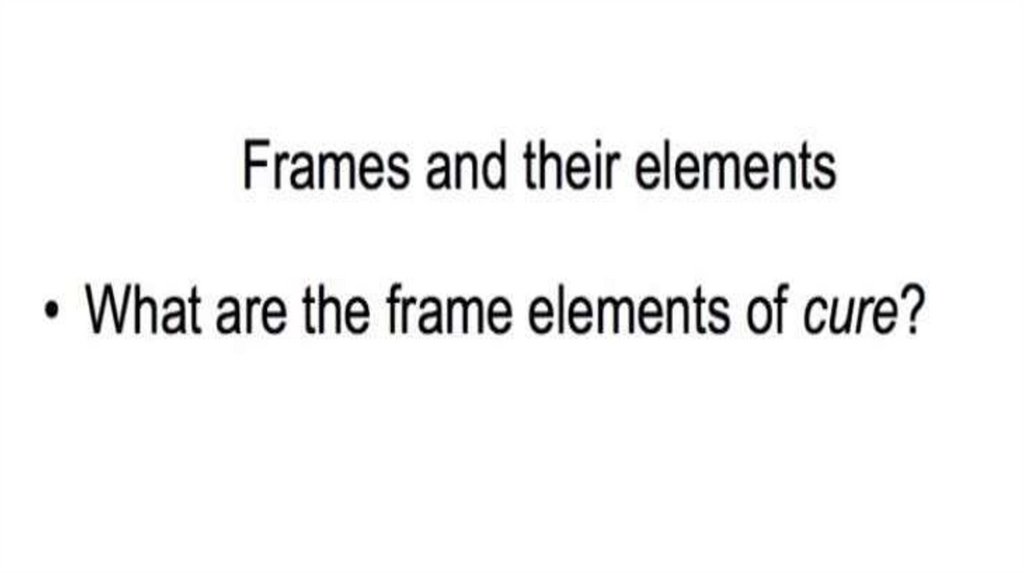
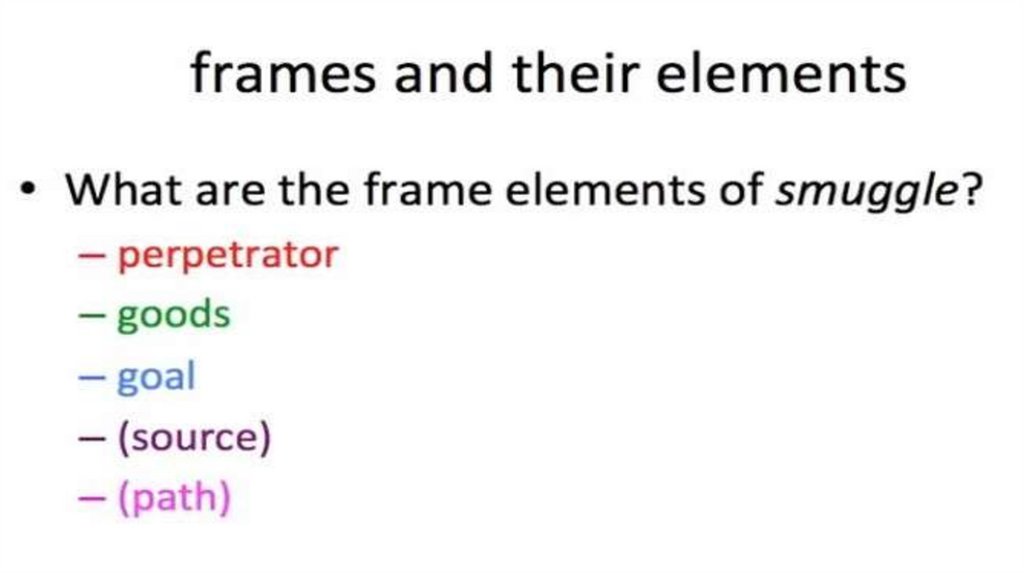
Frames and their elements.
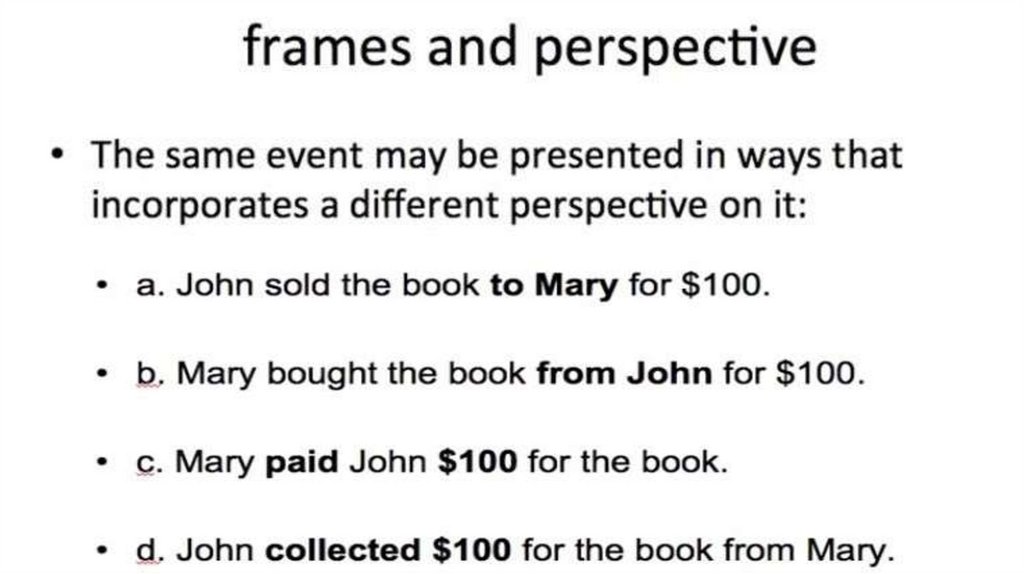
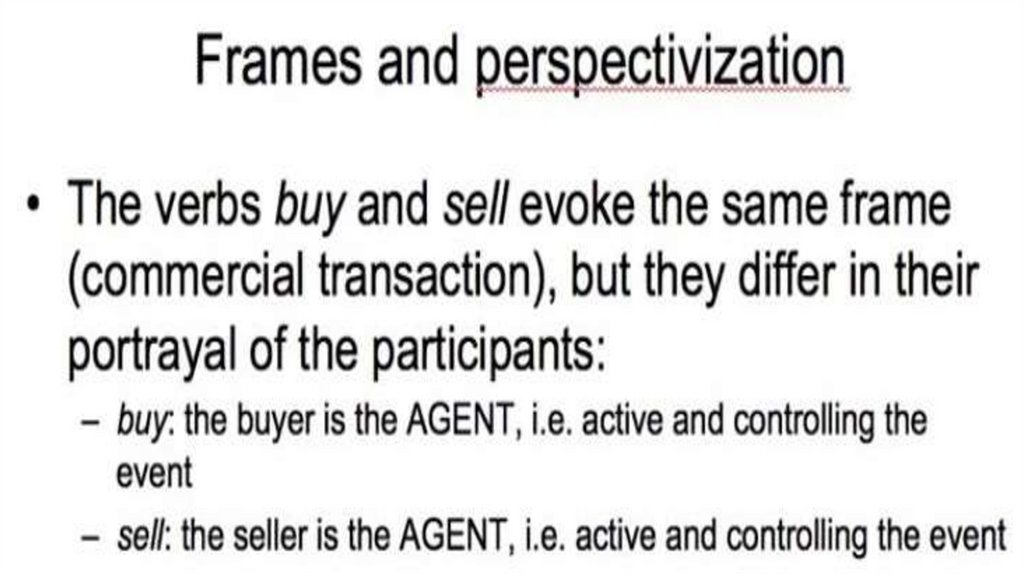
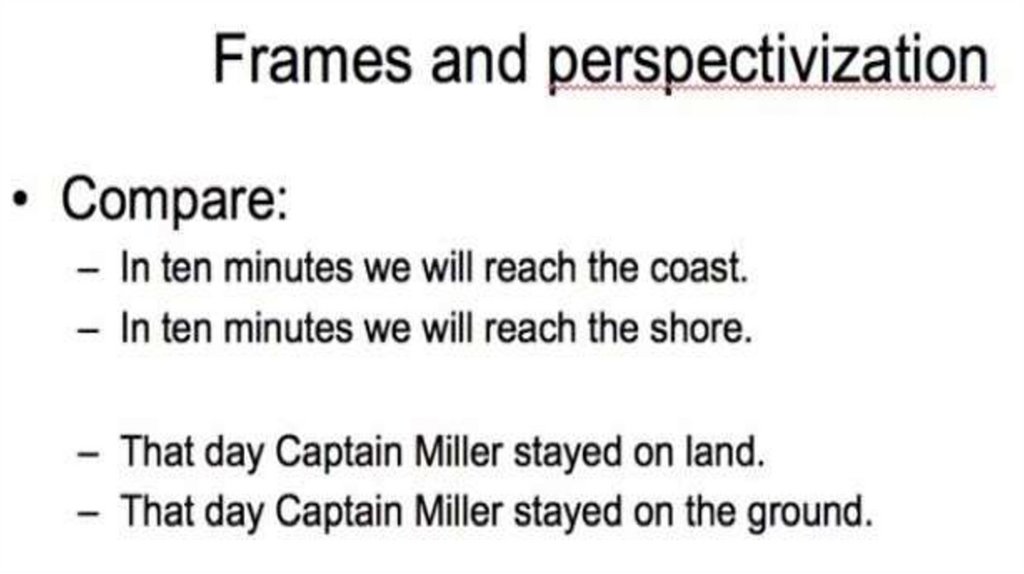
3 Frames impose a perspective on an event.
4 Frames reflect cultural practices.
5 Basic syntactic patterns reflect basic semantic frames.
6 Frames are culturally contested.
7 The implications of frame semantics for language learning and
teaching.
2. 1. What is a Semantic Frame?
According to Fillmore a frame is a schematisation ofexperience (a knowledge structure), which is represented at
the conceptual level and held in long-term memory. The
frame relates the elements and entities associated with a
particular culturally embedded scene from human
experience.
Charles Fillmore (1975, 1977, 1982, 1985a).
3. What is a semantic frame?
Frames are cognitive schemas that you use to interpretevents and situations in the world.
Frames are your mental representation of situations that
you experience very often in the world.
The frame that you use gives you a certain worldview.
The same event in the world may be interpreted in very
different ways.
4. Key features of frame semantics include:
Semantic FramesWord Meaning
Context-Dependent Meaning
Cultural and Contextual Variation
Pragmatic Inferences
Applications
5. Define discount
6.
7.
8.
9.
10.
How do words get their meanings?11.
12.
13.
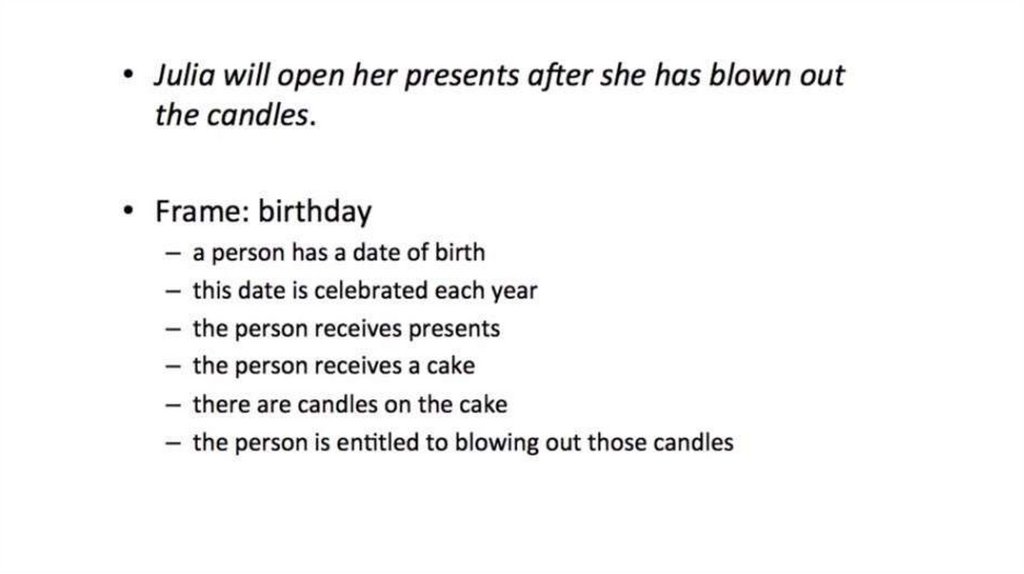
What do words do in terms of frame semantics?14. Words evoke frames
E.g. Julia will open her presents after she has blown out thecandles.
15.
16.
17.
18.
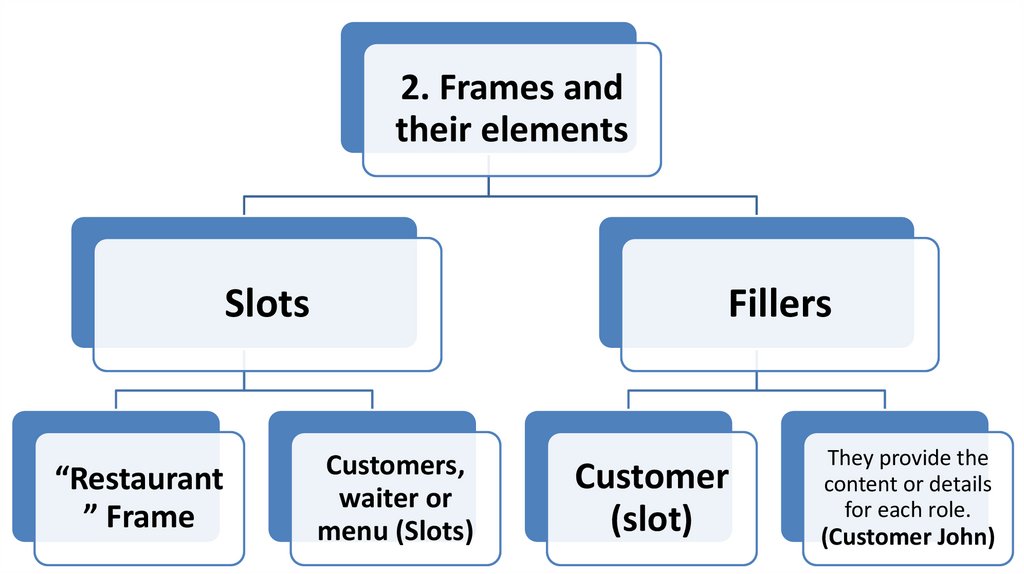
2. Frames andtheir elements
Slots
“Restaurant
” Frame
Fillers
Customers,
waiter or
menu (Slots)
Customer
(slot)
They provide the
content or details
for each role.
(Customer John)
19.
20.
21.
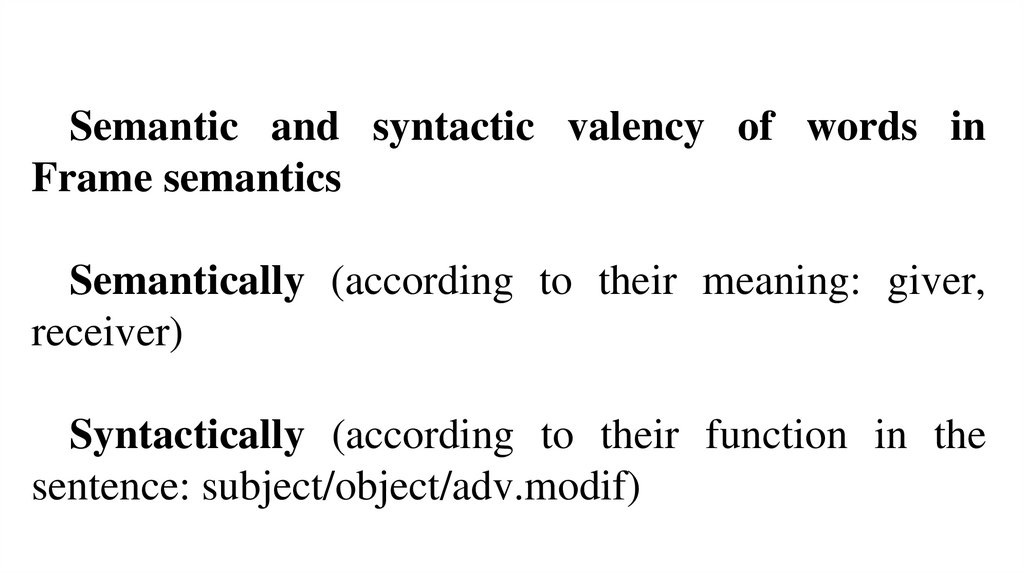
Semantic and syntactic valency of words inFrame semantics
Semantically (according to their meaning: giver,
receiver)
Syntactically (according to their function in the
sentence: subject/object/adv.modif)
22.
23.
24.
25.
3. Frames impose a perspective on anevent.
26.
27.
28.
29.
30.
31.
32.
33.
34.
35.
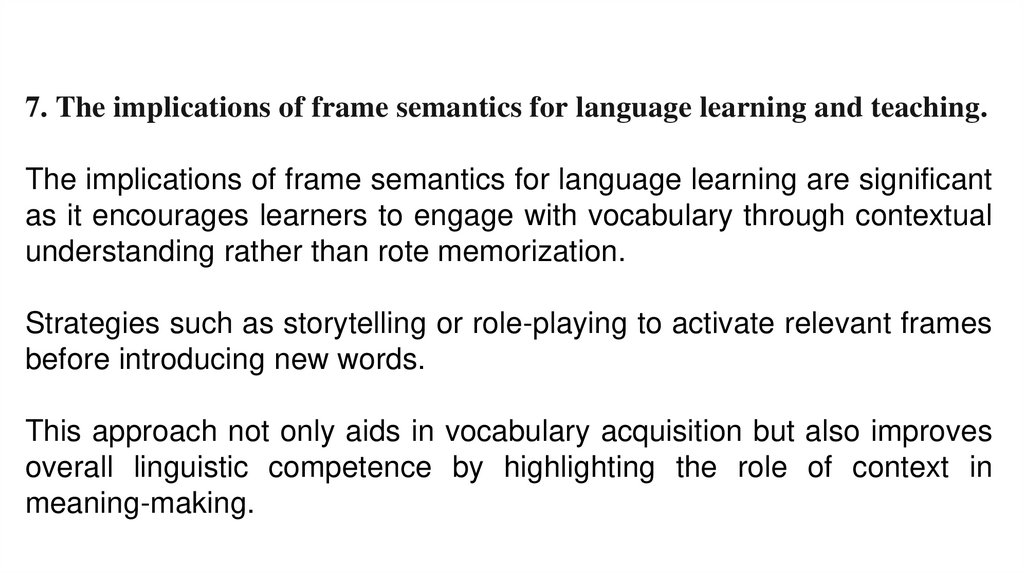
7. The implications of frame semantics for language learning and teaching.The implications of frame semantics for language learning are significant
as it encourages learners to engage with vocabulary through contextual
understanding rather than rote memorization.
Strategies such as storytelling or role-playing to activate relevant frames
before introducing new words.
This approach not only aids in vocabulary acquisition but also improves
overall linguistic competence by highlighting the role of context in
meaning-making.
36.
37. REFERENCES
1. Evans V., Green M. (2006). Cognitive Linguistics.An Introduction. EDINBURGH UNIVERSITY
PRESS.
2. Fillmore, Charles J. (1982). "Frame Semantics."
Linguistic Society of Korea (Ed.), Linguistics in
the Morning Calm (pp. 111-137).
3. Lakoff, George (1987). "Women, Fire, and
Dangerous Things: What Categories Reveal
About the Mind." University of Chicago Press.
4. Barsalou, Lawrence W. (2008). "Grounded
Cognition." Annual Review of Psychology, 59,
617-645.
5. Johnson, Mark (1987). "The Body in the Mind:
The Bodily Basis of Meaning, Imagination, and
Reason." University of Chicago Press.
6. Goffman, Erving (1974). "Frame Analysis: An
Essay on the Organization of Experience."
Harper & Row.
7. Kövecses, Zoltán (2000). "Metaphor and
Emotion: Language, Culture, and Body in Human
Feeling." Cambridge University Press.
8. Goldberg, Adele E. (1995). "Constructions: A
Construction Grammar Approach to Argument
Structure." University of Chicago Press.
9. Talmy, Leonard (1985). "Lexicalization patterns:
Semantic structure in lexical forms." Language
Typology and Syntactic Description, 57-149.
10. Fillmore, Charles J.(2006). "Frame semantics."
Malden, MA: Blackwell Publishing.
11. Lakoff, George, & Johnson, Mark (1980).
"Metaphors We Live By." University of Chicago
Press.