
 english
Similar presentations:
Units and components of phonetic system
1. UNITS AND COMPONENTS OF THE PHONETIC SYSTEM
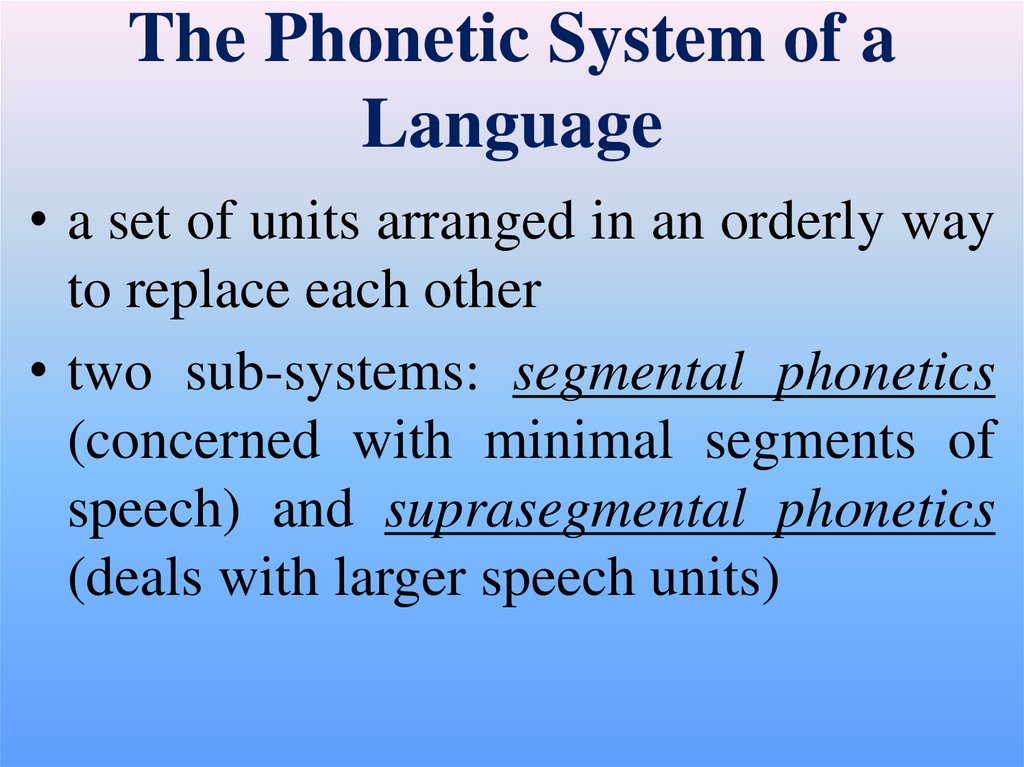
2. The Phonetic System of a Language
• a set of units arranged in an orderly wayto replace each other
• two sub-systems: segmental phonetics
(concerned with minimal segments of
speech) and suprasegmental phonetics
(deals with larger speech units)
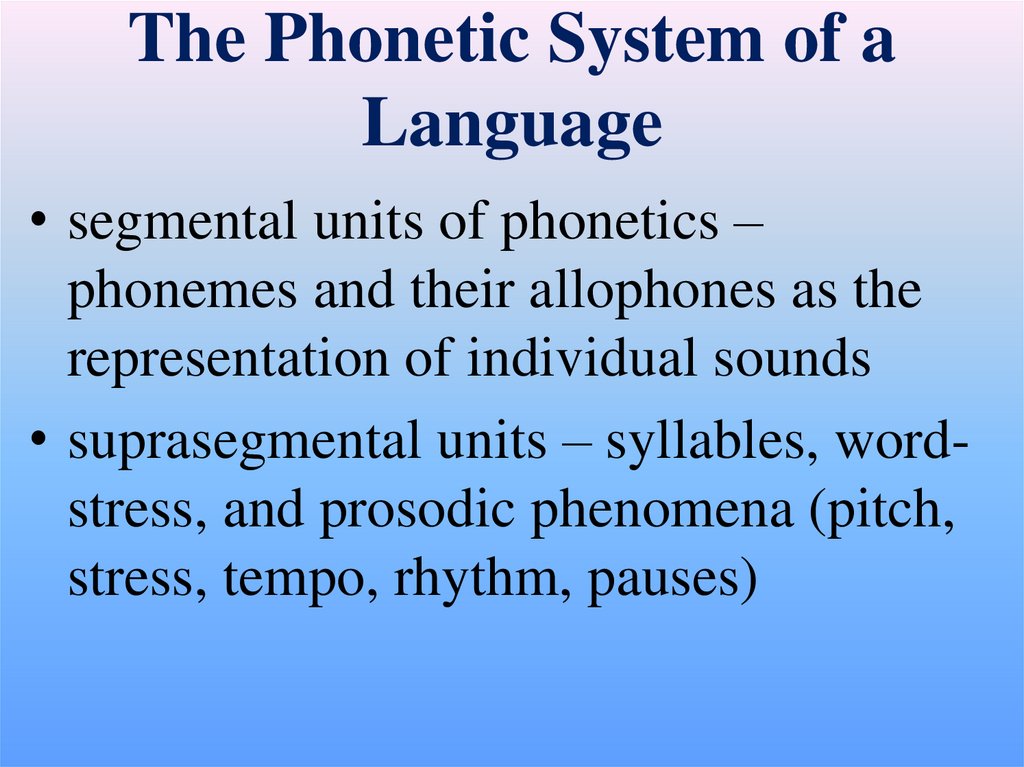
3. The Phonetic System of a Language
• segmental units of phonetics –phonemes and their allophones as the
representation of individual sounds
• suprasegmental units – syllables, wordstress, and prosodic phenomena (pitch,
stress, tempo, rhythm, pauses)
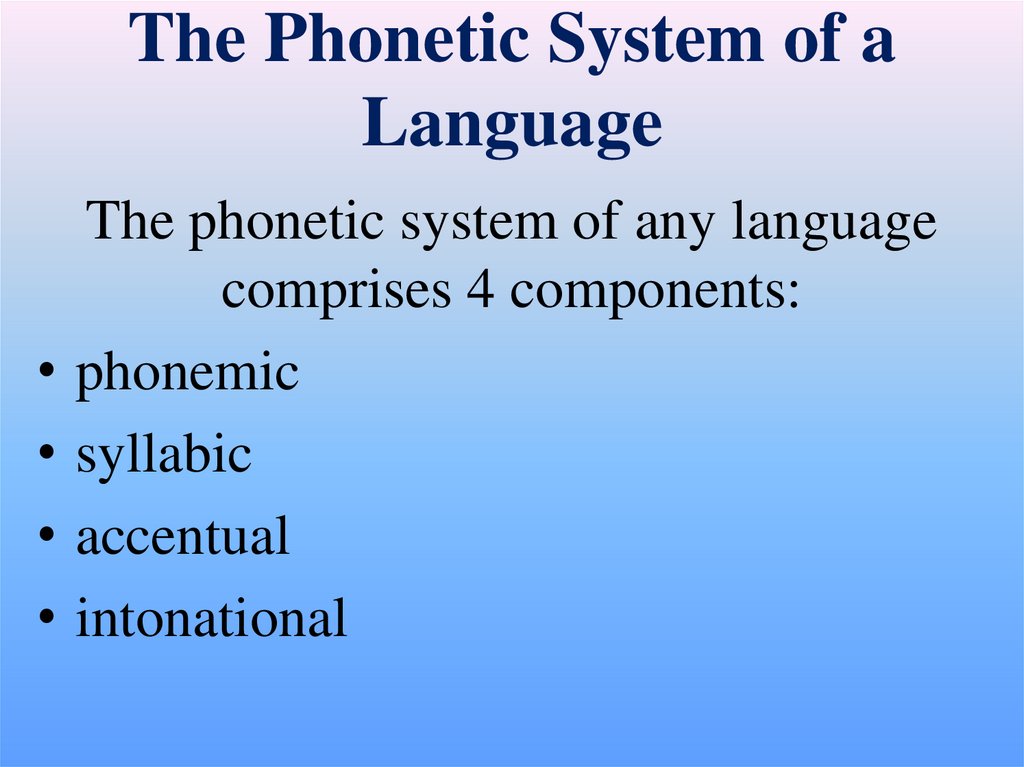
4. The Phonetic System of a Language
The phonetic system of any languagecomprises 4 components:
• phonemic
• syllabic
• accentual
• intonational
5. The Phonemic Component
—the system of phonemes as discreteisolated units
—the distribution of allophones of
different phonemes
—the methods of joining speech sounds
6. The Syllabic Structure
• syllable formation• syllable division
7. The Accentual Structure
—the acoustic nature of word stress—the stress position in disyllabic and
polysyllabic words
—the degrees of word stress
8. The Intonational Structure
—the prosodic components ofintonation
—the structure of intonation patterns
—the representation of patterns in
intonation groups
9. Phoneme: Definition
is a minimal abstract linguistic unitrealized in speech in the form of speech
sounds opposable to other phonemes of
the same language in order to distinguish
the meaning of morphemes and words
10. Phoneme: Definition
• the materialistic view of the phoneme– L.V. Shcherba, V.A. Vassilyev and
other phoneticians
• is viewed as a functional, material and
abstract unit, which performs 3
functions: distinctive, constitutive and
recognitive
11. Phoneme: Functions
as a functional unit – the distinctivefunction distinguishes different sounds in
a contrastive sense and serves as the
smallest language unit that discriminates
between larger language units
12. Phoneme: Functions
as a material, real and objective unit –the constitutive function – is realized in
speech in the form of its variants or
allophones and serve to constitute the
material form of morphemes
13. Phoneme: Functions
as an abstract and generalized unit –the recognitive function – serves to
distinguish and understand the
meaning
14. Phonemes, Allophones, Phones
• the phoneme is a minimal abstractlinguistic unit opposed to other phonemes
in order to distinguish the meaning of
morphemes and words
• possesses a bundle of distinctive features
(the invariant of the phoneme)
15. Phonemes, Allophones, Phones
• the articulatory features characteristic ofthe invariant – distinctive (relevant)
• can be extracted when opposing to each
other in the same phonetic context
• phonemes with a difference in one
articulatory feature bring changes in
meaning
16. Phonemes, Allophones, Phones
• articulatory features which do not serve todistinguish meaning – non-distinctive
(irrelevant)
• are observed within the allophones of a
certain phoneme
• 2 types: incidental (redundant) and
indispensable (concomitant)
17. Phonemes, Allophones, Phones
• allophones – possible variants of thesame phoneme, which never occur in
similar phonetic contexts
• aren't used to differentiate meaning,
depend on the phonetic context
• 2 types: principal and subsidiary
18. Phonemes, Allophones, Phones
• a principal allophone - retains the typicalarticulatory characteristics of the
phoneme
• a subsidiary allophone - changes in the
articulation of an allophone under the
influence of the phonetic environment
19. Phonemes, Allophones, Phones
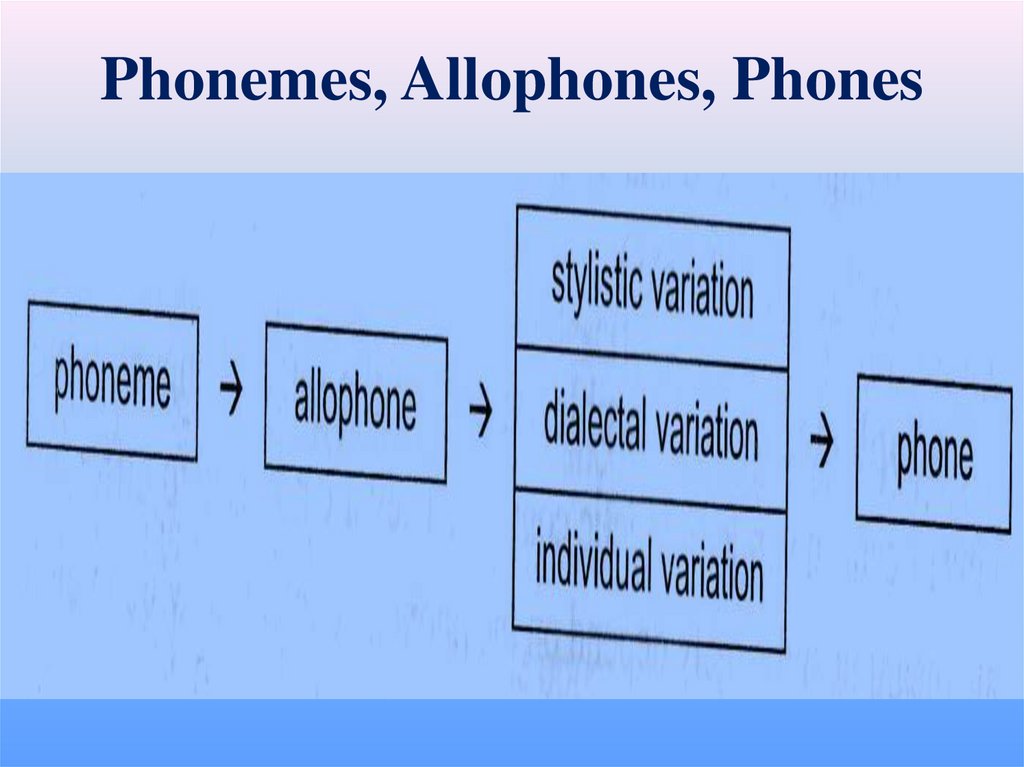
• the actual realization of allophones in thespeech chain is exercised through phones
• are not predicted by phonetic context but
modified by phonostylistic, dialectal and
individual variations