
 biography
Similar presentations:






The character of Newton
1.
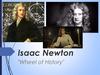
Isaac NewtonEnglish physicist, mathematician, mechanic and astronomer, one of the
founders of classical physics and mathematical analysis.
2.
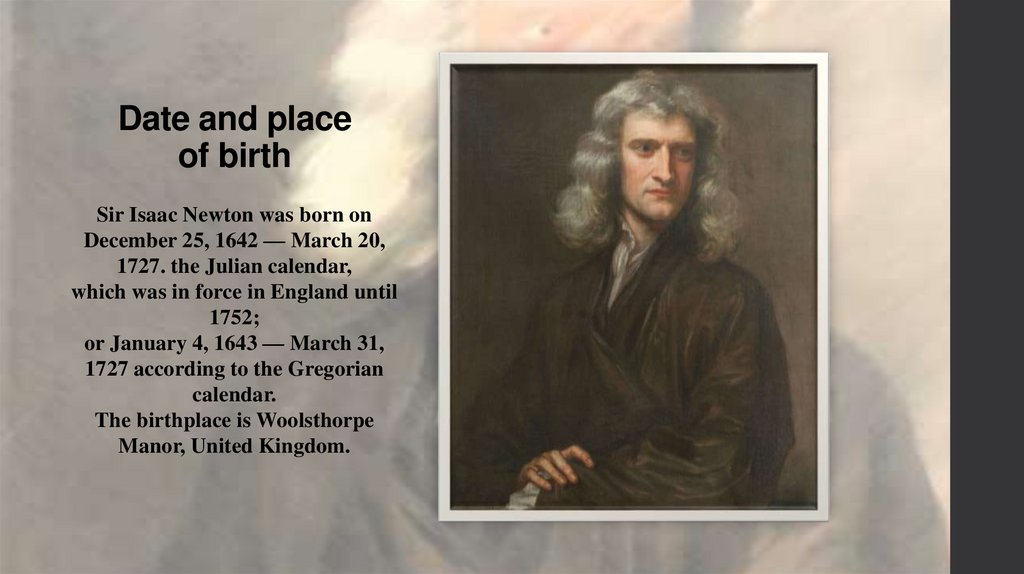
Date and placeof birth
Sir Isaac Newton was born on
December 25, 1642 — March 20,
1727. the Julian calendar,
which was in force in England until
1752;
or January 4, 1643 — March 31,
1727 according to the Gregorian
calendar.
The birthplace is Woolsthorpe
Manor, United Kingdom.
3.
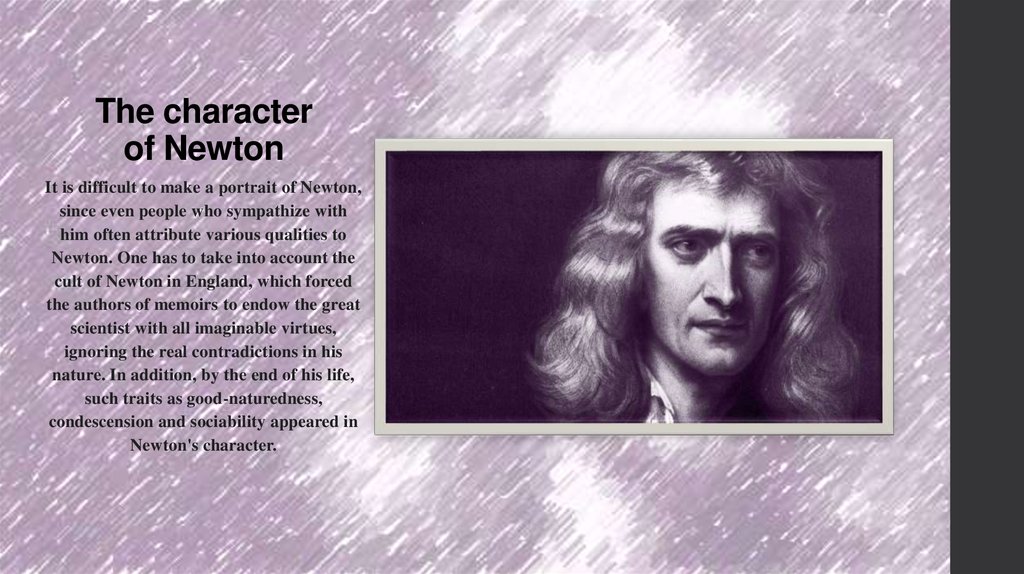
The characterof Newton
It is difficult to make a portrait of Newton,
since even people who sympathize with
him often attribute various qualities to
Newton. One has to take into account the
cult of Newton in England, which forced
the authors of memoirs to endow the great
scientist with all imaginable virtues,
ignoring the real contradictions in his
nature. In addition, by the end of his life,
such traits as good-naturedness,
condescension and sociability appeared in
Newton's character.
4.
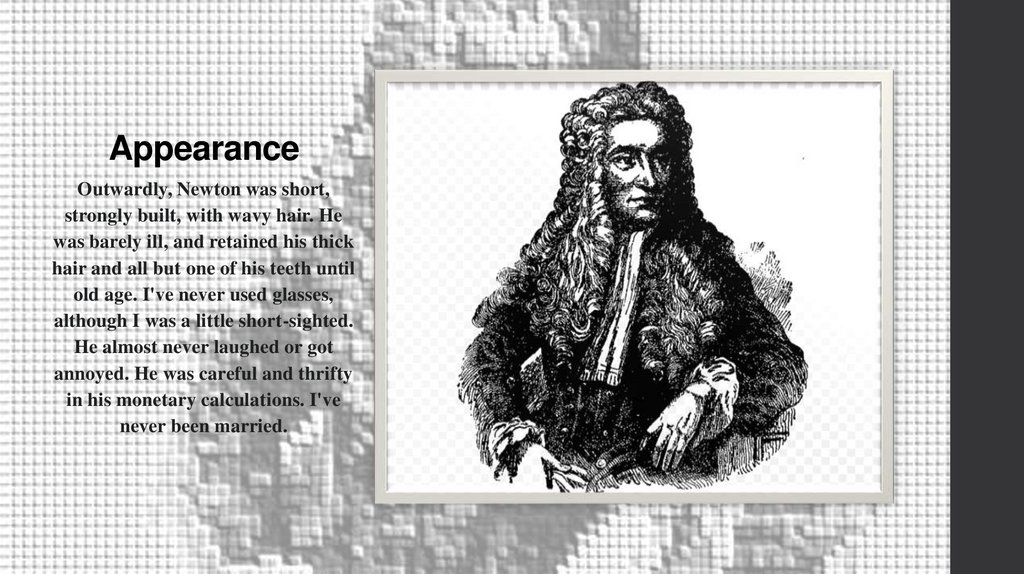
AppearanceOutwardly, Newton was short,
strongly built, with wavy hair. He
was barely ill, and retained his thick
hair and all but one of his teeth until
old age. I've never used glasses,
although I was a little short-sighted.
He almost never laughed or got
annoyed. He was careful and thrifty
in his monetary calculations. I've
never been married.
5.
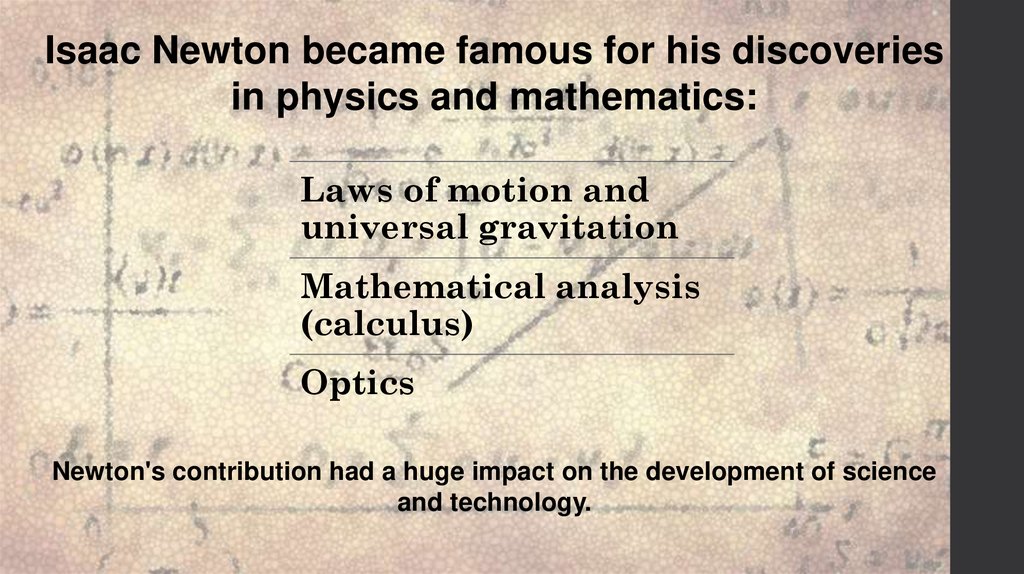
Isaac Newton became famous for his discoveriesin physics and mathematics:
Laws of motion and
universal gravitation
Mathematical analysis
(calculus)
Optics
Newton's contribution had a huge impact on the development of science
and technology.
6.
Newton's Three LawsNewton's First Law is the Law of Inertia
Newton's Second Law is the Basic Law of Dynamics
Newton's Third Law - The Law of Action and Reaction
These three laws underlie classical mechanics and describe
the motion of objects under the influence of forces.
7.
The story of Newton and the AppleNewton was forced to leave Cambridge and in the garden of his
house, he witnessed the fall of an apple.
Instead of just taking it for granted, Newton thought about it.
It is said that these reflections led Newton to formulate the law of
universal gravitation.
In conclusion: The story of Newton and the apple is not a literal
description of the discovery of gravity, but rather a metaphor
illustrating the process of scientific thinking and the ability to see
patterns in seemingly mundane phenomena. She emphasizes the
importance of curiosity, observation, and the ability to ask
questions.