 english
Similar presentations:





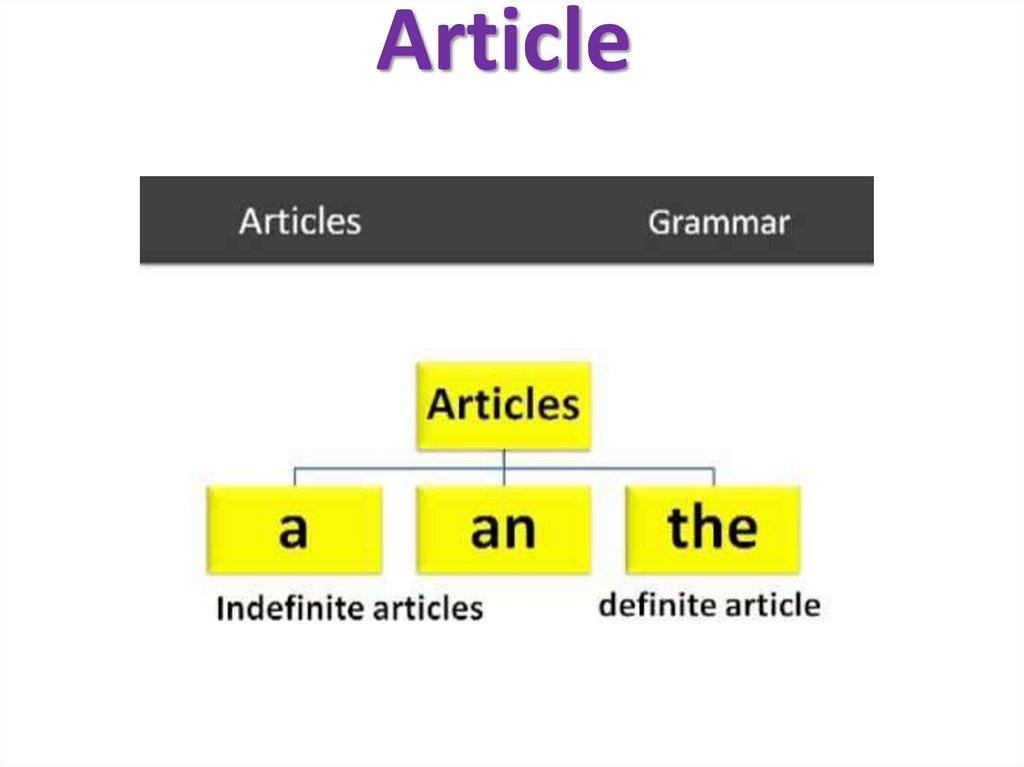
Article
1.
Article2.
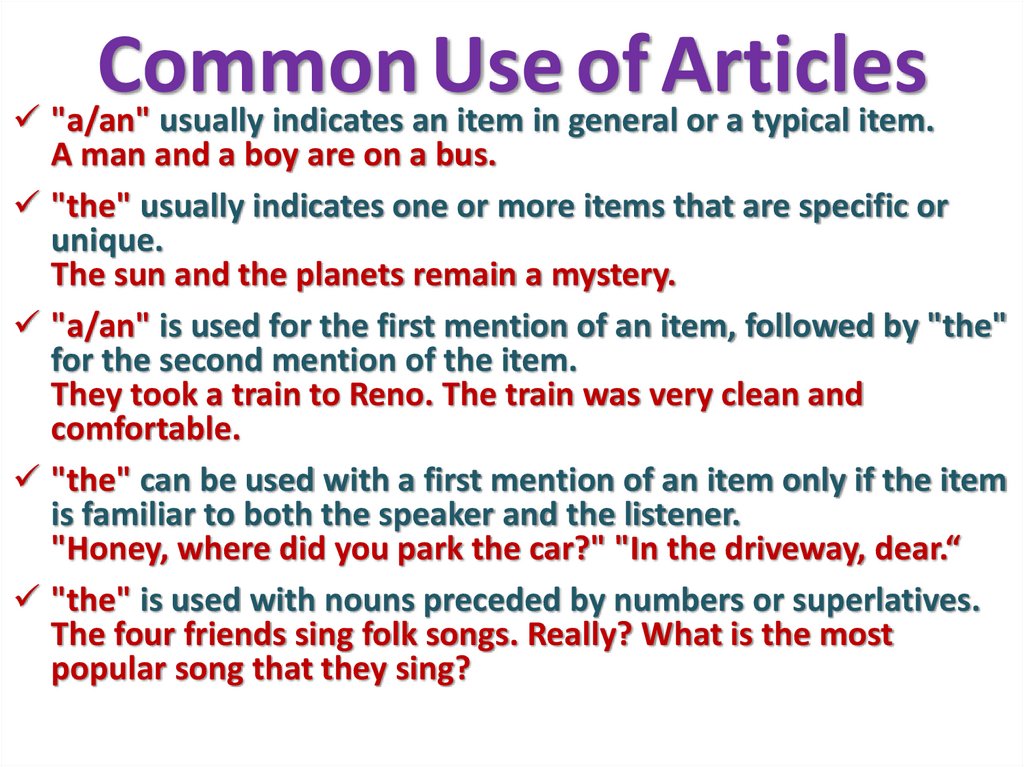
CommonUse
of
Articles
"a/an" usually indicates an item in general or a typical item.
A man and a boy are on a bus.
"the" usually indicates one or more items that are specific or
unique.
The sun and the planets remain a mystery.
"a/an" is used for the first mention of an item, followed by "the"
for the second mention of the item.
They took a train to Reno. The train was very clean and
comfortable.
"the" can be used with a first mention of an item only if the item
is familiar to both the speaker and the listener.
"Honey, where did you park the car?" "In the driveway, dear.“
"the" is used with nouns preceded by numbers or superlatives.
The four friends sing folk songs. Really? What is the most
popular song that they sing?
3.
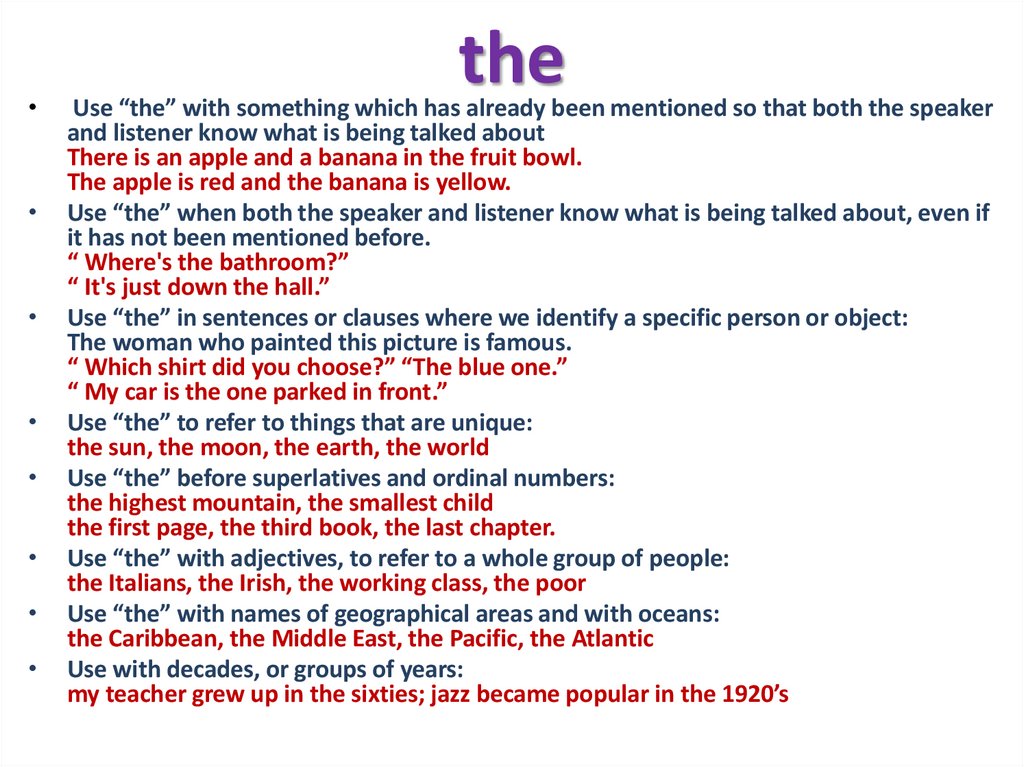
the
Use “the” with something which has already been mentioned so that both the speaker
and listener know what is being talked about
There is an apple and a banana in the fruit bowl.
The apple is red and the banana is yellow.
Use “the” when both the speaker and listener know what is being talked about, even if
it has not been mentioned before.
“ Where's the bathroom?”
“ It's just down the hall.”
Use “the” in sentences or clauses where we identify a specific person or object:
The woman who painted this picture is famous.
“ Which shirt did you choose?” “The blue one.”
“ My car is the one parked in front.”
Use “the” to refer to things that are unique:
the sun, the moon, the earth, the world
Use “the” before superlatives and ordinal numbers:
the highest mountain, the smallest child
the first page, the third book, the last chapter.
Use “the” with adjectives, to refer to a whole group of people:
the Italians, the Irish, the working class, the poor
Use “the” with names of geographical areas and with oceans:
the Caribbean, the Middle East, the Pacific, the Atlantic
Use with decades, or groups of years:
my teacher grew up in the sixties; jazz became popular in the 1920’s
4.
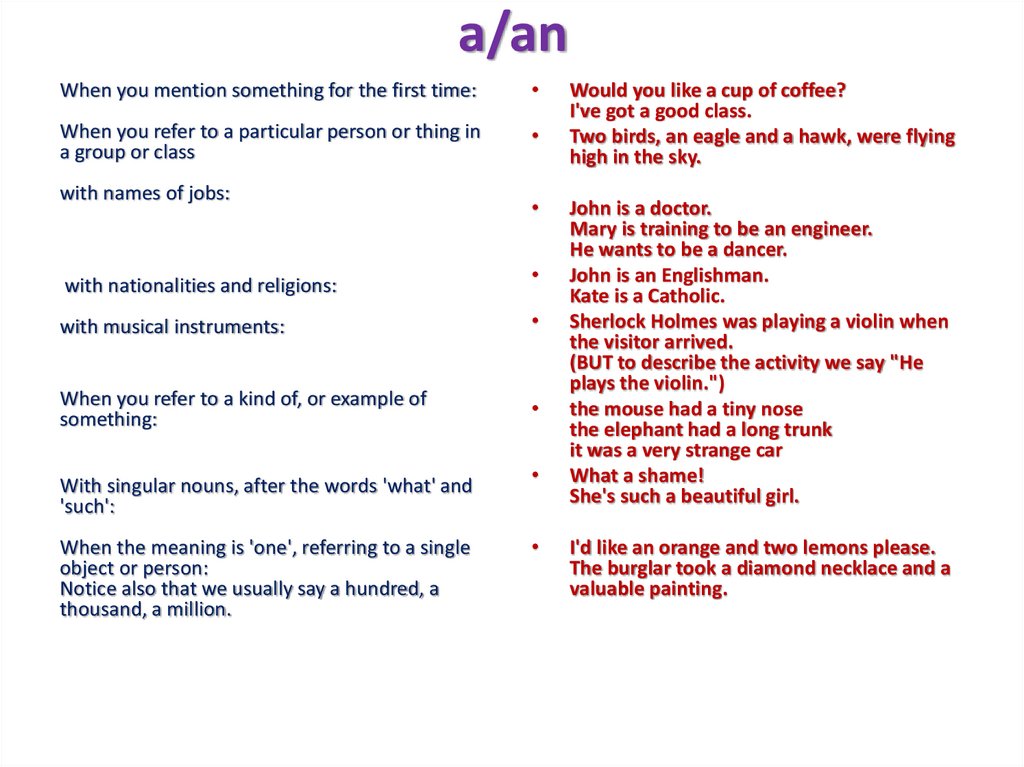
a/anWhen you mention something for the first time:
When you refer to a particular person or thing in
a group or class
with names of jobs:
with nationalities and religions:
with musical instruments:
When you refer to a kind of, or example of
something:
With singular nouns, after the words 'what' and
'such':
When the meaning is 'one', referring to a single
object or person:
Notice also that we usually say a hundred, a
thousand, a million.
Would you like a cup of coffee?
I've got a good class.
Two birds, an eagle and a hawk, were flying
high in the sky.
John is a doctor.
Mary is training to be an engineer.
He wants to be a dancer.
John is an Englishman.
Kate is a Catholic.
Sherlock Holmes was playing a violin when
the visitor arrived.
(BUT to describe the activity we say "He
plays the violin.")
the mouse had a tiny nose
the elephant had a long trunk
it was a very strange car
What a shame!
She's such a beautiful girl.
I'd like an orange and two lemons please.
The burglar took a diamond necklace and a
valuable painting.