

 literature
Similar presentations:
Poetic Language as Language
1. Yuri Kleiner Ludmila Verbitskaya Department of General Linguistics St. Petersrburg State University
• Poetic Language as Language2. ‘Poetic Language’ as a Metaphore
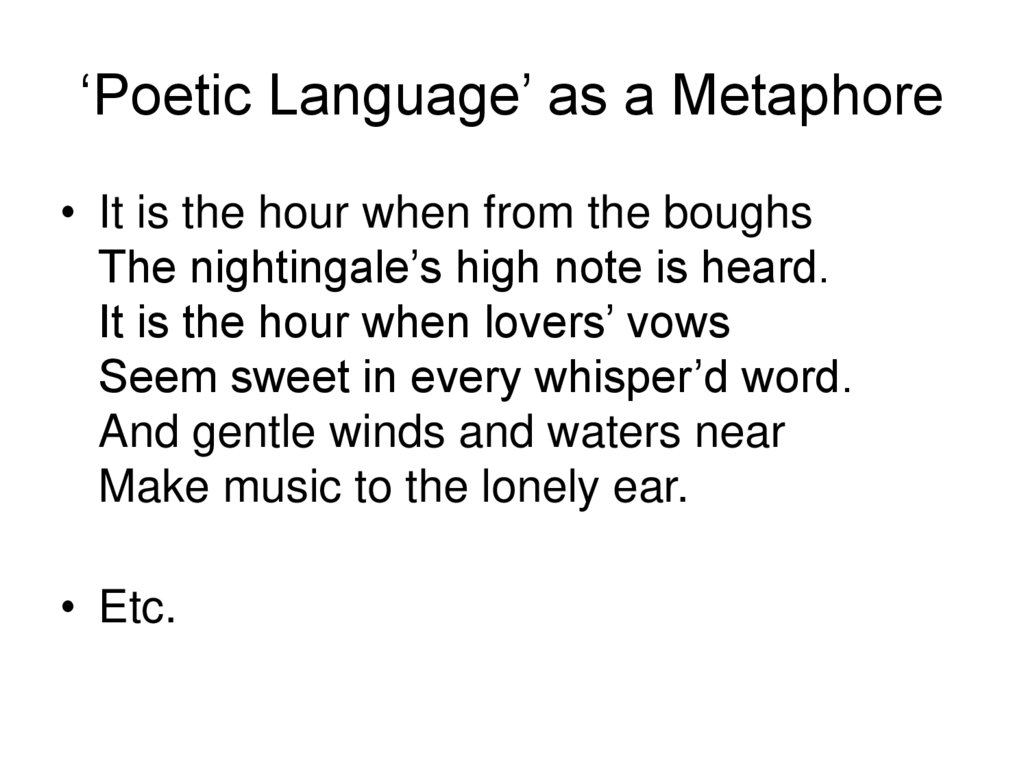
• It is the hour when from the boughsThe nightingale’s high note is heard.
It is the hour when lovers’ vows
Seem sweet in every whisper’d word.
And gentle winds and waters near
Make music to the lonely ear.
• Etc.
3. Language terminologically
• Vocabulary• +
• Grammar
• +
• Form
4. Form and Meaning
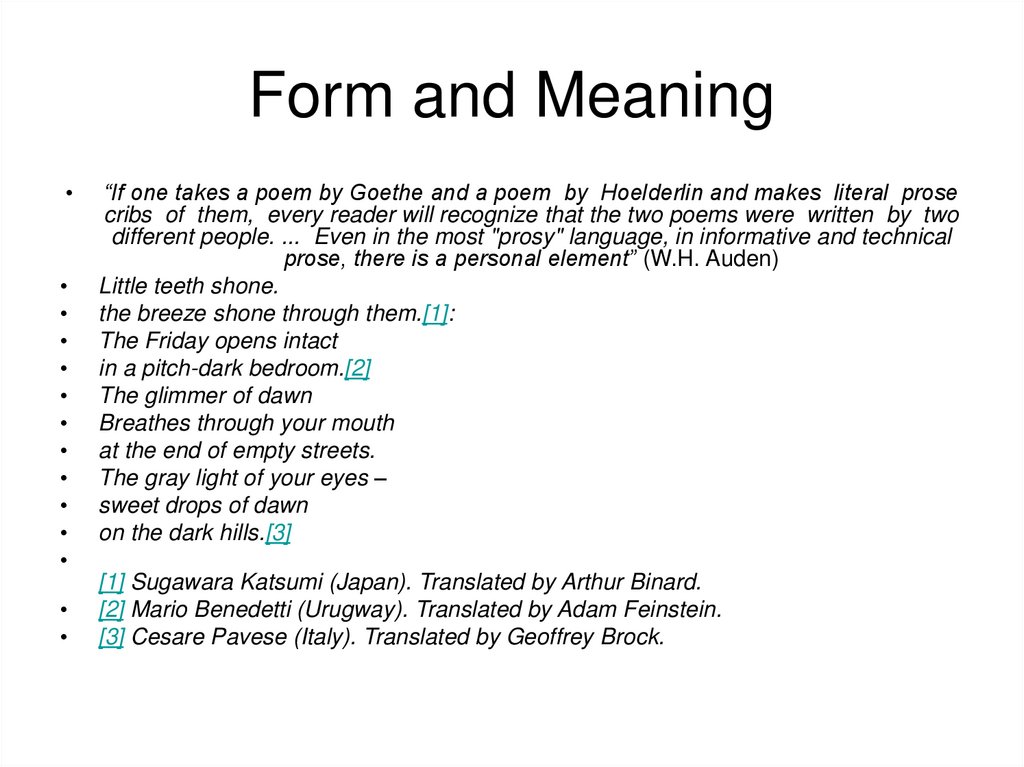
“If one takes a poem by Goethe and a poem by Hoelderlin and makes literal prose
cribs of them, every reader will recognize that the two poems were written by two
different people. ... Even in the most "prosy" language, in informative and technical
prose, there is a personal element” (W.H. Auden)
Little teeth shone.
the breeze shone through them.[1]:
The Friday opens intact
in a pitch-dark bedroom.[2]
The glimmer of dawn
Breathes through your mouth
at the end of empty streets.
The gray light of your eyes –
sweet drops of dawn
on the dark hills.[3]
[1] Sugawara Katsumi (Japan). Translated by Arthur Binard.
[2] Mario Benedetti (Urugway). Translated by Adam Feinstein.
[3] Cesare Pavese (Italy). Translated by Geoffrey Brock.
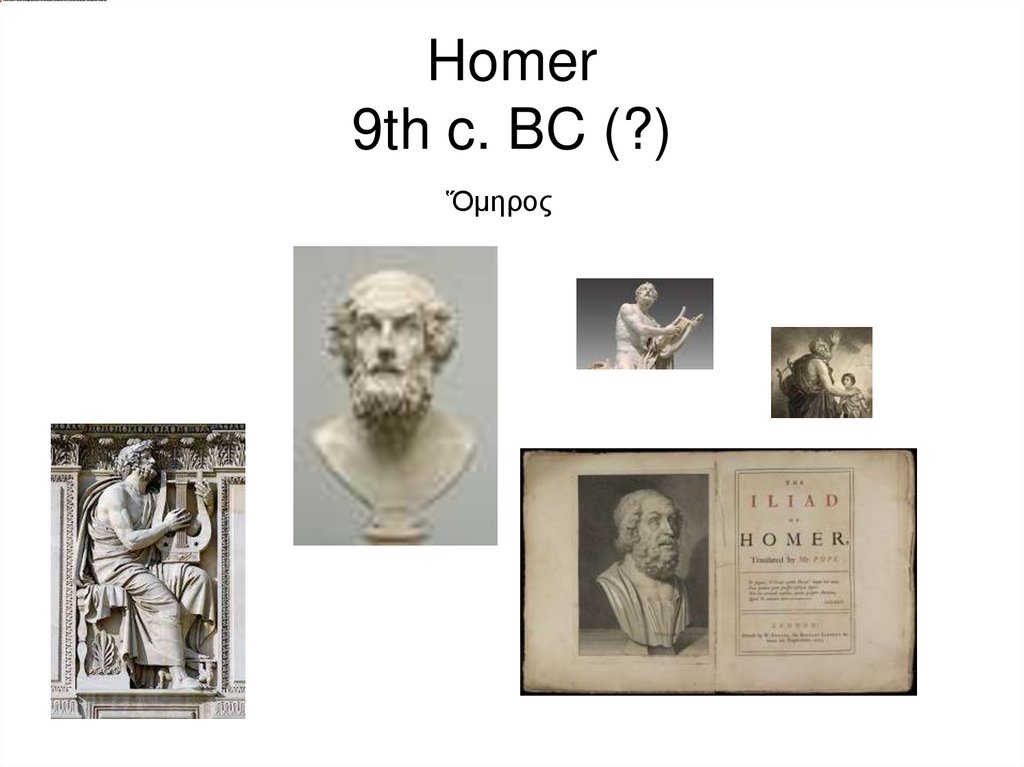
5. Homer 9th c. BC (?)
Ὅμηρος6. ?
• If there was no writing in Homer's time,how could such long poems be preserved
until the time of writing? In fact, how could
poems of such length come into being at
all without the aid of writing?
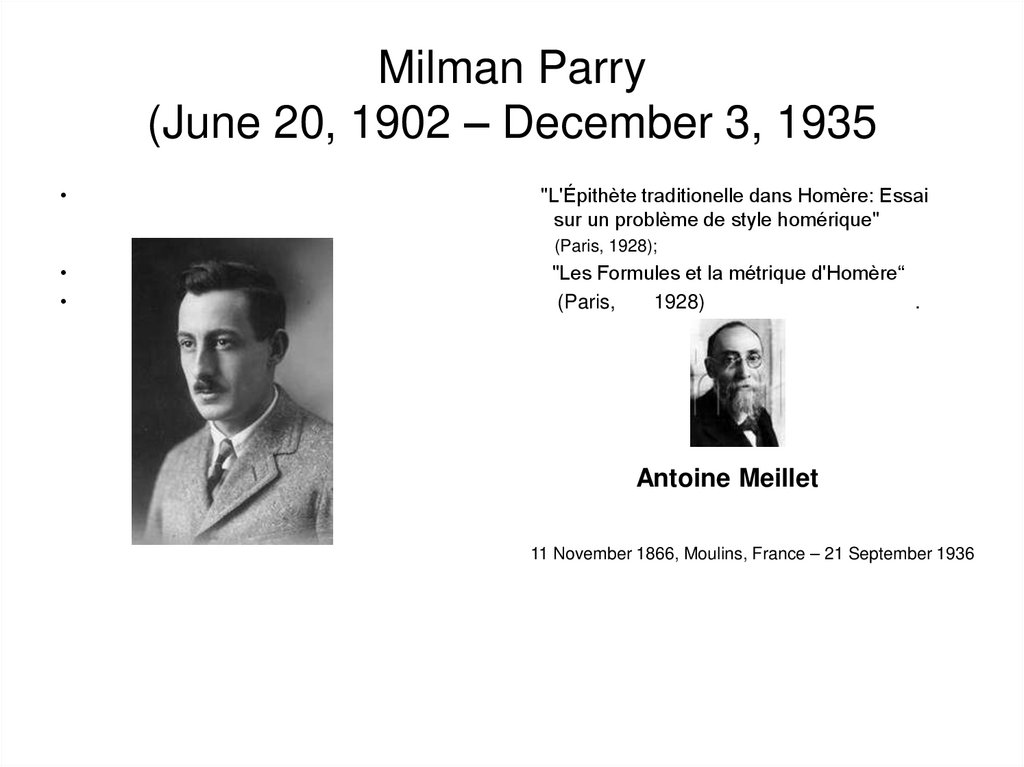
7. Milman Parry (June 20, 1902 – December 3, 1935
"L'Épithète traditionelle dans Homère: Essai
sur un problème de style homérique"
(Paris, 1928);
"Les Formules et la métrique d'Homère“
(Paris,
1928)
.
Antoine Meillet
11 November 1866, Moulins, France – 21 September 1936
8. Russian Singers of Tales
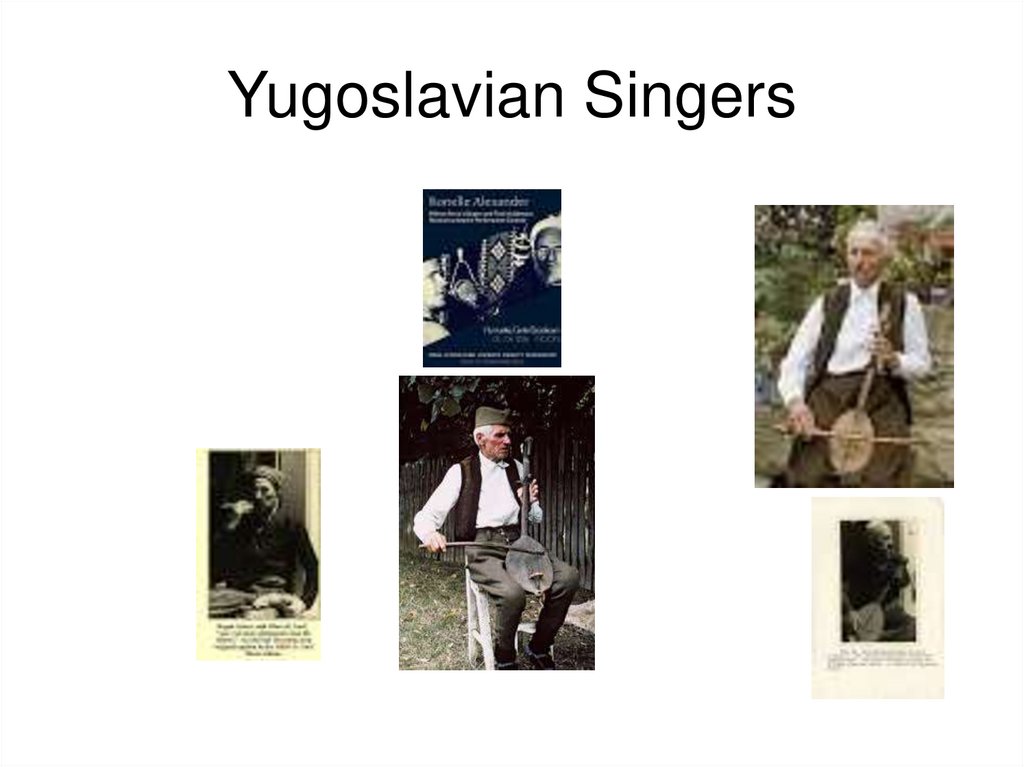
9. Yugoslavian Singers
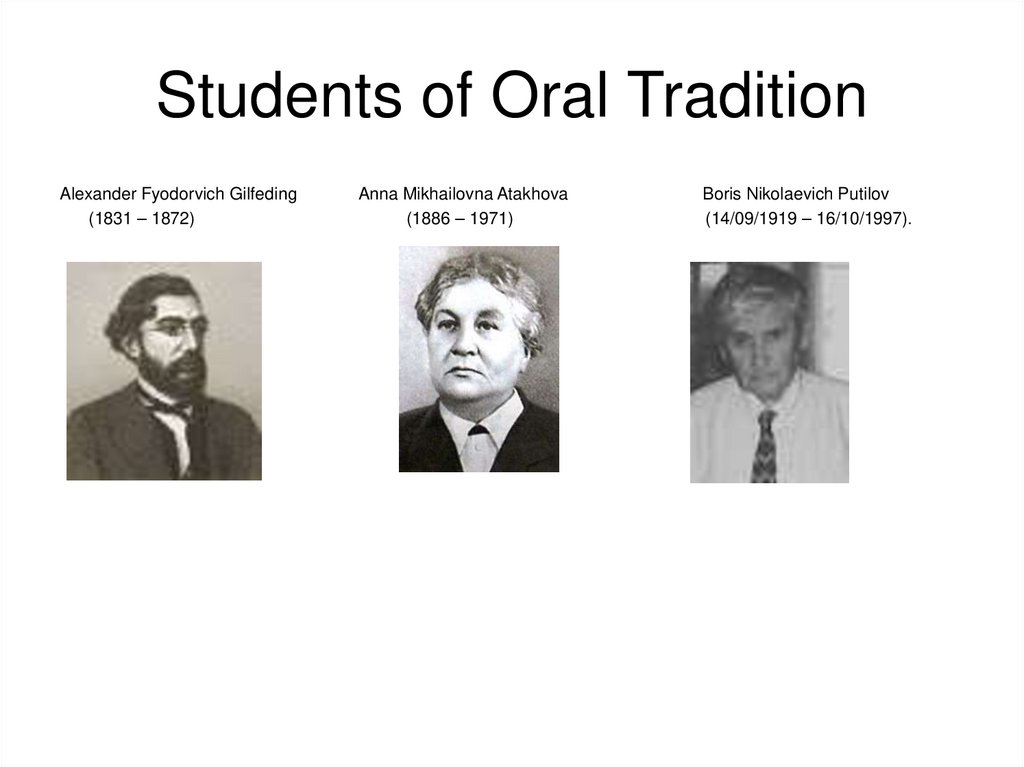
10. Students of Oral Tradition
Alexander Fyodorvich Gilfeding(1831 – 1872)
Anna Mikhailovna Atakhova
(1886 – 1971)
Boris Nikolaevich Putilov
(14/09/1919 – 16/10/1997).
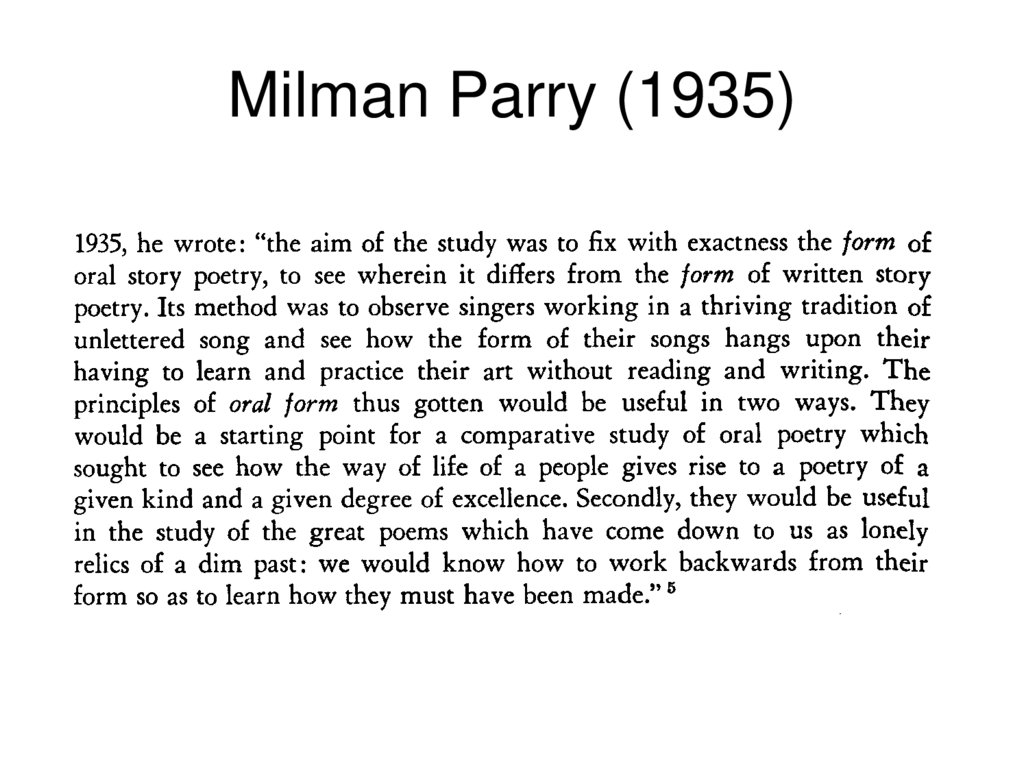
11. Milman Parry (1935)
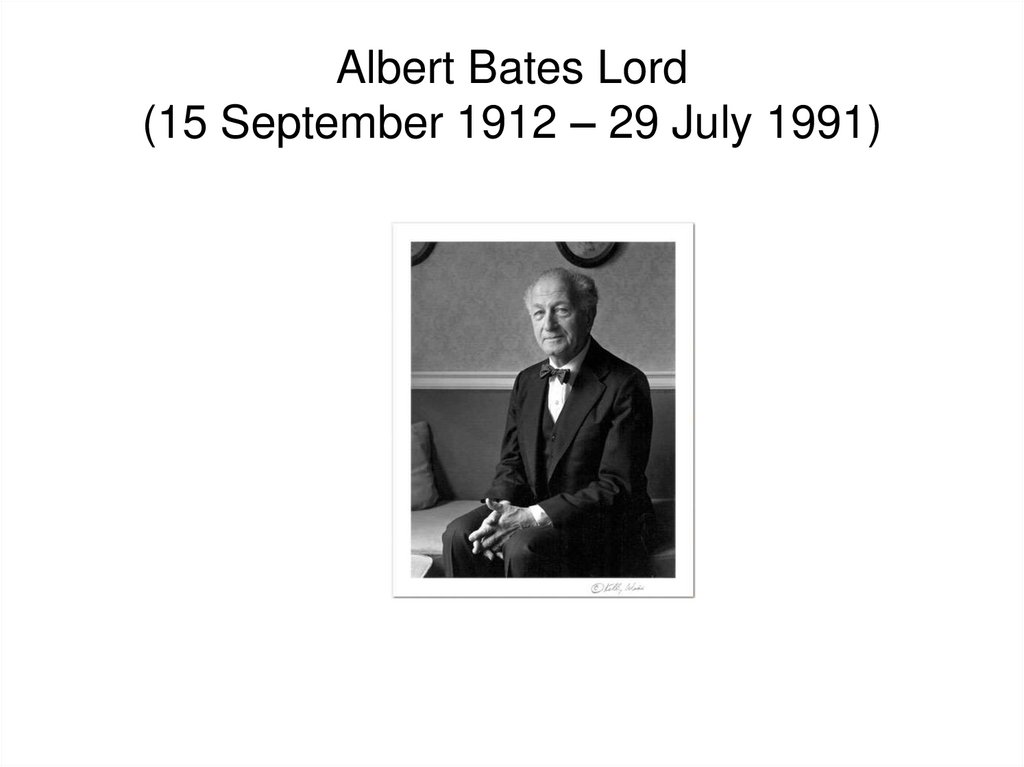
12. Albert Bates Lord (15 September 1912 – 29 July 1991)
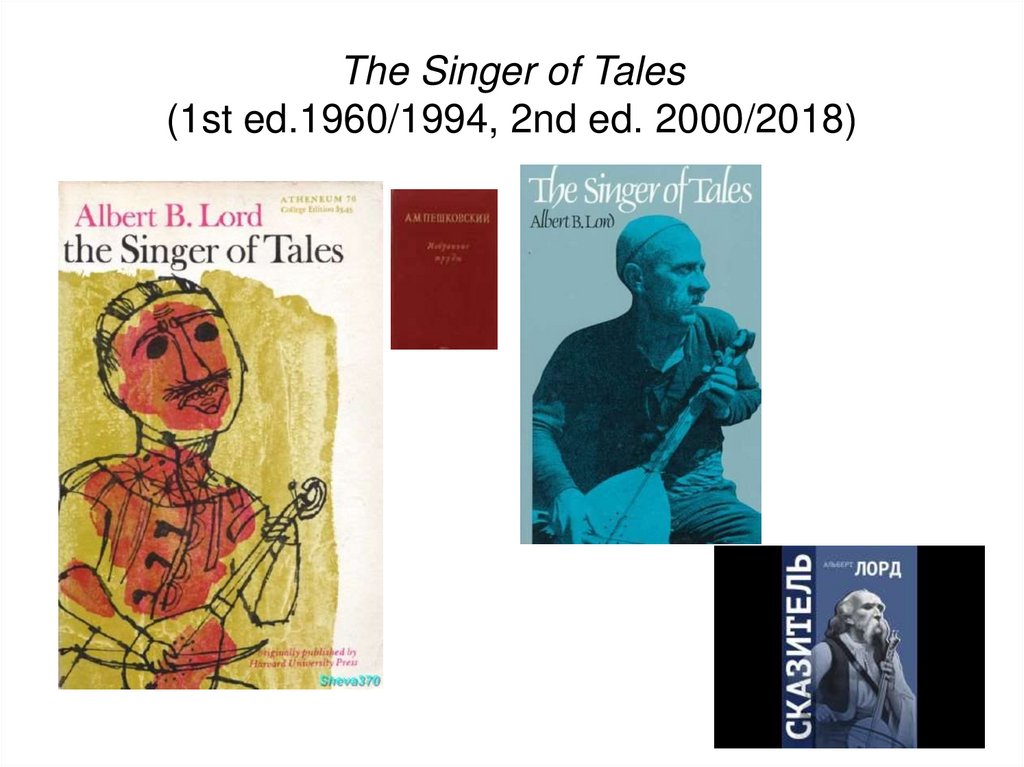
13. The Singer of Tales (1st ed.1960/1994, 2nd ed. 2000/2018)
14. Composition in performance
• every performance is a separate song; for everyperformance is unique, and every performance bears the
signature of its poet singer. He may have learned his
song and the technique of its construction from others,
but good or bad, the song produced in performance is
his own. The audience knows it as his because he is
before them. The singer of tales is at once the tradition
and an individual creator. … His art consists not so much
in learning through repetition the time-worn formulas as
in the ability to compose and recompose the phrases for
the idea of the moment on the pattern established by the
basic formulas.
15. Formula
• A group of words which is regularlyemployed under the same metrical
conditions to express a given essential
idea
16. Formula: problems and questions
• Formulas and orality• Formulas and fixity
• Usefulness
• A group of words
• metrical conditions
• essential idea
17. Formula
• (1) “an established form of words orsymbols for use in a ceremony or
procedure
• (2a) “a rule or principle expressed in
(algebraic) symbols” (mathematics)
• (2b) “an expression of the constituents of a
compound by means of symbols and
figures” (chemistry),
• e.g. H2O
18. Epic Formula
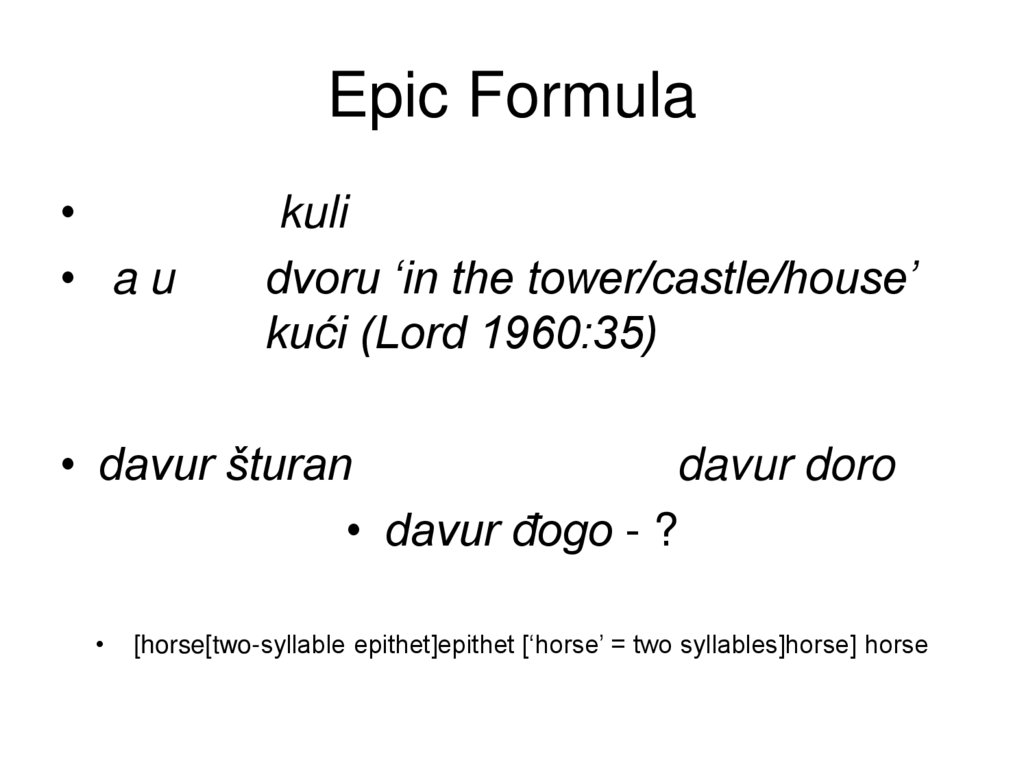
• au
kuli
dvoru ‘in the tower/castle/house’
kući (Lord 1960:35)
• davur šturan
davur doro
• davur đogo - ?
[horse[two-syllable epithet]epithet [‘horse’ = two syllables]horse] horse
19. Metrical Conditions
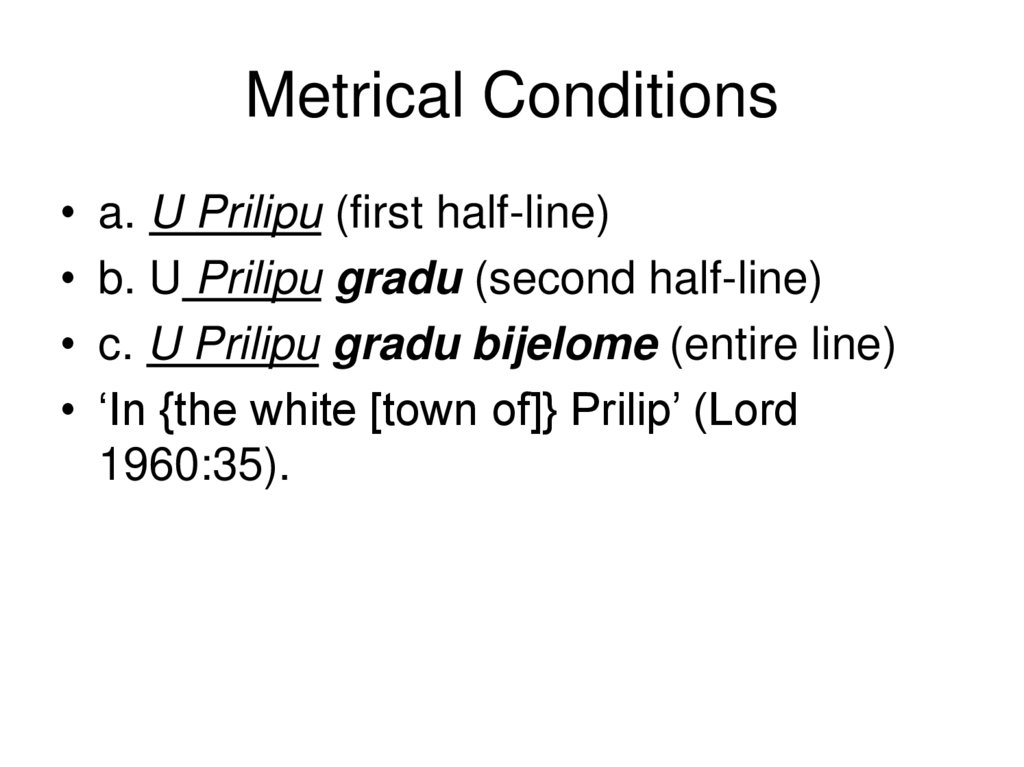
• a. U Prilipu (first half-line)• b. U Prilipu gradu (second half-line)
• c. U Prilipu gradu bijelome (entire line)
• ‘In {the white [town of]} Prilip’ (Lord
1960:35).
20. Meaning
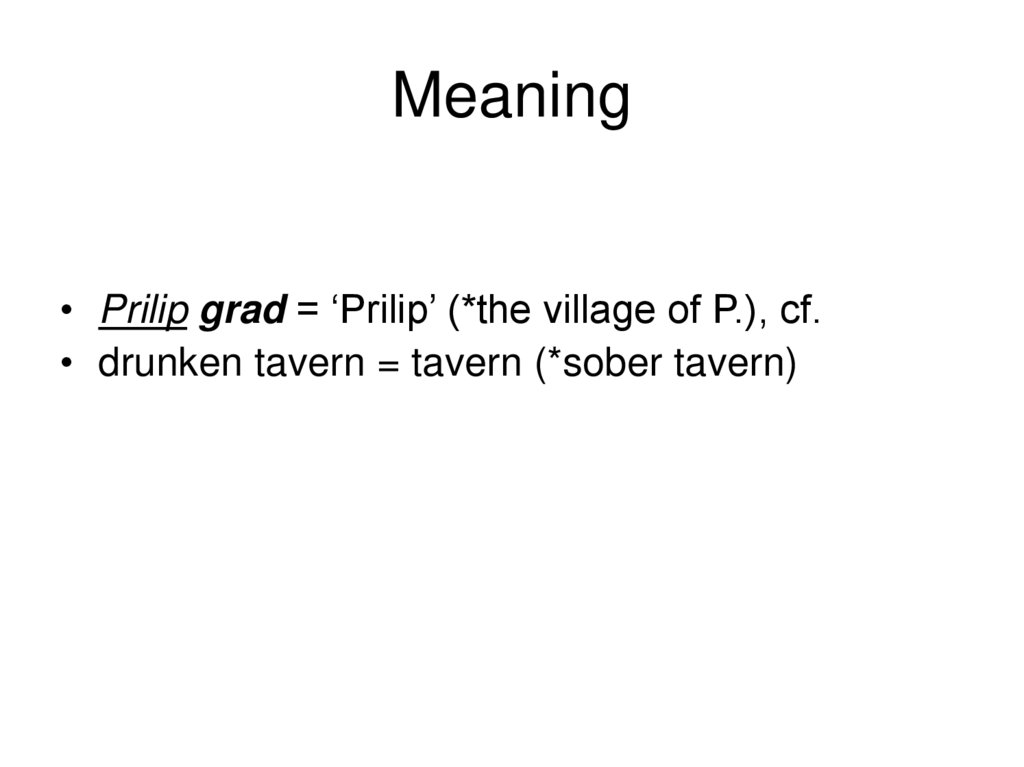
• Prilip grad = ‘Prilip’ (*the village of P.), cf.• drunken tavern = tavern (*sober tavern)
21. Metrical conditions and meaning
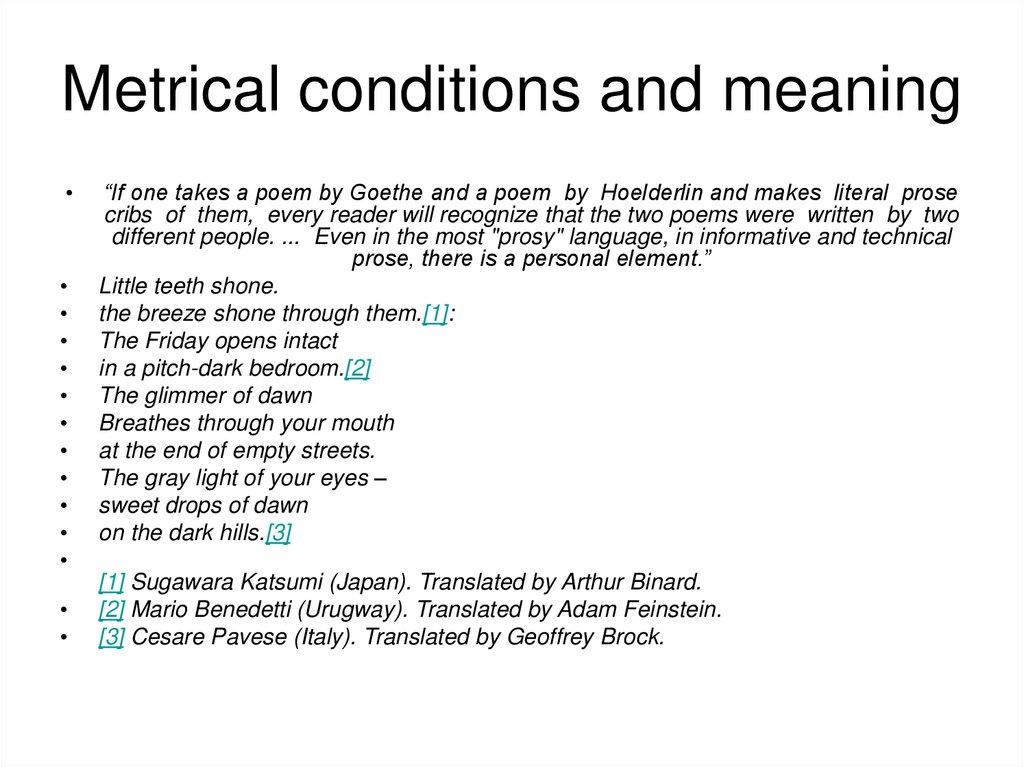
“If one takes a poem by Goethe and a poem by Hoelderlin and makes literal prose
cribs of them, every reader will recognize that the two poems were written by two
different people. ... Even in the most "prosy" language, in informative and technical
prose, there is a personal element.”
Little teeth shone.
the breeze shone through them.[1]:
The Friday opens intact
in a pitch-dark bedroom.[2]
The glimmer of dawn
Breathes through your mouth
at the end of empty streets.
The gray light of your eyes –
sweet drops of dawn
on the dark hills.[3]
[1] Sugawara Katsumi (Japan). Translated by Arthur Binard.
[2] Mario Benedetti (Urugway). Translated by Adam Feinstein.
[3] Cesare Pavese (Italy). Translated by Geoffrey Brock.
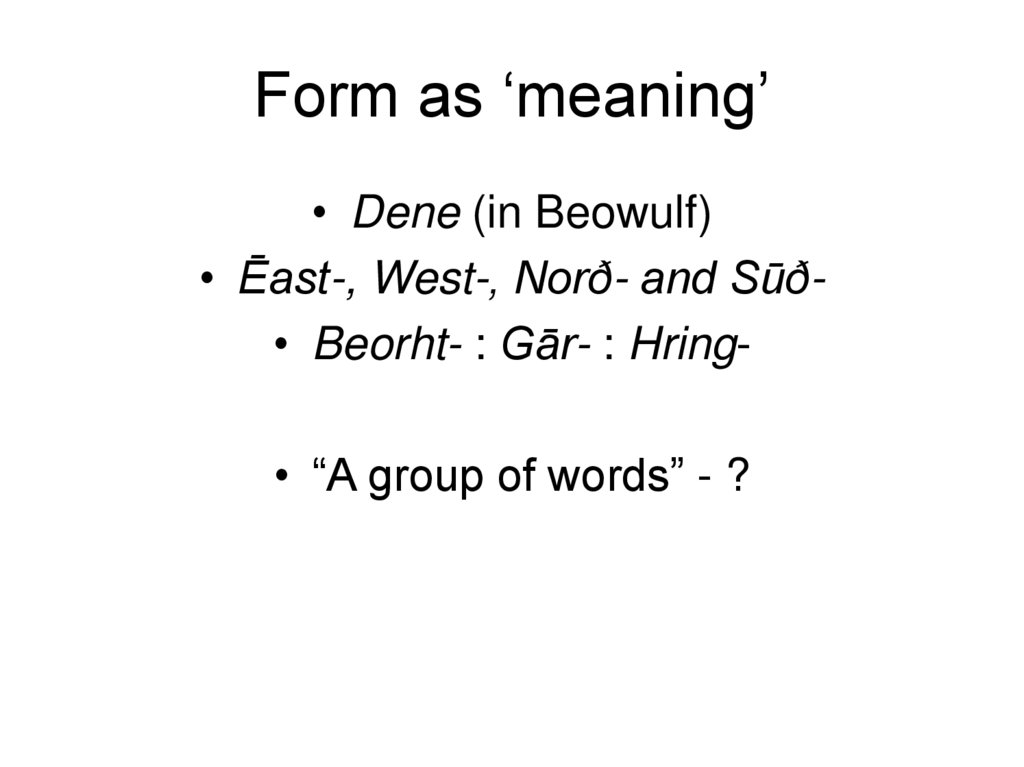
22. Form as ‘meaning’
• Dene (in Beowulf)• Ēast-, West-, Norð- and Sūð• Beorht- : Gār- : Hring-
• “A group of words” - ?
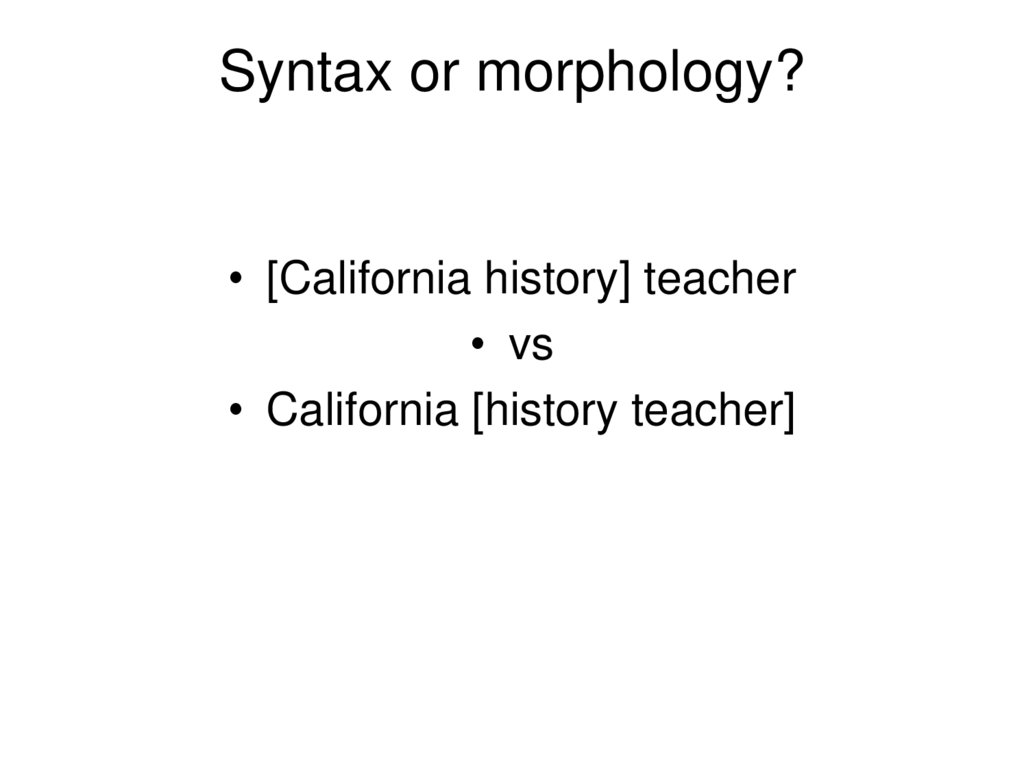
23. Syntax or morphology?
• [California history] teacher• vs
• California [history teacher]
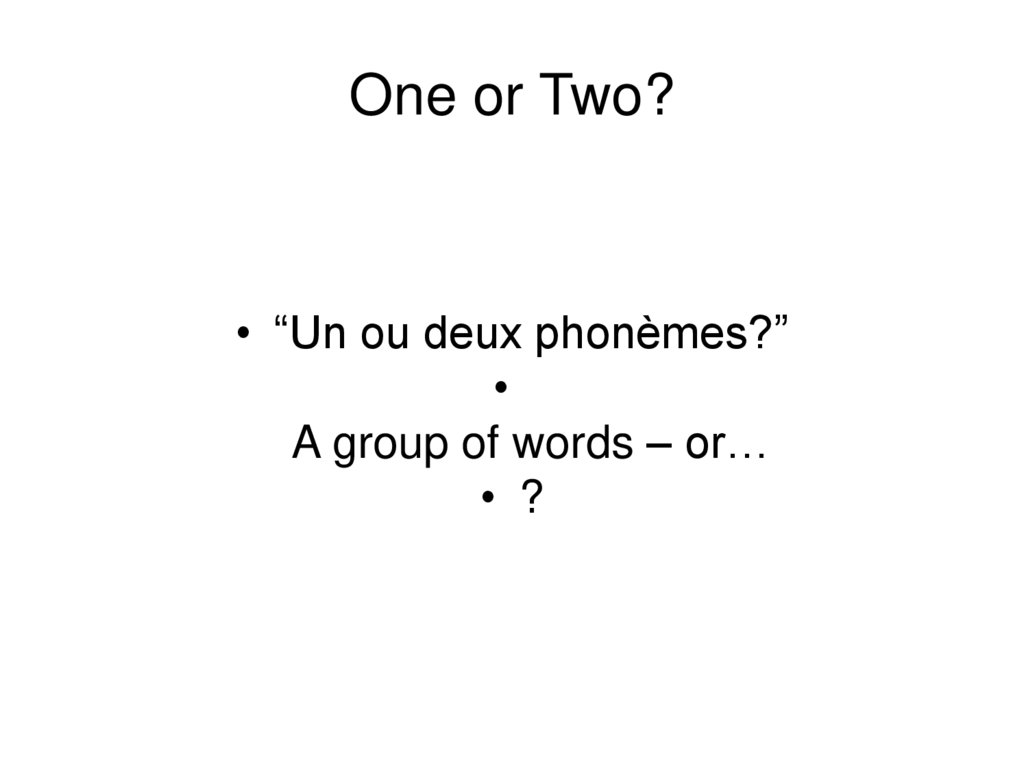
24. One or Two?
• “Un ou deux phonèmes?”A group of words – or…
• ?
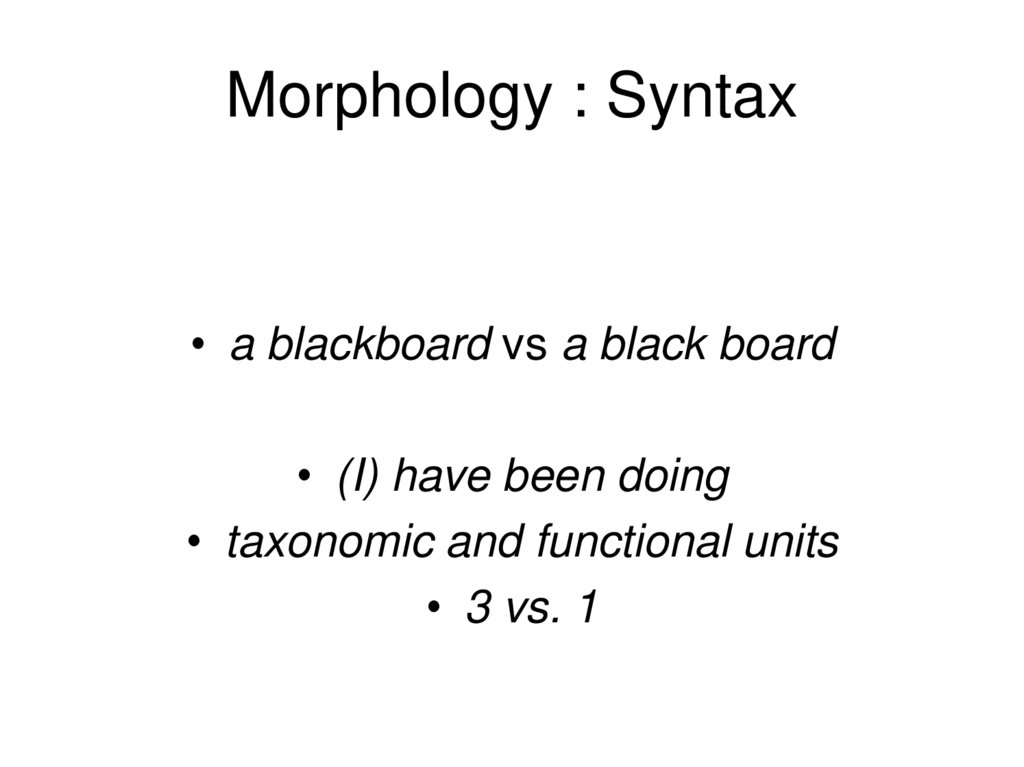
25. Morphology : Syntax
• a blackboard vs a black board• (I) have been doing
• taxonomic and functional units
• 3 vs. 1
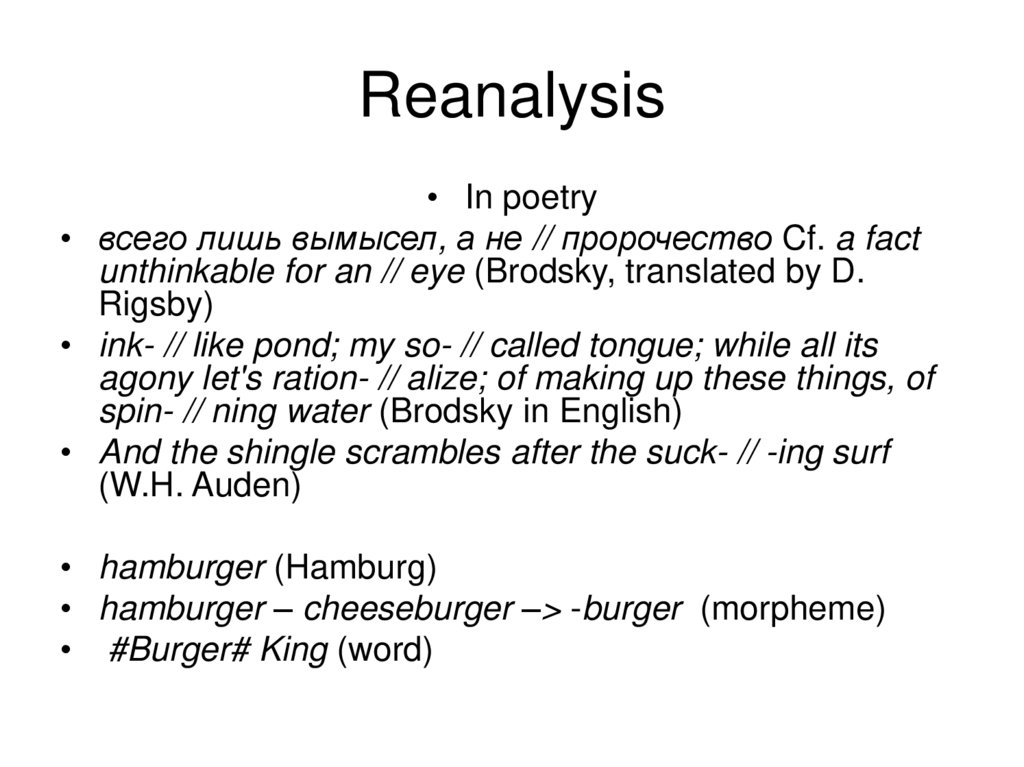
26. Reanalysis
• In poetry• всего лишь вымысел, а не // пророчество Cf. a fact
unthinkable for an // eye (Brodsky, translated by D.
Rigsby)
• ink- // like pond; my so- // called tongue; while all its
agony let's ration- // alize; of making up these things, of
spin- // ning water (Brodsky in English)
• And the shingle scrambles after the suck- // -ing surf
(W.H. Auden)
• hamburger (Hamburg)
• hamburger – cheeseburger –> -burger (morpheme)
• #Burger# King (word)
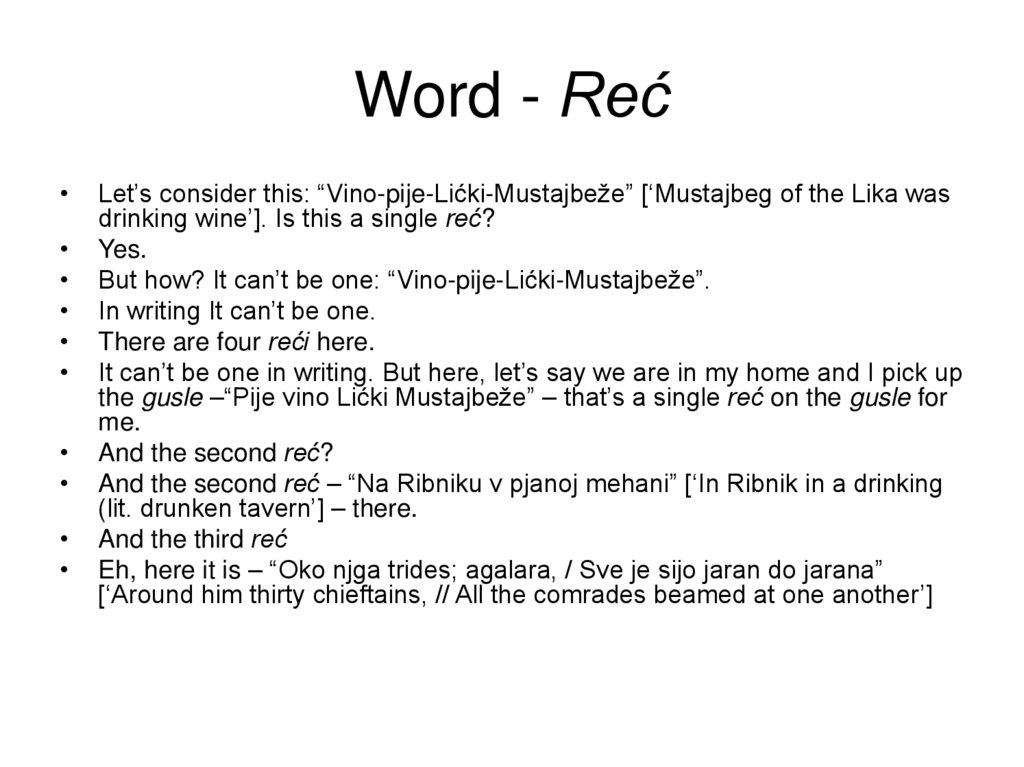
27. Word - Reć
Let’s consider this: “Vino-pije-Lićki-Mustajbeže” [‘Mustajbeg of the Lika was
drinking wine’]. Is this a single reć?
Yes.
But how? It can’t be one: “Vino-pije-Lićki-Mustajbeže”.
In writing It can’t be one.
There are four reći here.
It can’t be one in writing. But here, let’s say we are in my home and I pick up
the gusle –“Pije vino Lićki Mustajbeže” – that’s a single reć on the gusle for
me.
And the second reć?
And the second reć – “Na Ribniku v pjanoj mehani” [‘In Ribnik in a drinking
(lit. drunken tavern’] – there.
And the third reć
Eh, here it is – “Oko njga trides; agalara, / Sve je sijo jaran do jarana”
[‘Around him thirty chieftains, // All the comrades beamed at one another’]
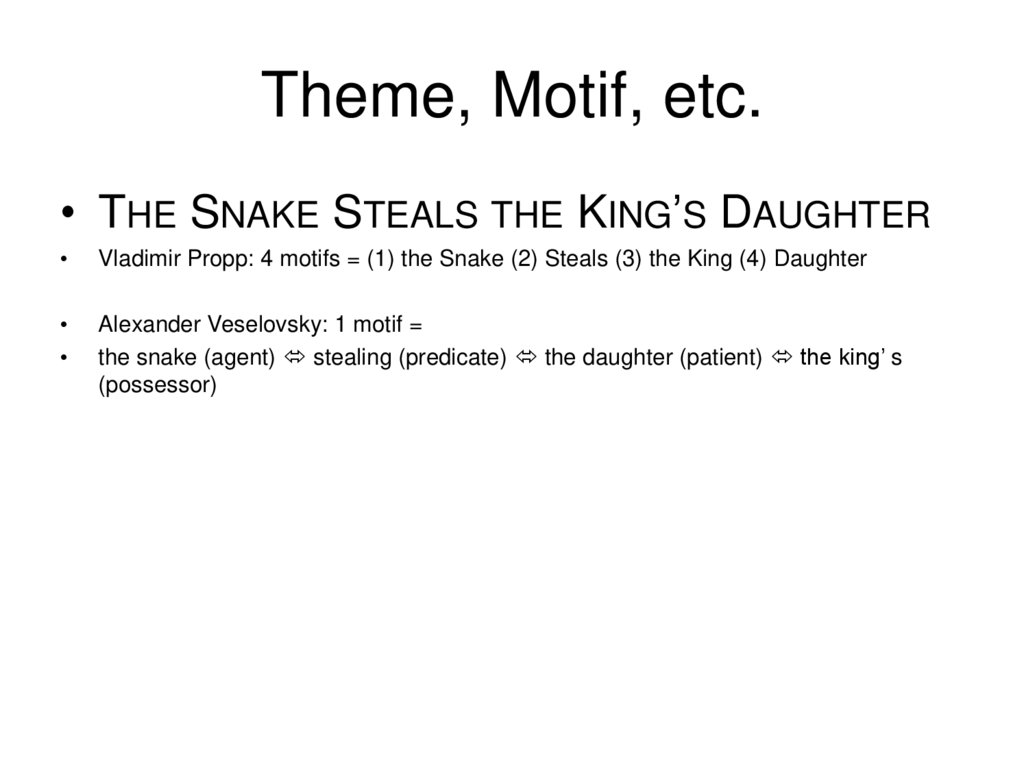
28. Theme, Motif, etc.
• THE SNAKE STEALS THE KING’S DAUGHTERVladimir Propp: 4 motifs = (1) the Snake (2) Steals (3) the King (4) Daughter
Alexander Veselovsky: 1 motif =
the snake (agent) stealing (predicate) the daughter (patient) the king’ s
(possessor)
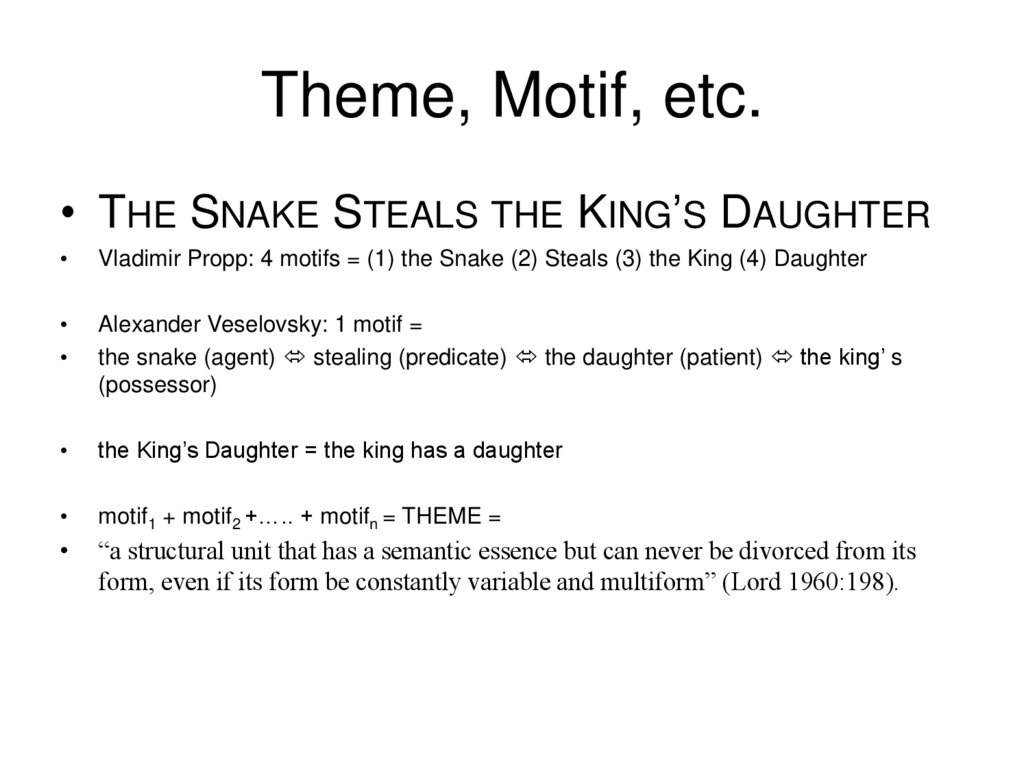
29. Theme, Motif, etc.
• THE SNAKE STEALS THE KING’S DAUGHTERVladimir Propp: 4 motifs = (1) the Snake (2) Steals (3) the King (4) Daughter
Alexander Veselovsky: 1 motif =
the snake (agent) stealing (predicate) the daughter (patient) the king’ s
(possessor)
the King’s Daughter = the king has a daughter
motif1 + motif2 +….. + motifn = THEME =
“a structural unit that has a semantic essence but can never be divorced from its
form, even if its form be constantly variable and multiform” (Lord 1960:198).
30.
THANK YOU
31. File to be sent to: yurikleiner@mail.ru
• Save as: Word.doc (2003)• File name: your family name
• (ФАМИЛИЯ ONLYCyrillic)
• Top of the page: your family name
• (ФАМИЛИЯ ONLYCyrillic)
Please, no
“Dept., GROUP,” etc.
nor
“DEAR PROFESSOR,”
or
“FIND ATTACHED,” etc.