
 english
Similar presentations:








Tongue-twister. Five fat rats friars frying flat fish
1.
TONGUE-TWISTERFive fat rats friars frying flat fish
The horses’ hard hooves hit the hard highroad
Two tiny tigers take to taxis to town
2.
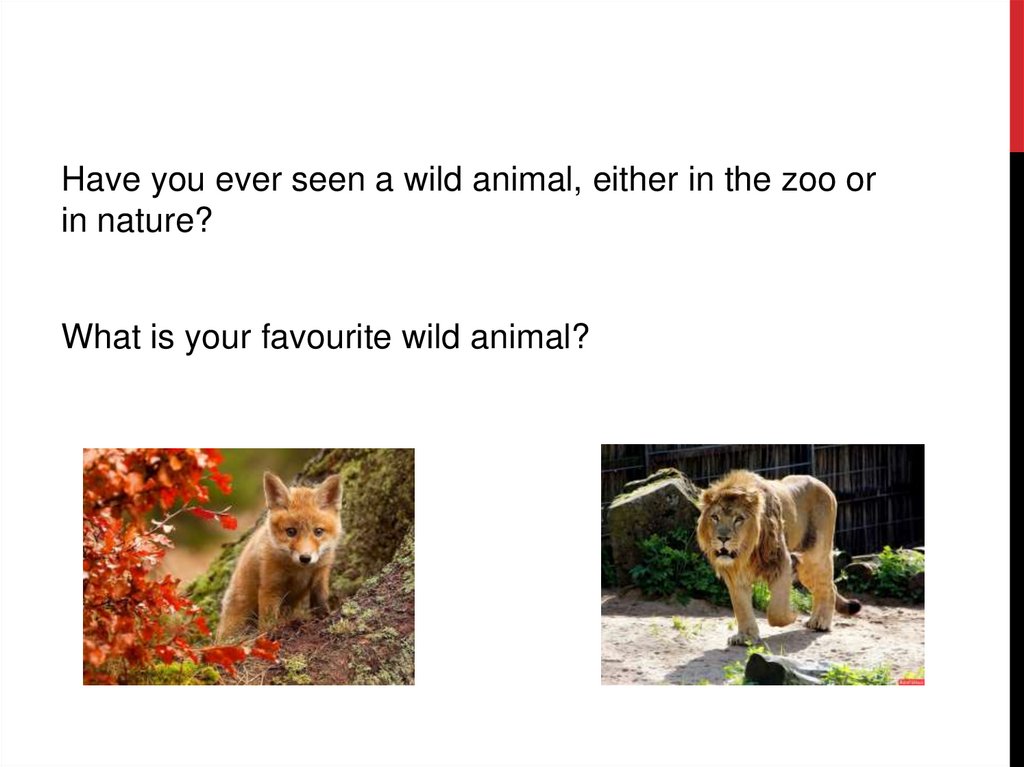
Have you ever seen a wild animal, either in the zoo orin nature?
What is your favourite wild animal?
3.
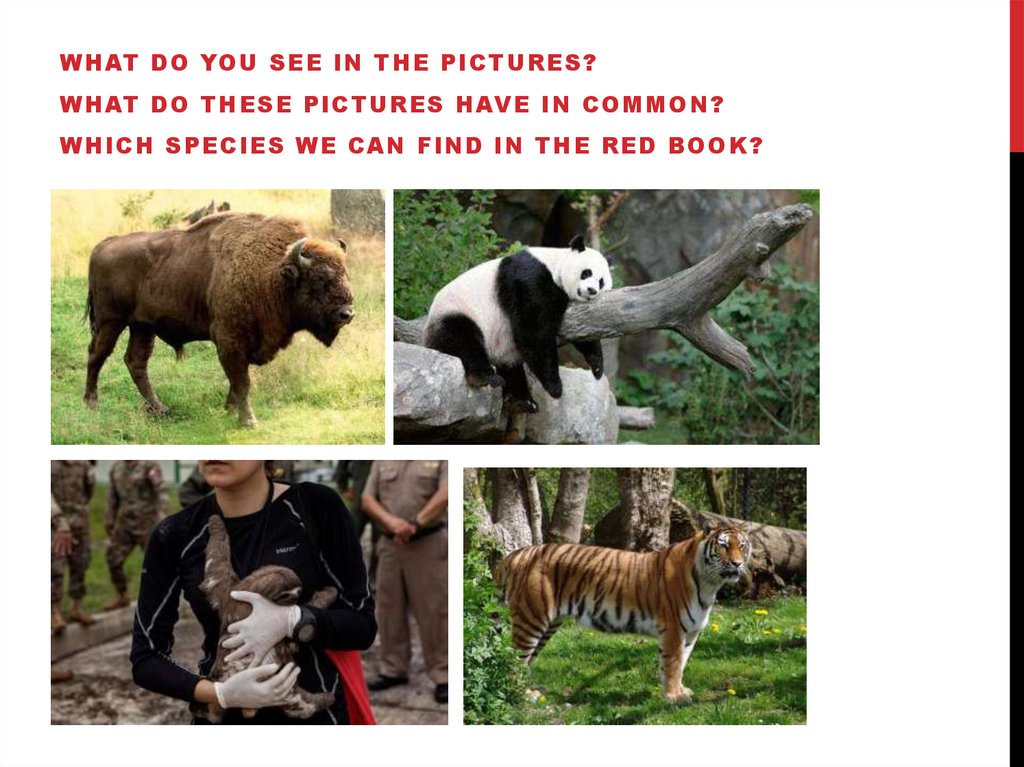
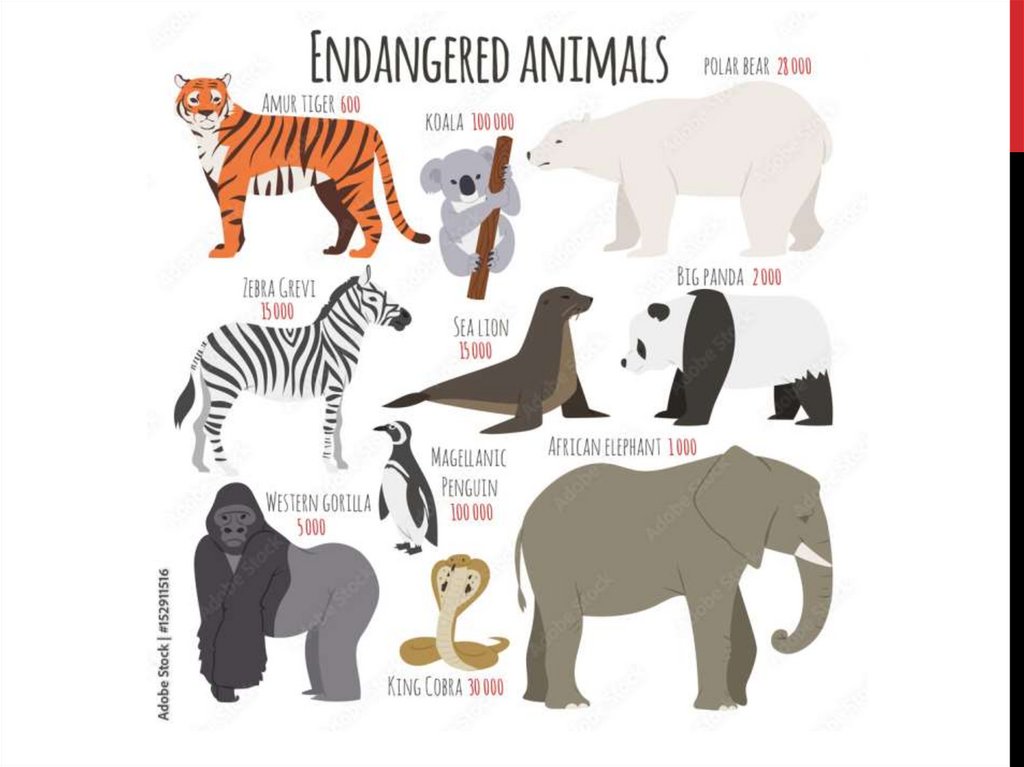
WHAT DO YOU SEE IN THE PICTURES?WHAT DO THESE PICTURES HAVE IN COMMON?
WHICH SPECIES WE CAN FIND IN THE RED BOOK?
4.
A HUMAN BEING ANDNATURE. PROTECTION
OF WILD ANIMALS
5.
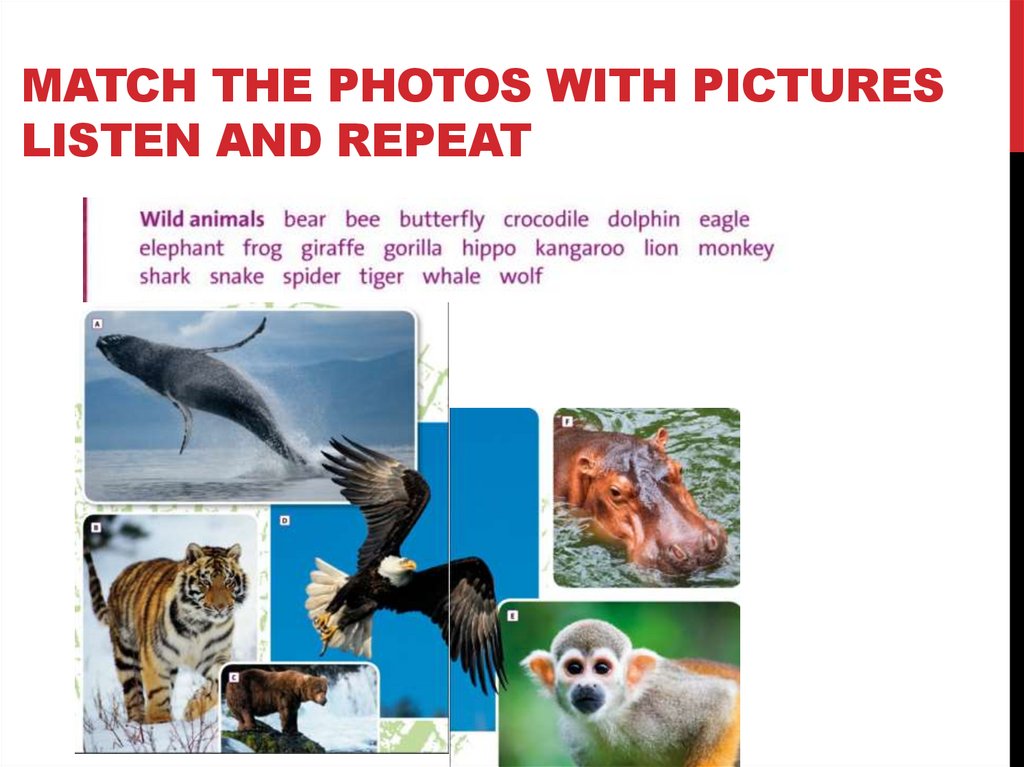
MATCH THE PHOTOS WITH PICTURESLISTEN AND REPEAT
6.
DECIDE WHICH ANIMALSFROM PREVIOUS EXERCISE
YOU USUALLY SEE
1. On land
2. In water
3. In the air
7.
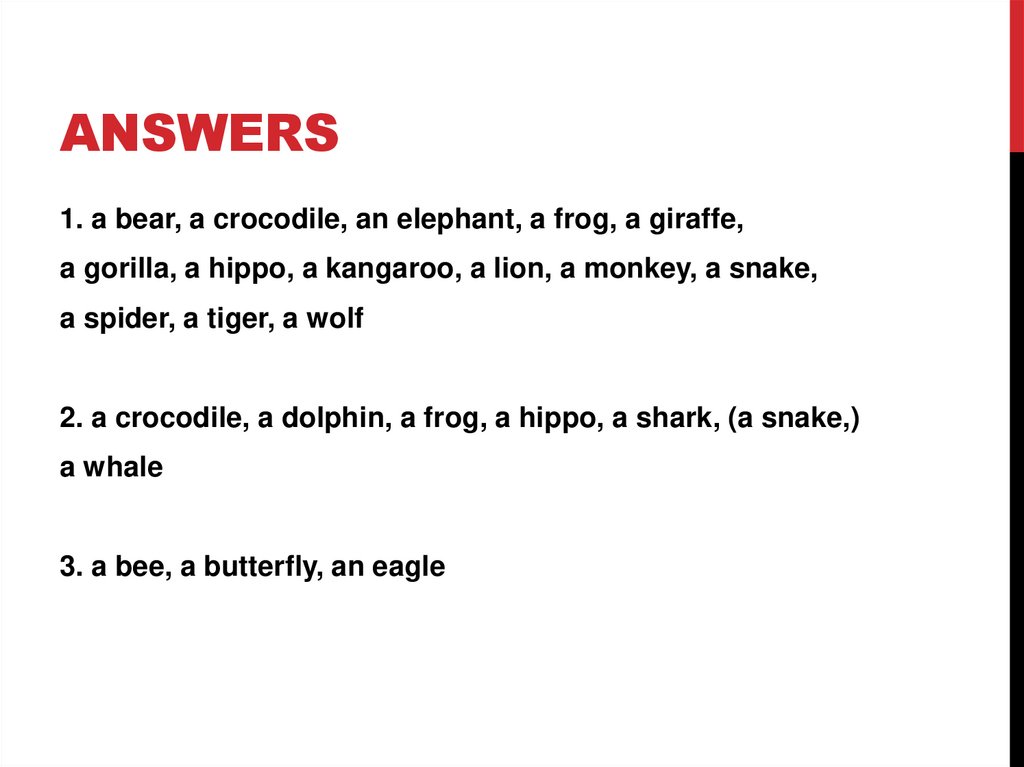
ANSWERS1. a bear, a crocodile, an elephant, a frog, a giraffe,
a gorilla, a hippo, a kangaroo, a lion, a monkey, a snake,
a spider, a tiger, a wolf
2. a crocodile, a dolphin, a frog, a hippo, a shark, (a snake,)
a whale
3. a bee, a butterfly, an eagle
8.
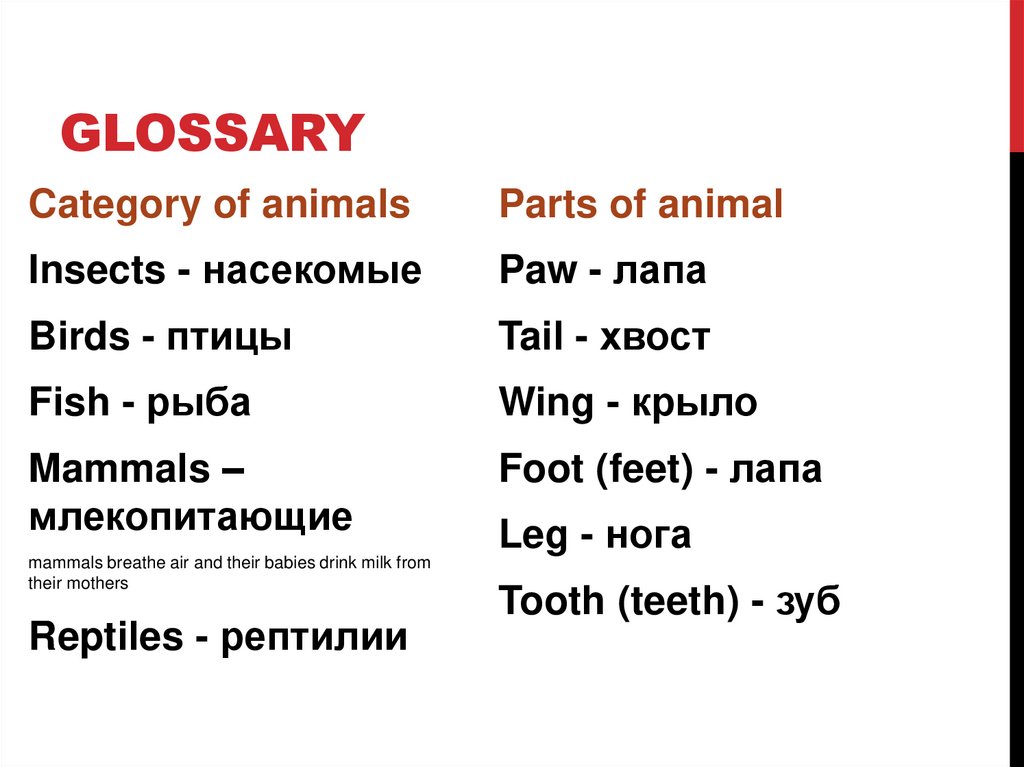
GLOSSARYCategory of animals
Parts of animal
Insects - насекомые
Paw - лапа
Birds - птицы
Tail - хвост
Fish - рыба
Wing - крыло
Mammals –
млекопитающие
Foot (feet) - лапа
mammals breathe air and their babies drink milk from
their mothers
Reptiles - рептилии
Leg - нога
Tooth (teeth) - зуб
9.
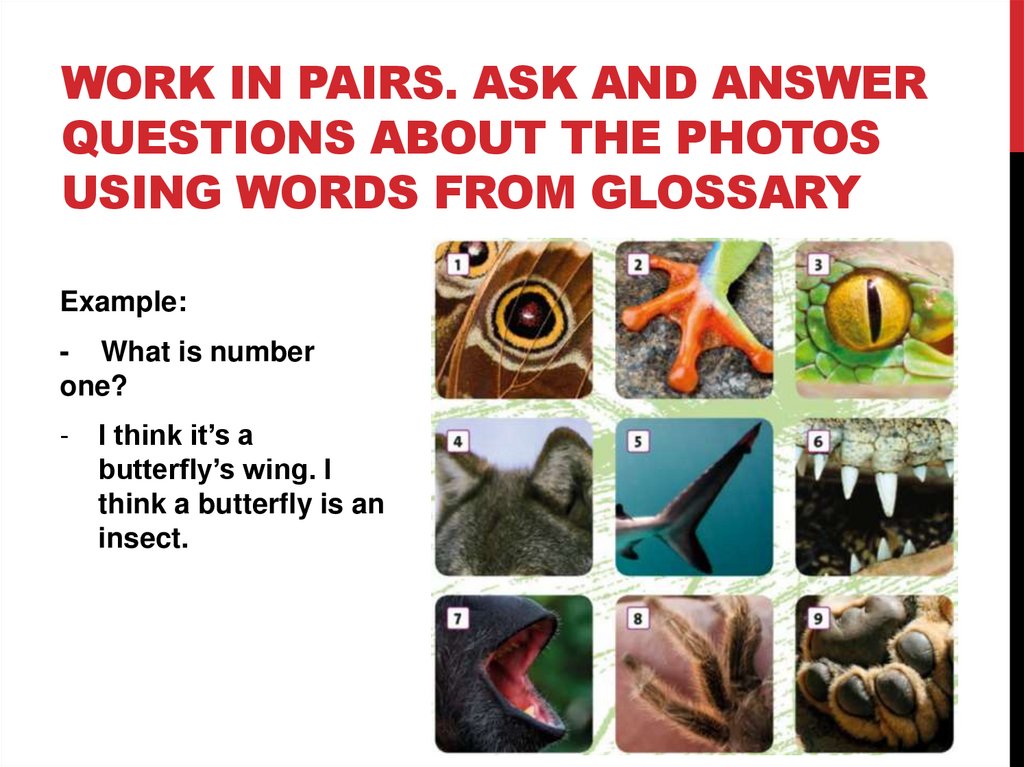
WORK IN PAIRS. ASK AND ANSWERQUESTIONS ABOUT THE PHOTOS
USING WORDS FROM GLOSSARY
Example:
- What is number
one?
-
I think it’s a
butterfly’s wing. I
think a butterfly is an
insect.
10.
11.
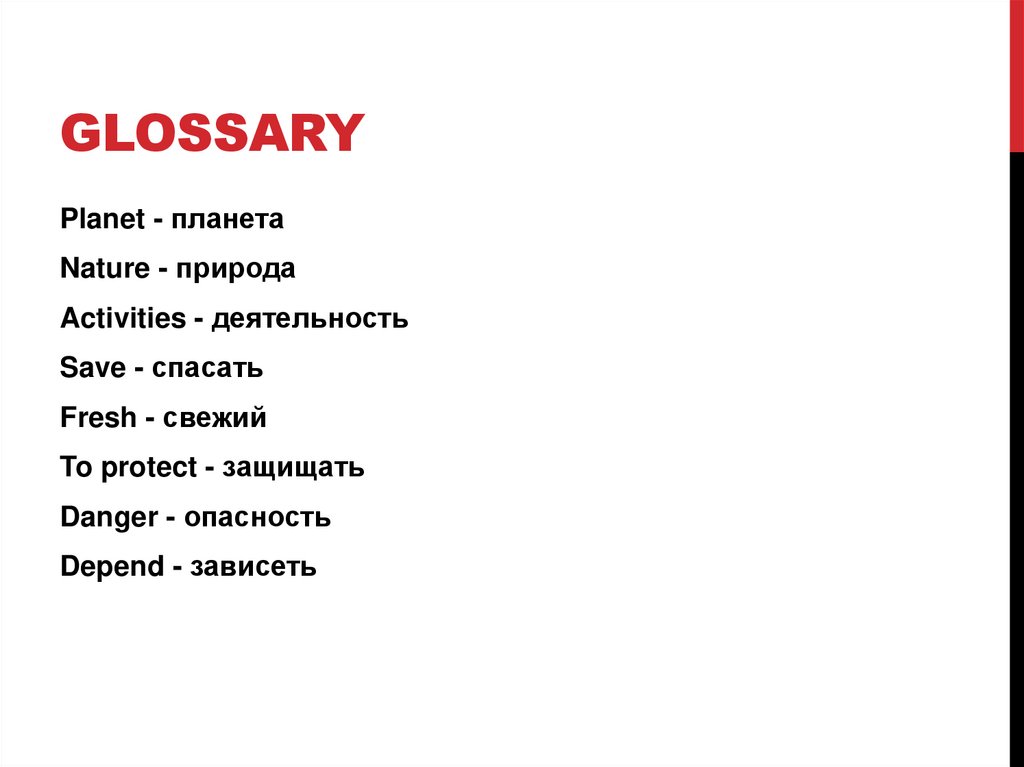
GLOSSARYPlanet - планета
Nature - природа
Activities - деятельность
Save - спасать
Fresh - свежий
To protect - защищать
Danger - опасность
Depend - зависеть
12.
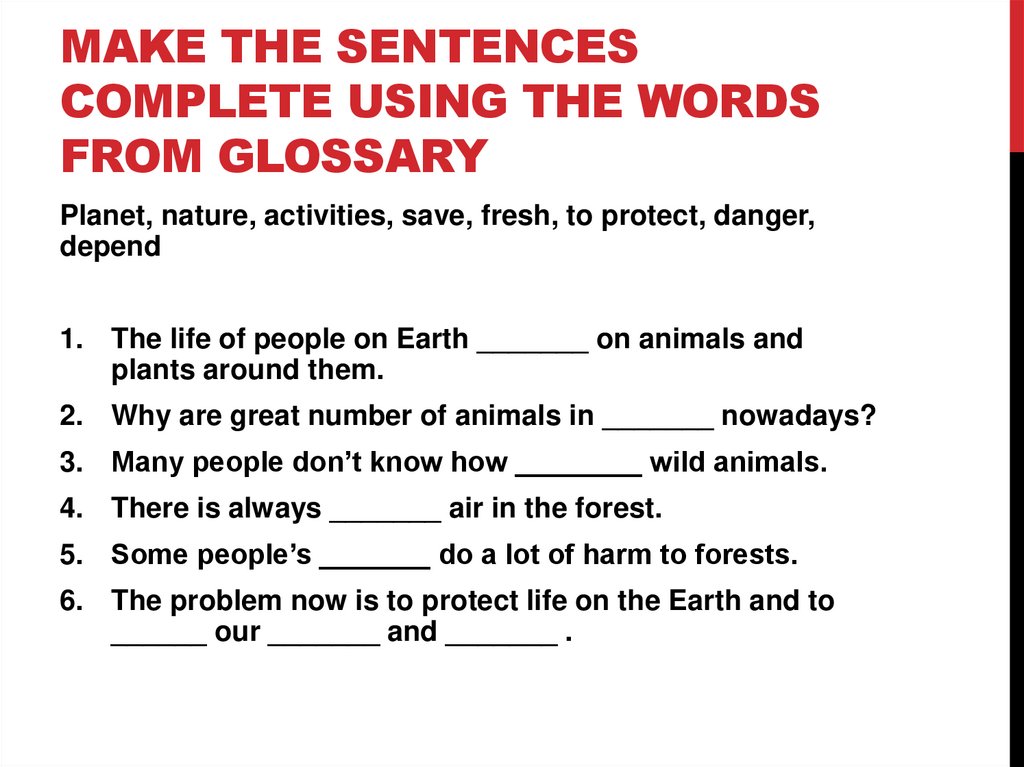
MAKE THE SENTENCESCOMPLETE USING THE WORDS
FROM GLOSSARY
Planet, nature, activities, save, fresh, to protect, danger,
depend
1. The life of people on Earth _______ on animals and
plants around them.
2. Why are great number of animals in _______ nowadays?
3. Many people don’t know how ________ wild animals.
4. There is always _______ air in the forest.
5. Some people’s _______ do a lot of harm to forests.
6. The problem now is to protect life on the Earth and to
______ our _______ and _______ .
13.
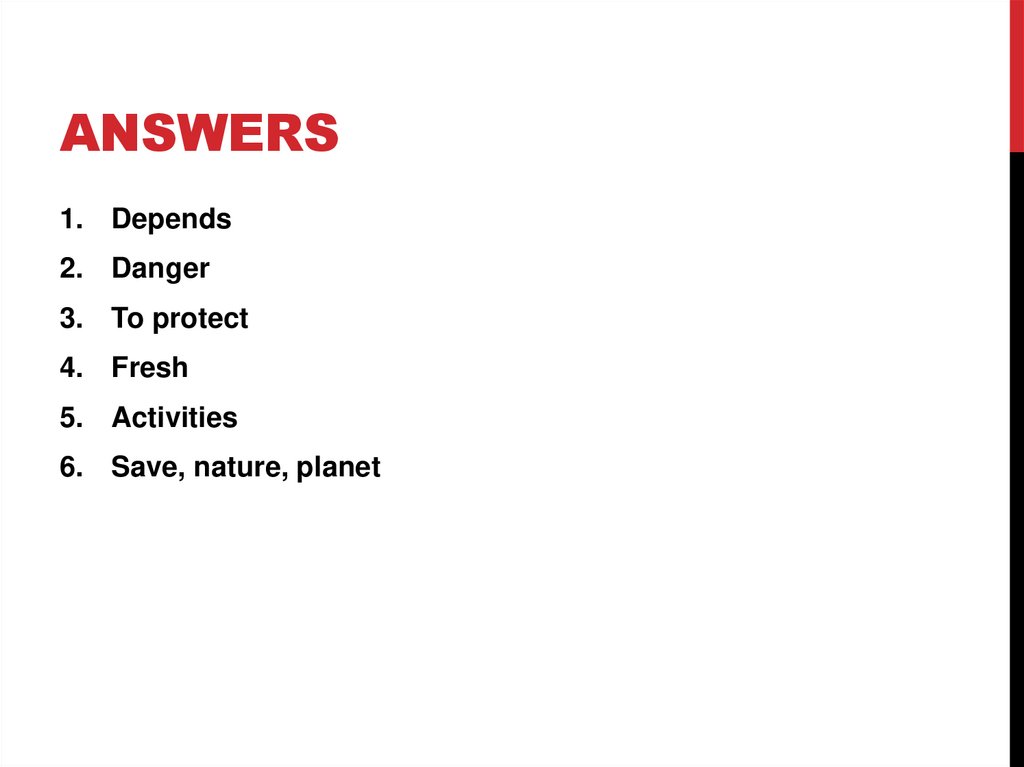
ANSWERS1. Depends
2. Danger
3. To protect
4. Fresh
5. Activities
6. Save, nature, planet
14.
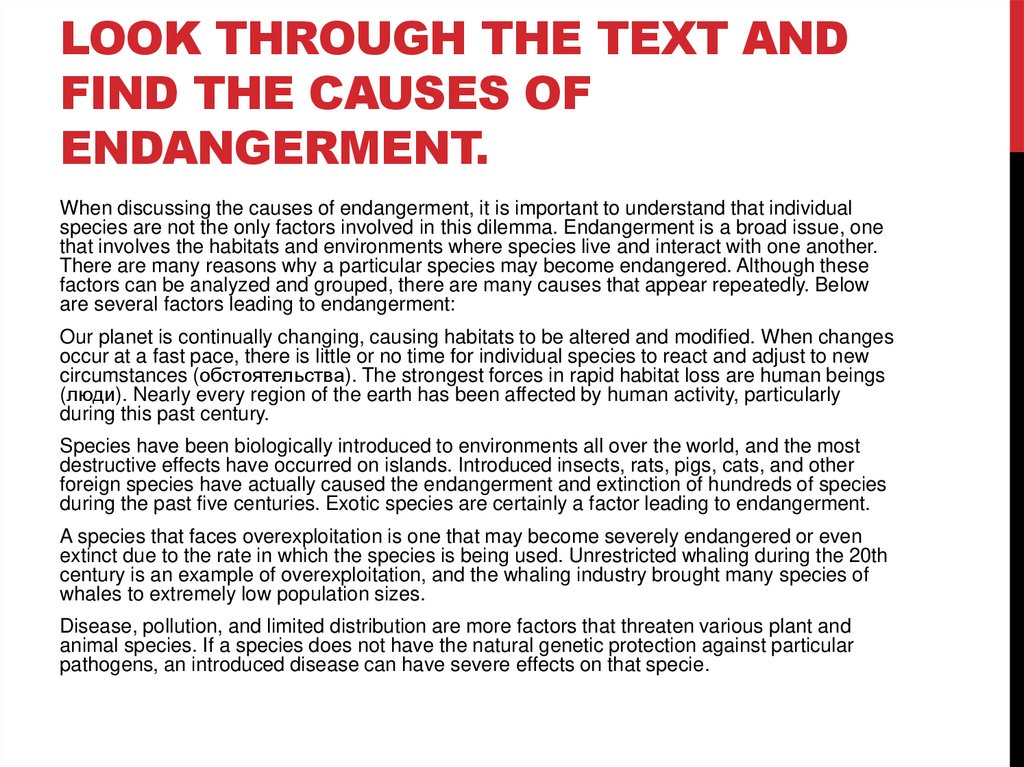
LOOK THROUGH THE TEXT ANDFIND THE CAUSES OF
ENDANGERMENT.
When discussing the causes of endangerment, it is important to understand that individual
species are not the only factors involved in this dilemma. Endangerment is a broad issue, one
that involves the habitats and environments where species live and interact with one another.
There are many reasons why a particular species may become endangered. Although these
factors can be analyzed and grouped, there are many causes that appear repeatedly. Below
are several factors leading to endangerment:
Our planet is continually changing, causing habitats to be altered and modified. When changes
occur at a fast pace, there is little or no time for individual species to react and adjust to new
circumstances (обстоятельства). The strongest forces in rapid habitat loss are human beings
(люди). Nearly every region of the earth has been affected by human activity, particularly
during this past century.
Species have been biologically introduced to environments all over the world, and the most
destructive effects have occurred on islands. Introduced insects, rats, pigs, cats, and other
foreign species have actually caused the endangerment and extinction of hundreds of species
during the past five centuries. Exotic species are certainly a factor leading to endangerment.
A species that faces overexploitation is one that may become severely endangered or even
extinct due to the rate in which the species is being used. Unrestricted whaling during the 20th
century is an example of overexploitation, and the whaling industry brought many species of
whales to extremely low population sizes.
Disease, pollution, and limited distribution are more factors that threaten various plant and
animal species. If a species does not have the natural genetic protection against particular
pathogens, an introduced disease can have severe effects on that specie.
15.
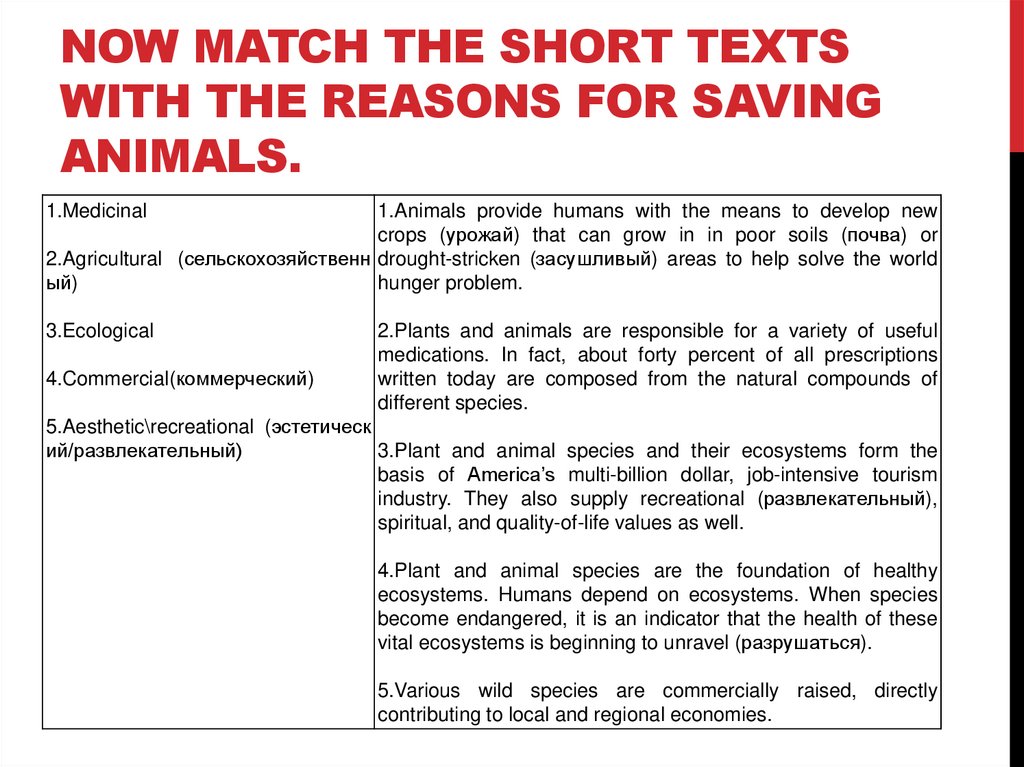
NOW MATCH THE SHORT TEXTSWITH THE REASONS FOR SAVING
ANIMALS.
1.Medicinal
1.Animals provide humans with the means to develop new
crops (урожай) that can grow in in poor soils (почва) or
2.Agricultural (сельскохозяйственн drought-stricken (засушливый) areas to help solve the world
ый)
hunger problem.
3.Ecological
4.Commercial(коммерческий)
2.Plants and animals are responsible for a variety of useful
medications. In fact, about forty percent of all prescriptions
written today are composed from the natural compounds of
different species.
5.Aesthetic\recreational (эстетическ
ий/развлекательный)
3.Plant and animal species and their ecosystems form the
basis of America’s multi-billion dollar, job-intensive tourism
industry. They also supply recreational (развлекательный),
spiritual, and quality-of-life values as well.
4.Plant and animal species are the foundation of healthy
ecosystems. Humans depend on ecosystems. When species
become endangered, it is an indicator that the health of these
vital ecosystems is beginning to unravel (разрушаться).
5.Various wild species are commercially raised, directly
contributing to local and regional economies.
16.
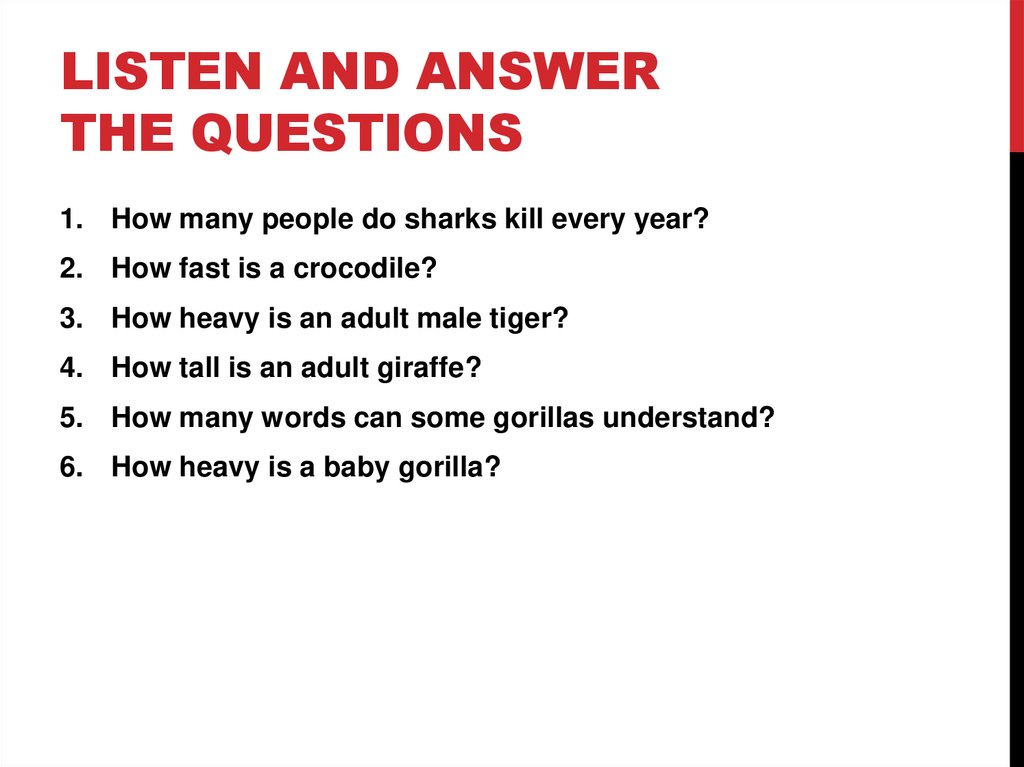
LISTEN AND ANSWERTHE QUESTIONS
1. How many people do sharks kill every year?
2. How fast is a crocodile?
3. How heavy is an adult male tiger?
4. How tall is an adult giraffe?
5. How many words can some gorillas understand?
6. How heavy is a baby gorilla?
17.
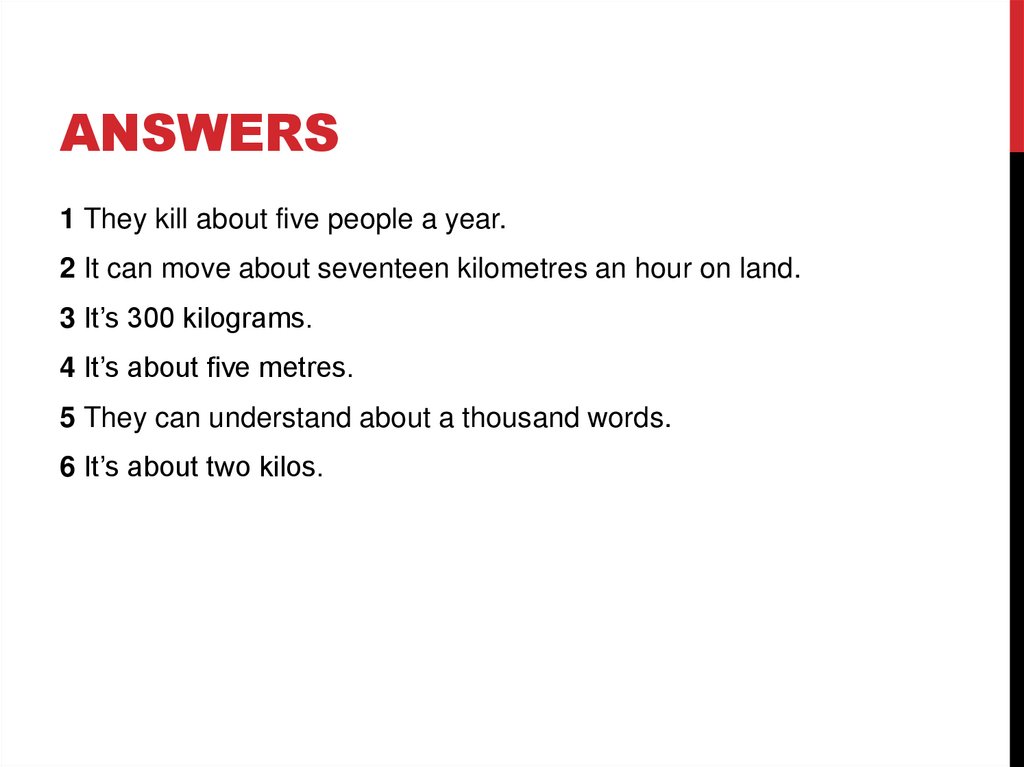
ANSWERS1 They kill about five people a year.
2 It can move about seventeen kilometres an hour on land.
3 It’s 300 kilograms.
4 It’s about five metres.
5 They can understand about a thousand words.
6 It’s about two kilos.
18.
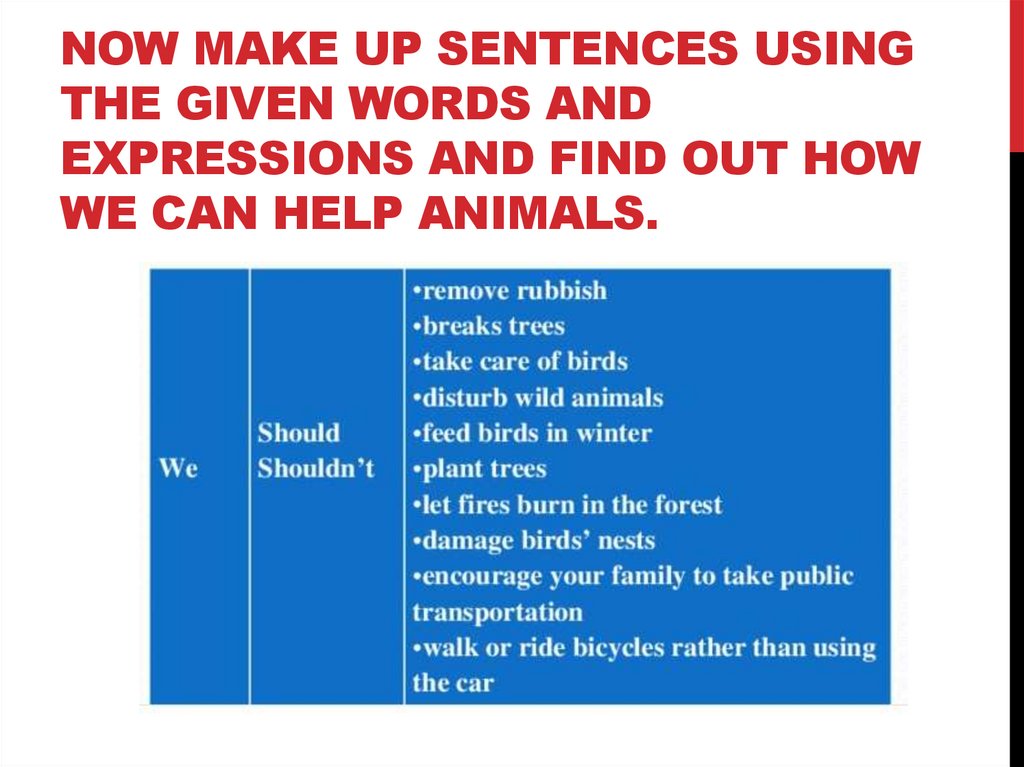
NOW MAKE UP SENTENCES USINGTHE GIVEN WORDS AND
EXPRESSIONS AND FIND OUT HOW
WE CAN HELP ANIMALS.