









 software
Similar presentations:






Classification of Testing - Testing Types, Testing Approaches, Testing Levels
1.
Classification of Testing - TestingTypes, Testing Approaches, Testing
Levels
2.
SummaryWhat is testing?
Testing types
Test levels
2
3.
What is Testing?3
4.
ISTQB: Testing definitionDefinition of software testing: “Software testing is a way to assess the quality of the
software and to reduce the risk of software failure in operation.”
Testing is the process consisting of all lifecycle activities, both static and dynamic,
concerned with planning, preparation and evaluation of software products and
related work products to determine that they satisfy specified requirements, to
demonstrate that they are fit for purpose and to detect defects.
4
5.
Types of Testing5
6.
Functional VS Non-Functional6
7.
Functional Testing vs Non-Functional TestingFunctional Testing
testing against functional requirements that describe the functions of a system and
its components.
Non-Functional Testing
testing of a software application for its non-functional requirements: the way a
system operates, rather than specific behaviours of that system.
7
8.
Non-Functional TestingGUI (Graphical User Interface) Testing
testing an application’s visual elements, such as images, texts, buttons, etc., to
validate their view and functional accuracy.
Usability (UX) Testing
focuses on the user's ease to use the application, flexibility in handling controls and
the ability of the system to meet its objectives.
8
9.
Non-Functional TestingConfiguration Testing
checks whether the software is capable of running on different hardware, operating
systems, browsers, network environments or mobile devices.
Performance Testing
testing performed to determine the system parameters in terms of responsiveness
and stability under various workload.
9
10.
Performance TestingLoad Testing
determines a system's performance under real-life load conditions.
Stress Testing
determines the system on its robustness and error handling under extremely heavy
load conditions.
Volume Testing
is carried out to find the response of the software with different sizes of the data
being received or to be processed by the software.
10
11.
Non-Functional TestingInternationalization Testing
testing to ensure that application can function in any culture or locale (language,
territory and code page).
Localization Testing
checks that software application behaves according to the local culture or settings.
The major area affected by localization testing includes content and UI.
11
12.
Testing Types by approach (methods)• Black Box
• White Box
• Gray Box
12
13.
Testing Types by Testing LevelsUnit Testing/Component Testing
Component testing is a method where testing of each component in an application is
done separately.
Integration Testing
Integration testing is one of the most common and important types of software
testing. Tests integration between components, interactions to different parts of the
system such as an operating system, file system and hardware or interfaces between
systems. There are different approaches for Integration testing namely, Top Down,
Bottom Up and Big Bang.
System Testing
System testing includes multiple software testing types that will enable to validate the
software as a whole (software, hardware, and network) against the requirements for
which it was built. Both functional and non-functional types of testing are carried out
to complete system testing.
13
14.
Testing LevelsDevelopment
Local architecture
Component testing
Global architecture
Integration testing
System requirements
System testing
User requirements
Acceptance testing
14
15.
Testing Types by Testing LevelsEnd-to-end Testing
End-to-end testing tests main flows across application e.g., right from order creation
till reporting or order creation till item return etc. End-to-end testing is usually
focused on mimicking real life scenarios and usage.
Acceptance Testing
Acceptance testing is a formal type of software testing that is performed by end user
when the features have been delivered by developers. The aim of this testing is to
check if the software confirms to their business needs and to the requirements
provided earlier.
15
16.
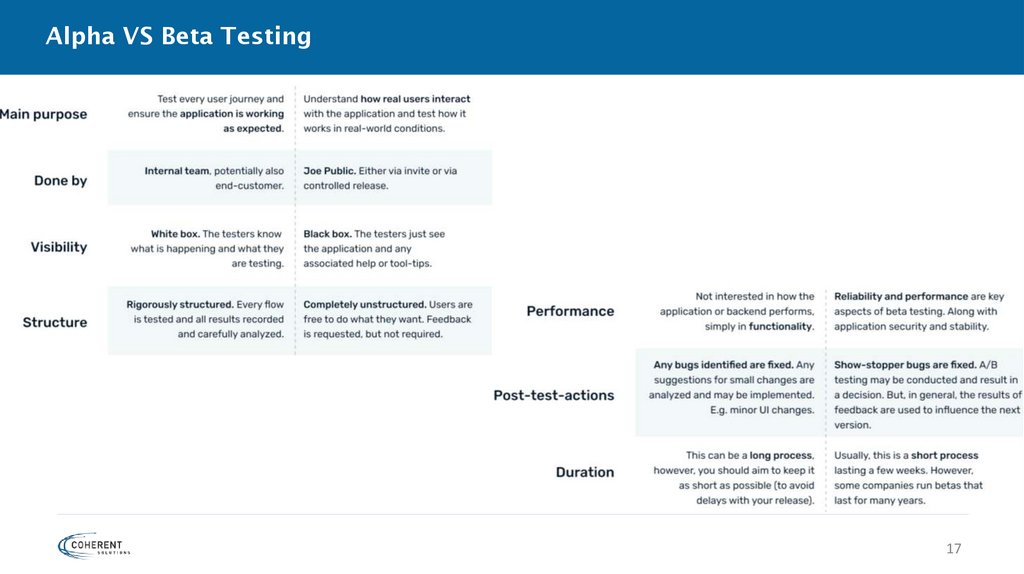
Testing Types by person who testAlpha Testing
is done at the developers site. It is done at the end of the development process. Alpha
testing is typically performed by a group that is independent of the design team, but
still within the company.
Beta Testing
is done at the customers site. This is a formal type of software testing that is carried
out by end customers before releasing or handing over software to end users.
Successful completion of Beta testing means customer acceptance of the software.
16
17.
Alpha VS Beta Testing17
18.
Testing Types by phase of testingRetesting (Confirmation testing)
is a type of retesting that is carried out by software testers as a part of defect fix
verification. For e.g. a tester is verifying a defect fix and let us say that there are 3
test cases failed due to this defect. Once a tester verifies the defect fix as resolved,
the tester will then retest or test the same functionality again by executing the test
cases that were failed earlier.
Regression Testing
is a type of software testing that is carried out by software testers as functional
regression tests. The objective of regression tests is to find defects that got
introduced to defect fix(es) or introduction of new feature(s). Regression tests are
ideal candidates for automation.
18
19.
Testing Types by phase of testingSmoke testing
is a type of testing that is carried out by software testers to check if the new build
provided by the development team is stable enough i.e., major functionality is
working as expected in order to carry out further or detailed testing. Smoke testing is
intended to find “show stopper” defects that can prevent testers from testing the
application in detail. Smoke testing carried out for a build is also known as build
verification test.
Sanity Testing
is brief or quick testing in order to ensure that the changes are working as expected
and as per the specification documents. Sanity testing is focused on one or two
functionalities whereas smoke testing is done to ensure that all the major features
of the project is working fine. Sanity tests are narrow and most of the time sanity
tests are not documented.
19
20.
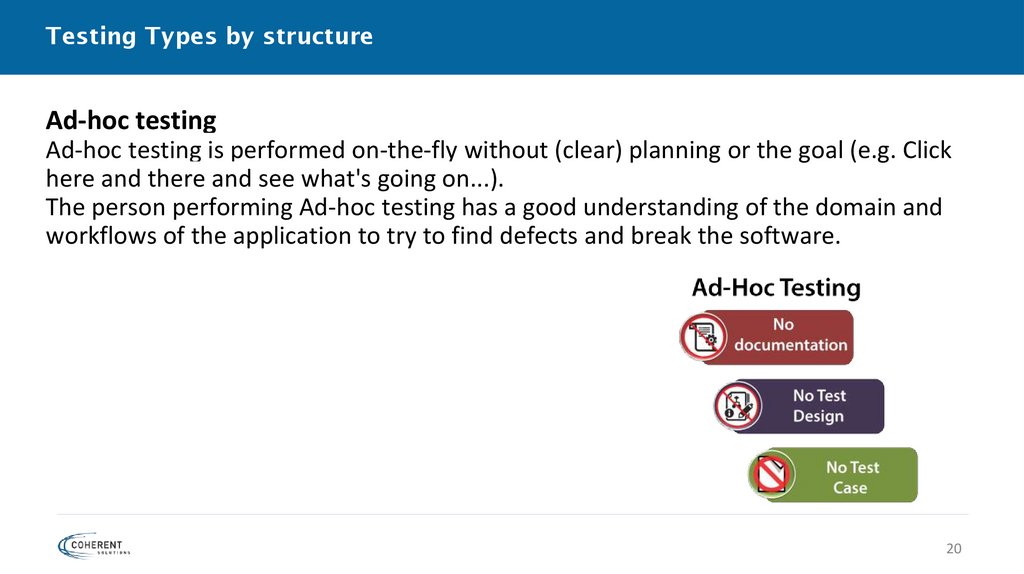
Testing Types by structureAd-hoc testing
Ad-hoc testing is performed on-the-fly without (clear) planning or the goal (e.g. Click
here and there and see what's going on...).
The person performing Ad-hoc testing has a good understanding of the domain and
workflows of the application to try to find defects and break the software.
20
21.
Testing Types by structureExploratory Testing
Exploratory testing is an informal type of testing conducted to learn the software at
the same time looking for errors or application behavior that seems non-obvious.
Exploratory testing is performed with a clear plan and structure in mind (e.g. Sessionbased testing is a good practice of exploratory testing)
21