

 ecology
Similar presentations:







Problem and Solution essay
1.
PROBLEMAND
SOLUTION
ESSAY
2.
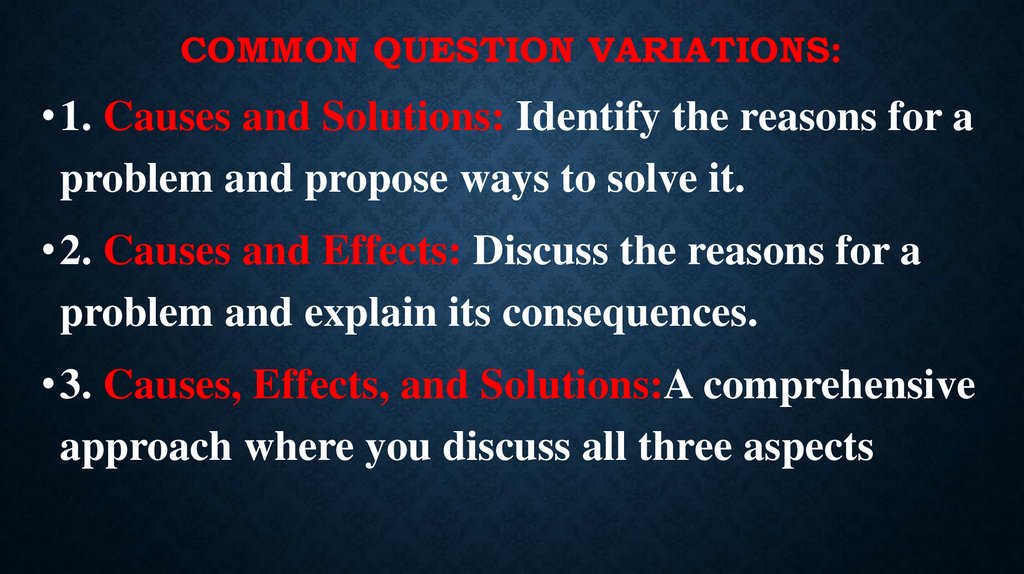
COMMON QUESTION VARIATIONS:• 1. Causes and Solutions: Identify the reasons for a
problem and propose ways to solve it.
• 2. Causes and Effects: Discuss the reasons for a
problem and explain its consequences.
• 3. Causes, Effects, and Solutions:A comprehensive
approach where you discuss all three aspects
3.
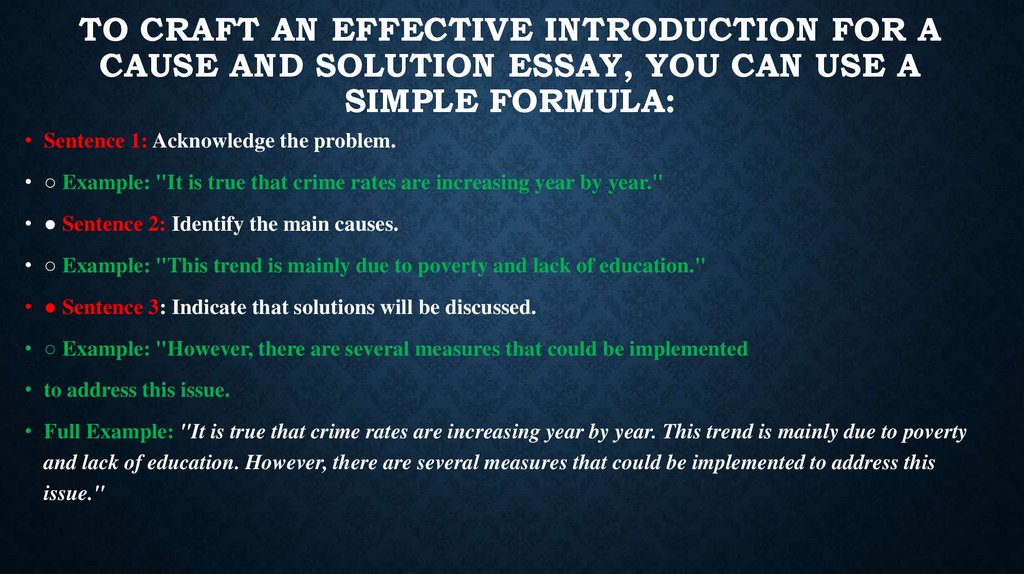
TO CRAFT AN EFFECTIVE INTRODUCTION FOR ACAUSE AND SOLUTION ESSAY, YOU CAN USE A
SIMPLE FORMULA:
• Sentence 1: Acknowledge the problem.
• ○ Example: "It is true that crime rates are increasing year by year."
• ● Sentence 2: Identify the main causes.
• ○ Example: "This trend is mainly due to poverty and lack of education."
• ● Sentence 3: Indicate that solutions will be discussed.
• ○ Example: "However, there are several measures that could be implemented
• to address this issue.
• Full Example: "It is true that crime rates are increasing year by year. This trend is mainly due to poverty
and lack of education. However, there are several measures that could be implemented to address this
issue."
4.
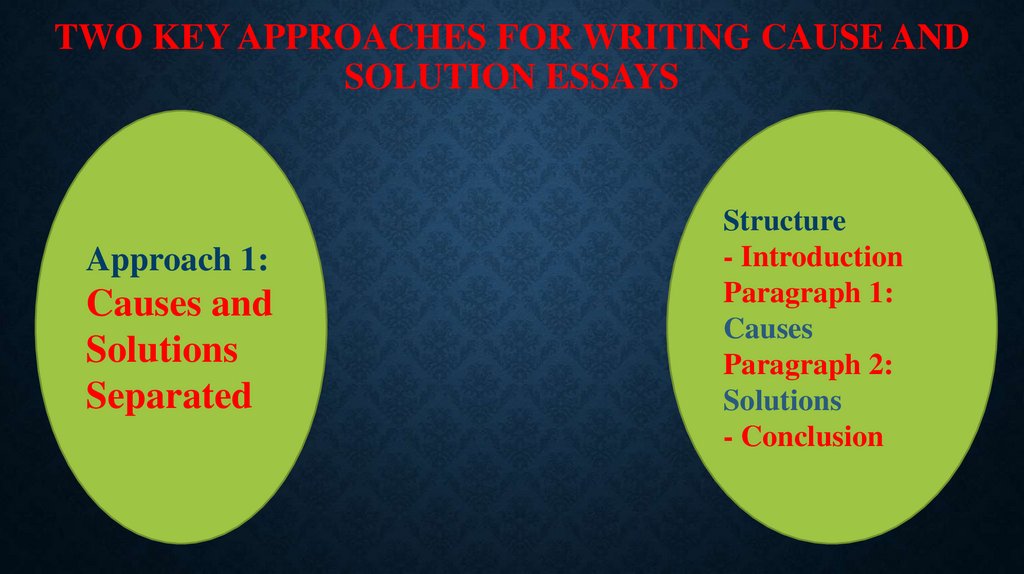
TWO KEY APPROACHES FOR WRITING CAUSE ANDSOLUTION ESSAYS
Approach 1:
Causes and
Solutions
Separated
Structure
- Introduction
Paragraph 1:
Causes
Paragraph 2:
Solutions
- Conclusion
5.
Approach 2:Causes and
Solutions
Paired
- Introduction
Paragraph 1:
Cause 1 +
Solution
Paragraph 2:
Cause 2 +
Solution
- Conclusion
6.
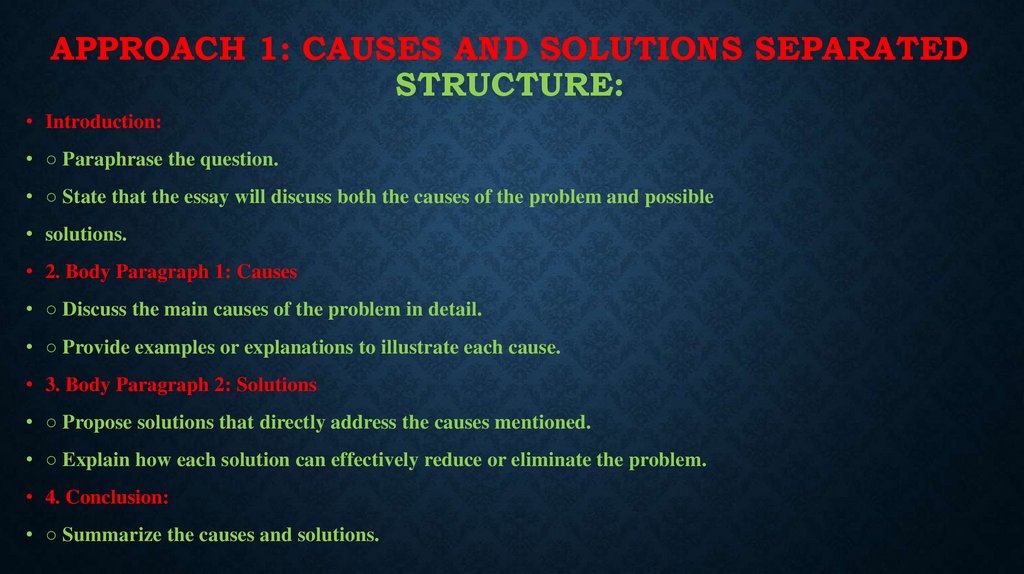
APPROACH 1: CAUSES AND SOLUTIONS SEPARATEDSTRUCTURE:
• Introduction:
• ○ Paraphrase the question.
• ○ State that the essay will discuss both the causes of the problem and possible
• solutions.
• 2. Body Paragraph 1: Causes
• ○ Discuss the main causes of the problem in detail.
• ○ Provide examples or explanations to illustrate each cause.
• 3. Body Paragraph 2: Solutions
• ○ Propose solutions that directly address the causes mentioned.
• ○ Explain how each solution can effectively reduce or eliminate the problem.
• 4. Conclusion:
• ○ Summarize the causes and solutions.
7.
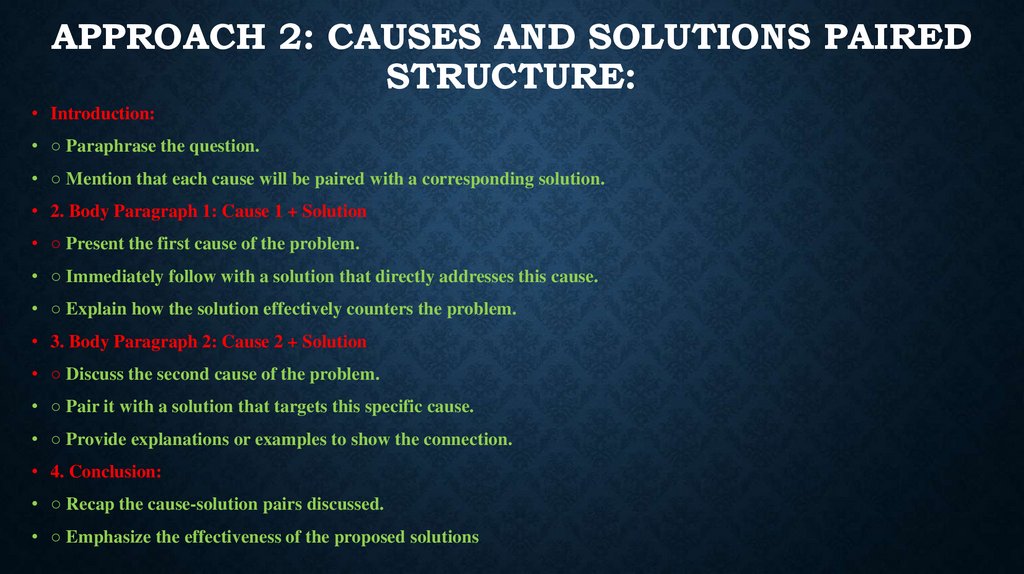
APPROACH 2: CAUSES AND SOLUTIONS PAIREDSTRUCTURE:
• Introduction:
• ○ Paraphrase the question.
• ○ Mention that each cause will be paired with a corresponding solution.
• 2. Body Paragraph 1: Cause 1 + Solution
• ○ Present the first cause of the problem.
• ○ Immediately follow with a solution that directly addresses this cause.
• ○ Explain how the solution effectively counters the problem.
• 3. Body Paragraph 2: Cause 2 + Solution
• ○ Discuss the second cause of the problem.
• ○ Pair it with a solution that targets this specific cause.
• ○ Provide explanations or examples to show the connection.
• 4. Conclusion:
• ○ Recap the cause-solution pairs discussed.
• ○ Emphasize the effectiveness of the proposed solutions
8.
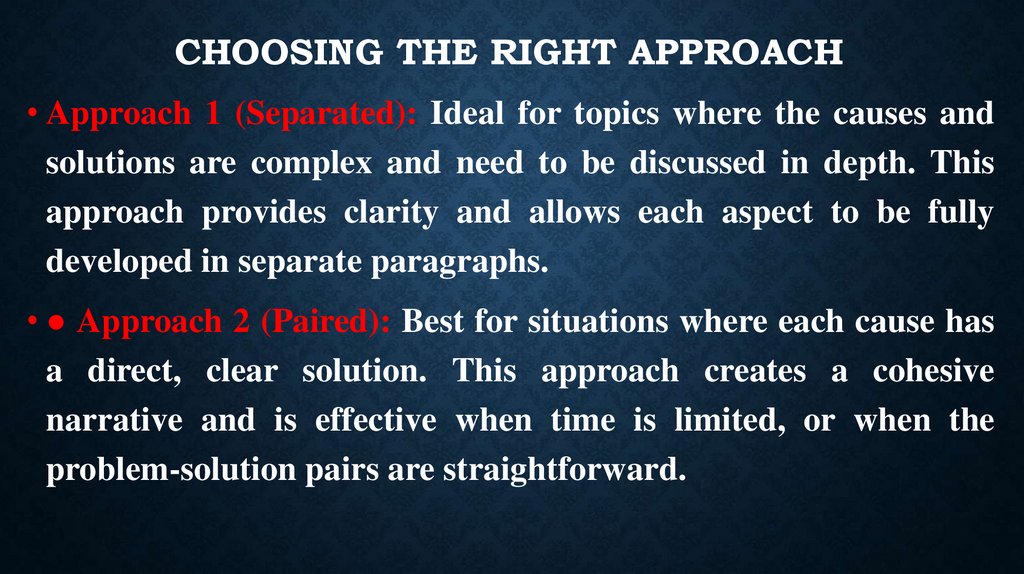
CHOOSING THE RIGHT APPROACH• Approach 1 (Separated): Ideal for topics where the causes and
solutions are complex and need to be discussed in depth. This
approach provides clarity and allows each aspect to be fully
developed in separate paragraphs.
• ● Approach 2 (Paired): Best for situations where each cause has
a direct, clear solution. This approach creates a cohesive
narrative and is effective when time is limited, or when the
problem-solution pairs are straightforward.
9.
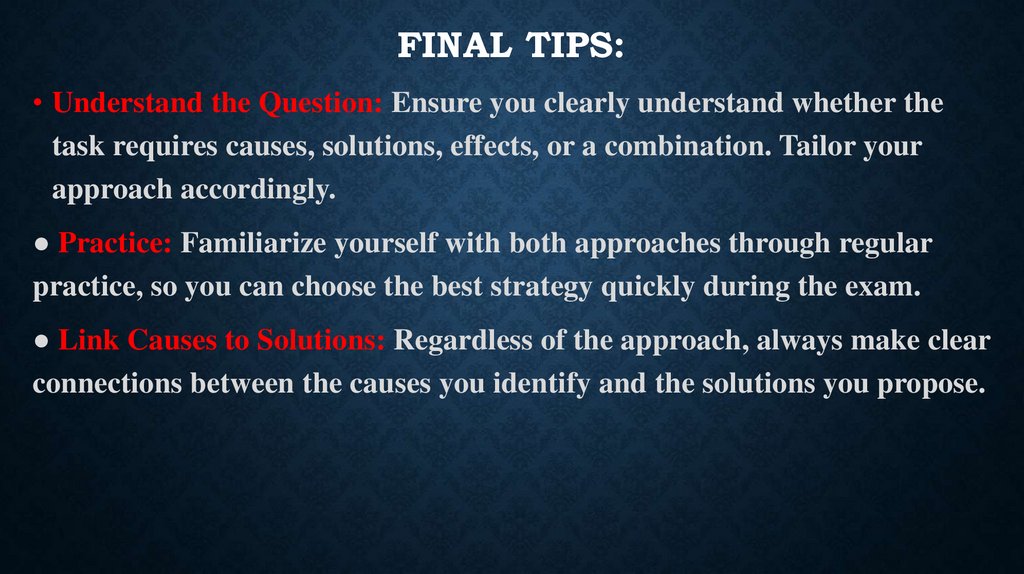
FINAL TIPS:• Understand the Question: Ensure you clearly understand whether the
task requires causes, solutions, effects, or a combination. Tailor your
approach accordingly.
● Practice: Familiarize yourself with both approaches through regular
practice, so you can choose the best strategy quickly during the exam.
● Link Causes to Solutions: Regardless of the approach, always make clear
connections between the causes you identify and the solutions you propose.
10.
IN MANY COUNTRIES, THE NUMBER OFANIMALS AND PLANTS IS DECLINING.
WHY DO YOU THINK THIS IS HAPPENING?
HOW CAN THIS ISSUE BE SOLVED?
11.
• Problem: In many countries, the number of animals and plants is declining.• Cause: Why do you think this is happening?
• Solutions: How can this issue be solved?
• Idea generation:
• Causes:
• habitat loss, climate change, deforestation, Urbanization, air pollution, illegal hunting
• Urbanization ⇒ Deforestation → Habitat Loss ⇒ Biodiversity loss
• Solutions for deforestation:
• Reforestation, public awareness, sustainable practices, stricter laws (imposing fines).
12.
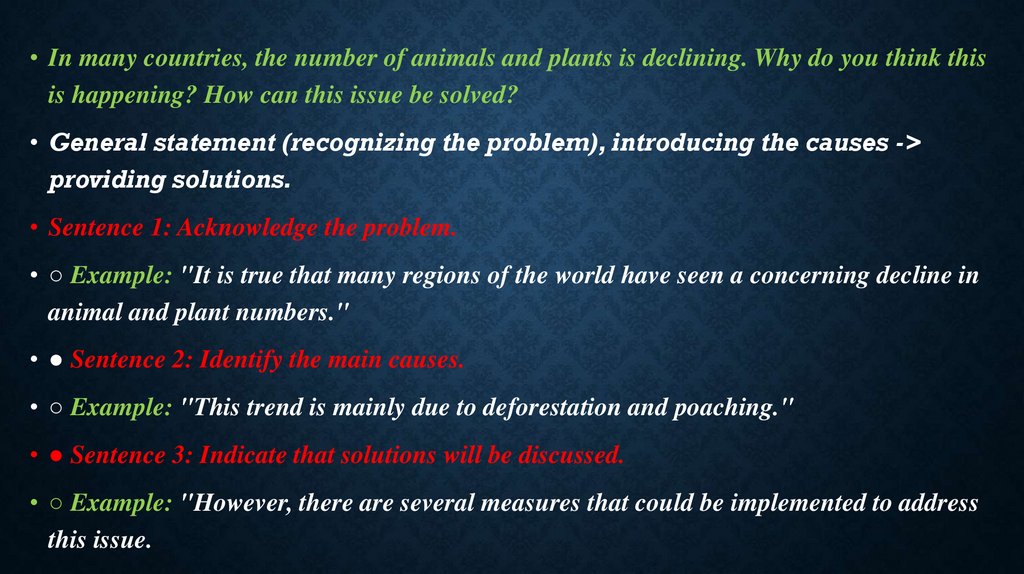
• In many countries, the number of animals and plants is declining. Why do you think thisis happening? How can this issue be solved?
• General statement (recognizing the problem), introducing the causes ->
providing solutions.
• Sentence 1: Acknowledge the problem.
• ○ Example: "It is true that many regions of the world have seen a concerning decline in
animal and plant numbers."
• ● Sentence 2: Identify the main causes.
• ○ Example: "This trend is mainly due to deforestation and poaching."
• ● Sentence 3: Indicate that solutions will be discussed.
• ○ Example: "However, there are several measures that could be implemented to address
this issue.
13.
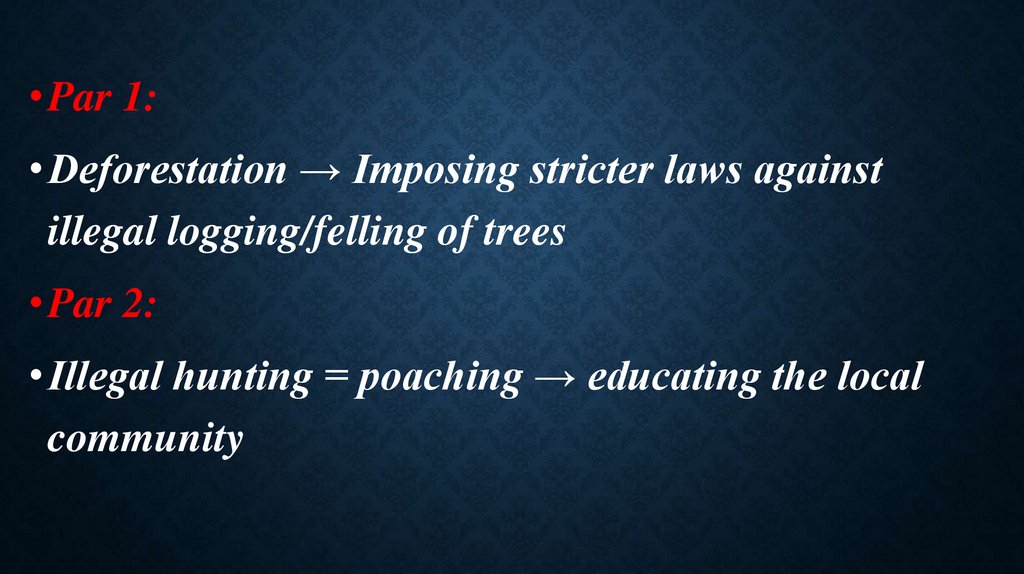
• Par 1:• Deforestation → Imposing stricter laws against
illegal logging/felling of trees
• Par 2:
• Illegal hunting = poaching → educating the local
community
14.
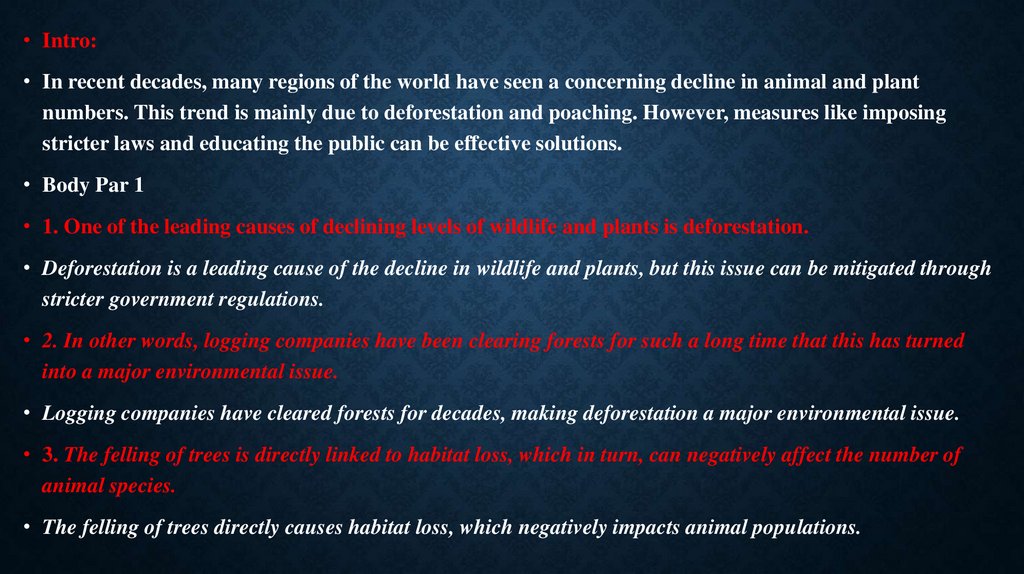
• Intro:• In recent decades, many regions of the world have seen a concerning decline in animal and plant
numbers. This trend is mainly due to deforestation and poaching. However, measures like imposing
stricter laws and educating the public can be effective solutions.
• Body Par 1
• 1. One of the leading causes of declining levels of wildlife and plants is deforestation.
• Deforestation is a leading cause of the decline in wildlife and plants, but this issue can be mitigated through
stricter government regulations.
• 2. In other words, logging companies have been clearing forests for such a long time that this has turned
into a major environmental issue.
• Logging companies have cleared forests for decades, making deforestation a major environmental issue.
• 3. The felling of trees is directly linked to habitat loss, which in turn, can negatively affect the number of
animal species.
• The felling of trees directly causes habitat loss, which negatively impacts animal populations.
15.
• 4. As a result of biodiversity loss, other animal and plant species are also likely to die outsince the whole ecosystem is interdependent.
• This biodiversity loss often leads to the extinction of other species due to the
interdependence of ecosystems.
• 5. To deal with this problem, governments can place stricter laws.
• Governments can address this problem by enforcing stricter laws.
• 6. Forests that are home to various animal and plant species should be protected by law.
• All forests should be legally protected to preserve their ecosystems and biodiversity.
• 7. Authorities should also limit construction, which mainly uses wood by
• imposing higher taxes. Authorities should also limit construction that relies on timber by
imposing higher taxes.
16.
• Body Par 2:• 1. Another reason why some animal species are going extinct is poaching, or illegal hunting in simpler terms.
• Another significant cause of species extinction is poaching, which can be countered by raising public
awareness.
• 2. The reasons for hunting animals include but are not limited to, game, which is more for entertainment
purposes, consumption and production of different items from animal products.
• Reasons for hunting include sport, consumption, and the production of goods from animal products.
• 3. In developing regions of the world, poachers do not take the laws seriously, so as a result, they are more
likely to hunt wildlife that may be considered ‘going extinct’.
• In developing regions, poachers often disregard laws, leading to the hunting of endangered wildlife.
• 4. An effective solution here is to raise public awareness, so the local people can collaborate with authorities
to protect their own land from illegal hunting.
• An effective solution involves raising public awareness to encourage local collaboration with authorities in
protecting against illegal hunting
17.
• 5. This can be done by educating the general public about the adverse effects ofbiodiversity loss.
• This can be achieved by educating the public about the adverse effects of biodiversity
loss.
• Conclusion:
• 1. In conclusion, while deforestation and poaching are the primary causes of the
disappearance of plants and animals, the government can place stricter laws and educate
the public to combat illegal logging of trees and hunting of keystone wildlife species.
• In conclusion, while deforestation and poaching are the main causes of species decline,
stricter laws and public education can combat illegal logging and hunting of key wildlife.