 english
Similar presentations:




Stylistic Classification of the English Vocabulary
1.
Stylistic Classification of theEnglish Vocabulary
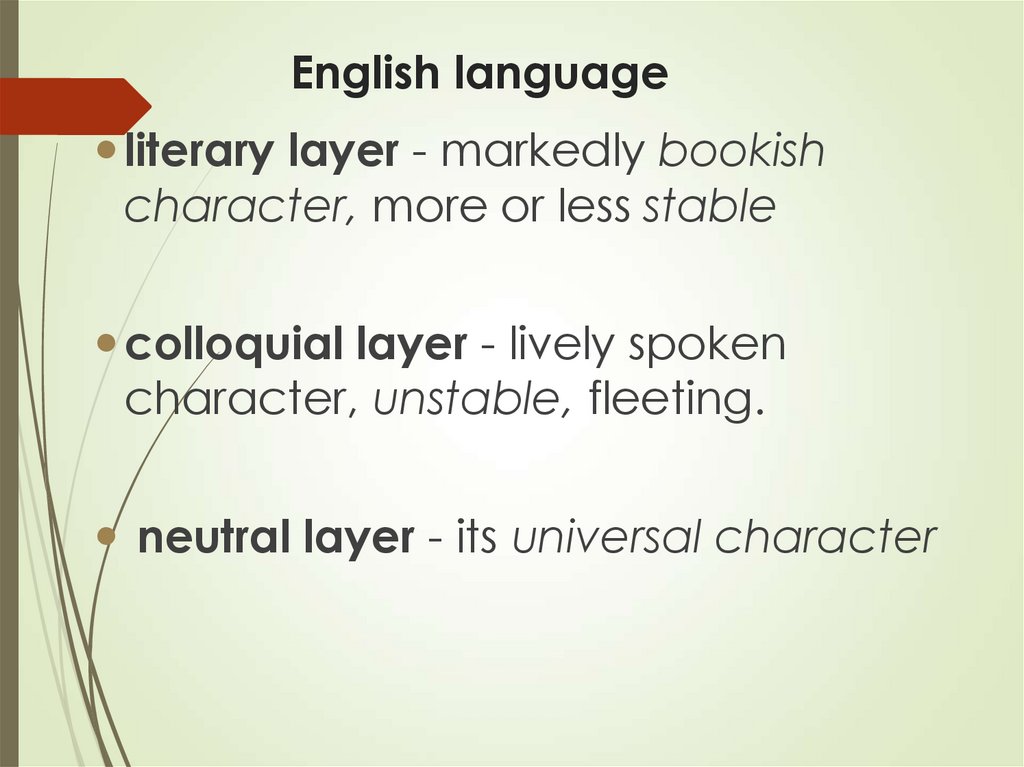
2. English language
literary layer - markedly bookishcharacter, more or less stable
colloquial layer - lively spoken
character, unstable, fleeting.
neutral layer - its universal character
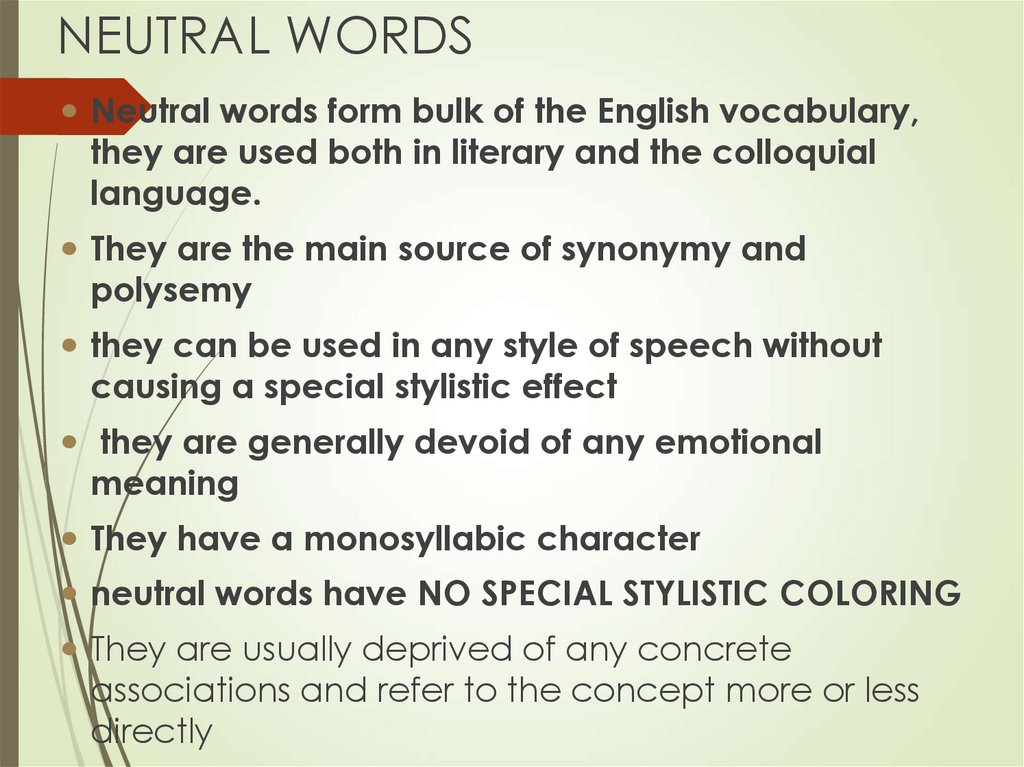
3. NEUTRAL WORDS
Neutral words form bulk of the English vocabulary,they are used both in literary and the colloquial
language.
They are the main source of synonymy and
polysemy
they can be used in any style of speech without
causing a special stylistic effect
they are generally devoid of any emotional
meaning
They have a monosyllabic character
neutral words have NO SPECIAL STYLISTIC COLORING
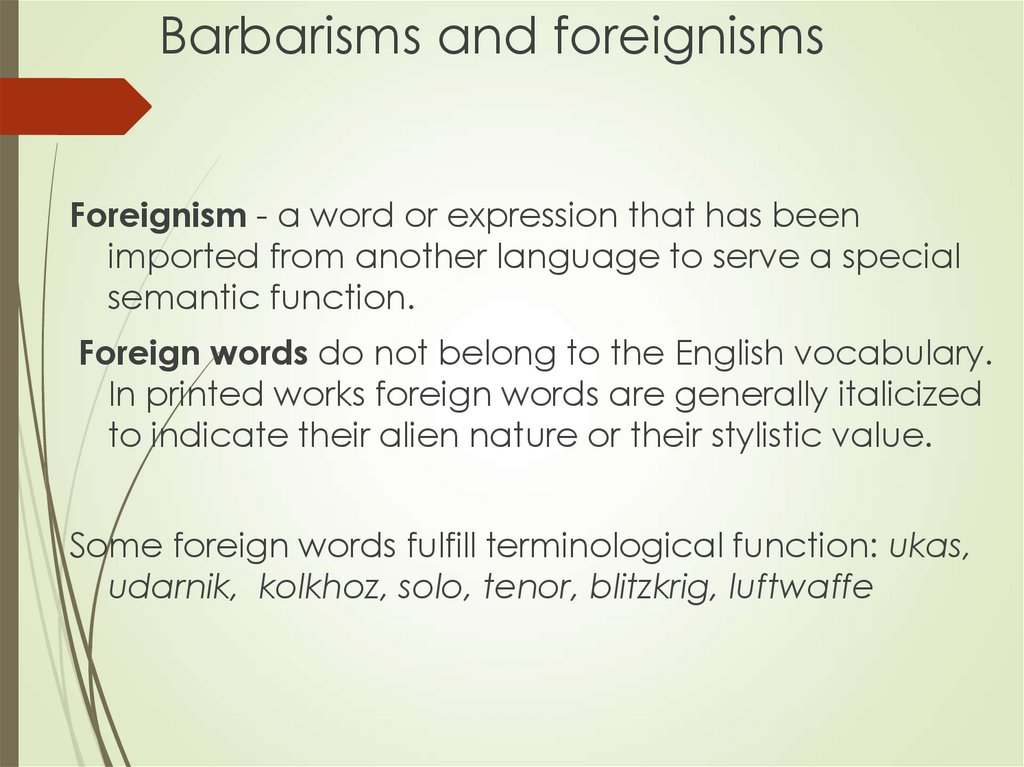
They are usually deprived of any concrete
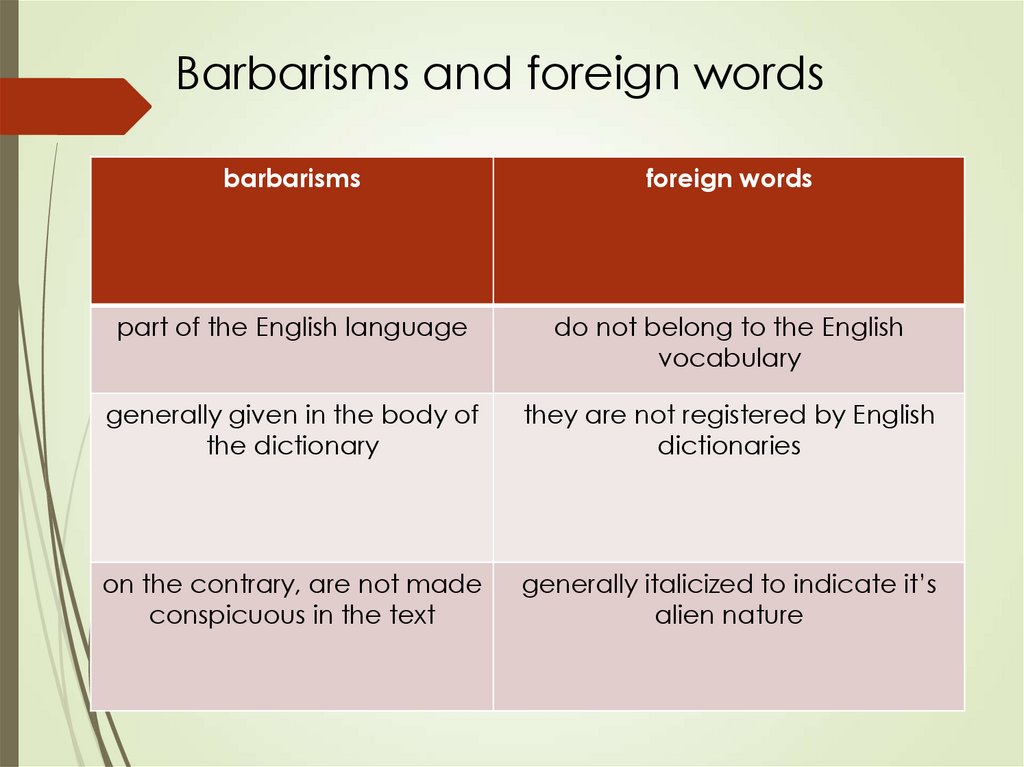
associations and refer to the concept more or less
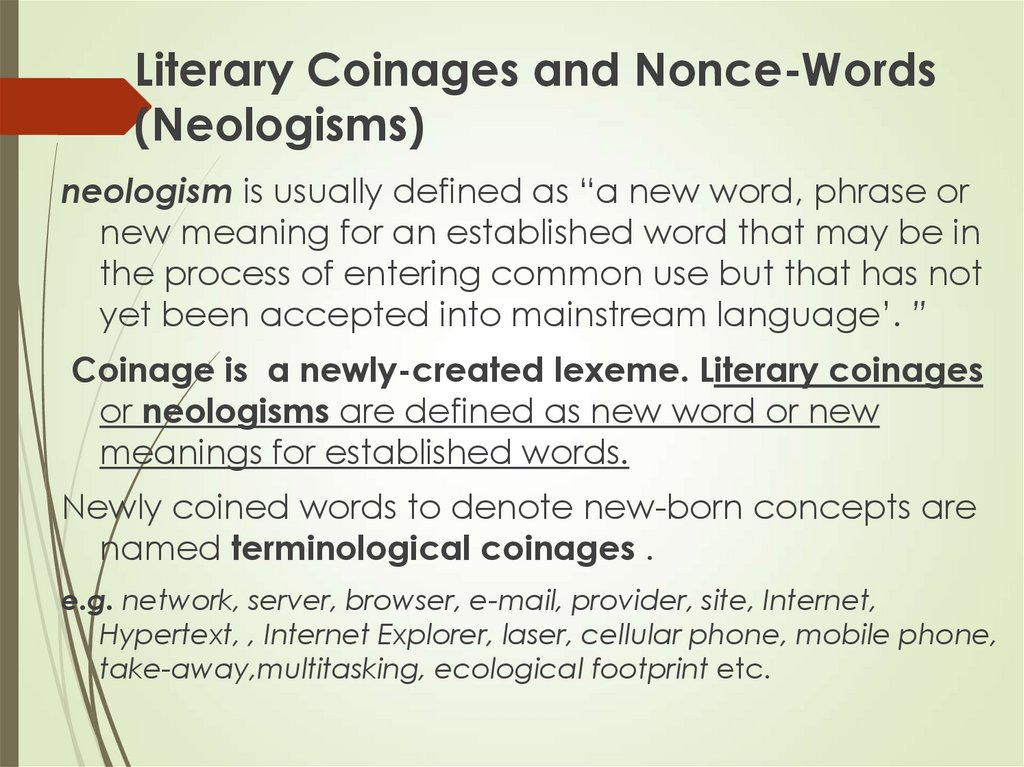
directly
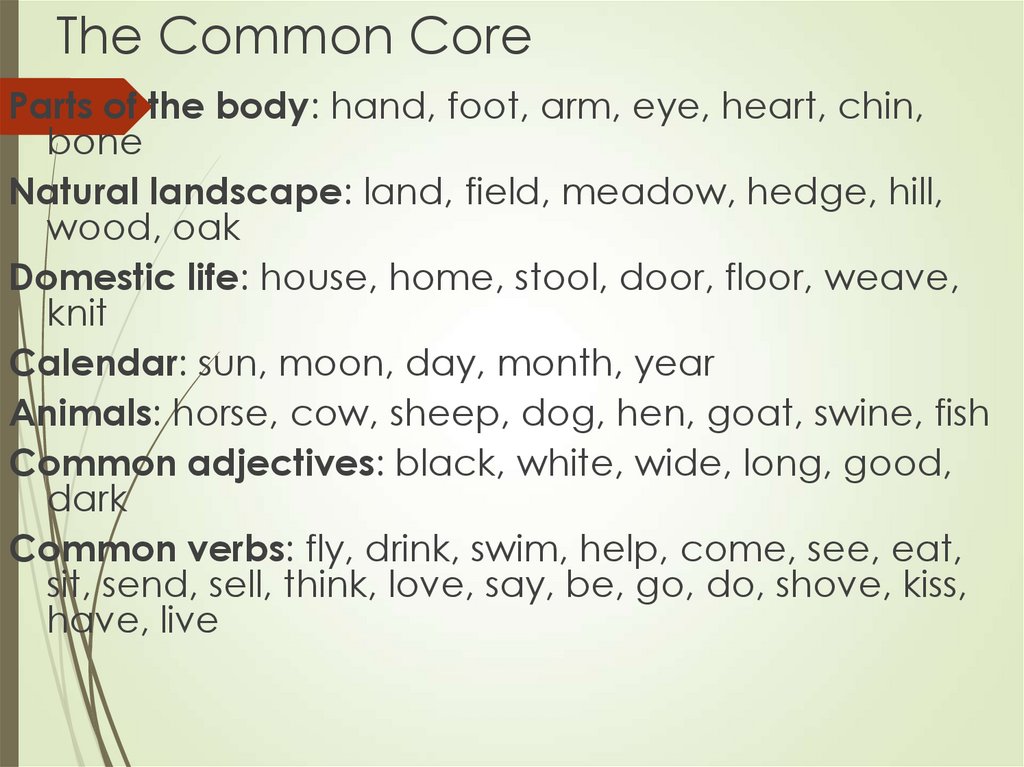
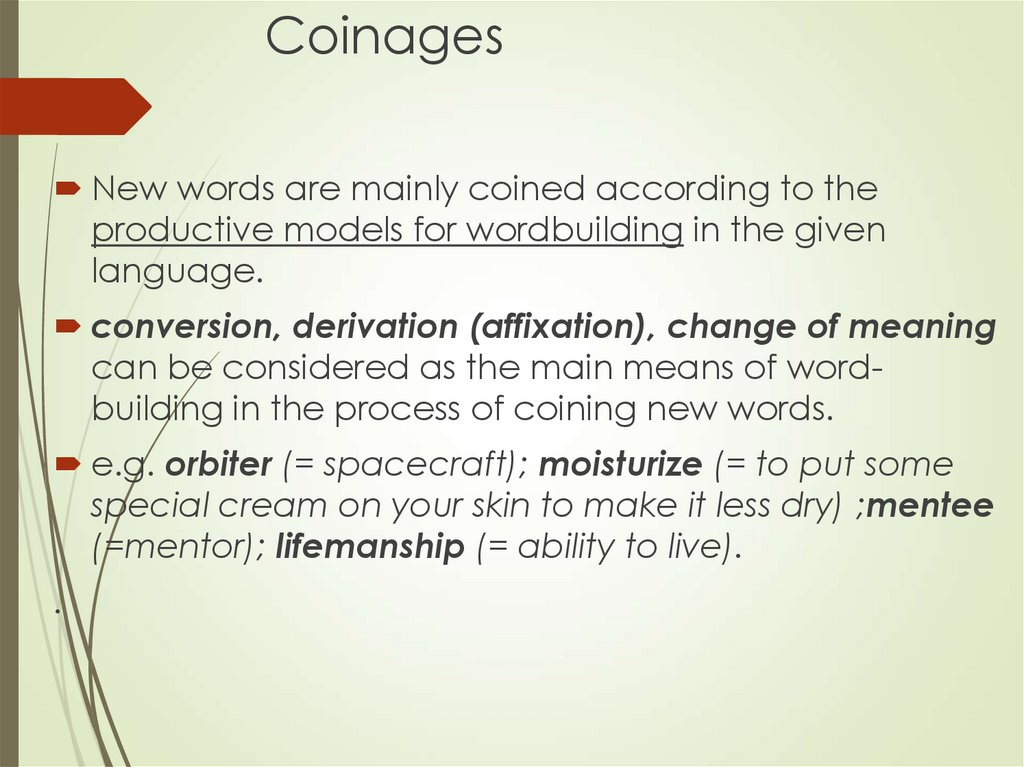
4. The Common Core
Parts of the body: hand, foot, arm, eye, heart, chin,bone
Natural landscape: land, field, meadow, hedge, hill,
wood, oak
Domestic life: house, home, stool, door, floor, weave,
knit
Calendar: sun, moon, day, month, year
Animals: horse, cow, sheep, dog, hen, goat, swine, fish
Common adjectives: black, white, wide, long, good,
dark
Common verbs: fly, drink, swim, help, come, see, eat,
sit, send, sell, think, love, say, be, go, do, shove, kiss,
have, live
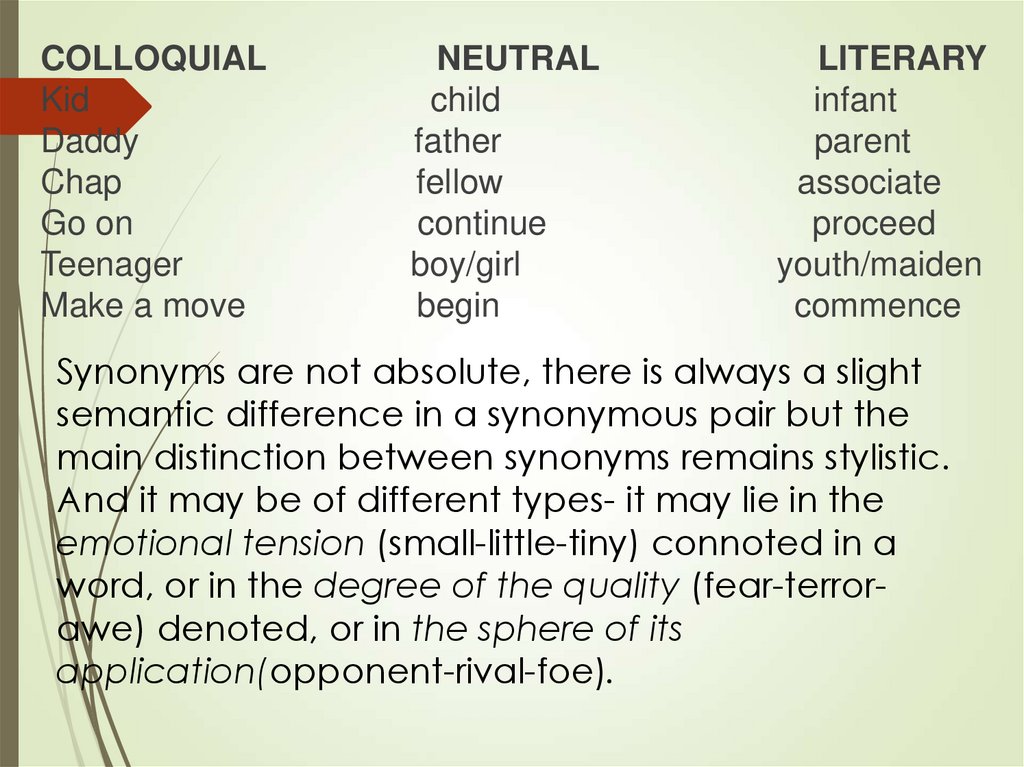
5. Synonyms are not absolute, there is always a slight semantic difference in a synonymous pair but the main distinction between
COLLOQUIALKid
Daddy
Chap
Go on
Teenager
Make a move
NEUTRAL
child
father
fellow
continue
boy/girl
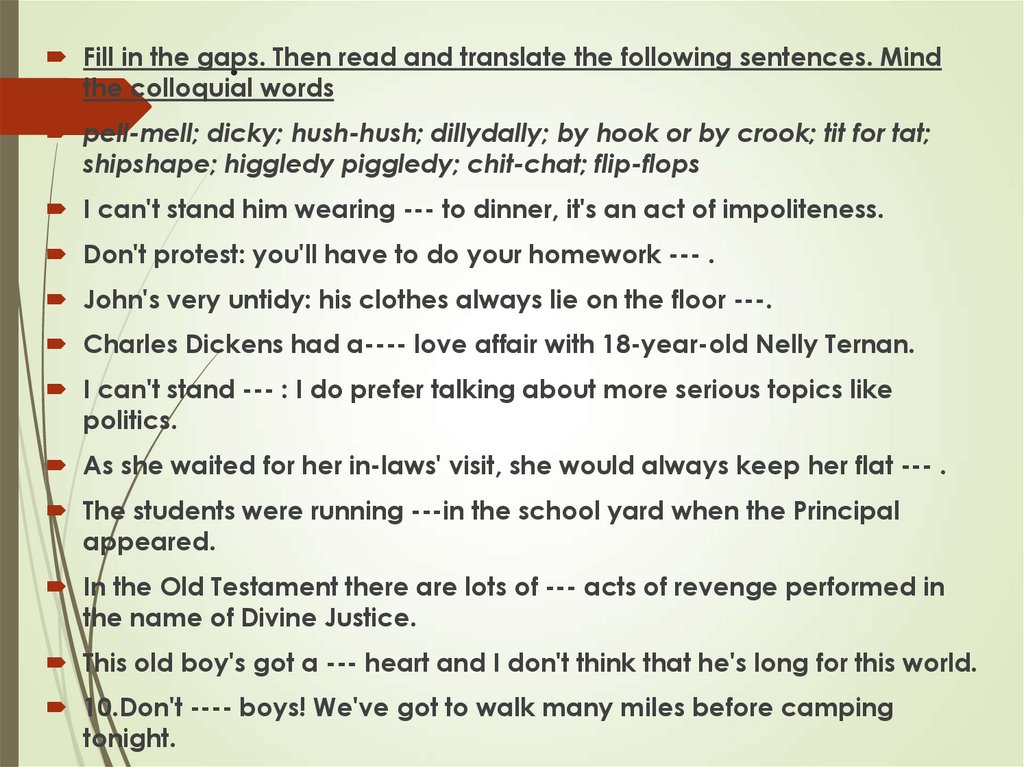
begin
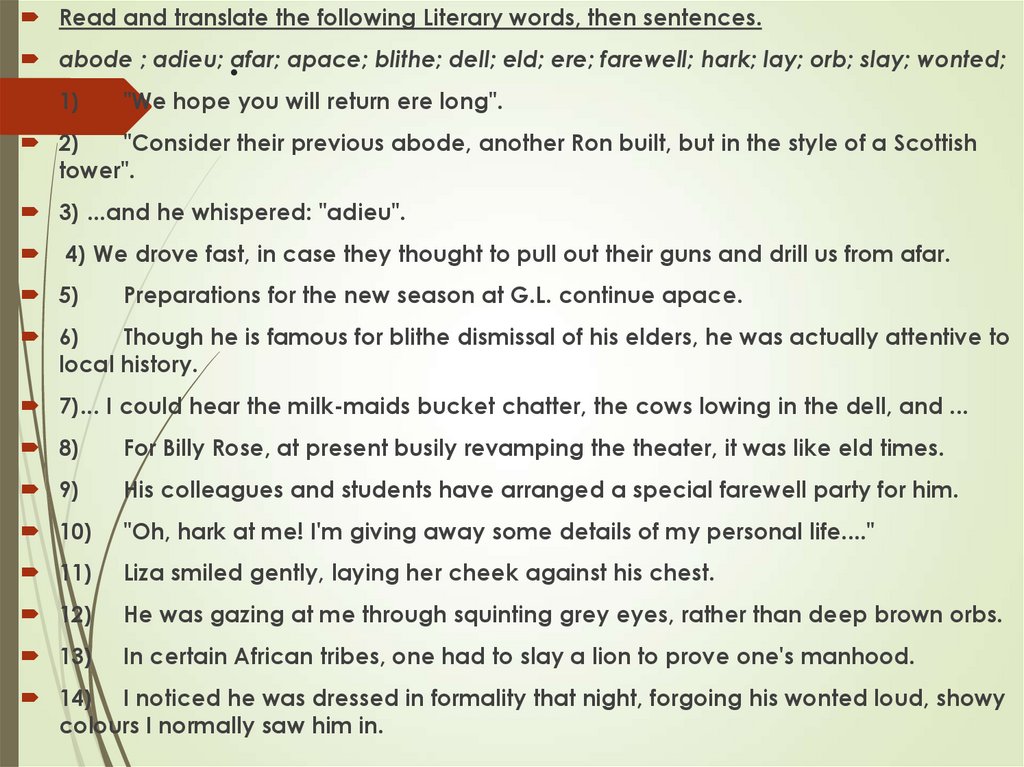
LITERARY
infant
parent
associate
proceed
youth/maiden
commence
Synonyms are not absolute, there is always a slight
semantic difference in a synonymous pair but the
main distinction between synonyms remains stylistic.
And it may be of different types- it may lie in the
emotional tension (small-little-tiny) connoted in a
word, or in the degree of the quality (fear-terrorawe) denoted, or in the sphere of its
application(opponent-rival-foe).
6. literary words
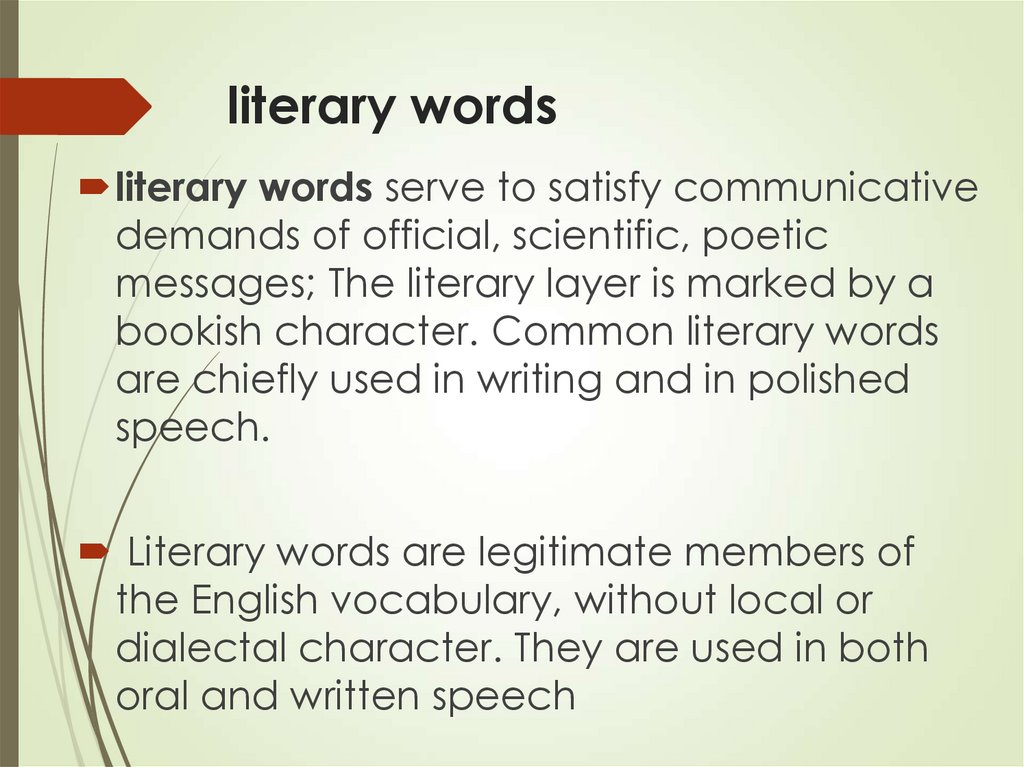
literary words serve to satisfy communicativedemands of official, scientific, poetic
messages; The literary layer is marked by a
bookish character. Common literary words
are chiefly used in writing and in polished
speech.
Literary words are legitimate members of
the English vocabulary, without local or
dialectal character. They are used in both
oral and written speech
7. literary words
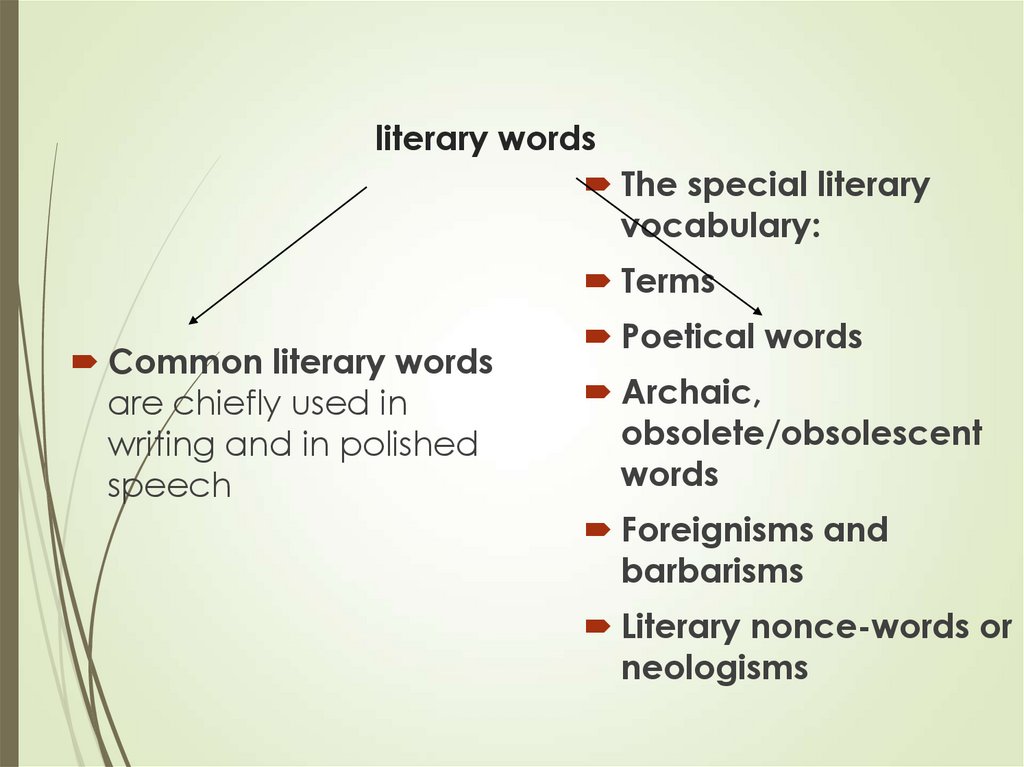
The special literaryvocabulary:
Terms
Common literary words
are chiefly used in
writing and in polished
speech
Poetical words
Archaic,
obsolete/obsolescent
words
Foreignisms and
barbarisms
Literary nonce-words or
neologisms
8. Colloquial words
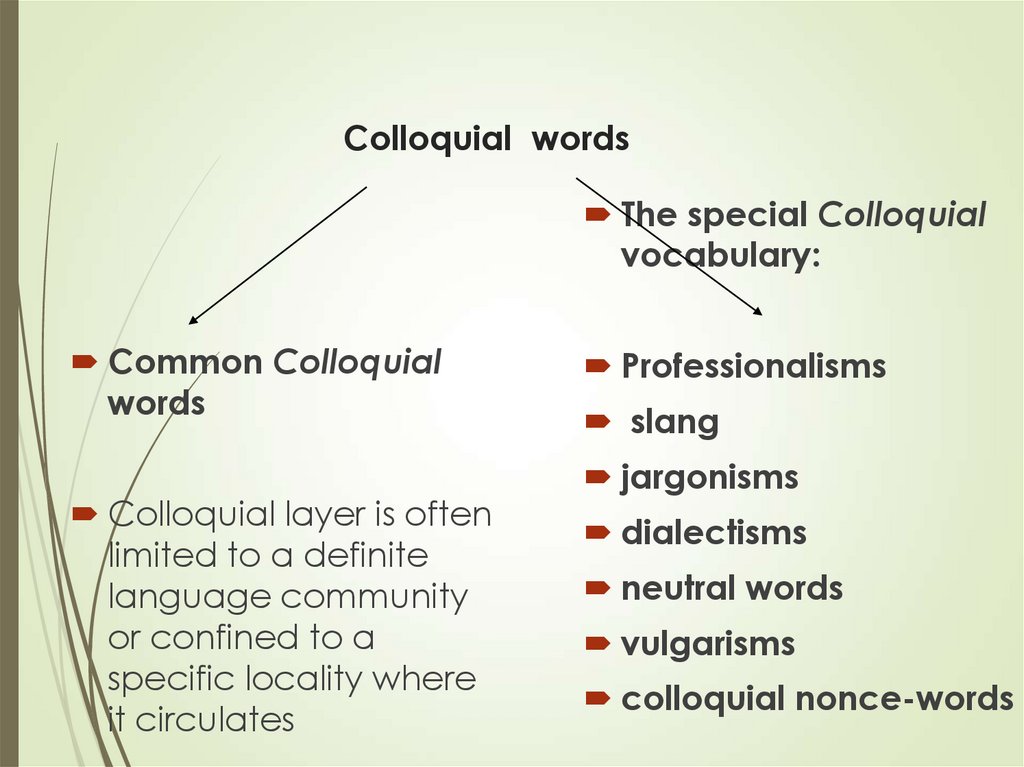
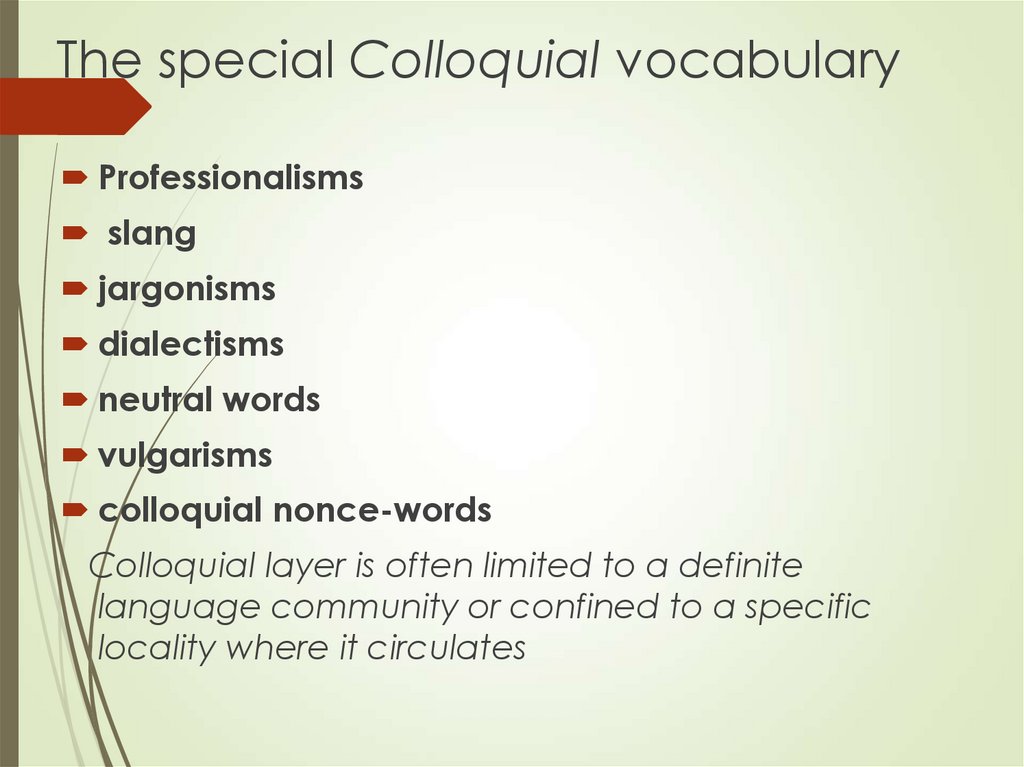
The special Colloquialvocabulary:
Common Colloquial
words
Colloquial layer is often
limited to a definite
language community
or confined to a
specific locality where
it circulates
Professionalisms
slang
jargonisms
dialectisms
neutral words
vulgarisms
colloquial nonce-words
9. The special Colloquial vocabulary
Professionalismsslang
jargonisms
dialectisms
neutral words
vulgarisms
colloquial nonce-words
Colloquial layer is often limited to a definite
language community or confined to a specific
locality where it circulates
10. Common Literary words
Literary words are mainly used in writing andin polished speech. It is not difficult to
distinguish between a literary word and a
colloquial word. Literary words stand in
opposition to colloquial units.
Colloquial words are more colorful than
literary, neutral words have no degree of
emotiveness.
11. DYNAMICS AND TENDENCIES
Both literary and colloquial words have their upper and lower ranges.The lower range of the common literary words approaches the
neutral layer and has a tendency to pass into it, while the upper
range of the common colloquial layer can easily pass into the neutral
layer.
So, the lines between common colloquial and neutral, on the one
hand, and common literary and neutral, on the other, are blurred
12. Terms and their groups
A term – is a word (word-combination) denoting a scientific concept.Terms formed from Greek, Latin, French, German or other foreign sources,
e.g.
Botany, anatomy, schedule, character, chemistry (Greek); locomotive,
chivalry, march, parliament, estate (Latin); facade, garage, massage,
reportage, banquet, ballet, buffet, fillet, masseur, chef, chassis, masseuse,
renaissance, retreat, maneuver, squad, coup d’etat, cliché, belles-lettres,
entrepreneur, crochet (French); cobalt, zinc, quartz, sauerkraut,
kindergarten (German).
Terms formed from the common word stock, by means of semantic
change, e.g. tank, company (milit.); wing (archit); fading, jamming (radio).
Terms formed by means of special suffixes and prefixes: e.g. ultra-violet,
antidote, transplant.
13. Features of a term
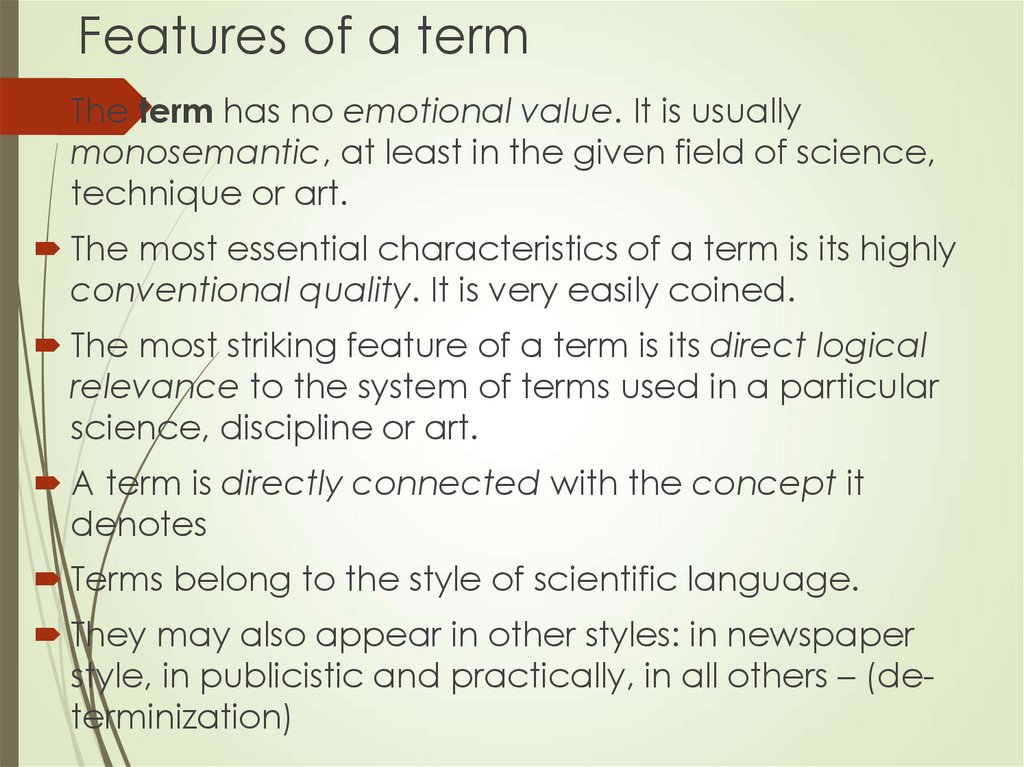
The term has no emotional value. It is usuallymonosemantic, at least in the given field of science,
technique or art.
The most essential characteristics of a term is its highly
conventional quality. It is very easily coined.
The most striking feature of a term is its direct logical
relevance to the system of terms used in a particular
science, discipline or art.
A term is directly connected with the concept it
denotes
Terms belong to the style of scientific language.
They may also appear in other styles: in newspaper
style, in publicistic and practically, in all others – (determinization)
14.
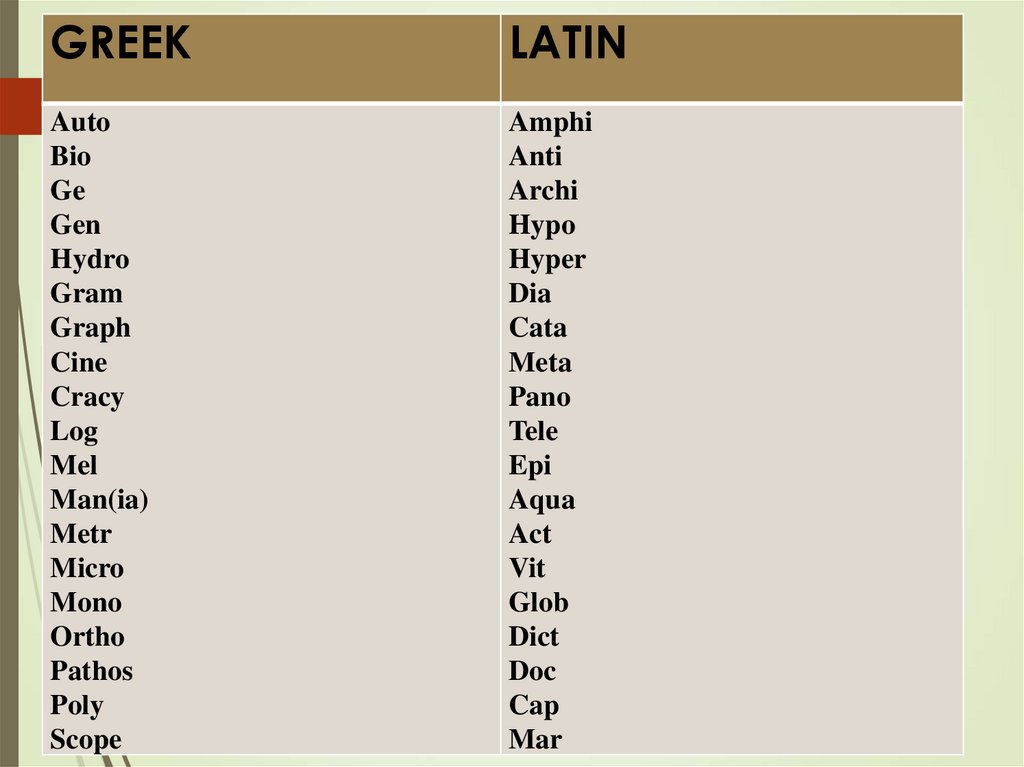
GREEKLATIN
Auto
Bio
Ge
Gen
Hydro
Gram
Graph
Cine
Cracy
Log
Mel
Man(ia)
Metr
Micro
Mono
Ortho
Pathos
Poly
Scope
Amphi
Anti
Archi
Hypo
Hyper
Dia
Cata
Meta
Pano
Tele
Epi
Aqua
Act
Vit
Glob
Dict
Doc
Cap
Mar
15. Poetic words
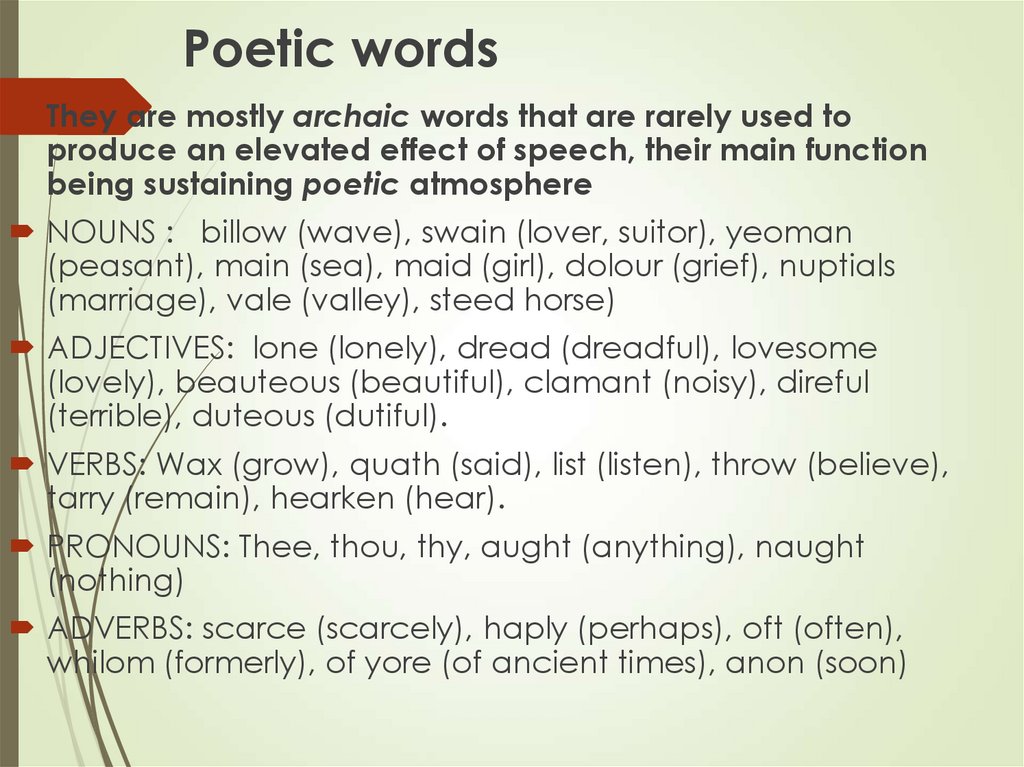
They are mostly archaic words that are rarely used toproduce an elevated effect of speech, their main function
being sustaining poetic atmosphere
NOUNS : billow (wave), swain (lover, suitor), yeoman
(peasant), main (sea), maid (girl), dolour (grief), nuptials
(marriage), vale (valley), steed horse)
ADJECTIVES: lone (lonely), dread (dreadful), lovesome
(lovely), beauteous (beautiful), clamant (noisy), direful
(terrible), duteous (dutiful).
VERBS: Wax (grow), quath (said), list (listen), throw (believe),
tarry (remain), hearken (hear).
PRONOUNS: Thee, thou, thy, aught (anything), naught
(nothing)
ADVERBS: scarce (scarcely), haply (perhaps), oft (often),
whilom (formerly), of yore (of ancient times), anon (soon)
16. Raven E.A. Poe
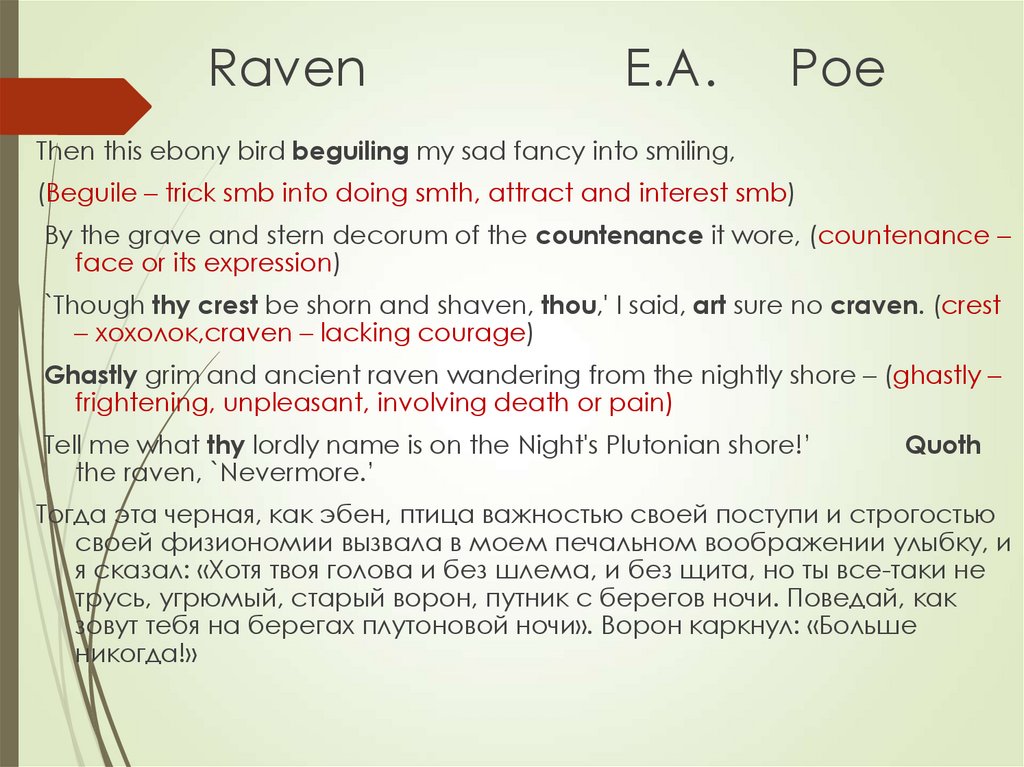
Then this ebony bird beguiling my sad fancy into smiling,(Beguile – trick smb into doing smth, attract and interest smb)
By the grave and stern decorum of the countenance it wore, (countenance –
face or its expression)
`Though thy crest be shorn and shaven, thou,' I said, art sure no craven. (crest
– хохолок,craven – lacking courage)
Ghastly grim and ancient raven wandering from the nightly shore – (ghastly –
frightening, unpleasant, involving death or pain)
Tell me what thy lordly name is on the Night's Plutonian shore!’
the raven, `Nevermore.’
Quoth
Тогда эта черная, как эбен, птица важностью своей поступи и строгостью
своей физиономии вызвала в моем печальном воображении улыбку, и
я сказал: «Хотя твоя голова и без шлема, и без щита, но ты все-таки не
трусь, угрюмый, старый ворон, путник с берегов ночи. Поведай, как
зовут тебя на берегах плутоновой ночи». Ворон каркнул: «Больше
никогда!»
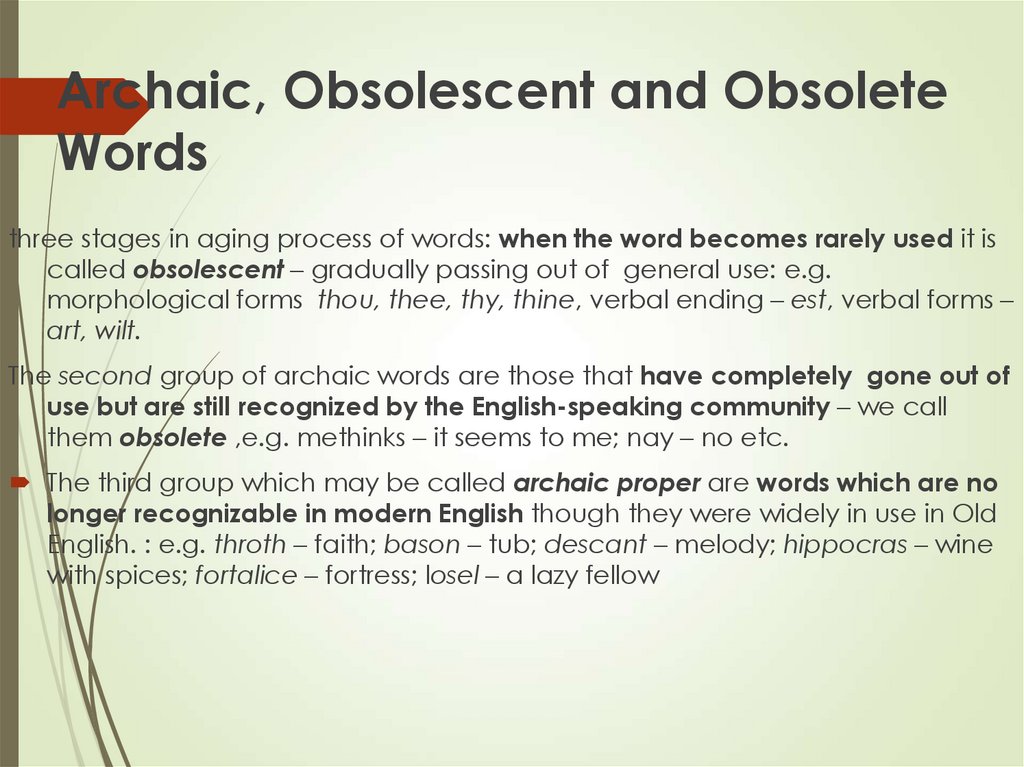
17. Archaic, Obsolescent and Obsolete Words
three stages in aging process of words: when the word becomes rarely used it iscalled obsolescent – gradually passing out of general use: e.g.
morphological forms thou, thee, thy, thine, verbal ending – est, verbal forms –
art, wilt.
The second group of archaic words are those that have completely gone out of
use but are still recognized by the English-speaking community – we call
them obsolete ,e.g. methinks – it seems to me; nay – no etc.
The third group which may be called archaic proper are words which are no
longer recognizable in modern English though they were widely in use in Old
English. : e.g. throth – faith; bason – tub; descant – melody; hippocras – wine
with spices; fortalice – fortress; losel – a lazy fellow
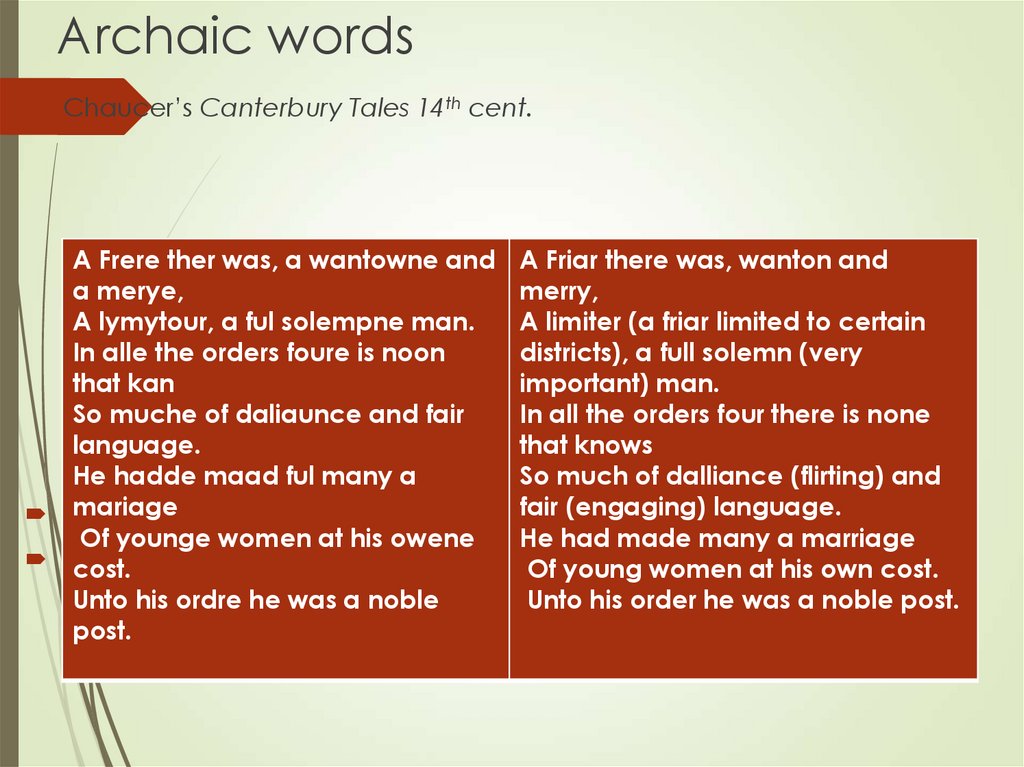
18. Archaic words
Chaucer’s Canterbury Tales 14th cent.A Frere ther was, a wantowne and A Friar there was, wanton and
a merye,
merry,
A lymytour, a ful solempne man.
A limiter (a friar limited to certain
In alle the orders foure is noon
districts), a full solemn (very
that kan
important) man.
So muche of daliaunce and fair
In all the orders four there is none
language.
that knows
He hadde maad ful many a
So much of dalliance (flirting) and
mariage
full
would be translated today as veryfair (engaging) language.
Of younge women at his owene
He had made many a marriage
marriage
(marriage)
was
pronounced
cost.
Ofzhyoung women at his own cost.
Unto his ordre he was a noble
Unto his order he was a noble post.
post.
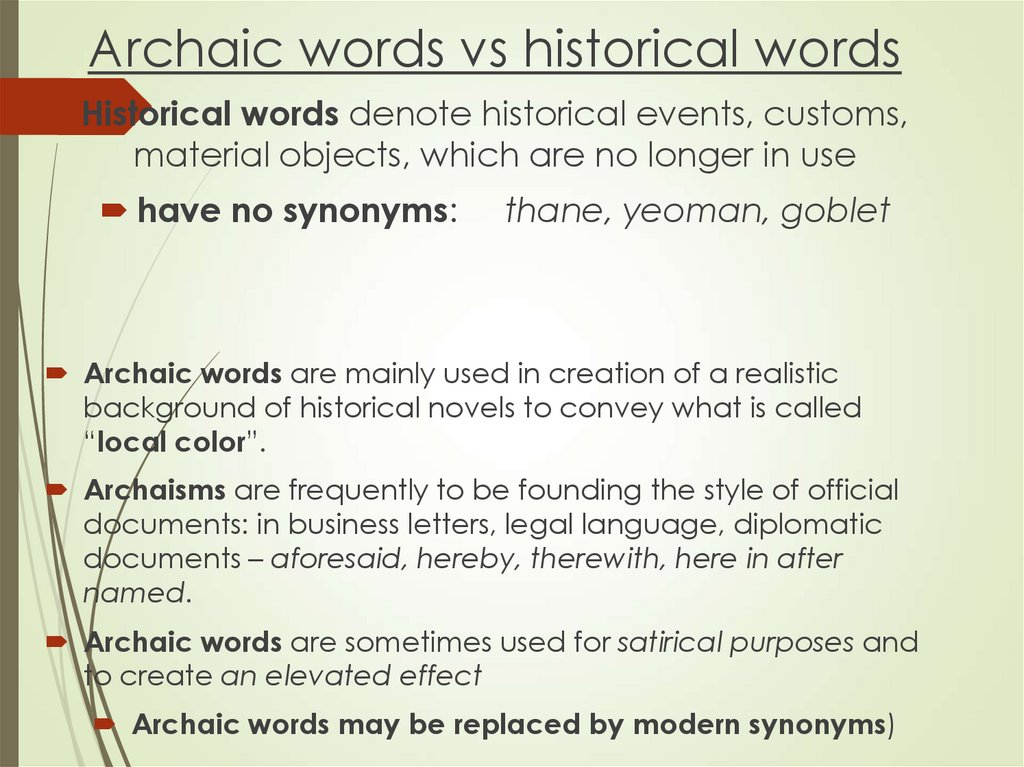
19.
Archaic words vs historical wordsHistorical words denote historical events, customs,
material objects, which are no longer in use
have no synonyms:
thane, yeoman, goblet
Archaic words are mainly used in creation of a realistic
background of historical novels to convey what is called
“local color”.
Archaisms are frequently to be founding the style of official
documents: in business letters, legal language, diplomatic
documents – aforesaid, hereby, therewith, here in after
named.
Archaic words are sometimes used for satirical purposes and
to create an elevated effect
Archaic words may be replaced by modern synonyms)
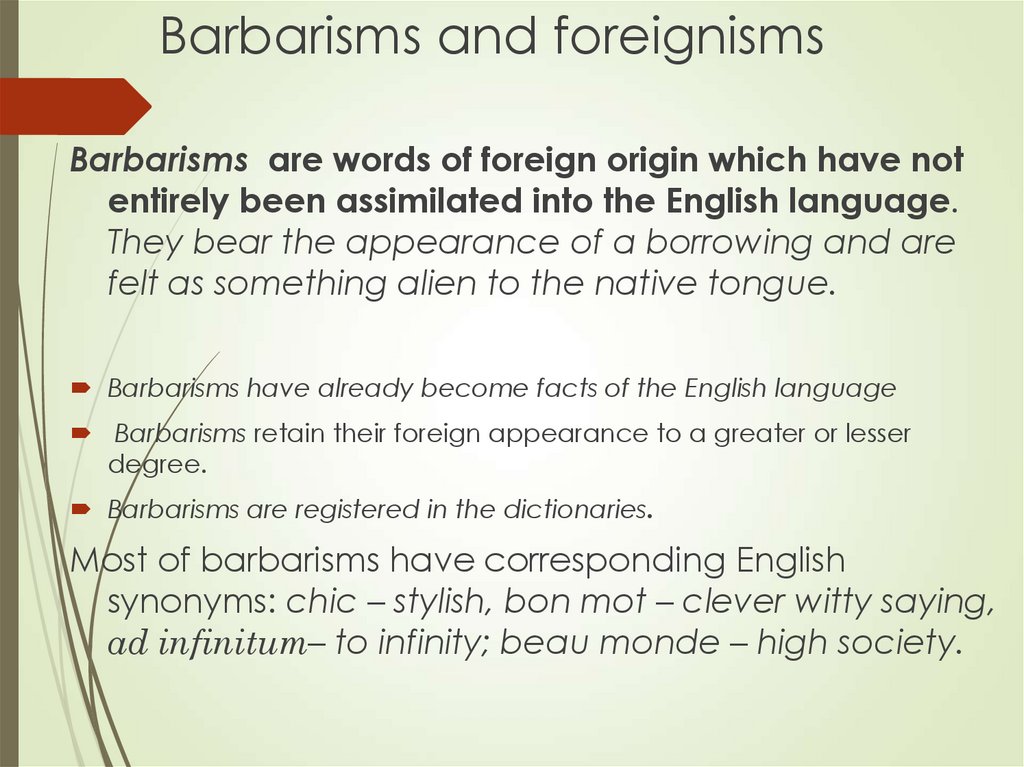
20. Barbarisms and foreignisms
Barbarisms are words of foreign origin which have notentirely been assimilated into the English language.
They bear the appearance of a borrowing and are
felt as something alien to the native tongue.
Barbarisms have already become facts of the English language
Barbarisms retain their foreign appearance to a greater or lesser
degree.
Barbarisms are registered in the dictionaries.
Most of barbarisms have corresponding English
synonyms: chic – stylish, bon mot – clever witty saying,
ad infinitum– to infinity; beau monde – high society.
21. Barbarisms and foreignisms
Foreignism - a word or expression that has beenimported from another language to serve a special
semantic function.
Foreign words do not belong to the English vocabulary.
In printed works foreign words are generally italicized
to indicate their alien nature or their stylistic value.
Some foreign words fulfill terminological function: ukas,
udarnik, kolkhoz, solo, tenor, blitzkrig, luftwaffe
22. Barbarisms and foreign words
barbarismsforeign words
part of the English language
do not belong to the English
vocabulary
generally given in the body of
the dictionary
they are not registered by English
dictionaries
on the contrary, are not made
conspicuous in the text
generally italicized to indicate it’s
alien nature
23. Literary Coinages and Nonce-Words (Neologisms)
neologism is usually defined as “a new word, phrase ornew meaning for an established word that may be in
the process of entering common use but that has not
yet been accepted into mainstream language’. ”
Coinage is a newly-created lexeme. Literary coinages
or neologisms are defined as new word or new
meanings for established words.
Newly coined words to denote new-born concepts are
named terminological coinages .
e.g. network, server, browser, e-mail, provider, site, Internet,
Hypertext, , Internet Explorer, laser, cellular phone, mobile phone,
take-away,multitasking, ecological footprint etc.
24. Coinages
New words are mainly coined according to theproductive models for wordbuilding in the given
language.
conversion, derivation (affixation), change of meaning
can be considered as the main means of wordbuilding in the process of coining new words.
e.g. orbiter (= spacecraft); moisturize (= to put some
special cream on your skin to make it less dry) ;mentee
(=mentor); lifemanship (= ability to live).
.
25. Coinages
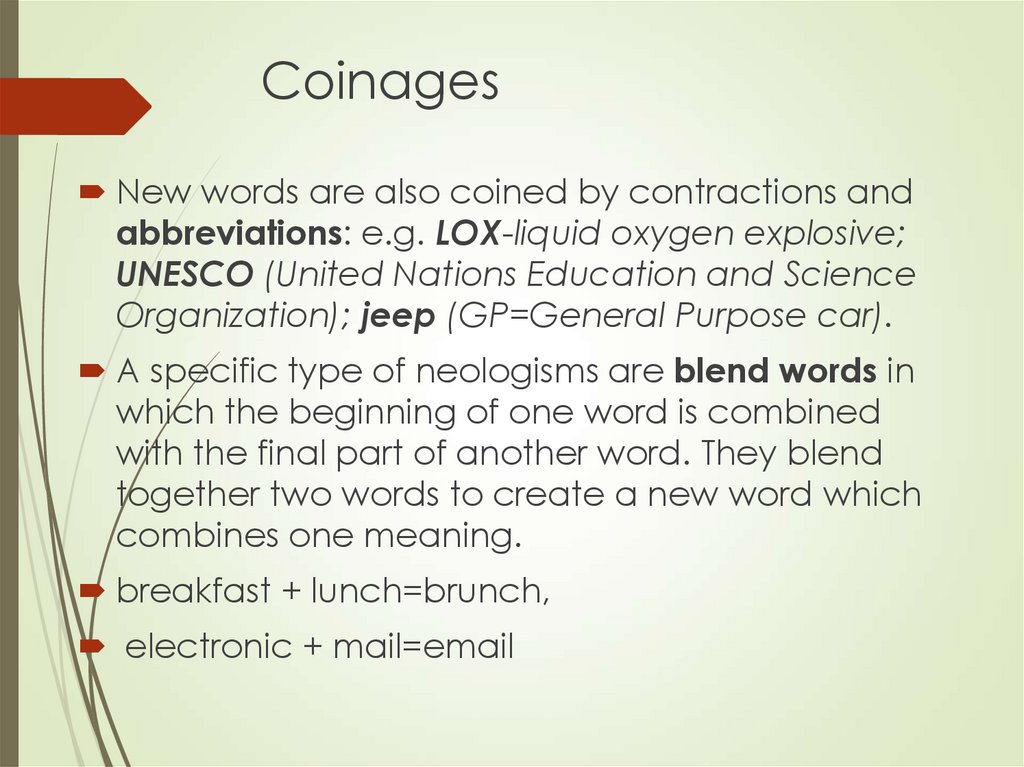
New words are also coined by contractions andabbreviations: e.g. LOX-liquid oxygen explosive;
UNESCO (United Nations Education and Science
Organization); jeep (GP=General Purpose car).
A specific type of neologisms are blend words in
which the beginning of one word is combined
with the final part of another word. They blend
together two words to create a new word which
combines one meaning.
breakfast + lunch=brunch,
electronic + mail=email
26. Coinages and nonce-words
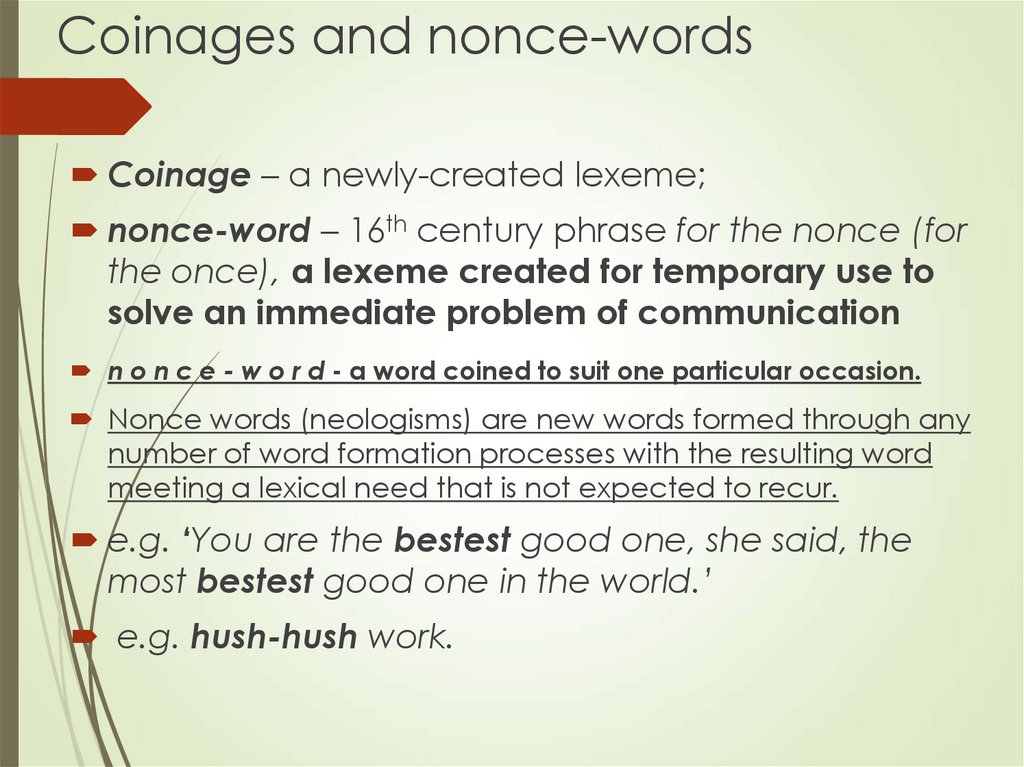
Coinage – a newly-created lexeme;nonce-word – 16th century phrase for the nonce (for
the once), a lexeme created for temporary use to
solve an immediate problem of communication
n o n c e - w o r d - a word coined to suit one particular occasion.
Nonce words (neologisms) are new words formed through any
number of word formation processes with the resulting word
meeting a lexical need that is not expected to recur.
e.g. ‘You are the bestest good one, she said, the
most bestest good one in the world.’
e.g. hush-hush work.
27. Colloquial words
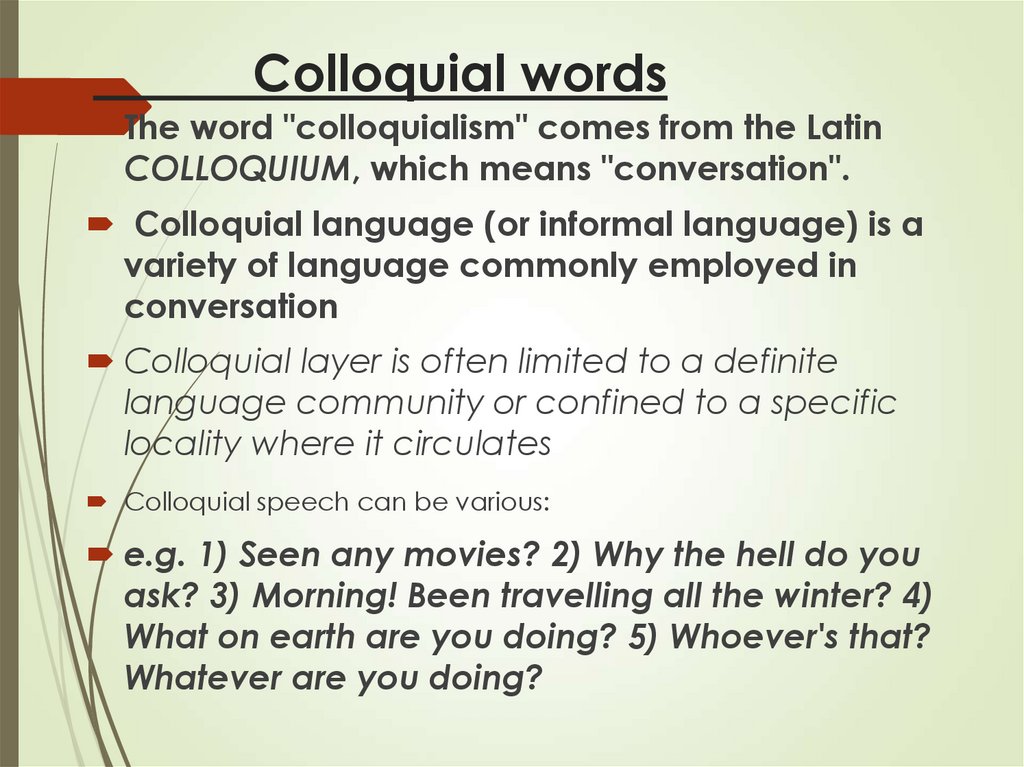
The word "colloquialism" comes from the LatinCOLLOQUIUM, which means "conversation".
Colloquial language (or informal language) is a
variety of language commonly employed in
conversation
Colloquial layer is often limited to a definite
language community or confined to a specific
locality where it circulates
Colloquial speech can be various:
e.g. 1) Seen any movies? 2) Why the hell do you
ask? 3) Morning! Been travelling all the winter? 4)
What on earth are you doing? 5) Whoever's that?
Whatever are you doing?
28. Colloquial words
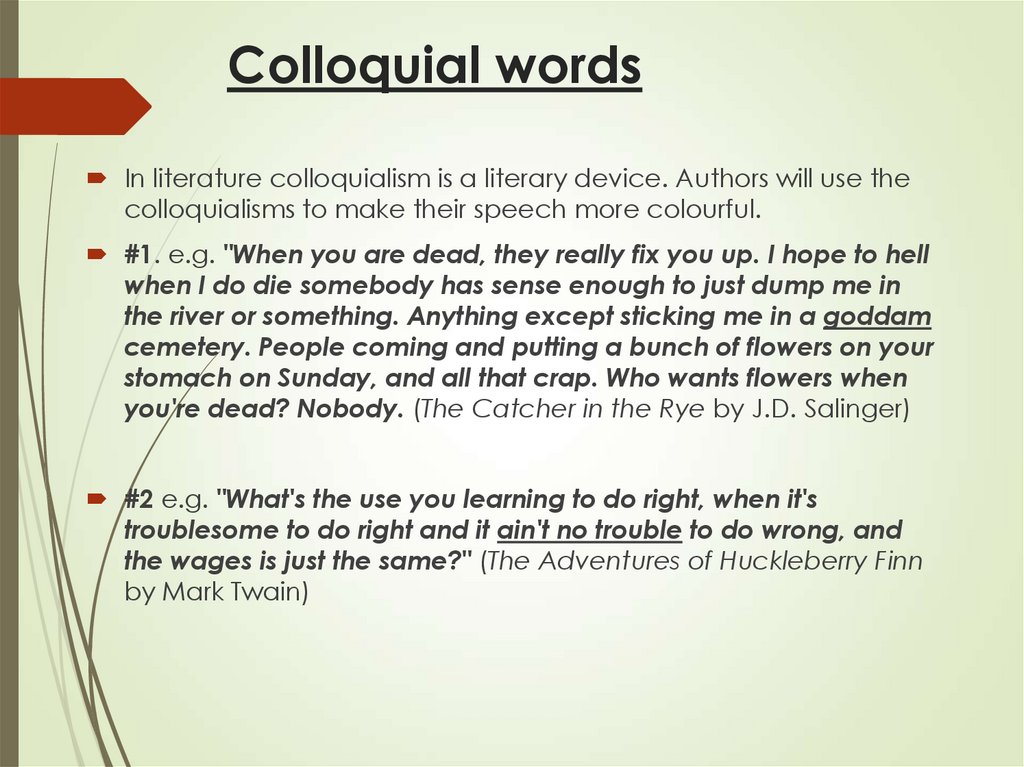
In literature colloquialism is a literary device. Authors will use thecolloquialisms to make their speech more colourful.
#1. e.g. "When you are dead, they really fix you up. I hope to hell
when I do die somebody has sense enough to just dump me in
the river or something. Anything except sticking me in a goddam
cemetery. People coming and putting a bunch of flowers on your
stomach on Sunday, and all that crap. Who wants flowers when
you're dead? Nobody. (The Catcher in the Rye by J.D. Salinger)
#2 e.g. "What's the use you learning to do right, when it's
troublesome to do right and it ain't no trouble to do wrong, and
the wages is just the same?" (The Adventures of Huckleberry Finn
by Mark Twain)
29. Colloquial words
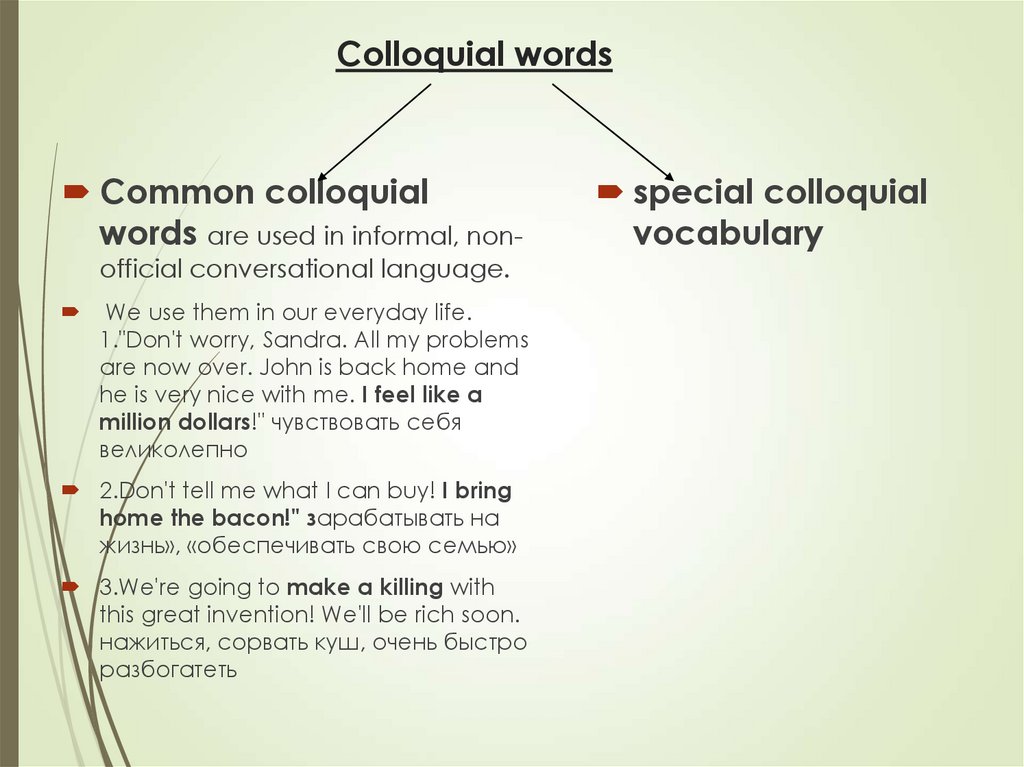
Common colloquialwords are used in informal, nonofficial conversational language.
We use them in our everyday life.
1."Don't worry, Sandra. All my problems
are now over. John is back home and
he is very nice with me. I feel like a
million dollars!" чувствовать себя
великолепно
2.Don't tell me what I can buy! I bring
home the bacon!" зарабатывать на
жизнь», «обеспечивать свою семью»
3.We're going to make a killing with
this great invention! We'll be rich soon.
нажиться, сорвать куш, очень быстро
разбогатеть
special colloquial
vocabulary
30. The special Colloquial vocabulary
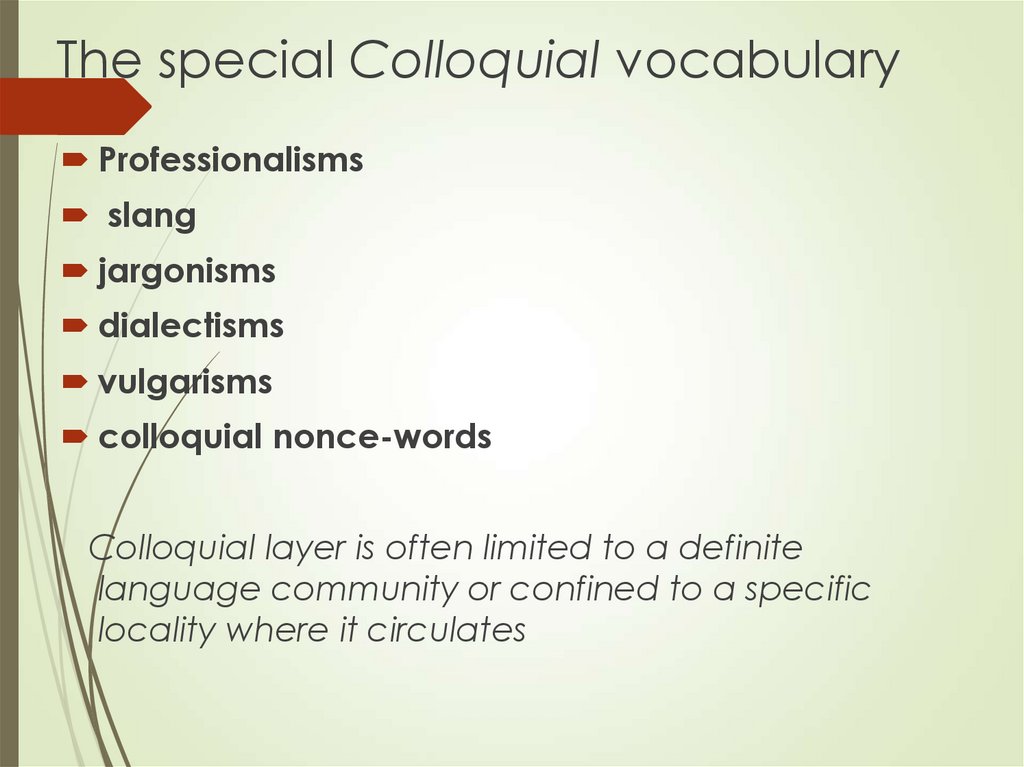
Professionalismsslang
jargonisms
dialectisms
vulgarisms
colloquial nonce-words
Colloquial layer is often limited to a definite
language community or confined to a specific
locality where it circulates
31. SLANG
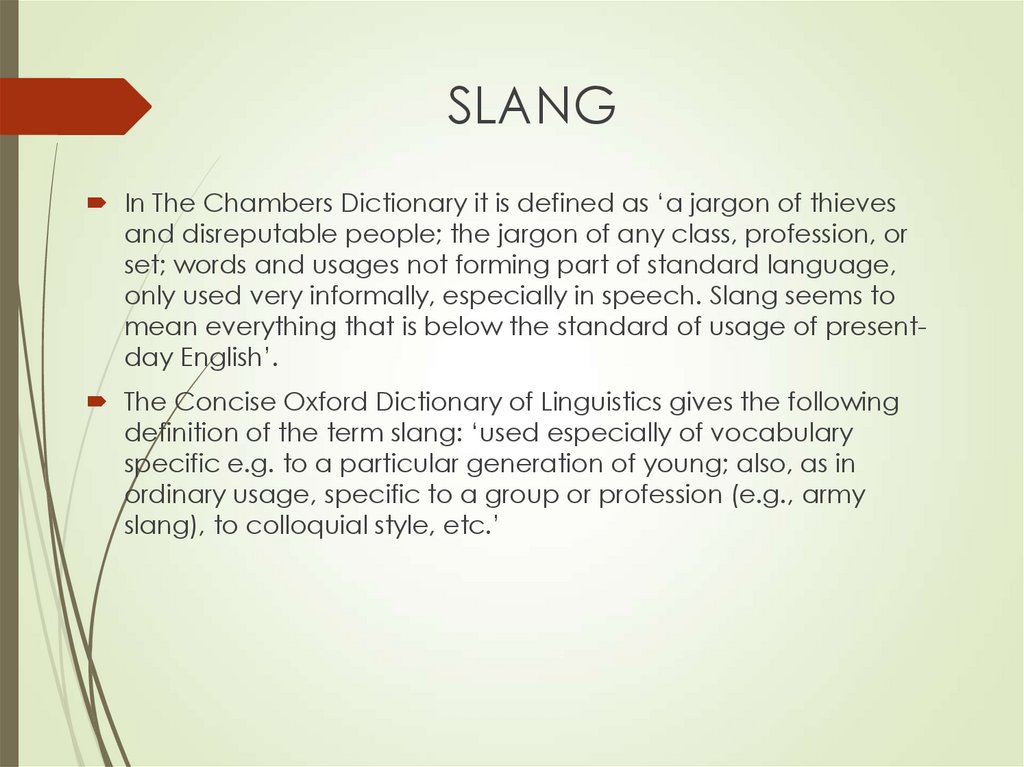
In The Chambers Dictionary it is defined as ‘a jargon of thievesand disreputable people; the jargon of any class, profession, or
set; words and usages not forming part of standard language,
only used very informally, especially in speech. Slang seems to
mean everything that is below the standard of usage of presentday English’.
The Concise Oxford Dictionary of Linguistics gives the following
definition of the term slang: ‘used especially of vocabulary
specific e.g. to a particular generation of young; also, as in
ordinary usage, specific to a group or profession (e.g., army
slang), to colloquial style, etc.’
32. SLANG
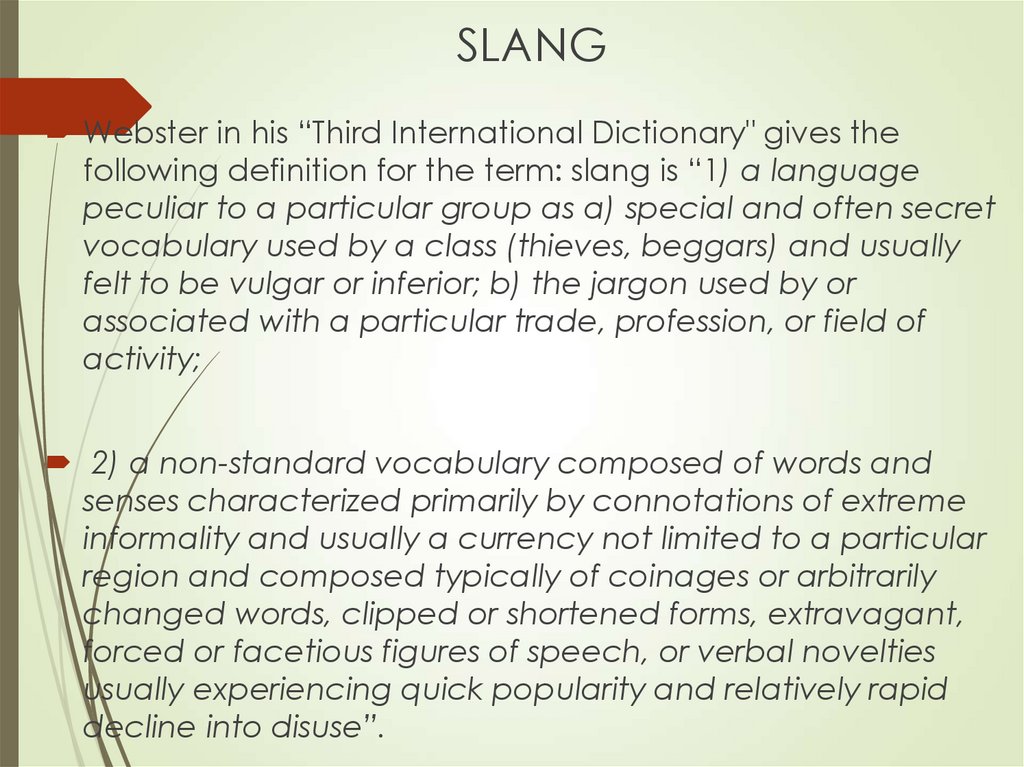
Webster in his “Third International Dictionary" gives thefollowing definition for the term: slang is “1) a language
peculiar to a particular group as a) special and often secret
vocabulary used by a class (thieves, beggars) and usually
felt to be vulgar or inferior; b) the jargon used by or
associated with a particular trade, profession, or field of
activity;
2) a non-standard vocabulary composed of words and
senses characterized primarily by connotations of extreme
informality and usually a currency not limited to a particular
region and composed typically of coinages or arbitrarily
changed words, clipped or shortened forms, extravagant,
forced or facetious figures of speech, or verbal novelties
usually experiencing quick popularity and relatively rapid
decline into disuse”.
33. SLANG
The New Oxford English Dictionary defines slang asfollows:”
a) the special vocabulary used by any set of persons of
a low or disreputable character; language of a low and
vulgar type;
b) the cant or jargon of a certain class or period;
c) language of a highly colloquial type considered
below the level of standard educated speech and
consisting either of new words or of current words
employed in some special sense.”
34. SLANG
Nowadays slang is highly praised as ‘vivid’, ‘more flexible’, ‘morepicturesque’, ‘richer in vocabulary’.
slang is much rather a spoken than a literary language. It originates,
nearly always, in speech.
ex.: breadbasket ("‘the stomach’), frenemy (a combination of
the words ‘friend’ and ‘enemy.’ It is a person who appears, on
one hand, to be your friend but, at the same time is
antagonistic towards you), banana oil (‘flattery’), ball up
(‘make a mess’), brain bucket ("‘motorcycle helmet’), dog’s
dinner (very smart, dressed up flamboyantly,), It’s Monkeys
Outside!(‘It’s very cold outside!’), cabbage (‘money’), dicey
(‘risky, dangerous’), barker (‘revolver’), big boy (‘gun’), etc.
35. SLANG
slang reflects the personality, gives us clearly visiblecharacteristics of the speaker.
The most conspicuous features of slang are:
it requires continuous innovation;
it never grows stale.
If a slang word or phrase become stale, it is
replaced by a new slang word.
36. SLANG
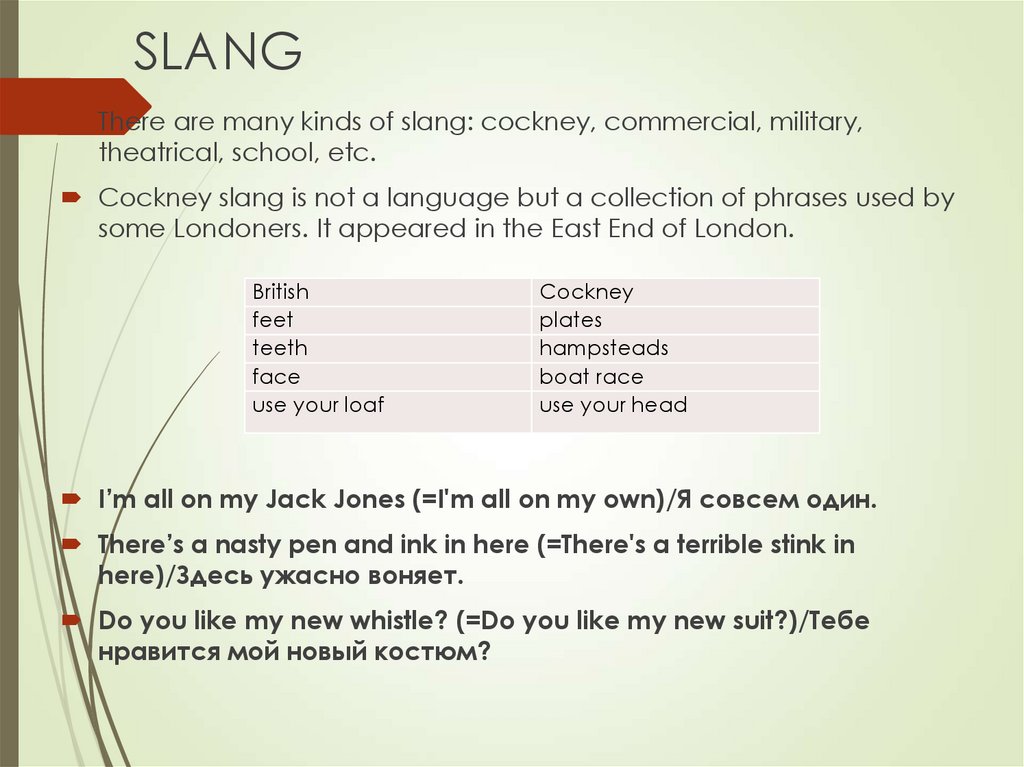
There are many kinds of slang: cockney, commercial, military,theatrical, school, etc.
Cockney slang is not a language but a collection of phrases used by
some Londoners. It appeared in the East End of London.
British
feet
teeth
face
use your loaf
Cockney
plates
hampsteads
boat race
use your head
I’m all on my Jack Jones (=I'm all on my own)/Я совсем один.
There’s a nasty pen and ink in here (=There's a terrible stink in
here)/Здесь ужасно воняет.
Do you like my new whistle? (=Do you like my new suit?)/Тебе
нравится мой новый костюм?
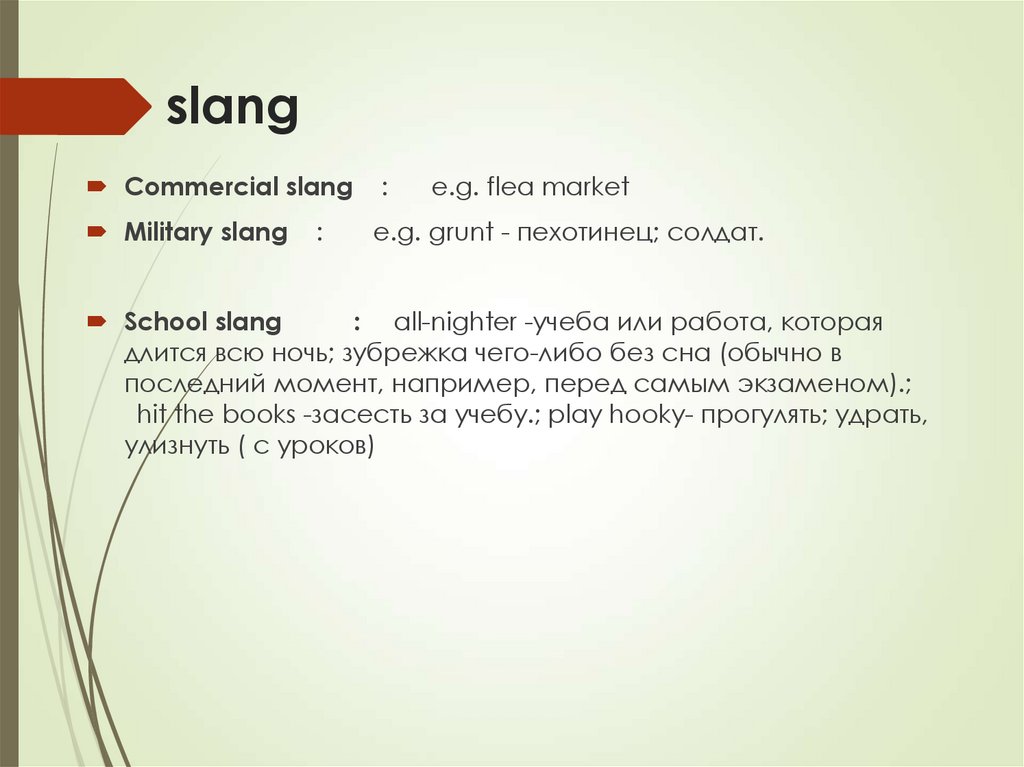
37. slang
Commercial slang:
Military slang
e.g. grunt - пехотинец; солдат.
:
e.g. flea market
School slang
: all-nighter -учеба или работа, которая
длится всю ночь; зубрежка чего-либо без сна (обычно в
последний момент, например, перед самым экзаменом).;
hit the books -засесть за учебу.; play hooky- прогулять; удрать,
улизнуть ( с уроков)
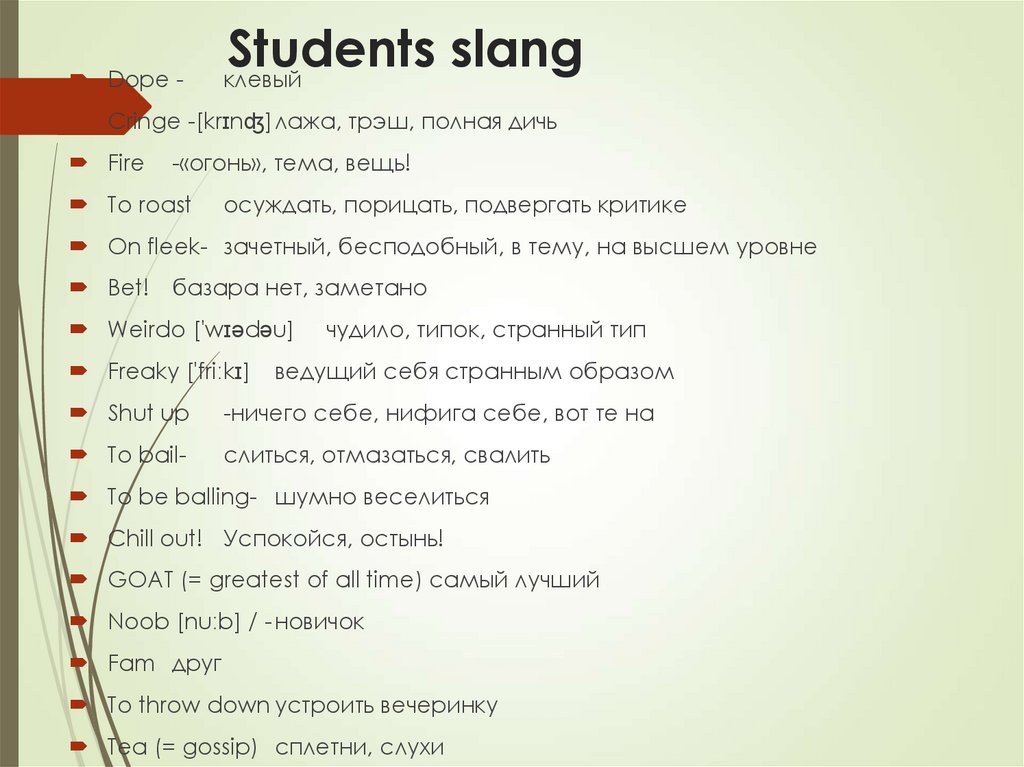
38. Students slang
Dope -Students slang
клевый
Cringe -[krɪnʤ]лажа, трэш, полная дичь
Fire
-«огонь», тема, вещь!
To roast
осуждать, порицать, подвергать критике
On fleek- зачетный, бесподобный, в тему, на высшем уровне
Bet! базара нет, заметано
Weirdo ['wɪədəu]
Freaky ['friːkɪ]
чудило, типок, странный тип
ведущий себя странным образом
Shut up
-ничего себе, нифига себе, вот те на
To bail-
слиться, отмазаться, свалить
To be balling- шумно веселиться
Chill out! Успокойся, остынь!
GOAT (= greatest of all time) самый лучший
Noob [nuːb] / - новичок
Fam друг
To throw down устроить вечеринку
Tea (= gossip) сплетни, слухи
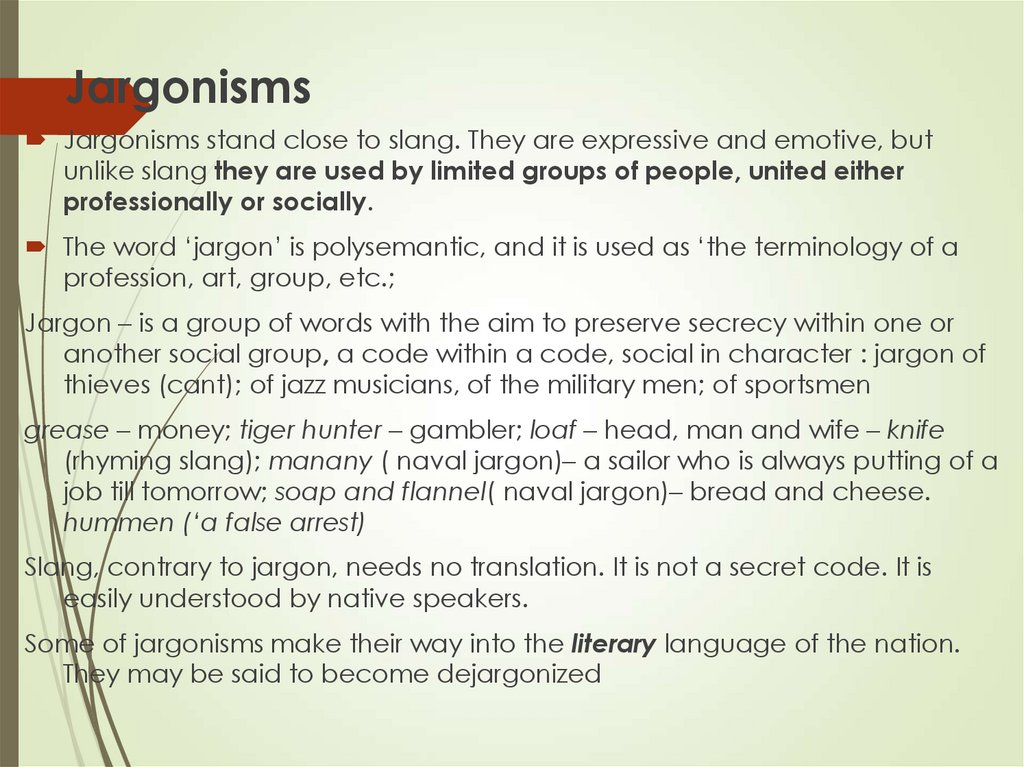
39. Jargonisms
Jargonisms stand close to slang. They are expressive and emotive, butunlike slang they are used by limited groups of people, united either
professionally or socially.
The word ‘jargon’ is polysemantic, and it is used as ‘the terminology of a
profession, art, group, etc.;
Jargon – is a group of words with the aim to preserve secrecy within one or
another social group, a code within a code, social in character : jargon of
thieves (cant); of jazz musicians, of the military men; of sportsmen
grease – money; tiger hunter – gambler; loaf – head, man and wife – knife
(rhyming slang); manany ( naval jargon)– a sailor who is always putting of a
job till tomorrow; soap and flannel( naval jargon)– bread and cheese.
hummen (‘a false arrest)
Slang, contrary to jargon, needs no translation. It is not a secret code. It is
easily understood by native speakers.
Some of jargonisms make their way into the literary language of the nation.
They may be said to become dejargonized
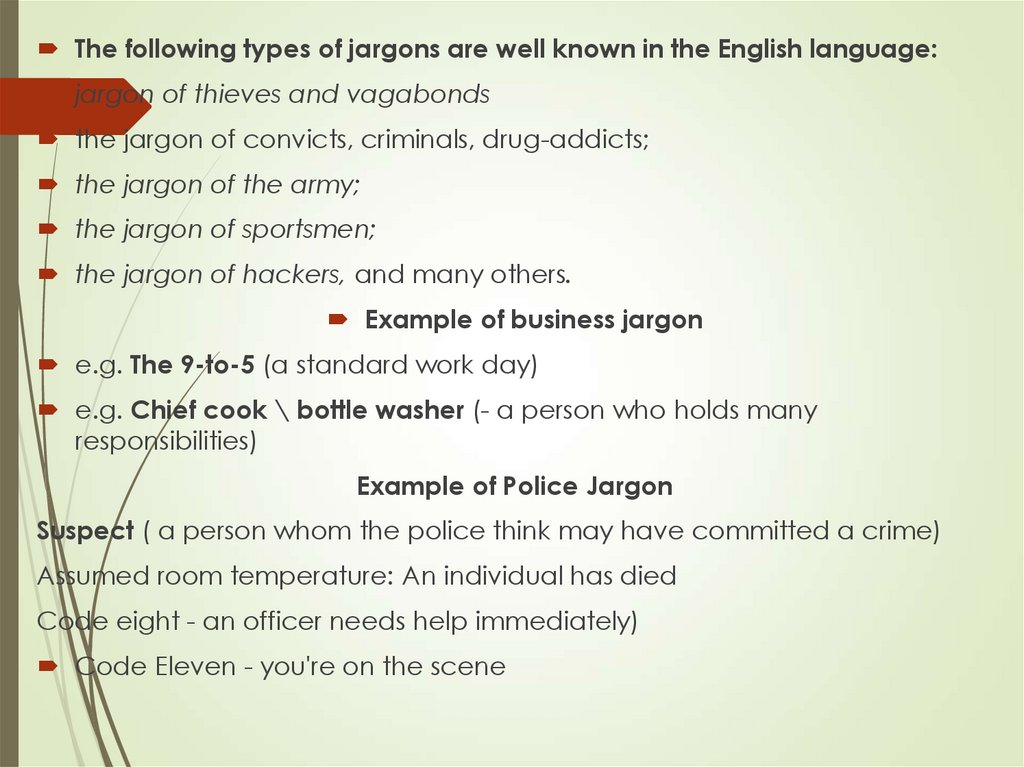
40.
The following types of jargons are well known in the English language:jargon of thieves and vagabonds
the jargon of convicts, criminals, drug-addicts;
the jargon of the army;
the jargon of sportsmen;
the jargon of hackers, and many others.
Example of business jargon
e.g. The 9-to-5 (a standard work day)
e.g. Chief cook \ bottle washer (- a person who holds many
responsibilities)
Example of Police Jargon
Suspect ( a person whom the police think may have committed a crime)
Assumed room temperature: An individual has died
Code eight - an officer needs help immediately)
Code Eleven - you're on the scene
41.
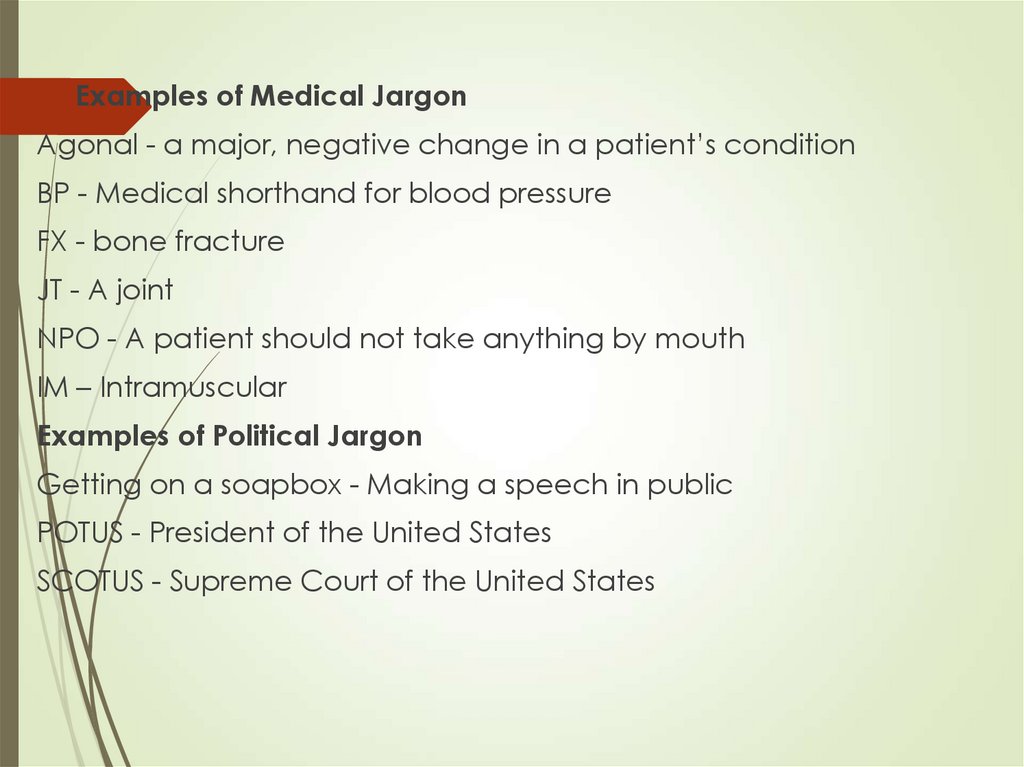
Examples of Medical JargonAgonal - a major, negative change in a patient’s condition
BP - Medical shorthand for blood pressure
FX - bone fracture
JT - A joint
NPO - A patient should not take anything by mouth
IM – Intramuscular
Examples of Political Jargon
Getting on a soapbox - Making a speech in public
POTUS - President of the United States
SCOTUS - Supreme Court of the United States
42.
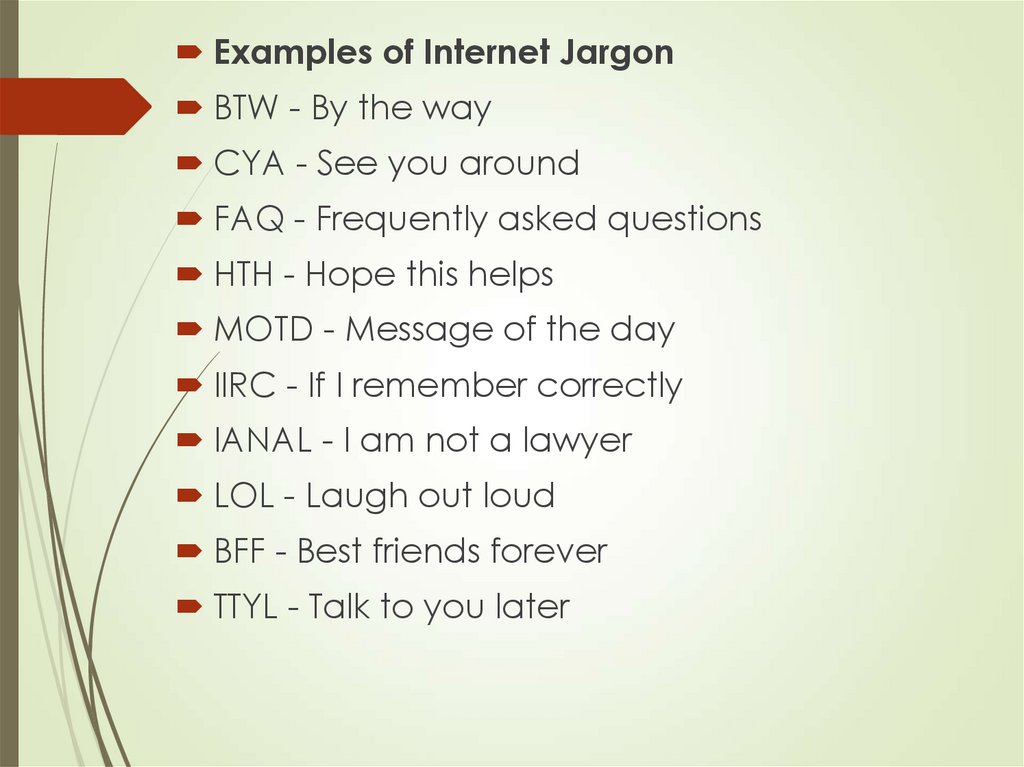
Examples of Internet JargonBTW - By the way
CYA - See you around
FAQ - Frequently asked questions
HTH - Hope this helps
MOTD - Message of the day
IIRC - If I remember correctly
IANAL - I am not a lawyer
LOL - Laugh out loud
BFF - Best friends forever
TTYL - Talk to you later
43. Professionalisms
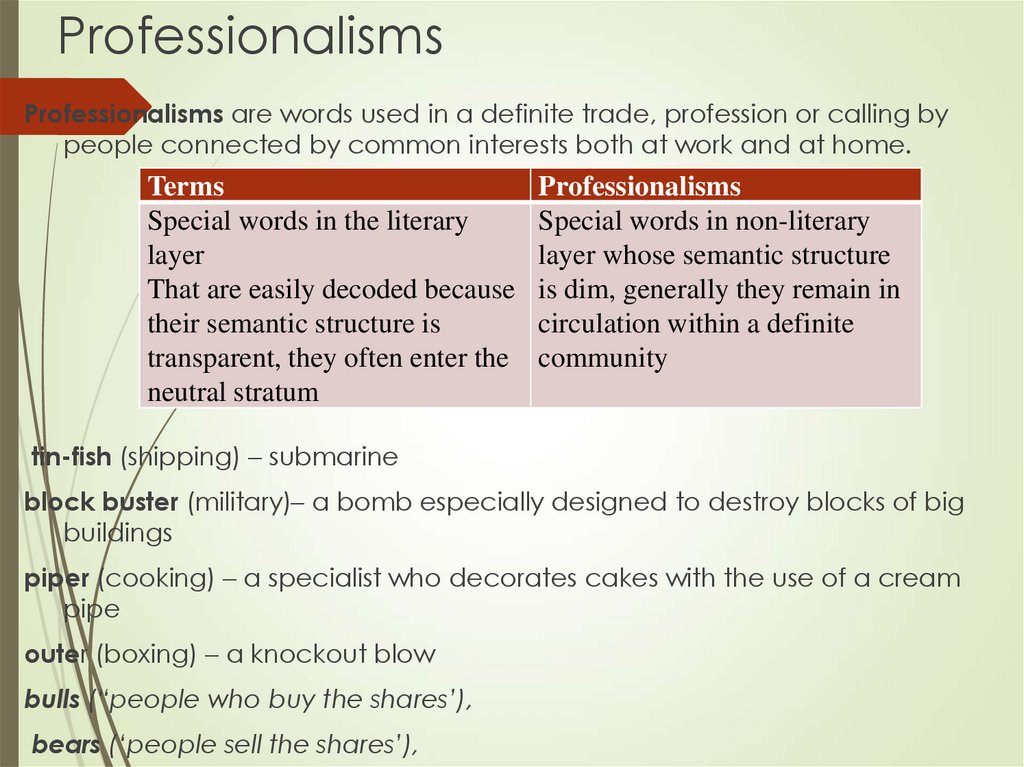
Professionalisms are words used in a definite trade, profession or calling bypeople connected by common interests both at work and at home.
Terms
Special words in the literary
layer
That are easily decoded because
their semantic structure is
transparent, they often enter the
neutral stratum
Professionalisms
Special words in non-literary
layer whose semantic structure
is dim, generally they remain in
circulation within a definite
community
tin-fish (shipping) – submarine
block buster (military)– a bomb especially designed to destroy blocks of big
buildings
piper (cooking) – a specialist who decorates cakes with the use of a cream
pipe
outer (boxing) – a knockout blow
bulls (“people who buy the shares’),
bears (‘people sell the shares’),
44. Dialectal words
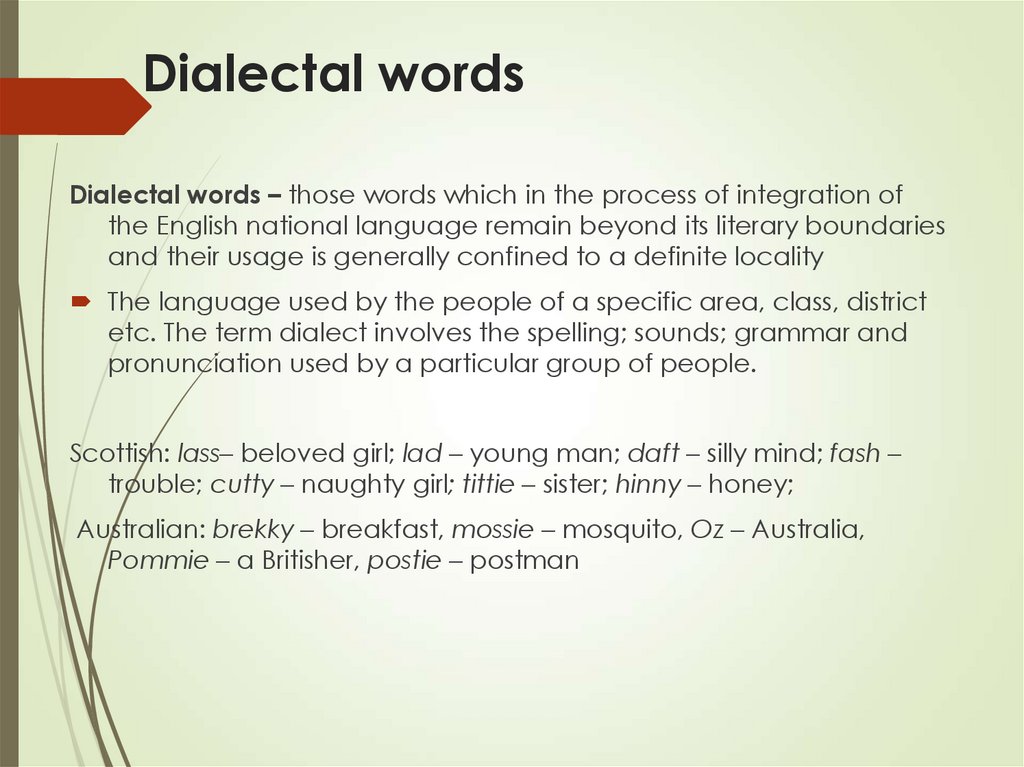
Dialectal words – those words which in the process of integration ofthe English national language remain beyond its literary boundaries
and their usage is generally confined to a definite locality
The language used by the people of a specific area, class, district
etc. The term dialect involves the spelling; sounds; grammar and
pronunciation used by a particular group of people.
Scottish: lass– beloved girl; lad – young man; daft – silly mind; fash –
trouble; cutty – naughty girl; tittie – sister; hinny – honey;
Australian: brekky – breakfast, mossie – mosquito, Oz – Australia,
Pommie – a Britisher, postie – postman
45.
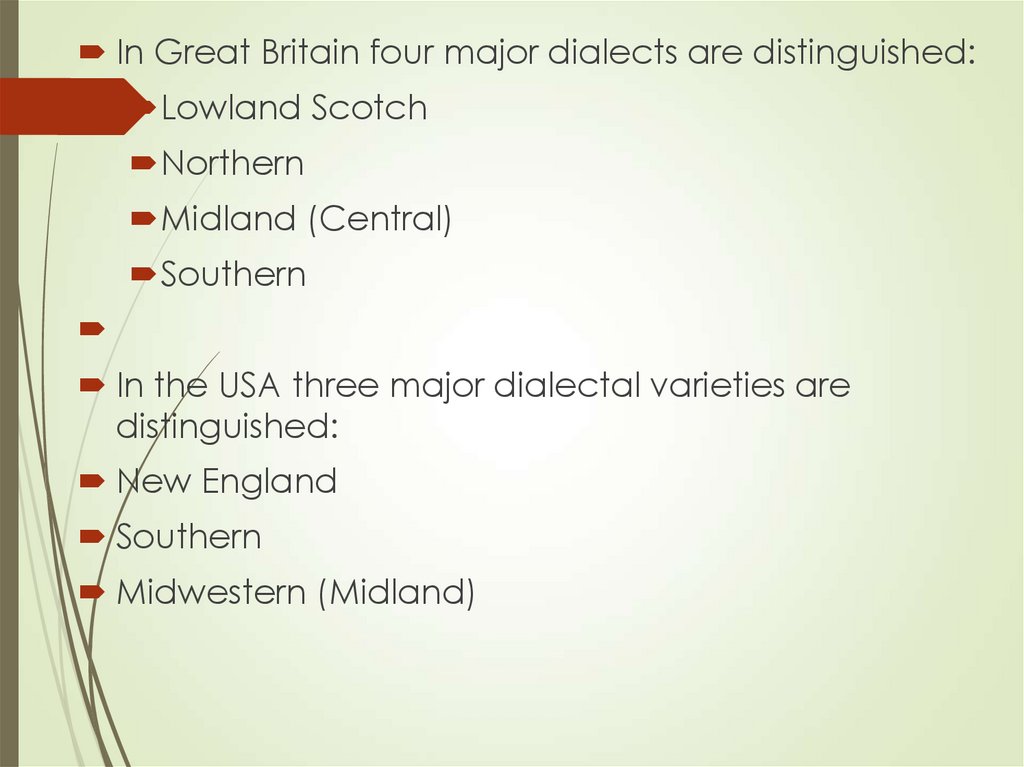
In Great Britain four major dialects are distinguished:Lowland Scotch
Northern
Midland (Central)
Southern
In the USA three major dialectal varieties are
distinguished:
New England
Southern
Midwestern (Midland)
46.
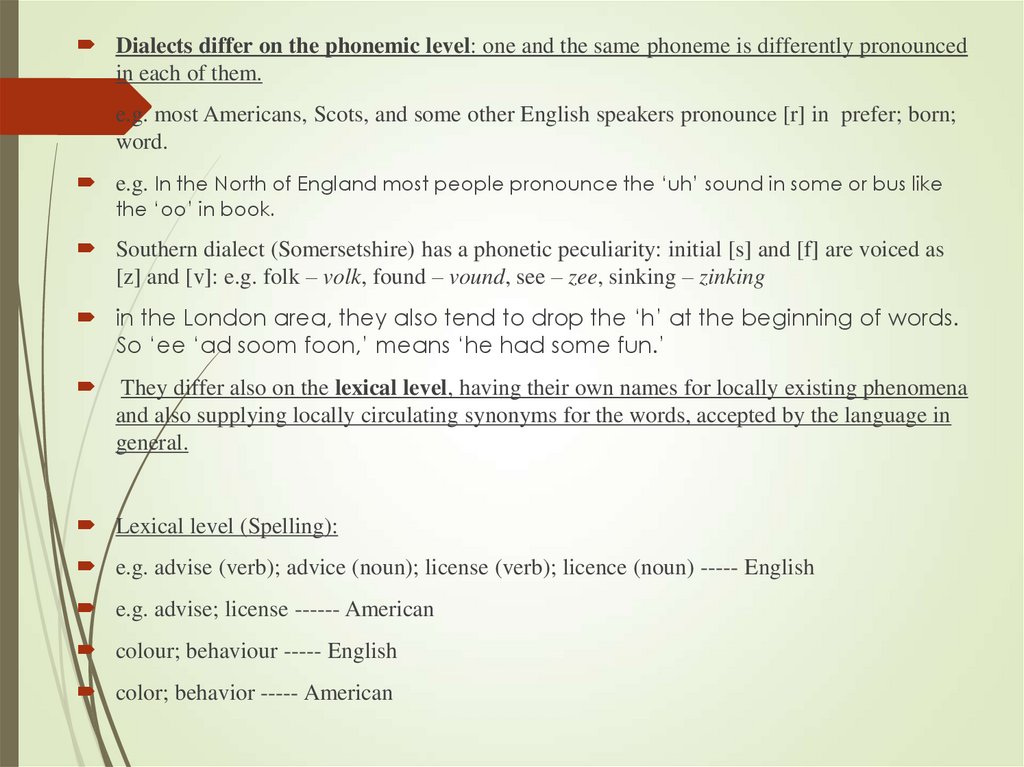
Dialects differ on the phonemic level: one and the same phoneme is differently pronouncedin each of them.
e.g. most Americans, Scots, and some other English speakers pronounce [r] in prefer; born;
word.
e.g. In the North of England most people pronounce the ‘uh’ sound in some or bus like
the ‘oo’ in book.
Southern dialect (Somersetshire) has a phonetic peculiarity: initial [s] and [f] are voiced as
[z] and [v]: e.g. folk – volk, found – vound, see – zee, sinking – zinking
in the London area, they also tend to drop the ‘h’ at the beginning of words.
So ‘ее ‘ad soom foon,’ means ‘he had some fun.’
They differ also on the lexical level, having their own names for locally existing phenomena
and also supplying locally circulating synonyms for the words, accepted by the language in
general.
Lexical level (Spelling):
e.g. advise (verb); advice (noun); license (verb); licence (noun) ----- English
e.g. advise; license ------ American
colour; behaviour ----- English
color; behavior ----- American
47. Vulgar words or vulgarisms
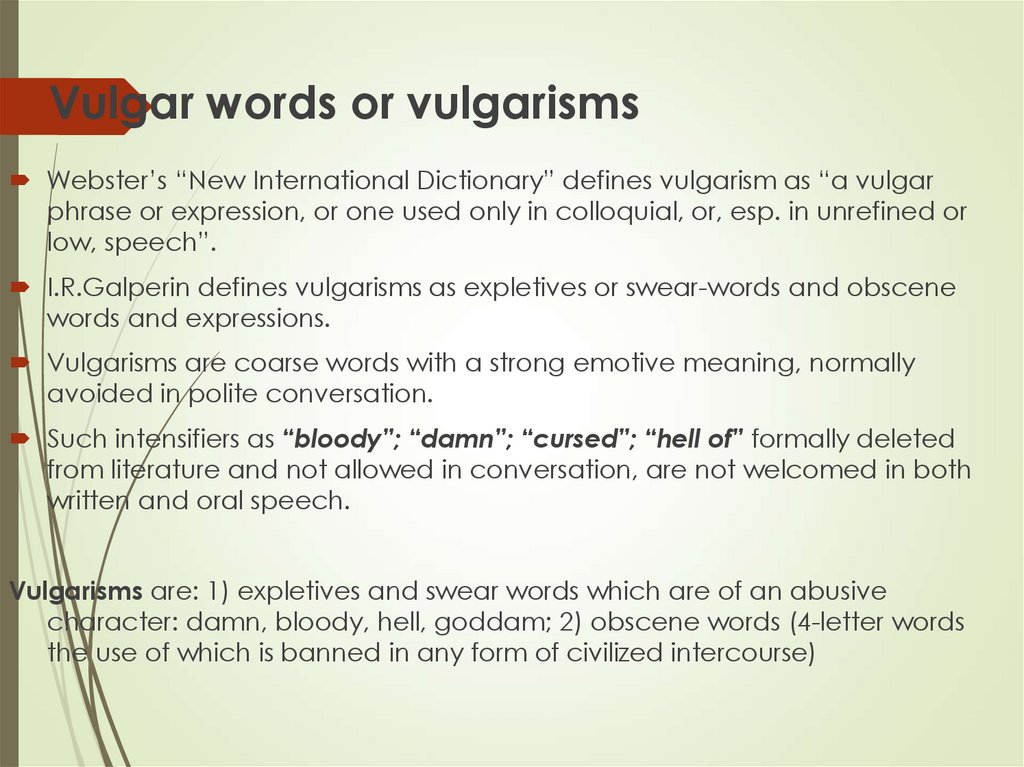
Webster’s “New International Dictionary” defines vulgarism as “a vulgarphrase or expression, or one used only in colloquial, or, esp. in unrefined or
low, speech”.
I.R.Galperin defines vulgarisms as expletives or swear-words and obscene
words and expressions.
Vulgarisms are coarse words with a strong emotive meaning, normally
avoided in polite conversation.
Such intensifiers as “bloody”; “damn”; “cursed”; “hell of” formally deleted
from literature and not allowed in conversation, are not welcomed in both
written and oral speech.
Vulgarisms are: 1) expletives and swear words which are of an abusive
character: damn, bloody, hell, goddam; 2) obscene words (4-letter words
the use of which is banned in any form of civilized intercourse)
48.
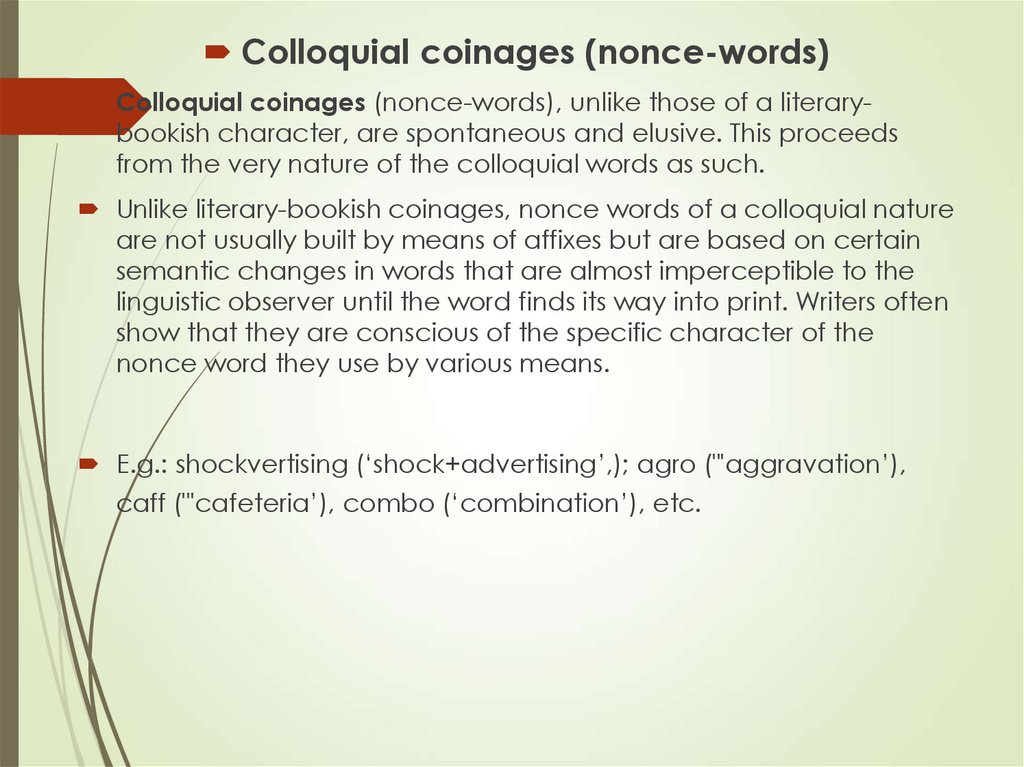
Colloquial coinages (nonce-words)Colloquial coinages (nonce-words), unlike those of a literarybookish character, are spontaneous and elusive. This proceeds
from the very nature of the colloquial words as such.
Unlike literary-bookish coinages, nonce words of a colloquial nature
are not usually built by means of affixes but are based on certain
semantic changes in words that are almost imperceptible to the
linguistic observer until the word finds its way into print. Writers often
show that they are conscious of the specific character of the
nonce word they use by various means.
E.g.: shockvertising (‘shock+advertising’,); agro ("'aggravation’),
caff ("'cafeteria’), combo (‘combination’), etc.
49.
Colloquial coinages (nonce-words)Unlike literary-bookish coinages, nonce words of a colloquial
nature are not usually built by means of affixes but are
based on certain semantic changes in words that are
almost imperceptible to the linguistic observer until the word
finds its way into print. Writers often show that they are
conscious of the specific character of the nonce word they
use by various means.
In some cases it is difficult to distihguish between noncewords of bookish and of colloquial origin. Some words which
have undoubtedly sprung from the literary-bookish stratum
have become popular in ordinary colloquial language and
have acquired new meanings in their new environment.
50. .
Fill in the gaps. Then read and translate the following sentences. Mindthe colloquial words
pell-mell; dicky; hush-hush; dillydally; by hook or by crook; tit for tat;
shipshape; higgledy piggledy; chit-chat; flip-flops
I can't stand him wearing --- to dinner, it's an act of impoliteness.
Don't protest: you'll have to do your homework --- .
John's very untidy: his clothes always lie on the floor ---.
Charles Dickens had a---- love affair with 18-year-old Nelly Ternan.
I can't stand --- : I do prefer talking about more serious topics like
politics.
As she waited for her in-laws' visit, she would always keep her flat --- .
The students were running ---in the school yard when the Principal
appeared.
In the Old Testament there are lots of --- acts of revenge performed in
the name of Divine Justice.
This old boy's got a --- heart and I don't think that he's long for this world.
10.Don't ---- boys! We've got to walk many miles before camping
tonight.
51. .
Read and translate the following Literary words, then sentences..
abode ; adieu; afar; apace; blithe; dell; eld; ere; farewell; hark; lay; orb; slay; wonted;
1)
"We hope you will return ere long".
2)
"Consider their previous abode, another Ron built, but in the style of a Scottish
tower".
3) ...and he whispered: "adieu".
4) We drove fast, in case they thought to pull out their guns and drill us from afar.
5)
Preparations for the new season at G.L. continue apace.
6)
Though he is famous for blithe dismissal of his elders, he was actually attentive to
local history.
7)... I could hear the milk-maids bucket chatter, the cows lowing in the dell, and ...
8)
For Billy Rose, at present busily revamping the theater, it was like eld times.
9)
His colleagues and students have arranged a special farewell party for him.
10)
"Oh, hark at me! I'm giving away some details of my personal life...."
11)
Liza smiled gently, laying her cheek against his chest.
12)
He was gazing at me through squinting grey eyes, rather than deep brown orbs.
13)
In certain African tribes, one had to slay a lion to prove one's manhood.
14) I noticed he was dressed in formality that night, forgoing his wonted loud, showy
colours I normally saw him in.