



 english
Similar presentations:




Stylistics as a Linguistic Science
1. LECTURE 1.
• Stylistics as a Linguistic Science.• The notion of style.
• Connection of stylistics with other branches
of linguistics.
• Levels in stylistics: lexical, grammatical,
phonetic.
2. 1. Stylistics as a Linguistic Science.
• 1. Stylistics as a Linguistic Science.Stylistics is a branch of linguistics that
investigates the principles and the effect of the
choice and the use of lexical, grammatical,
phonetic, and general linguistic resources for
the transmission of thought and emotion in
different contexts of communication.
3. The Sources of Stylistics
Rhetoric – the art of creating speech;
Poetics the process of artistic creation;
Dialectics – the study of methods of persuasion
4. .
Stylistics (by Galperin) is a language science which deals withthe results of the act of communication. (I.R. Galperin). It is
the study of varieties of language For example, the language
of advertising, politics, religion, individual authors, etc., or the
language of a period in time, all belong in a particular
situation.
According to scholars, stylistics studies the principles and the
effect of choice and usage of different language elements in
rendering thought and emotion under different conditions of
communication.
5. .
Some scholars, (Galperin), define the notion of expressive meansand stylistic devices.
The expressive means of the language are those phonetic,
morphological, word-building, lexical, phraseological and
syntactical forms which exist in language-as-a-system for the
purpose of logical and emotional intensifications of the utterance.
Stylistic device is a conscious and intentional intensification of
some typical structural and semantic property of a language unit
(neutral or expressive) promoted to a generalized status and thus
becoming a generative model.
EMs and SDs have a lot in common. But they are not completely
synonymous. All SDs belong to EMs but not all EMs are SDs.
Phonetic phenomena such as vocal pitch, pauses, logical stress,
drawling, etc. are EMs without being SDs.
6. .
There are different classifications of expressivemeans and stylistic devices.
I. R. Galperin suggests the following
subdivision of expressive means and stylistic
devices based on the level-oriented approach:
1. Phonetic EMs and SDs.
2. Lexical EMs and SDs
3. Syntactical EMs and SDs.
7. Functional styles
According to Galperin I.R.,A functional style of language is a system of
interrelated language means which serve
a definite aim of communication.
the belles-lettres style,
the publicistic style,
the newspaper style,
the scientific prose style,
the style of official documents.
8. /
Stylistics is a branch of linguistics that studiesvarious functional styles and expressive means
and devices of language.
Apart from that some linguists apply the term
“stylistics” to the study of stylistic peculiarities
of the language of the work of fiction.
9. 2. The notion of style.
The main subject of stylistics is STYLE.The word “style” came from Latin word
“stulus” that means “stick” for writing. Then
it meant the “ability” to write. Now it is the
ability to use language in a proper way.
10. /
1. Style is the correspondence between thoughtand expression. The notion is based on the
assumption that language is said to have two
functions: it serves as a means of communication
and also as a means of shaping one's thoughts. The
first function is called communicative, the second –
expressive.
The linguistic form of the idea expressed always
reflects the peculiarities of the thought. And vice
versa, the character of the thought will always
manifest itself in the language forms chosen for the
expression of the idea.
11. /
2. Style is addition to language. Language and styleare regarded as separate bodies, but language
can easily dispense with style.
3. Style is technique of expression. In this sense
style is generally defined as the ability to write
clearly, correctly and in a manner calculated to the
interest of the reader. It sets up a number of rules as
to how to speak and write and discards all kinds of
deviations as being violations of the norm.
12. /
4. Style signifies a literary genre. Thus we speak ofclassical style or the style of classicism; realistic
style; the style of romanticism and so on. On the
other hand, the term is widely used in literature,
being applied to the various kinds of literary work,
the fable, novel, ballad, story etc.
A style of language is a system of interrelated language means which
serves a definite aim in communication. The peculiar choice of
language means is primarily dependent on the aim of
communication.
Thus we may distinguish the following styles within the English literary
language: 1) the belles-letters style; 2) the public style; 3) the
newspaper style; 4) the scientific prose style; 5) the style of official
documents and some others.
13. .
5. Individual style/idiostyle/idiolect can also standfor a unique combination of language units,
expressive means and stylistic devices peculiar to
a given writer, which makes his works or
utterances easily recognizable. Hence, individual
style may be linked to a proper name. The main
feature of individual style is idiosyncratic and
deliberate choice of language, and the ways the
selected elements are treated.
14. .
‘Style’ in a broad sense of the word concernsmany spheres of our life. The term ’Style’ applied
in linguistics has several meanings. Here are
some of them:
A) literary genre (for example, style of
romanticism)
B) author's individual style, manner of writing (for
example Hemingway's style)
C) technique of expression (for example he writes
in a clear style)
15. .
.The term STYLE is understood by various
scholars in the following sense: the individual
manner of a writer or a speaker in making use
of language to achieve the desirable effect in
speech or in writing.
The most frequent definition of
"style" is one expressed by Seymour
Chatman: “Style is a product of individual
choices and patterns of choices among
linguistic possibilities”.
16. .
Scholars give different definitions of the term “style”.Here are some of them:
1) “Style is a quality of language which communicates
precisely emotions or thoughts, or a system of emotions
or thoughts, peculiar to the author” (J. Middleton
Murry)
2) “Style is a contextually restricted linguistic
variation” (Enkvist)
3) “Style is a selection of non-distinctive features of
language” (L. Bloomfield)
17. .
Style in a language is understood as to be thewhole corpus of expressive means of the
language. It is lingo-stylistics.
Style in literature studies the peculiarities of the
writer’s style, his individual and creative choice of
the resources of the language; the limitations are
superimposed by the writer’s period, genre and
purpose. The main difference is that linguostylistics studies all the expressive means of the
language while style in literature (literary style)
studies the peculiarities of that or this writer’s style,
so called individual styles.
18. .
In stylistics the term individual style is impliedsince it studies peculiarities of a writer’s individual
manner of using language means to achieve the
desired effect.
According to I.R. Galperin, individual style is a
unique combination of language units, expressive
means and stylistic devices peculiar to a given
writer, which makes the writer’s works easily
recognizable.
19. .
Among the features that highlight the individual style of anauthor can be mentioned:
-rhythm and melody of utterances
-system of imagery
-preferences for definite stylistic devices
-the characteristic of the personages
Features that form the individual style of the author:
biography and life experience of the writer;
the civic position, culture and own talent allowing to
introduce smth new into literature;
20. . 3.CONNECTION OF STYLISTICS WITH OTHER BRANCHES OF LINGUISTICS.
3.CONNECTION OF STYLISTICS WITH OTHER BRANCHES OFLINGUISTICS.
.
Stylistics and phonetics – phonetics studies sounds,
articulation and intonation. Stylistics concentrates on
expressive sound combinations, intonational patterns.
Phonostylistics is engaged in the study of style-forming
phonetic features of the text. It describes the variants of
pronunciation in different types of speech (colloquial or
oratory).
Phonostylistics studies how the sound form of speech
makes it more expressive. It studies metre, rhyme, rhythm,
alliteration, assonance, sound imitation, etc.
21. .
Stylistics and lexicologyLexicology describes words, their origin, development,
semantic and structural features of words , the meaning of
words and word-building.. Stylistics also deals with words,
but only those which are expressive.
Stylistic lexicology – the science of layers of vocabulary
(literary and colloquial words)
Stylistic Lexicology studies the semantic structure of the
word and the interrelation of the connotative and
denotative meanings of the word, the interaction of
primary and contextual meanings as well as the
interrelation of the stylistic connotations of the word and
the context,. It studies expressive, evaluative, emotional
and etc meanings of words.
E.g. The hall applauded. (metonymy)
1) hall – room (primary meaning)
2) hall – people (contextual meaning)
22. .
Stylistic and grammargrammar describes regularities of building words, word combinations,
sentences, and texts. Stylistics restricts itself to those grammatical regularities,
which make language units expressive.
Grammatical stylistics – the science of expressive morphological and
syntactic language units
Grammatical stylistics comprises Stylistic Morphology and Stylistic Syntax.
Stylistic Morphology is interested in the stylistic potentials of specific
grammatical forms and categories, such as the number of the noun, or the
peculiar use of tense forms of the verb, etc.
Stylistic Syntax is one of the oldest branches of stylistic studies that grew out of
classical rhetoric. Stylistic syntax has to do with the expressive order of words,
types of syntactic links (for example asyndeton, polysyndeton), figures of
speech (for example antithesis, chiasmus, etc.). It also deals with bigger units
from paragraph onwards.
23. .
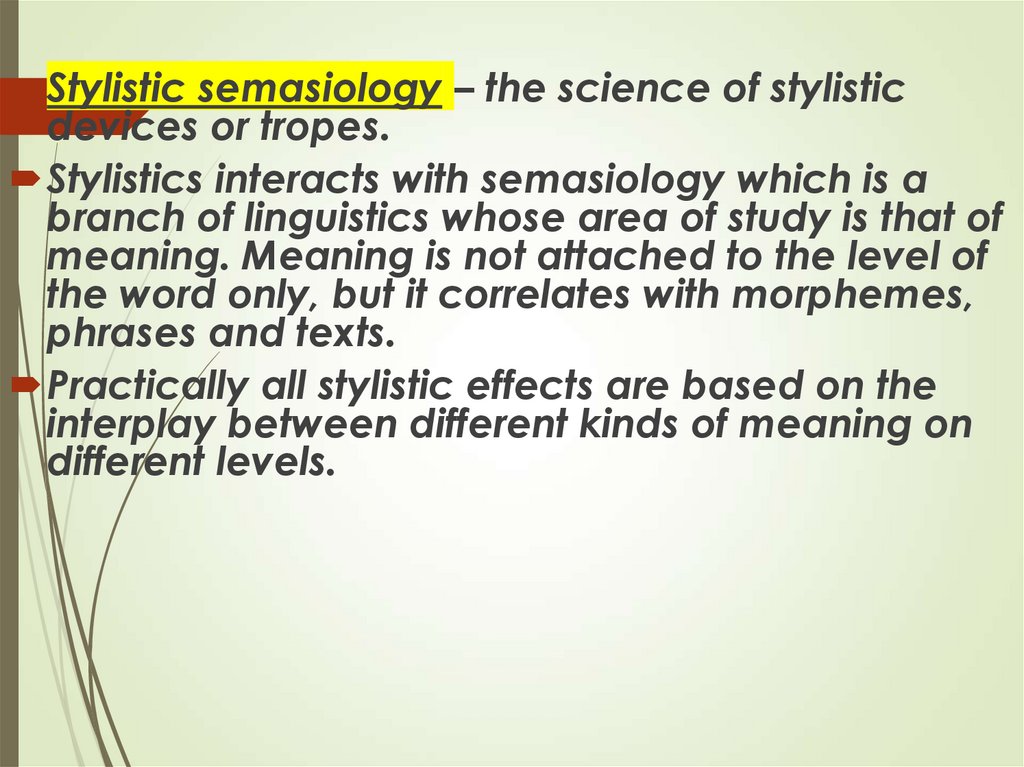
Stylistic semasiology – the science of stylisticdevices or tropes.
Stylistics interacts with semasiology which is a
branch of linguistics whose area of study is that of
meaning. Meaning is not attached to the level of
the word only, but it correlates with morphemes,
phrases and texts.
Practically all stylistic effects are based on the
interplay between different kinds of meaning on
different levels.
24. .
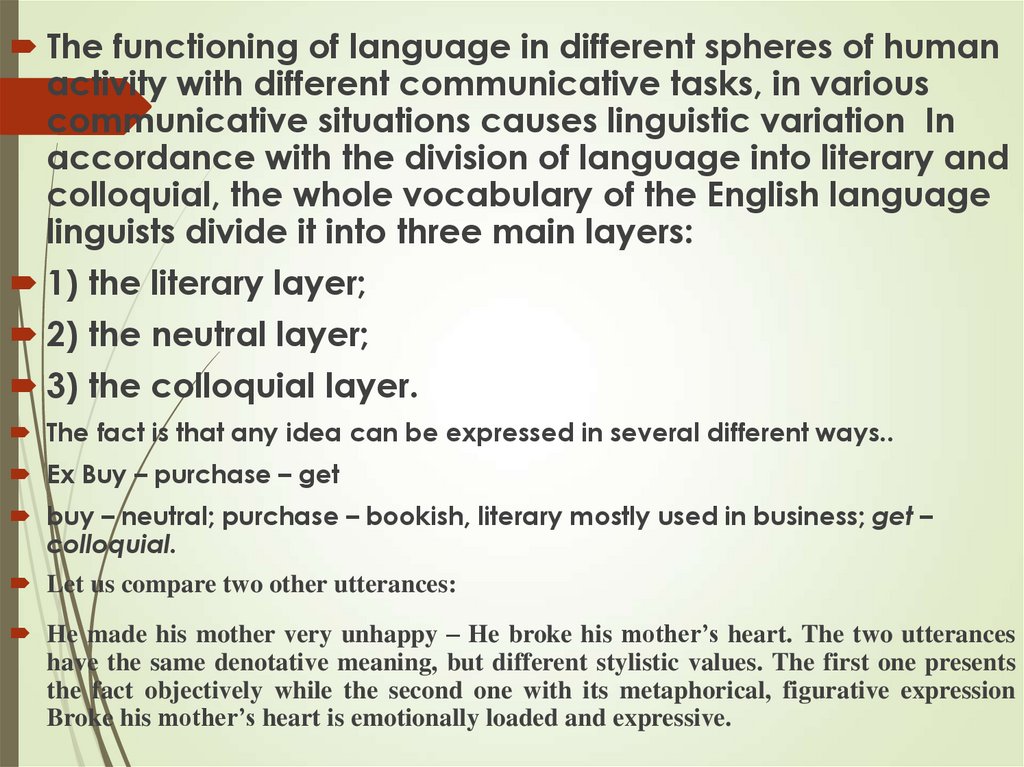
The functioning of language in different spheres of humanactivity with different communicative tasks, in various
communicative situations causes linguistic variation In
accordance with the division of language into literary and
colloquial, the whole vocabulary of the English language
linguists divide it into three main layers:
1) the literary layer;
2) the neutral layer;
3) the colloquial layer.
The fact is that any idea can be expressed in several different ways..
Ex Buy – purchase – get
buy – neutral; purchase – bookish, literary mostly used in business; get –
colloquial.
Let us compare two other utterances:
He made his mother very unhappy – He broke his mother’s heart. The two utterances
have the same denotative meaning, but different stylistic values. The first one presents
the fact objectively while the second one with its metaphorical, figurative expression
Broke his mother’s heart is emotionally loaded and expressive.
25. .
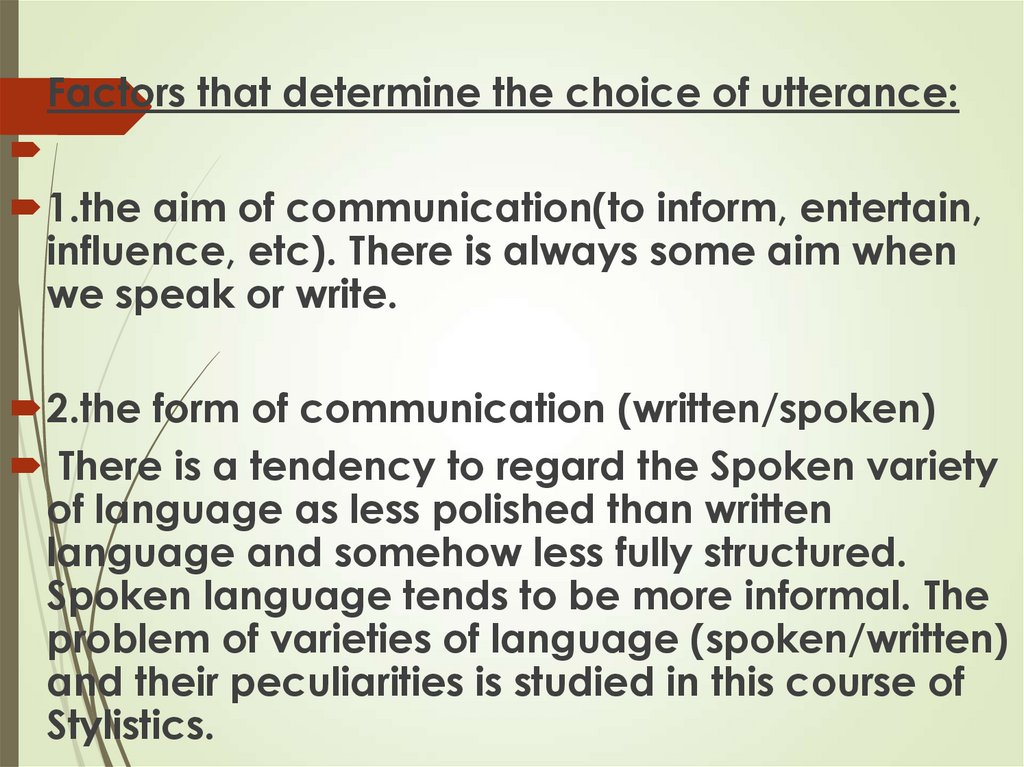
Factors that determine the choice of utterance:1.the aim of communication(to inform, entertain,
influence, etc). There is always some aim when
we speak or write.
2.the form of communication (written/spoken)
There is a tendency to regard the Spoken variety
of language as less polished than written
language and somehow less fully structured.
Spoken language tends to be more informal. The
problem of varieties of language (spoken/written)
and their peculiarities is studied in this course of
Stylistics.
26. .
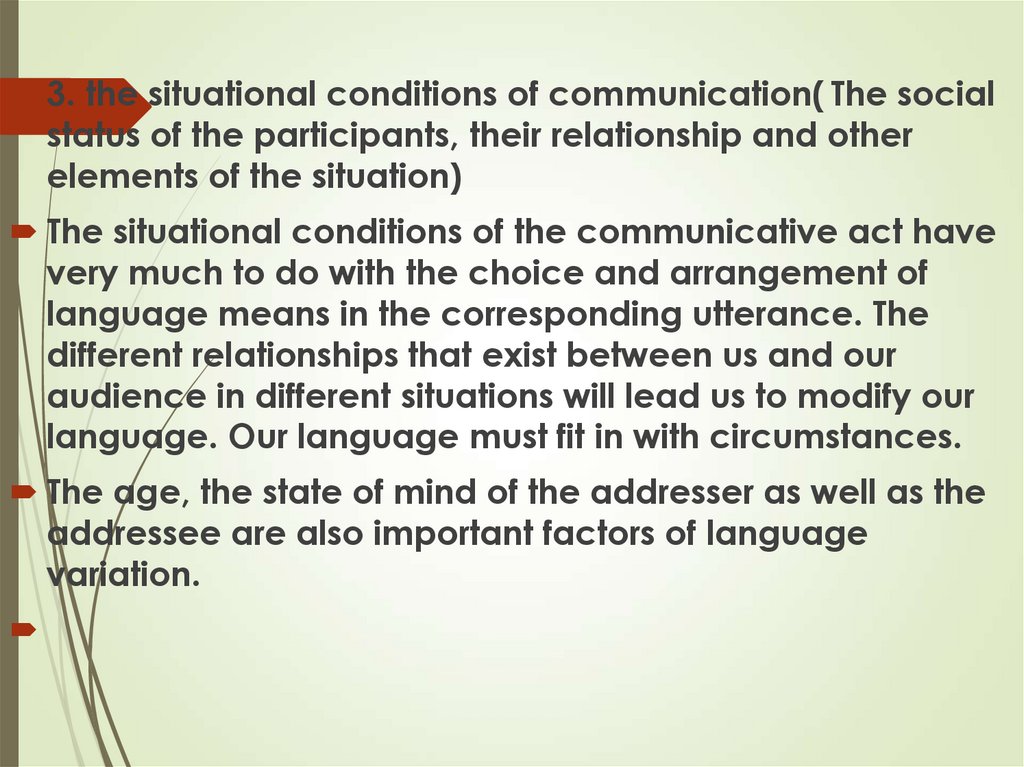
3. the situational conditions of communication( The socialstatus of the participants, their relationship and other
elements of the situation)
The situational conditions of the communicative act have
very much to do with the choice and arrangement of
language means in the corresponding utterance. The
different relationships that exist between us and our
audience in different situations will lead us to modify our
language. Our language must fit in with circumstances.
The age, the state of mind of the addresser as well as the
addressee are also important factors of language
variation.
27. .
4. the degree of formality ofcommunication(formal/informal) A more widespread
classification comprises three registers: formal, neutral
and informal.
5. the degree of expressiveness, emotional impact of the
utterance(высказывание) on the listener/reader
The degree of expressiveness is another important factor.
It is closely related to the writer’s intentions and feelings,
which affect the stylistic quality of the text or utterance.
This quality manifests itself in emotionally colored units,
expressive means and stylistic devices.
28. .
4.Levels in stylistics: lexical, grammatical, phonetic.According to the type of stylistic research scholars
distinguish several branches of stylistics.
The most important division is the differentiation between
literary stylistics and lingua -stylistics.
Both of them study the common ground of:
a) the literary language from the point of view of
variability,
b) the idiolect (individual speech) of a writer,
c) poetic speech that has its own specific laws.
29. .
Linguo-stylistics is called as functional stylistics and studiesthe elements of the language in terms of their ability to
express and evoke emotions and associations. It explores
the expressive possibilities of the language.
Literary stylistics explores means of artistic expression in
literary works.
The difference between them proceeds from the different
points of analysis. While lingua-stylistics studies functional
styles (in their development and current state) and the
linguistic nature of the expressive means of the language,
their systematic character and their functions; literary
stylistics is focused on the composition of the work of art,
various literary genres and the author’s views and outlook.
30. .
.Other branches of stylistics
Comparative stylistics is connected with the contrastive and/or
comparative study of stylistic characteristics of more than one
language (e.g., English and French, English and Russian, English
and Kazakh, etc.).
Decoding stylistics is the trend in stylistics that employs the
knowledge of such sciences as information theory, psychology,
linguistics, literary studies, history of art, etc. This branch of
stylistics helps the reader in understanding of a literary work by
explaining (decoding) the information that may be encoded
by the writer and hidden from immediate view.
Functional stylistics investigates functional styles, i.e. special
sublanguages or varieties of the national language. In the
English literary standard linguists distinguish the following major
functional styles: belles-lettres style, publicist style, newspaper
style, scientific style, official style.
31. .
Thereis the following division of the levels in stylistics:
- lexical; - grammatical;- phonetic;
Lexical level corresponds to the lexical style. It studies the stylistic features of
vocabulary and explores the interaction of direct and figurative meaning. This
level deals with various types of connotation – expressive, evaluative,
emotive, dialectical words, different terms; slang words; colloquial words and
expressions, neologisms, archaisms, foreign words, phraseological units,
proverbs etc.
Grammatical level – is subdivided into morphological and syntactical.
Morphological level – deals with stylistic potential of grammatical categories
of different parts of speech.
Syntactical level – studies syntactic expressive means, word order, different
types of sentence and types of syntactic connections. Also, deals with origin
of the text, its division on the paragraphs, dialogues, direct/indirect speech,
types of sentences.
Phonetic level – phonetic organization of prose and poetic texts. Here are
included rhythms, rhythmical structure, alliteration etc. It shows how separate
sounds and intonation can serve as expressive means.
32. .
Thus,to sum up, Stylistics studies
1) synonymous ways of rendering one and the same idea;
2) emotional coloring in language;
3) the individual manner of an author in making use of language.
4)varieties of language – spoken and written, and their peculiarities;
5)functional styles of the English language, their typical featres and
interrelation of the styles;
6) stylistic differentiation of the English vocabulary;
7) expressive means and stylistic devices, their stylistic functions;
8) the problem of the English literary norm and deviations from the norm.
The main aims of a course in Stylistics are as follows:
firstly, Stylistic analysis broadens theoretical horizons of a language learner,
teaches them the skill of competent reading, adequate translation and the
rules of situational use of language;
Secondly, it develops the learner’s skill in shaping certain information into a
message.
33. .
1. What is the stylistic classification of the Englishvocabulary ?
2. What are the main branches of stylistics?
3. What are the links of stylistics with other branches of
linguistics.