



 marketing
Similar presentations:









Leadership and Decision Making. Chapter 9
1.
Leadership andDecision Making
Chapter 9
Copyright©
©2017
2012Pearson
PearsonEducation,
Education, Ltd.
Inc.
Copyright
Publishing as Prentice Hall
9-1
2.
IntroductionIn this chapter we
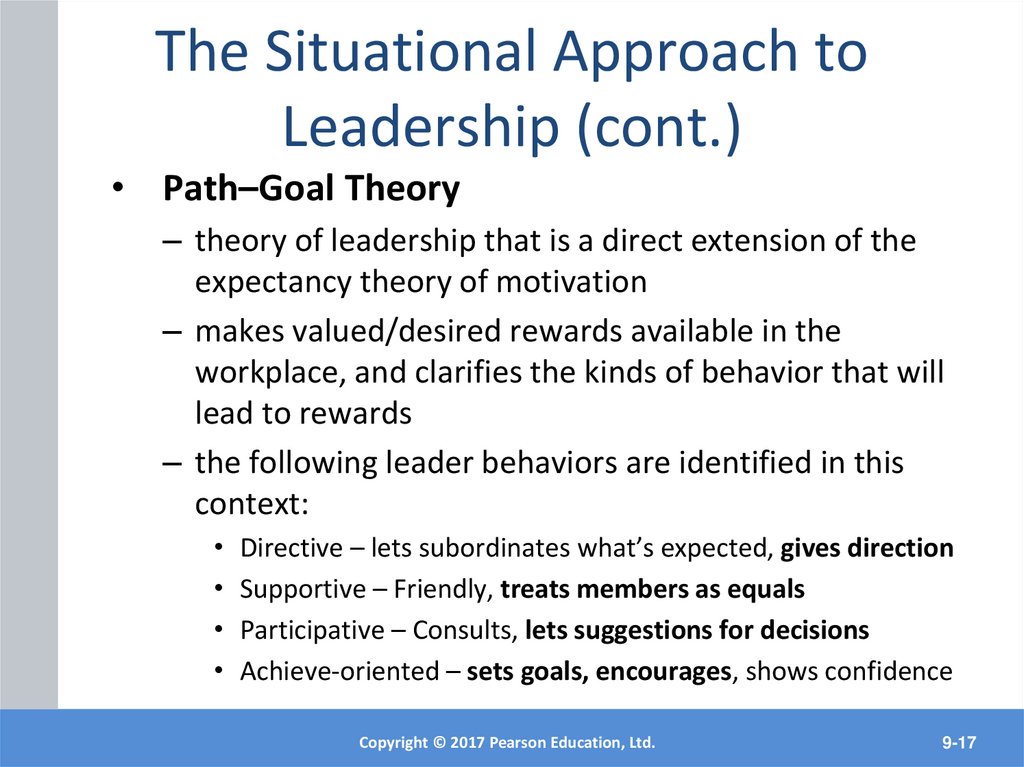
– look at the nature of leadership
– describe early approaches to leadership, as
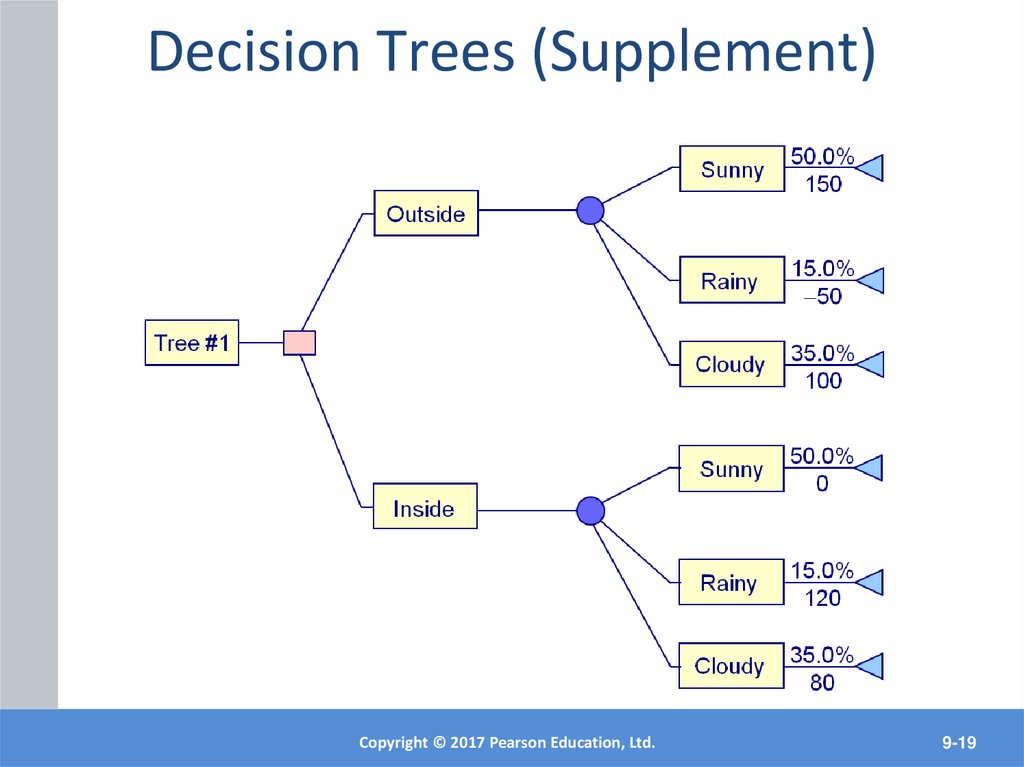
well as the situational perspective accepted
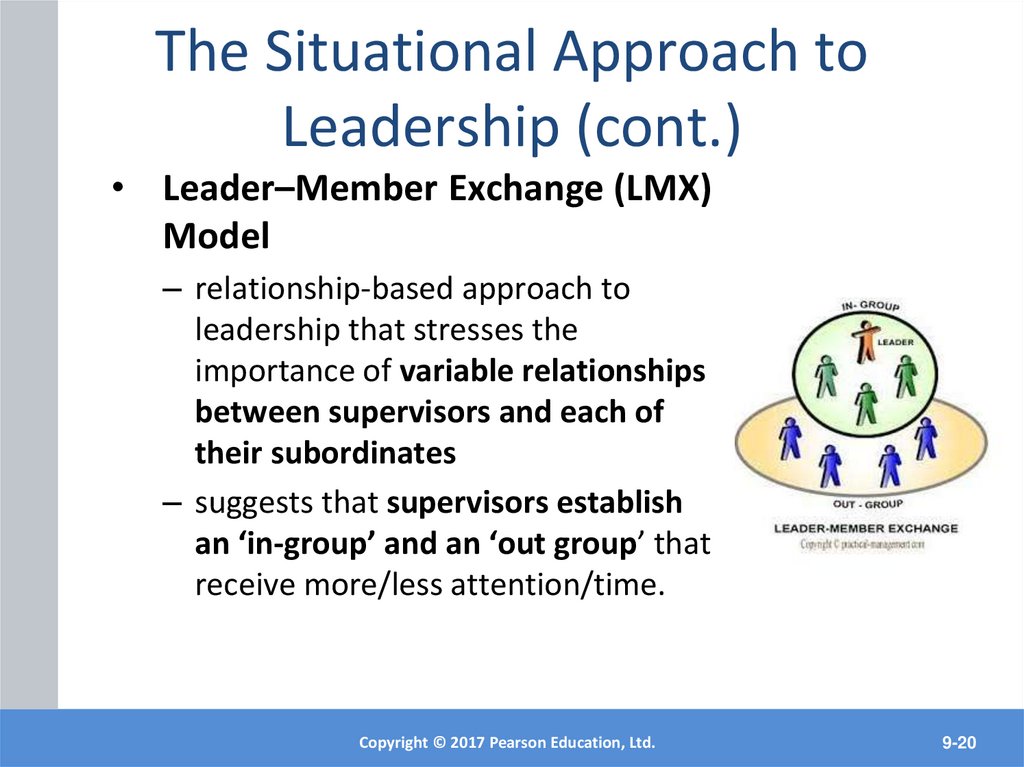
today
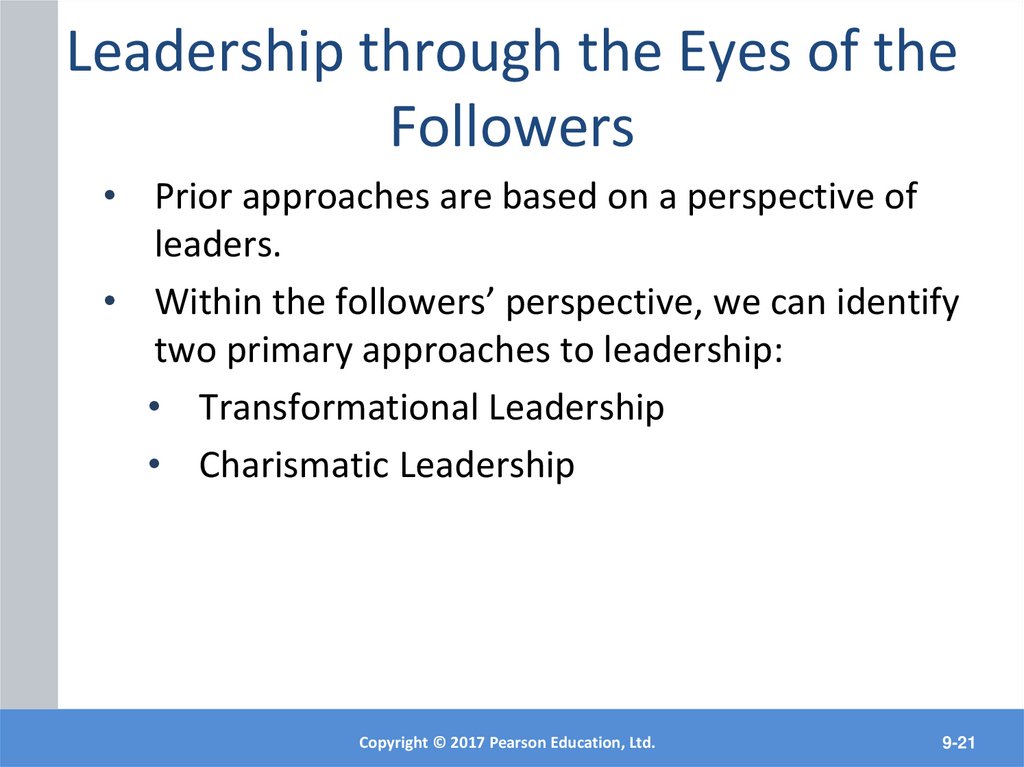
– examine leadership through the eyes of
followers as well as alternatives to leadership
– describe the important related concept of
decision making
Copyright©
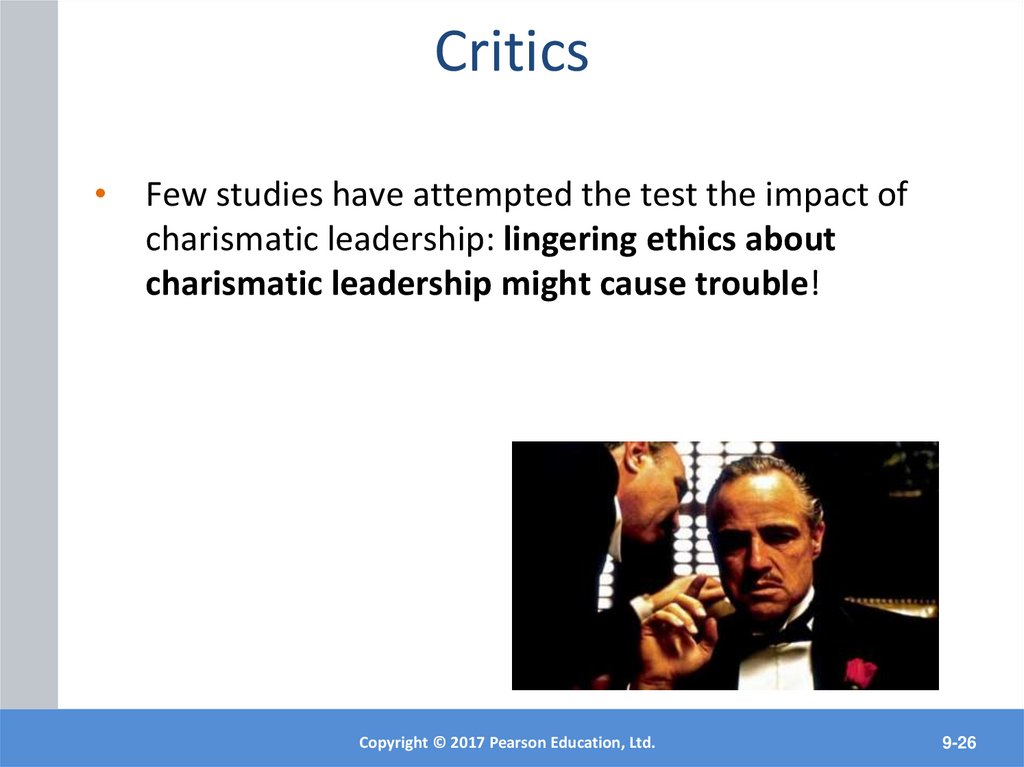
©2017
2012Pearson
PearsonEducation,
Education, Ltd.
Inc.
Copyright
Publishing as Prentice Hall
9-2
3.
Learning Objectives1. Define leadership and distinguish it from
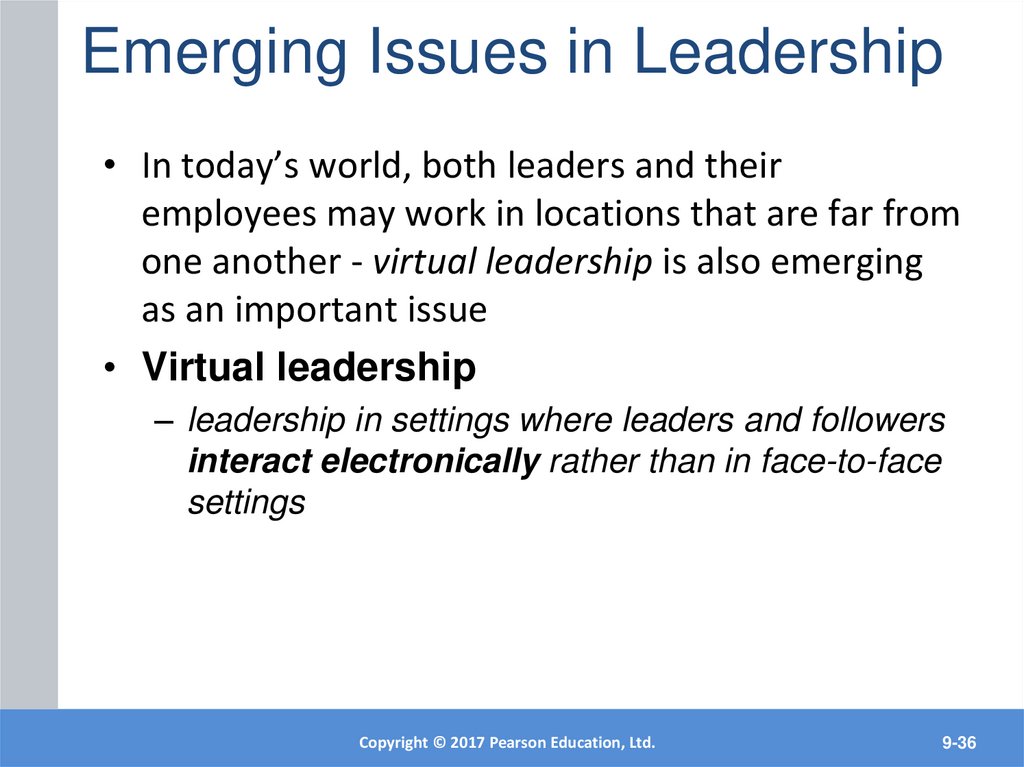
management.
2. Summarize early approaches to the study of
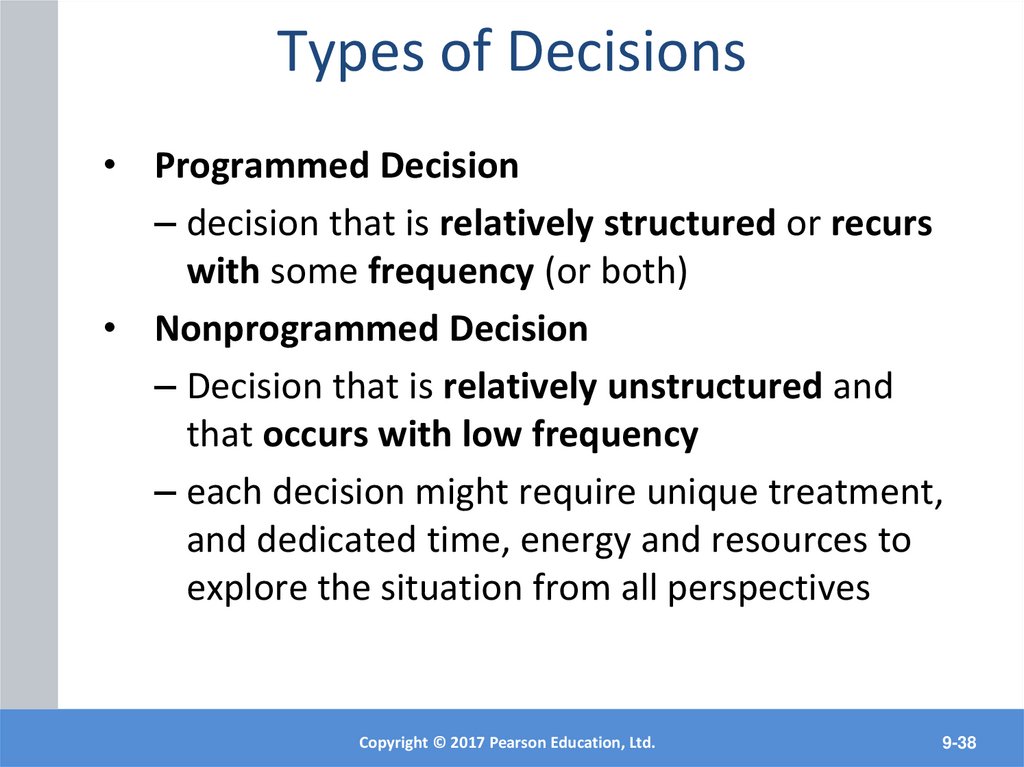
leadership.
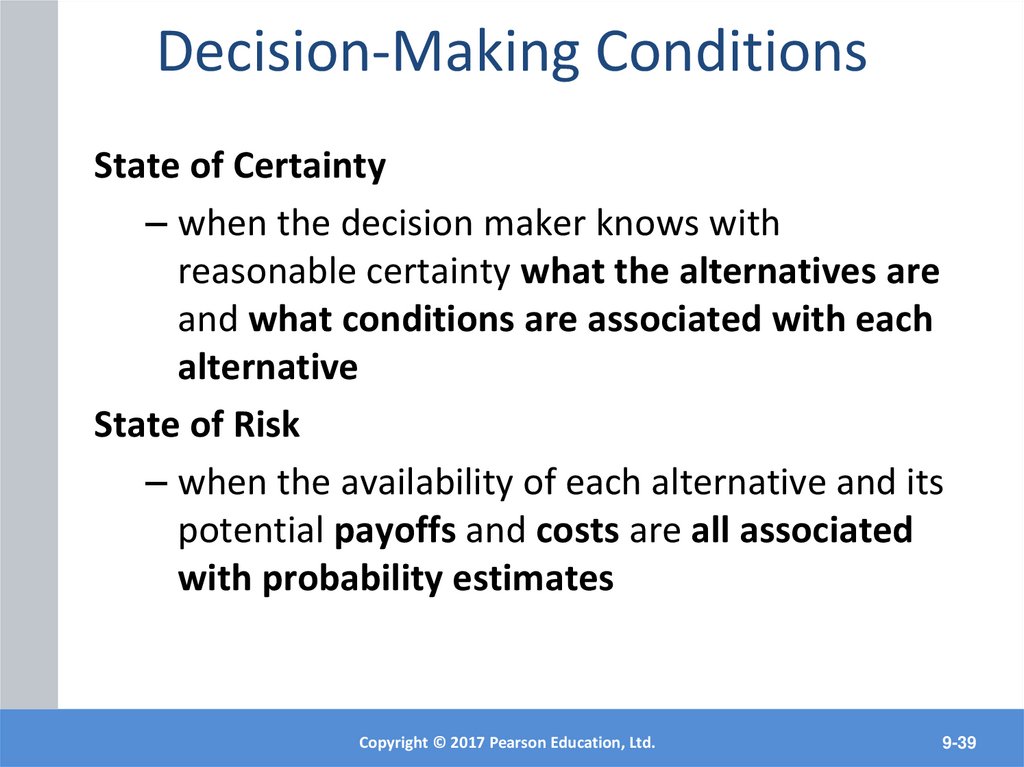
3. Discuss the concept of situational approaches
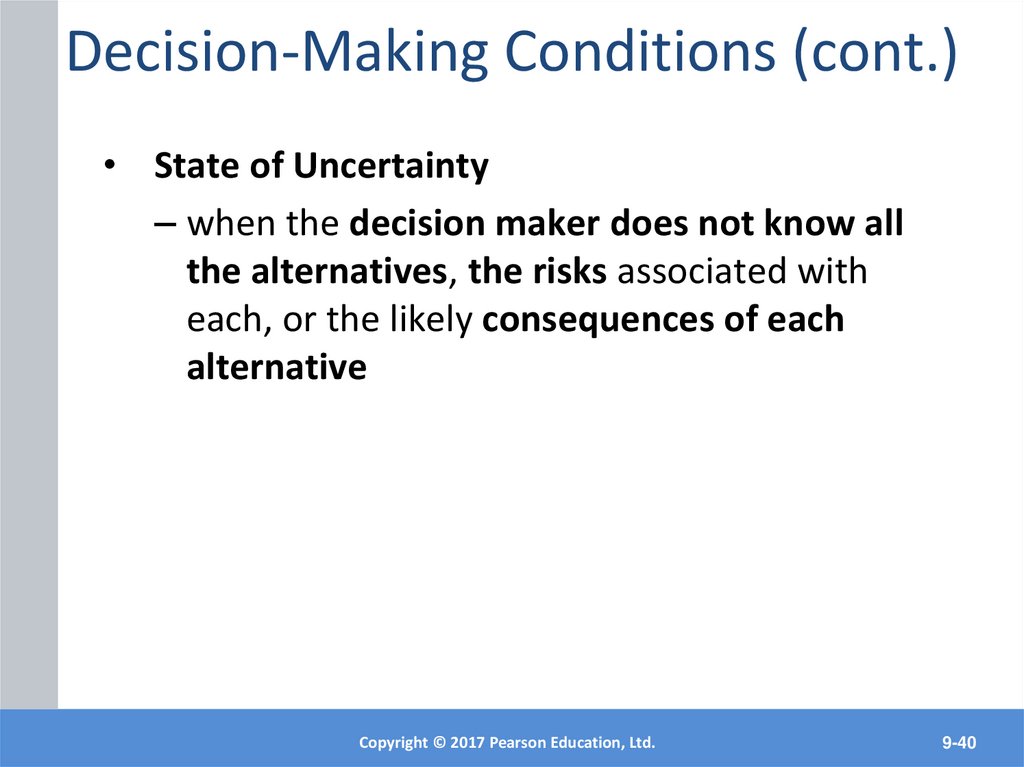
to leadership
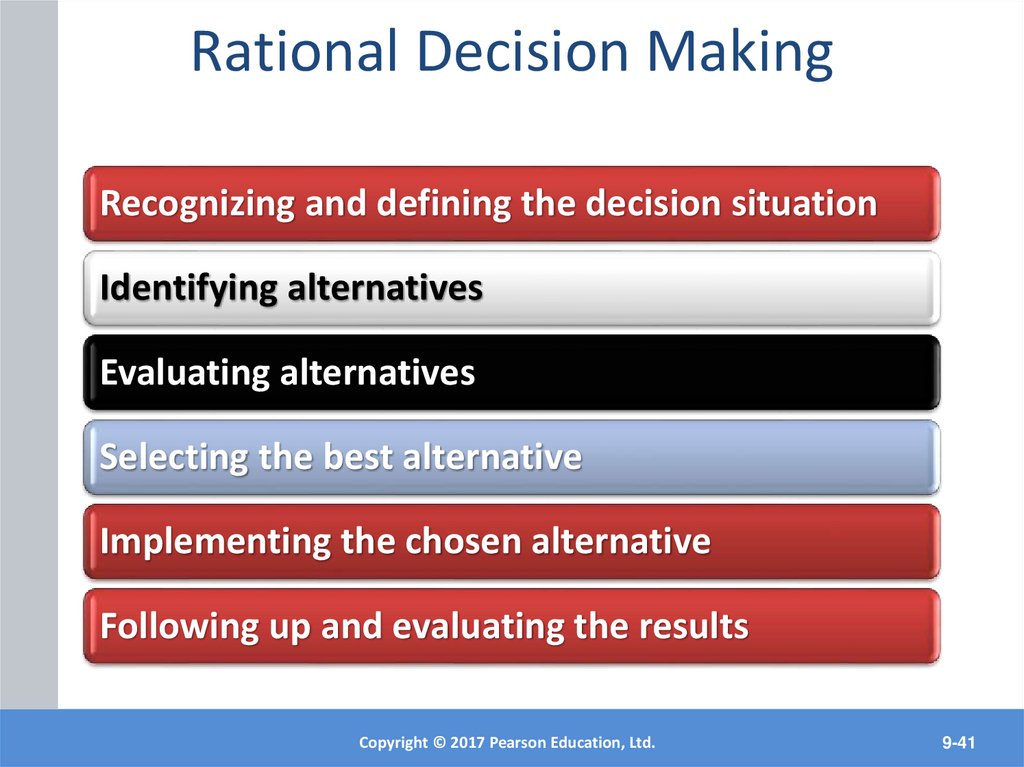
4. Describe transformational and charismatic
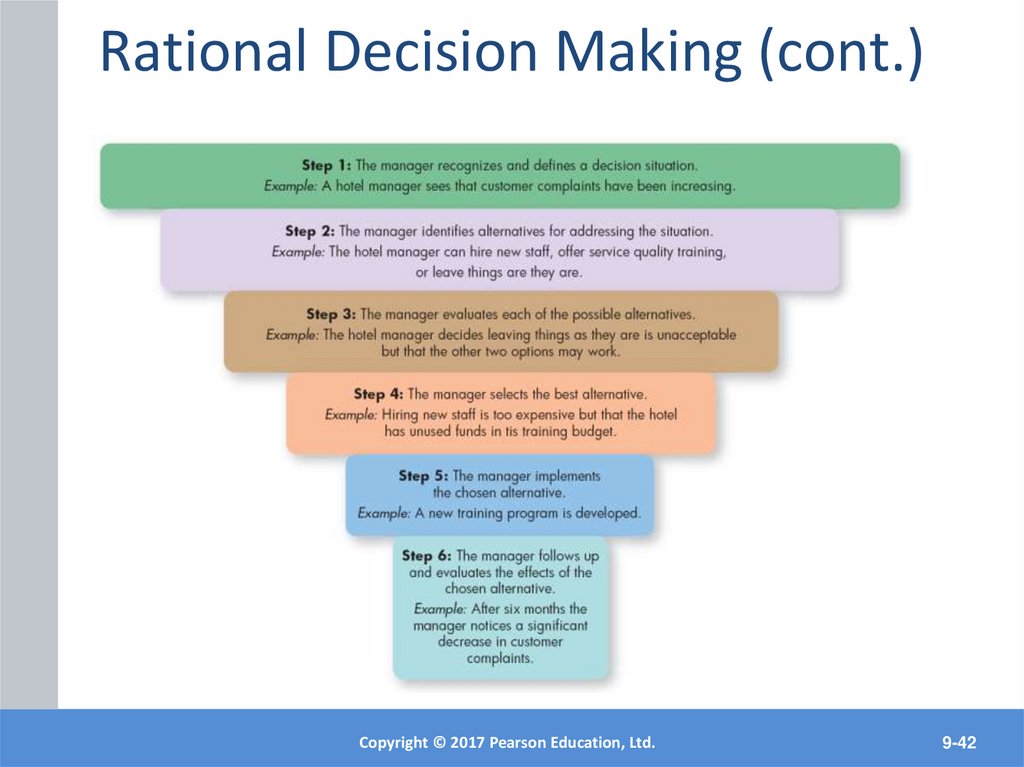
perspectives on leadership.
Copyright©
©2017
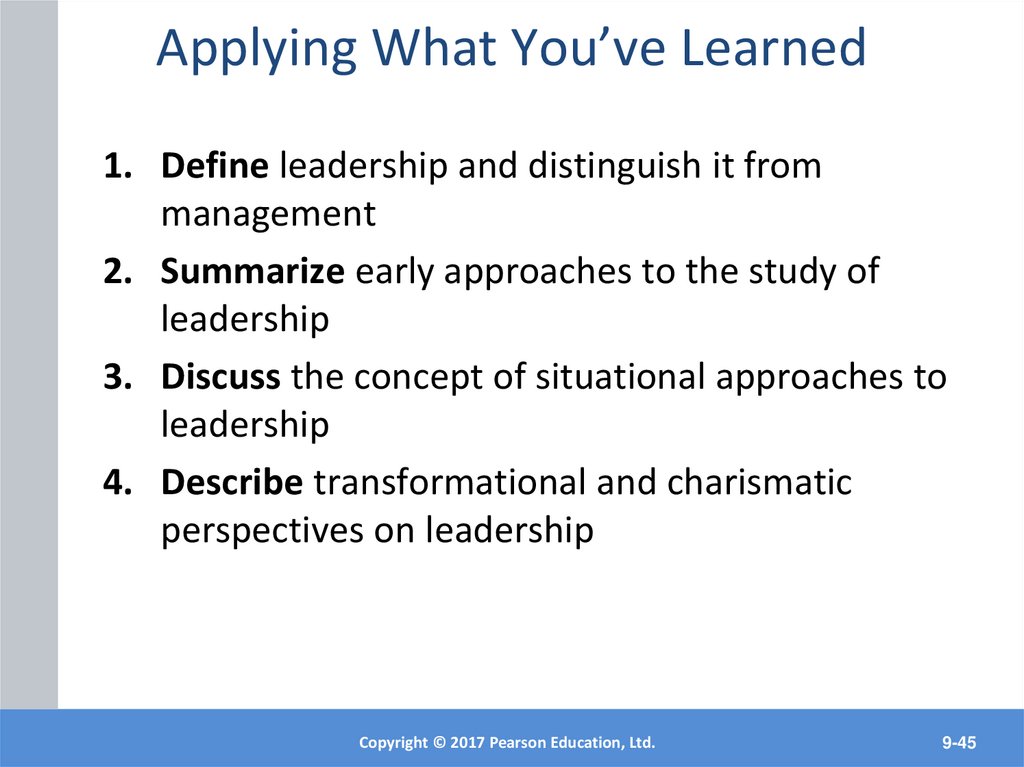
2012Pearson
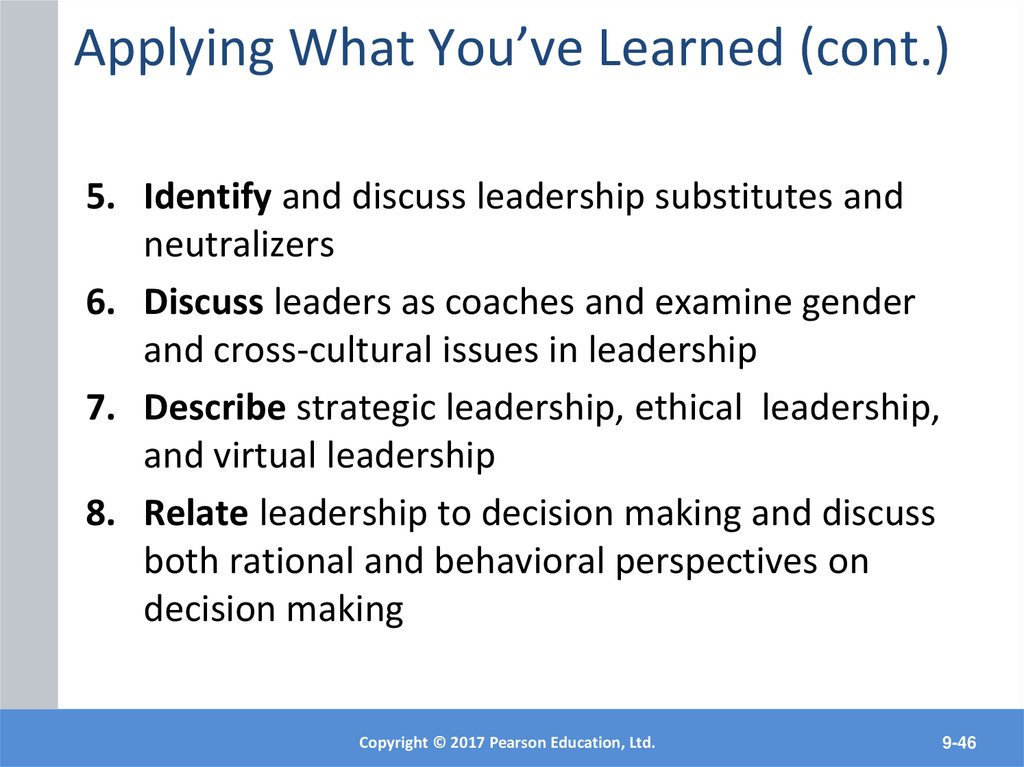
PearsonEducation,
Education, Ltd.
Inc.
Copyright
Publishing as Prentice Hall
9-3
4.
Learning Objectives5. Identify and discuss leadership substitutes and
neutralizers.
6. Discuss leaders as coaches and examine gender
and cross-cultural issues in leadership.
7. Describe strategic leadership, ethical
leadership, and virtual leadership.
8. Relate leadership to decision making and
discuss both rational and behavioral
perspectives on decision making.
Copyright©
©2017
2012Pearson
PearsonEducation,
Education, Ltd.
Inc.
Copyright
Publishing as Prentice Hall
9-4
5.
The Nature of Leadership• Leadership
– the processes and behaviors used by someone,
such as a manager, to motivate, inspire, and
influence the behaviors of others
Copyright©
©2017
2012Pearson
PearsonEducation,
Education, Ltd.
Inc.
Copyright
Publishing as Prentice Hall
9-5
6.
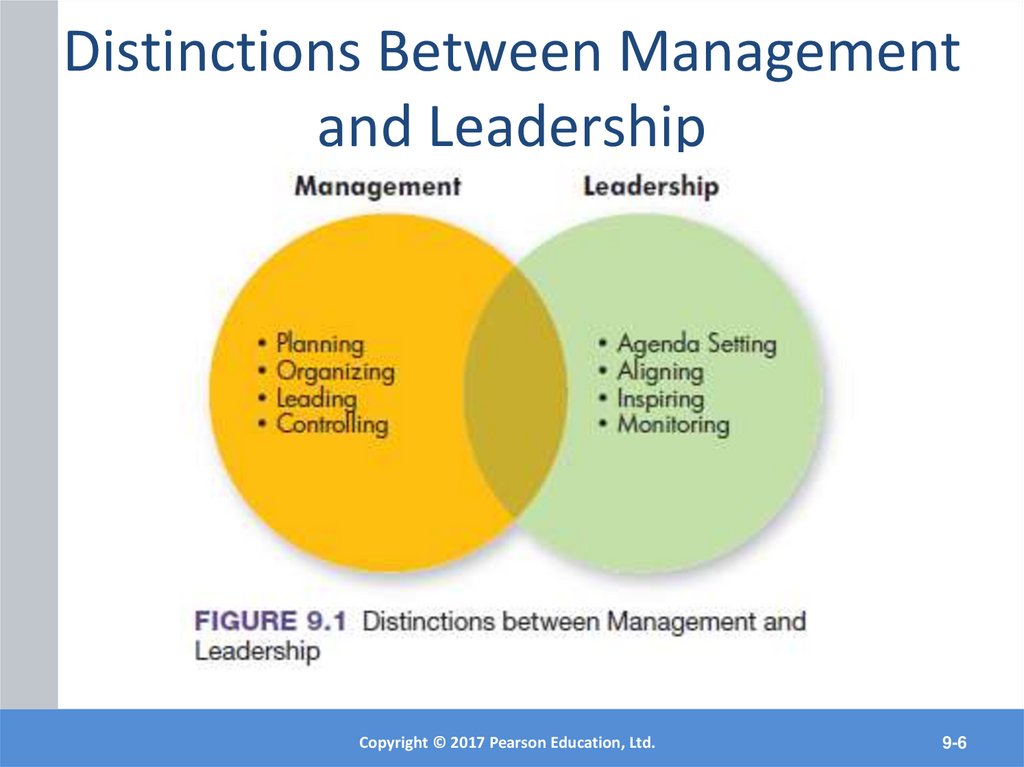
Distinctions Between Managementand Leadership
Copyright©
©2017
2012Pearson
PearsonEducation,
Education, Ltd.
Inc.
Copyright
Publishing as Prentice Hall
9-6
7.
Leadership and Power• Power
– the ability to affect the behavior of others
• In organizational settings, there are usually five kinds of
power:
• Legitimate power
• Reward power
• Coercive power
• Referent power
• Expert power
Copyright©
©2017
2012Pearson
PearsonEducation,
Education, Ltd.
Inc.
Copyright
Publishing as Prentice Hall
9-7
8.
Leadership and Power• Legitimate Power
– power granted through the organizational hierarchy
• Reward Power
– the power to give or withhold rewards (bonuses, salary
increases, promotion recommendations, praise,
recognition, interesting job assignments)
• Coercive Power
– the power to force compliance by means of
psychological, emotional, or physical threat
Copyright©
©2017
2012Pearson
PearsonEducation,
Education, Ltd.
Inc.
Copyright
Publishing as Prentice Hall
9-8
9.
Leadership and Power (cont.)• Referent Power
– power based on identification, imitation,
loyalty, or charisma
– abstract (not as direct as the reward or
coercive power)
• Expert Power
– power derived from information or expertise
– scientists, bureaucrats, experts on specific
topics have such power on anyone who needs
that information
Copyright©
©2017
2012Pearson
PearsonEducation,
Education, Ltd.
Inc.
Copyright
Publishing as Prentice Hall
9-9
10.
Early Approaches to Leadership• Trait Approach to Leadership
– focused on identifying the essential traits that
distinguished leaders
– intelligence, dominance, self-confidence,
energy, activity (versus passivity), and
knowledge about the job
Copyright©
©2017
2012Pearson
PearsonEducation,
Education, Ltd.
Inc.
Copyright
Publishing as Prentice Hall
9-10
11.
Early Approaches to Leadership• Early researchers believed that notable leaders had some
unique set of qualities or traits that distinguished them
from their peers and endured throughout history.
• This approach to leadership led researchers to focus on
identifying the essential leadership traits, including
• intelligence, dominance,
• self-confidence,
• energy,
• activity (versus passivity),
• and knowledge about the job.
• Unfortunately, the list of potential leadership traits quickly
became so long that it lost any practical value.
Copyright©
©2017
2012Pearson
PearsonEducation,
Education, Ltd.
Inc.
Copyright
Publishing as Prentice Hall
9-11
12.
Early Approaches to Leadership• In the late 1940s, most researchers began to shift away
from the trait approach and to look at leadership as a set
of actual behaviors (rather than traits).
• The goal of the behavioral approach to leadership was to
determine what behaviors were employed by effective
leaders.
• These researchers assumed that the behaviors of effective
leaders differed somehow from the behaviors of less
effective leaders, and that the behaviors of effective
leaders would be the same across all situations.
Copyright©
©2017
2012Pearson
PearsonEducation,
Education, Ltd.
Inc.
Copyright
Publishing as Prentice Hall
9-12
13.
Early Approaches to Leadership(cont.)
• Behavioral Approach to Leadership
– focused on determining what behaviors are
employed by leaders
• Basic leader behaviors identified during this
period (1940’s):
• Task-focused leader behavior
• Employee-focused leader behavior
Copyright©
©2017
2012Pearson
PearsonEducation,
Education, Ltd.
Inc.
Copyright
Publishing as Prentice Hall
9-13
14.
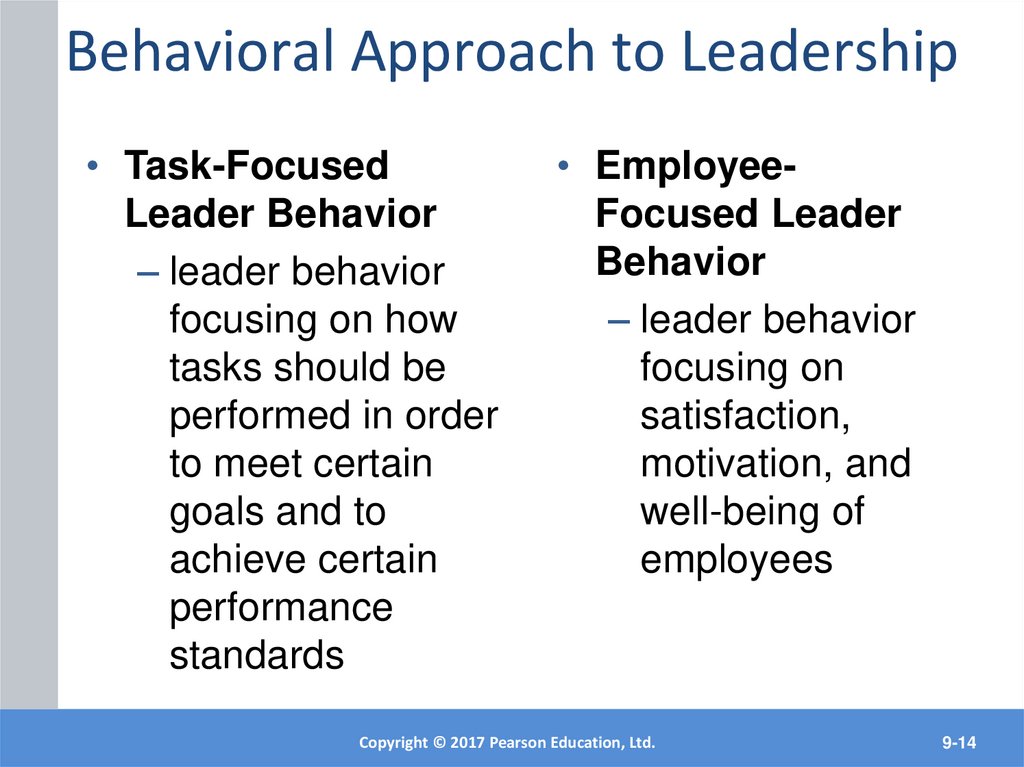
Behavioral Approach to Leadership• Task-Focused
Leader Behavior
– leader behavior
focusing on how
tasks should be
performed in order
to meet certain
goals and to
achieve certain
performance
standards
• EmployeeFocused Leader
Behavior
– leader behavior
focusing on
satisfaction,
motivation, and
well-being of
employees
Copyright©
©2017
2012Pearson
PearsonEducation,
Education, Ltd.
Inc.
Copyright
Publishing as Prentice Hall
9-14
15.
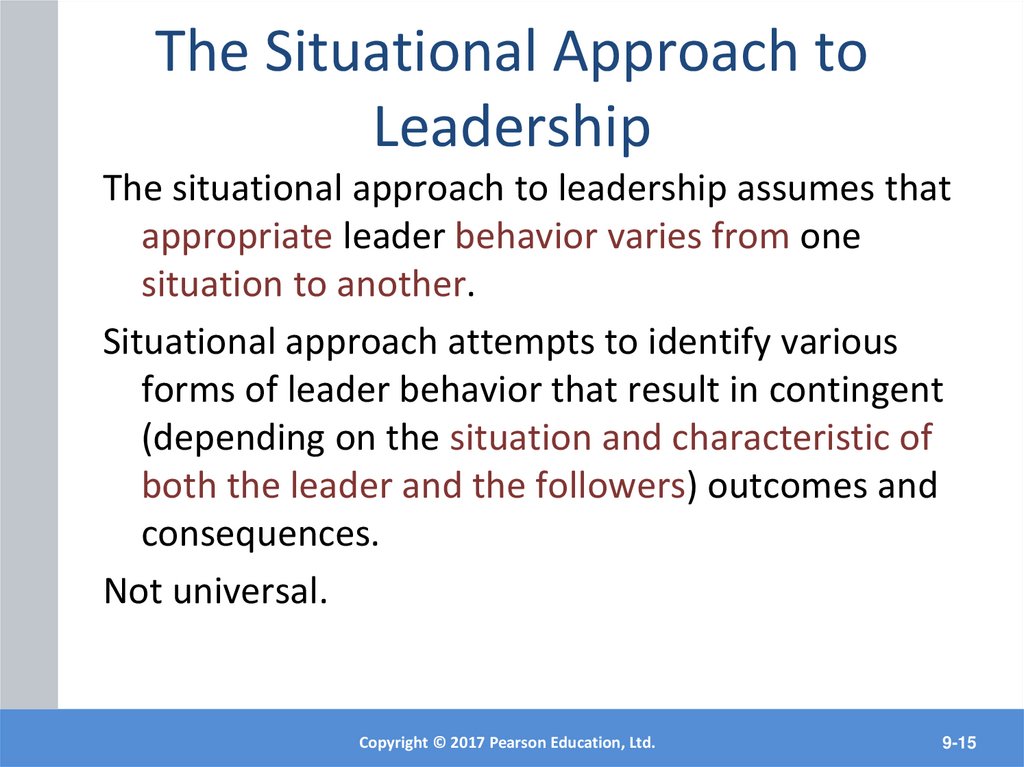
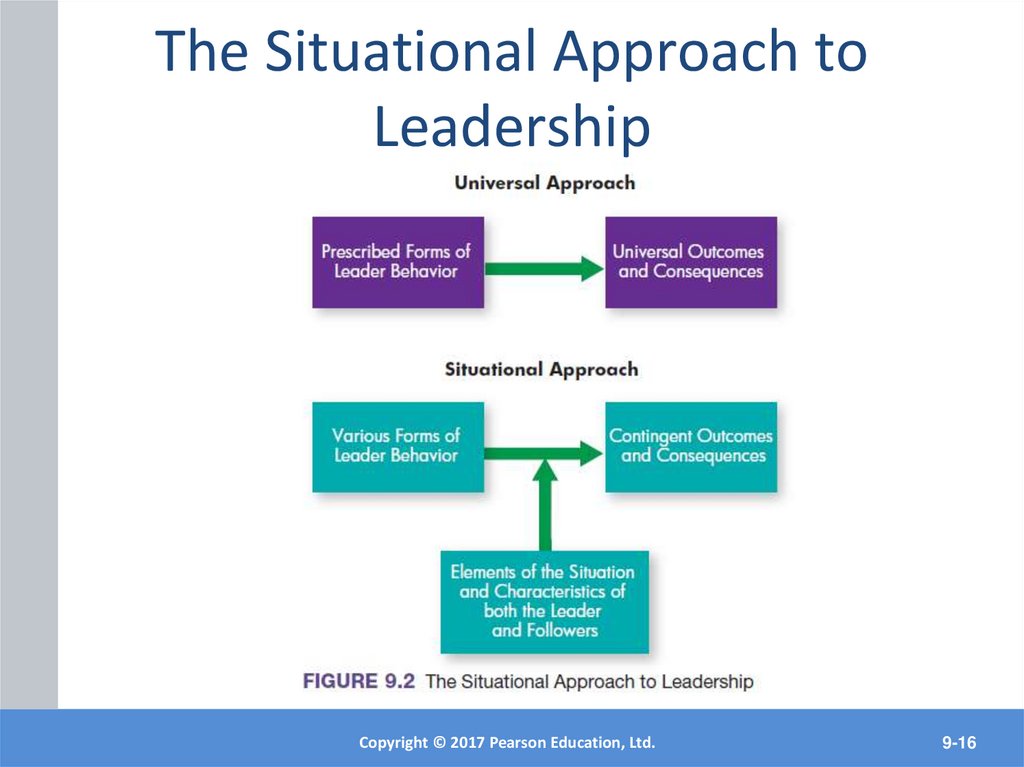
The Situational Approach toLeadership
The situational approach to leadership assumes that
appropriate leader behavior varies from one
situation to another.
Situational approach attempts to identify various
forms of leader behavior that result in contingent
(depending on the situation and characteristic of
both the leader and the followers) outcomes and
consequences.
Not universal.
Copyright©
©2017
2012Pearson
PearsonEducation,
Education, Ltd.
Inc.
Copyright
Publishing as Prentice Hall
9-15
16.
The Situational Approach toLeadership
Copyright©
©2017
2012Pearson
PearsonEducation,
Education, Ltd.
Inc.
Copyright
Publishing as Prentice Hall
9-16
17.
The Situational Approach toLeadership (cont.)
• Path–Goal Theory
– theory of leadership that is a direct extension of the
expectancy theory of motivation
– makes valued/desired rewards available in the
workplace, and clarifies the kinds of behavior that will
lead to rewards
– the following leader behaviors are identified in this
context:
• Directive – lets subordinates what’s expected, gives direction
• Supportive – Friendly, treats members as equals
• Participative – Consults, lets suggestions for decisions
• Achieve-oriented – sets goals, encourages, shows confidence
Copyright©
©2017
2012Pearson
PearsonEducation,
Education, Ltd.
Inc.
Copyright
Publishing as Prentice Hall
9-17
18.
The Situational Approach toLeadership (cont.)
• Decision Tree Approach
– approach to leadership that provides decision rules to
decide on how much participation to allow
– according to this approach, after evaluating a variety
of problem attributes, the leader determines an
appropriate decision that specifies a degree
Copyright©
©2017
2012Pearson
PearsonEducation,
Education, Ltd.
Inc.
Copyright
Publishing as Prentice Hall
9-18
19.
Decision Trees (Supplement)Copyright©
©2017
2012Pearson
PearsonEducation,
Education, Ltd.
Inc.
Copyright
Publishing as Prentice Hall
9-19
20.
The Situational Approach toLeadership (cont.)
• Leader–Member Exchange (LMX)
Model
– relationship-based approach to
leadership that stresses the
importance of variable relationships
between supervisors and each of
their subordinates
– suggests that supervisors establish
an ‘in-group’ and an ‘out group’ that
receive more/less attention/time.
Copyright©
©2017
2012Pearson
PearsonEducation,
Education, Ltd.
Inc.
Copyright
Publishing as Prentice Hall
9-20
21.
Leadership through the Eyes of theFollowers
• Prior approaches are based on a perspective of
leaders.
• Within the followers’ perspective, we can identify
two primary approaches to leadership:
• Transformational Leadership
• Charismatic Leadership
Copyright©
©2017
2012Pearson
PearsonEducation,
Education, Ltd.
Inc.
Copyright
Publishing as Prentice Hall
9-21
22.
• Transformational Leadership• Transformational Leadership
– the set of abilities that allows a leader to
recognize the need for change, to create a
vision to guide that change, and to execute the
change effectively
• Transactional Leadership
– comparable to management, it involves
routine, regimented activities
Copyright©
©2017
2012Pearson
PearsonEducation,
Education, Ltd.
Inc.
Copyright
Publishing as Prentice Hall
9-22
23.
Charismatic Leadership• A type of influence based on the leader’s
charisma, a form of interpersonal attraction that
inspires support and acceptance.
• Charismatic leaders are likely to have a lot of
confidence in their beliefs and ideals and a
strong need to influence people.
• They also tend to communicate high
expectations about follower performance and to
express confidence in their followers.
Copyright©
©2017
2012Pearson
PearsonEducation,
Education, Ltd.
Inc.
Copyright
Publishing as Prentice Hall
9-23
24.
Leadership Through the Eyes ofFollowers (cont.)
• Charisma
• Charismatic Leadership
– a form of interpersonal
attraction that inspires
support and
acceptance
– type of influence based on
the leader’s personal
charisma
Copyright©
©2017
2012Pearson
PearsonEducation,
Education, Ltd.
Inc.
Copyright
Publishing as Prentice Hall
9-24
25.
Crucial Elements of CharismaticLeadership
1. Charismatic leaders envision likely future trends
and patterns, set high expectations for
themselves and for others, and behave in ways
that meet or exceed those expectations.
2. Charismatic leaders energize others by
demonstrating personal excitement, personal
confidence, and consistent patterns of success.
3. Charismatic leaders enable others by supporting
them, empathizing with them, and expressing
confidence in them.
Copyright©
©2017
2012Pearson
PearsonEducation,
Education, Ltd.
Inc.
Copyright
Publishing as Prentice Hall
9-25
26.
CriticsFew studies have attempted the test the impact of
charismatic leadership: lingering ethics about
charismatic leadership might cause trouble!
Copyright©
©2017
2012Pearson
PearsonEducation,
Education, Ltd.
Inc.
Copyright
Publishing as Prentice Hall
9-26
27.
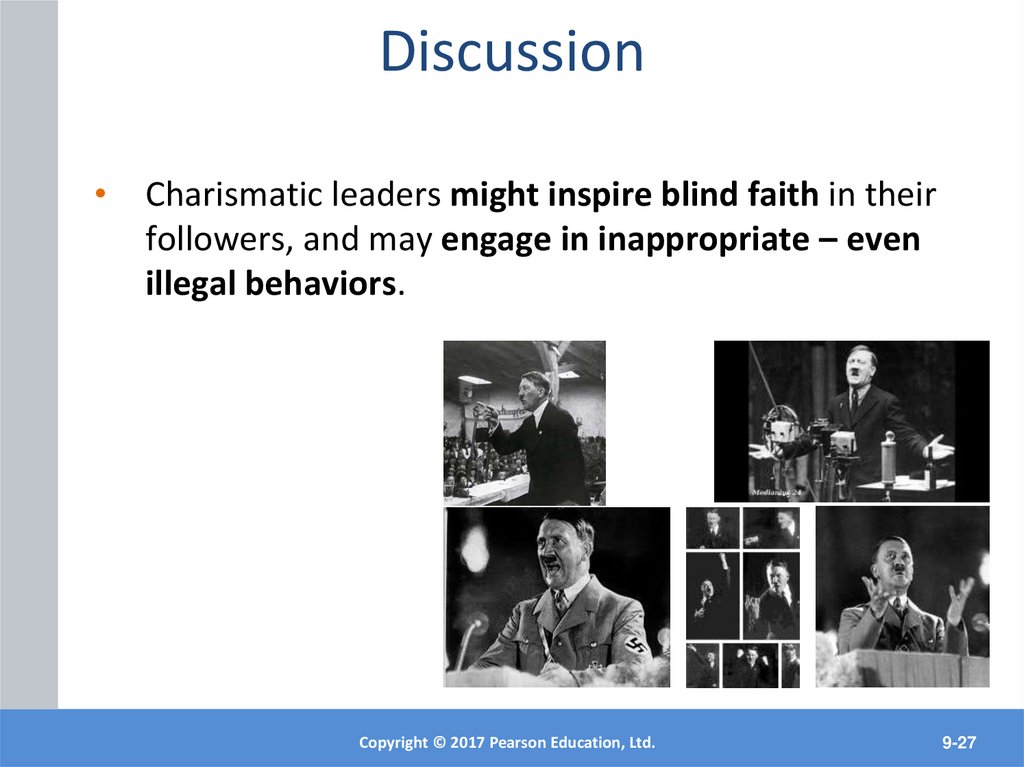
DiscussionCharismatic leaders might inspire blind faith in their
followers, and may engage in inappropriate – even
illegal behaviors.
Copyright©
©2017
2012Pearson
PearsonEducation,
Education, Ltd.
Inc.
Copyright
Publishing as Prentice Hall
9-27
28.
Special Issues in Leadership• Leadership Substitutes
– individual, task, and organizational
characteristics that tend to outweigh the need
for a leader to initiate or direct employee
performance
– in many cases, jobs should be taken care of
without leaders (2009 Hudson River Accident)
• Leadership Neutralizers
– factors that may render leader behaviors
ineffective (A young, inexperienced person
trying to lead a cohesive group of senior experts)
Copyright©
©2017
2012Pearson
PearsonEducation,
Education, Ltd.
Inc.
Copyright
Publishing as Prentice Hall
9-28
29.
Leadership Substitutes andNeutralizers
Copyright©
©2017
2012Pearson
PearsonEducation,
Education, Ltd.
Inc.
Copyright
Publishing as Prentice Hall
9-29
30.
The Changing Nature of Leadership• Leaders as Coaches (or Mentors)
– leaders were once expected to control
situations, direct work, supervise people,
closely monitor performance, make decisions,
and structure activities, many leaders today are
being asked to change how they manage
people
– coaching involves selecting and training team
members, provide general direction, helping
the team to get to the info and resources
– from directive overseer to mentor
Copyright©
©2017
2012Pearson
PearsonEducation,
Education, Ltd.
Inc.
Copyright
Publishing as Prentice Hall
9-30
31.
The Changing Nature of Leadership• Gender and Leadership
– most leadership theories and research studies
have focused on male leaders, developing a
better understanding of how women lead is
clearly an important next step
– research (more required) suggests that
• female leaders are not necessarily more nurturing
or supportive than male leaders
• male leaders are not systematically harsher, more
controlling, or more task focused than female
leaders
Copyright©
©2017
2012Pearson
PearsonEducation,
Education, Ltd.
Inc.
Copyright
Publishing as Prentice Hall
9-31
32.
The Changing Nature of Leadership(cont.)
• Cross-Cultural Leadership
– Another changing perspective on leadership
relates to cross-cultural issues.
– Leadership is connected to culture (both
international differences and diversity-based
differences). Japan is generally characterized
by collectivism (group before individual),
whereas the United States is based more on
individualism (individual before group)
Copyright©
©2017
2012Pearson
PearsonEducation,
Education, Ltd.
Inc.
Copyright
Publishing as Prentice Hall
9-32
33.
Emerging Issues in Leadership• The following are some of the important emerging
issues in leadership topic:
o Strategic leadership
o Ethical leadership
o Virtual leadership
Copyright©
©2017
2012Pearson
PearsonEducation,
Education, Ltd.
Inc.
Copyright
Publishing as Prentice Hall
9-33
34.
Emerging Issues in Leadership• Strategic Leadership
– leader’s ability to understand the complexities of
both the organization and its environment and to
lead change in the organization so as to enhance
its competitiveness
– an effective strategic leader needs to have a
thorough understanding of the organization: its
history, culture, strengths, weaknesses; and must
have an understanding on the external
environment.
Copyright©
©2017
2012Pearson
PearsonEducation,
Education, Ltd.
Inc.
Copyright
Publishing as Prentice Hall
9-34
35.
Emerging Issues in LeadershipBusiness leaders are being called on to maintain
high ethical standards for their own conduct, to
unfailingly exhibit ethical behavior, and to hold others
in their organizations to the same standards—in
short, to practice ethical leadership.
Ethical Leadership
– leader behaviors that reflect high ethical standards
– maintain high ethical standards
– hold others in the organization to the same standards
Copyright©
©2017
2012Pearson
PearsonEducation,
Education, Ltd.
Inc.
Copyright
Publishing as Prentice Hall
9-35
36.
Emerging Issues in Leadership• In today’s world, both leaders and their
employees may work in locations that are far from
one another - virtual leadership is also emerging
as an important issue
• Virtual leadership
– leadership in settings where leaders and followers
interact electronically rather than in face-to-face
settings
Copyright©
©2017
2012Pearson
PearsonEducation,
Education, Ltd.
Inc.
Copyright
Publishing as Prentice Hall
9-36
37.
Leadership, Management, andDecision Making
• Decision Making
– choosing one alternative from several options
– decisions are mostly made on problems on
opportunities
• Decision-Making Process
– recognizing and defining the nature of a decision
situation, identifying alternatives, choosing the
“best” alternative, and putting it into practice
Copyright©
©2017
2012Pearson
PearsonEducation,
Education, Ltd.
Inc.
Copyright
Publishing as Prentice Hall
9-37
38.
Types of Decisions• Programmed Decision
– decision that is relatively structured or recurs
with some frequency (or both)
• Nonprogrammed Decision
– Decision that is relatively unstructured and
that occurs with low frequency
– each decision might require unique treatment,
and dedicated time, energy and resources to
explore the situation from all perspectives
Copyright©
©2017
2012Pearson
PearsonEducation,
Education, Ltd.
Inc.
Copyright
Publishing as Prentice Hall
9-38
39.
Decision-Making ConditionsState of Certainty
– when the decision maker knows with
reasonable certainty what the alternatives are
and what conditions are associated with each
alternative
State of Risk
– when the availability of each alternative and its
potential payoffs and costs are all associated
with probability estimates
Copyright©
©2017
2012Pearson
PearsonEducation,
Education, Ltd.
Inc.
Copyright
Publishing as Prentice Hall
9-39
40.
Decision-Making Conditions (cont.)• State of Uncertainty
– when the decision maker does not know all
the alternatives, the risks associated with
each, or the likely consequences of each
alternative
Copyright©
©2017
2012Pearson
PearsonEducation,
Education, Ltd.
Inc.
Copyright
Publishing as Prentice Hall
9-40
41.
Rational Decision MakingRecognizing and defining the decision situation
Identifying alternatives
Evaluating alternatives
Selecting the best alternative
Implementing the chosen alternative
Following up and evaluating the results
Copyright©
©2017
2012Pearson
PearsonEducation,
Education, Ltd.
Inc.
Copyright
Publishing as Prentice Hall
9-41
42.
Rational Decision Making (cont.)Copyright©
©2017
2012Pearson
PearsonEducation,
Education, Ltd.
Inc.
Copyright
Publishing as Prentice Hall
9-42
43.
Behavioral Aspects of DecisionMaking
• Coalition
– an informal alliance of individuals or groups
formed to achieve a common goal
• Intuition
– an innate belief about something, often without
conscious consideration
– sometimes managers pick an alternative because
it “feels right”
– often works due to long years of experience and
practice in decisions in similar situations
Copyright©
©2017
2012Pearson
PearsonEducation,
Education, Ltd.
Inc.
Copyright
Publishing as Prentice Hall
9-43
44.
Behavioral Aspects of DecisionMaking (cont.)
• Escalation of Commitment
– condition in which a decision maker becomes so
committed to a course of action that she or he
stays with it even when it appears to have been
wrong
• Risk Propensity
– extent to which a decision maker is willing to
gamble when making a decision
Copyright©
©2017
2012Pearson
PearsonEducation,
Education, Ltd.
Inc.
Copyright
Publishing as Prentice Hall
9-44
45.
Applying What You’ve Learned1. Define leadership and distinguish it from
management
2. Summarize early approaches to the study of
leadership
3. Discuss the concept of situational approaches to
leadership
4. Describe transformational and charismatic
perspectives on leadership
Copyright©
©2017
2012Pearson
PearsonEducation,
Education, Ltd.
Inc.
Copyright
Publishing as Prentice Hall
9-45
46.
Applying What You’ve Learned (cont.)5. Identify and discuss leadership substitutes and
neutralizers
6. Discuss leaders as coaches and examine gender
and cross-cultural issues in leadership
7. Describe strategic leadership, ethical leadership,
and virtual leadership
8. Relate leadership to decision making and discuss
both rational and behavioral perspectives on
decision making
Copyright©
©2017
2012Pearson
PearsonEducation,
Education, Ltd.
Inc.
Copyright
Publishing as Prentice Hall
9-46