 management
Similar presentations:





Modern approaches to Al training
1.
2.
Supervised LearningSupervised Learning
Training Process
A core machine learning method where a model learns
from labeled data. The algorithm learns from examples
where each input (image, text, or numerical data) has a
corresponding correct answer. The goal is to predict
correct answers for new, unseen data.
1. Data Preparation: Clean and prepare data with
corresponding answers.
2. Model Training: Train the model on a dataset. The
algorithm adjusts model parameters.
3. Model Evaluation: Test the model's accuracy after
training.
3.
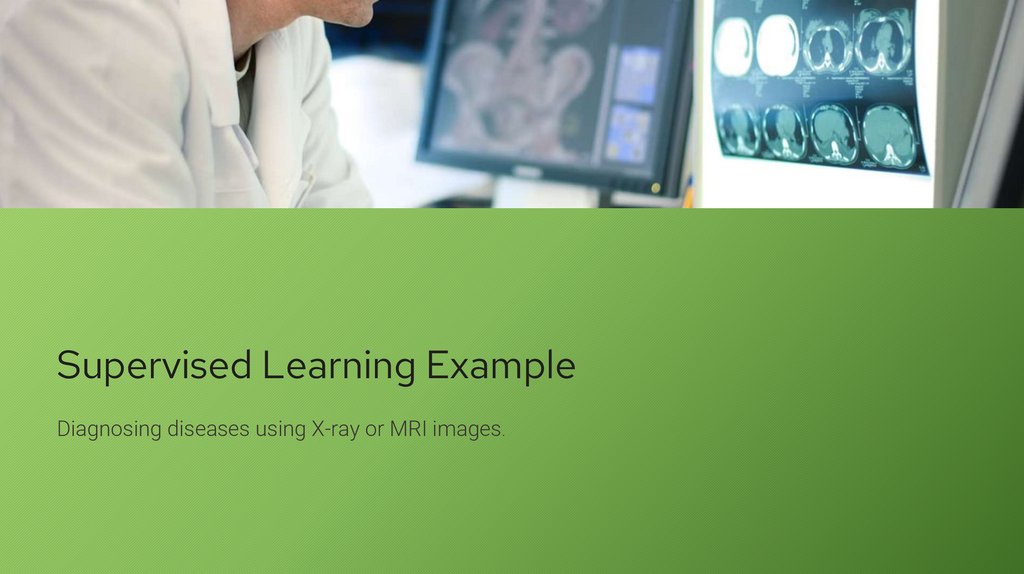
Supervised Learning ExampleDiagnosing diseases using X-ray or MRI images.
4.
Unsupervised LearningUnsupervised Learning
Training Process
A machine learning method where a model learns from
data without explicit labels or correct answers. Unlike
supervised learning, the algorithm independently seeks
structure, patterns, or hidden relationships in the data.
1. Data Preparation: Prepare data as in supervised
learning, but without pre-defined answers.
2. Model Training: Train the model on data, attempting
to find hidden structures or patterns. The algorithm
groups data based on similarities.
3. Model Evaluation: Test the model's ability to identify
structures or patterns after training.
5.
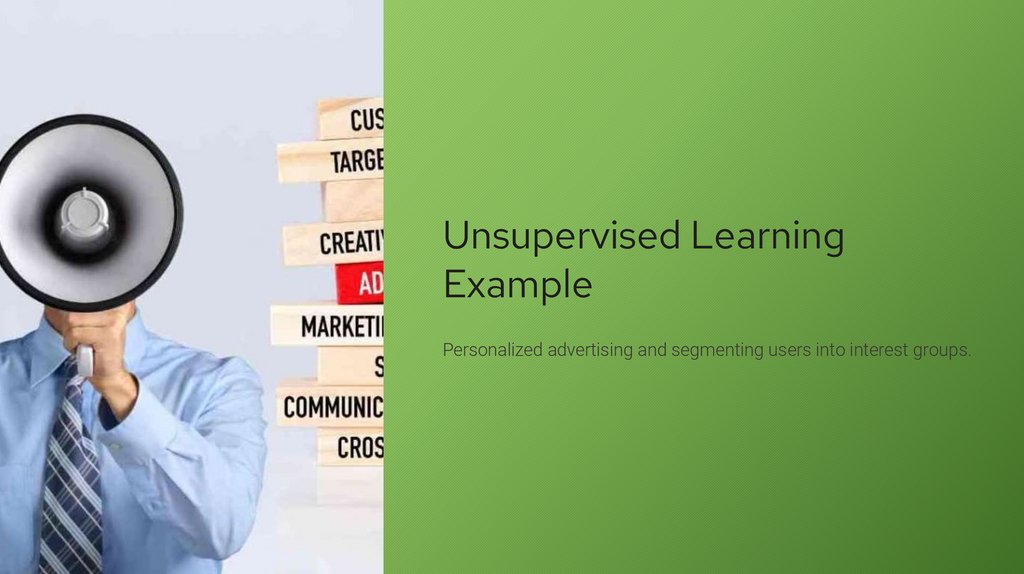
Unsupervised LearningExample
Personalized advertising and segmenting users into interest groups.
6.
Reinforcement LearningReinforcement Learning
Training Process
A machine learning method where an agent learns to make
1. Data Preparation: The model doesn't receive any data; it
decisions by interacting with an environment. Unlike
interacts with the environment. It has a set of actions
supervised and unsupervised learning, the model doesn't
and modifies its behavior based on feedback.
receive instructions. Instead, it learns based on rewards and
2. Model Training: The agent learns through trial and error.
penalties for its actions. The goal is to maximize the total
It chooses actions in each state, receives rewards, and
reward through its actions.
updates its strategy for future rewards.
3. Model Evaluation: After training, the AI is tested in the
environment to assess its ability to maximize rewards.
7.
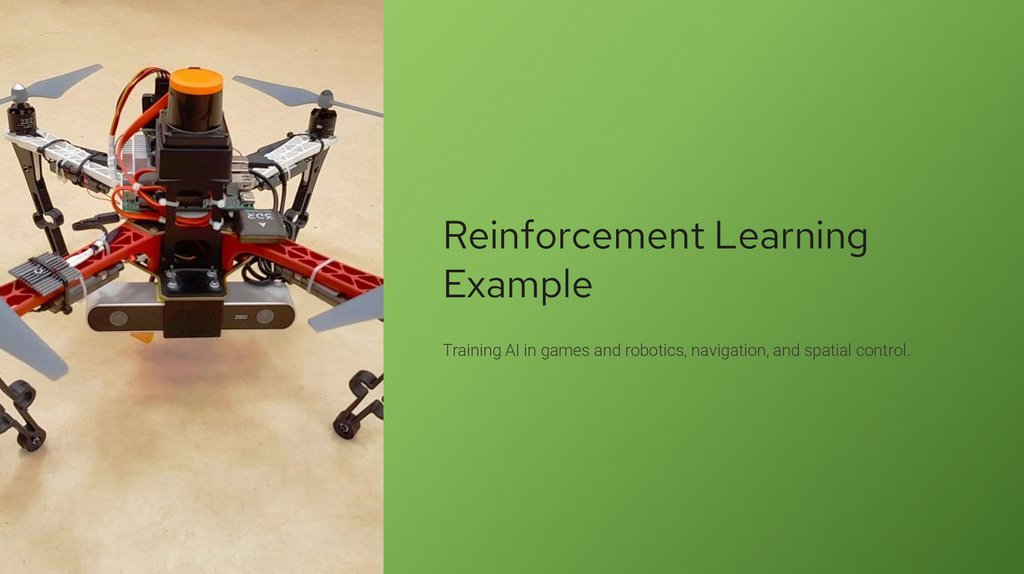
Reinforcement LearningExample
Training AI in games and robotics, navigation, and spatial control.
8.
Semi-supervised LearningSemi-supervised Learning
Training Process
A hybrid approach combining elements of supervised
and unsupervised learning. It uses both labeled and
unlabeled data.
1. Data Preparation: Some prepared data has answers,
while others don't.
2. Model Training: The model first trains on labeled
data, then on unlabeled data.
3. Model Evaluation: After training, the model is
checked for accuracy and correctness.
9.
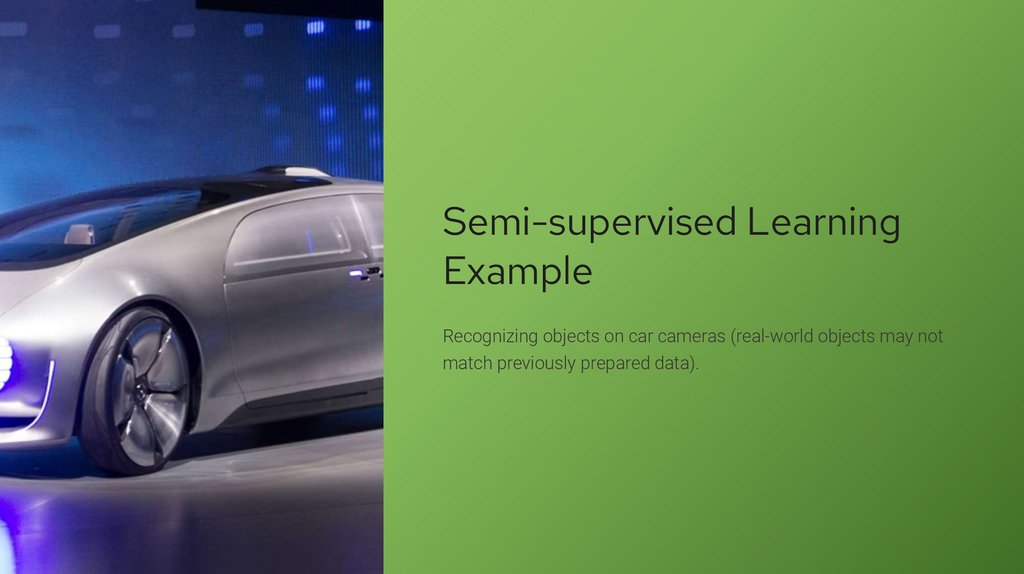
Semi-supervised LearningExample
Recognizing objects on car cameras (real-world objects may not
match previously prepared data).
10.
https://cyberleninka.ru/article/n/regression-based-on-decision-treealgorithm-1https://robots.net/fintech/what-is-machine-learning-in-datascience/
https://aiforsocialgood.ca/blog/a-comprehensive-overview-of-aitechniques-in-artificial-intelligence
https://intersog.co.il/blog/technologies/artificial-intelligence-in-anutshell-types-principles-and-history/
https://ru.wikipedia.org/wiki/%D0%9C%D0%B0%D1%88%D0%B8%D0%BD
%D0%BD%D0%BE%D0%B5_%D0%BE%D0%B1%D1%83%D1%87%D0%B5%D0%B
D%D0%B8%D0%B5#%D0%A2%D0%B8%D0%BF%D1%8B_%D0%B2%D1%85%D0
%BE%D0%B4%D0%BD%D1%8B%D1%85_%D0%B4%D0%B0%D0%BD%D0%BD%D
1%8B%D1%85_%D0%BF%D1%80%D0%B8_%D0%BE%D0%B1%D1%83%D1%87%
D0%B5%D0%BD%D0%B8%D0%B8