 english
Similar presentations:





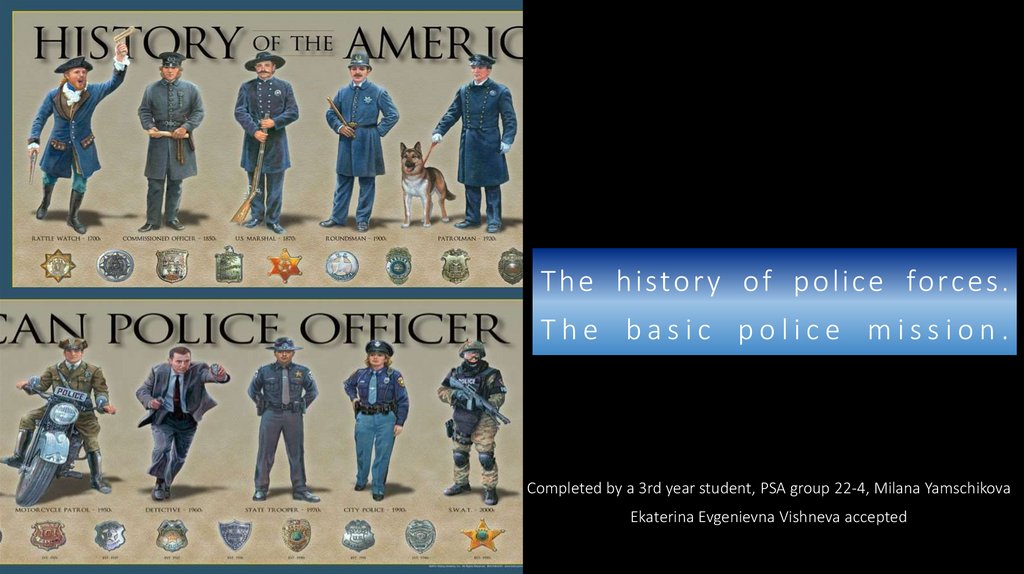
The history of police forces. The basic police mission
1.
T h e h isto r y o f p o lic e fo rc e s .The basic police mission.
Completed by a 3rd year student, PSA group 22-4, Milana Yamschikova
Ekaterina Evgenievna Vishneva accepted
2.
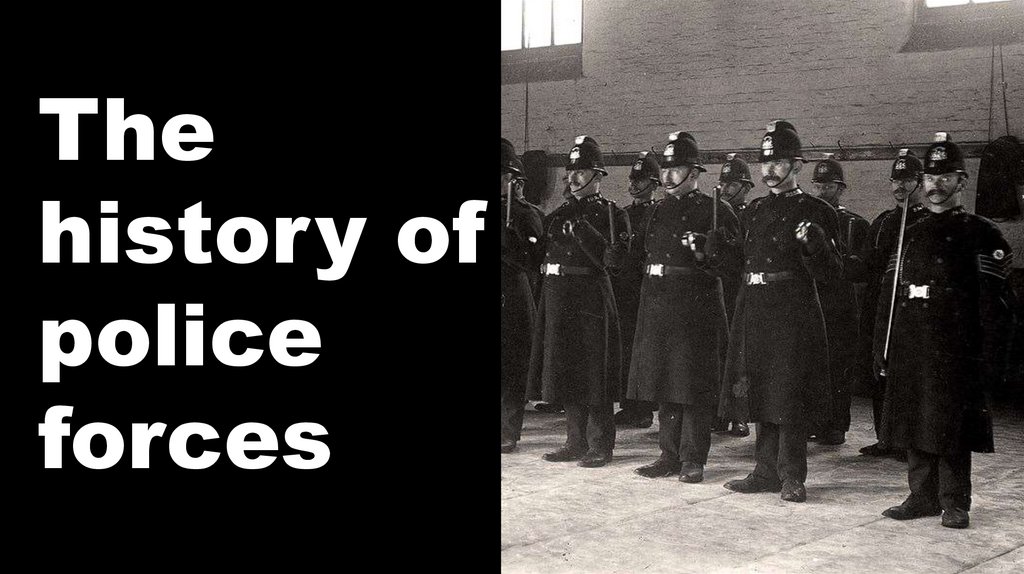
Thehistory of
police
forces
3.
Middle AgesHenry II of England made an Assize of
Arms of 1181 which created an
obligation on all freemen of England to
possess and bear arms in the service of
king and realm.
The Statute of Winchester 1285 was
the primary piece of legislation that
regulated the policing in the period after
the Norman Conquest until the
nineteenth century.
4.
Watchmen andconstables
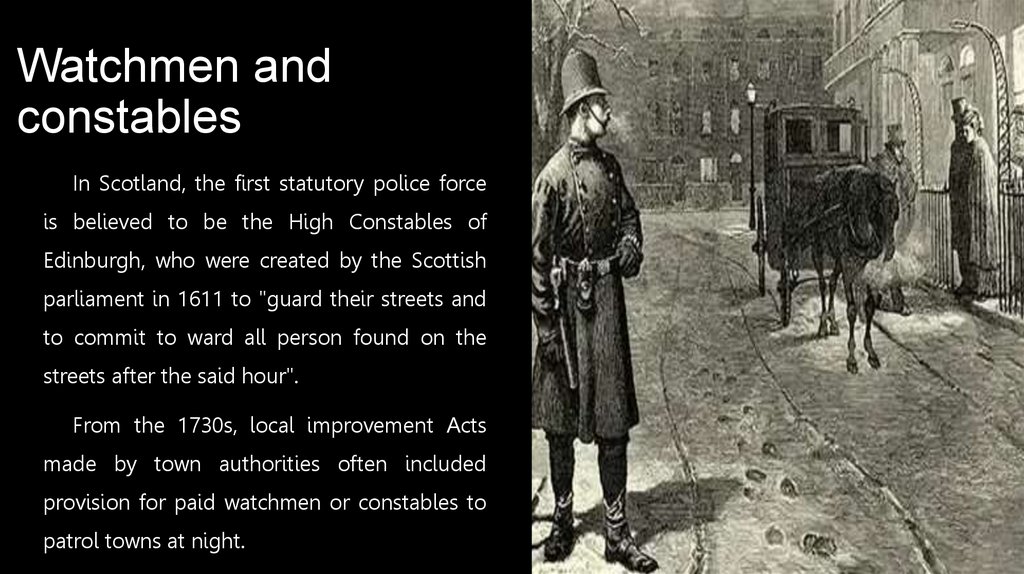
In Scotland, the first statutory police force
is believed to be the High Constables of
Edinburgh, who were created by the Scottish
parliament in 1611 to "guard their streets and
to commit to ward all person found on the
streets after the said hour".
From the 1730s, local improvement Acts
made by town authorities often included
provision for paid watchmen or constables to
patrol towns at night.
5.
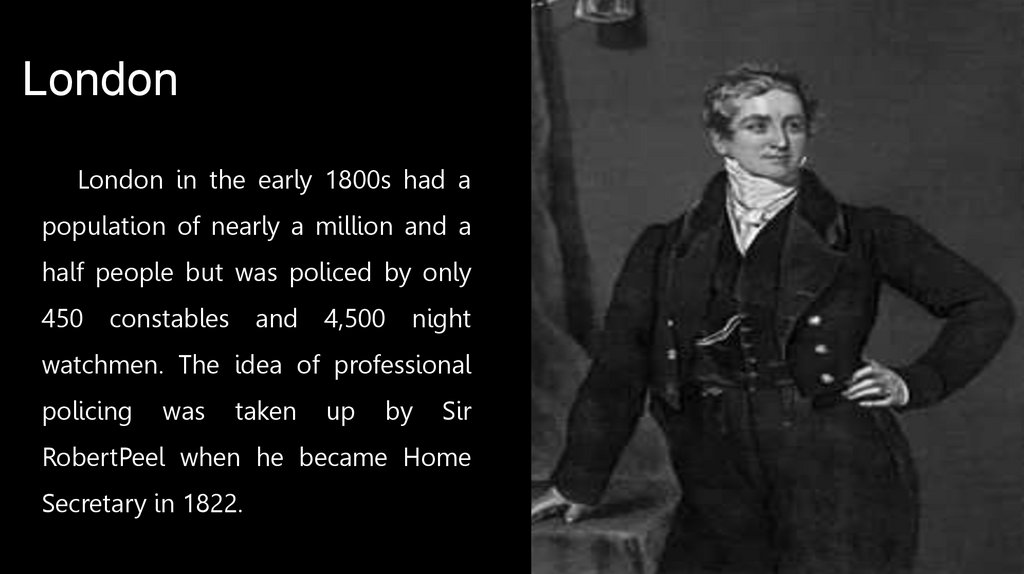
LondonLondon in the early 1800s had a
population of nearly a million and a
half people but was policed by only
450
constables
and
4,500
night
watchmen. The idea of professional
policing
was
taken
up
by
Sir
RobertPeel when he became Home
Secretary in 1822.
6.
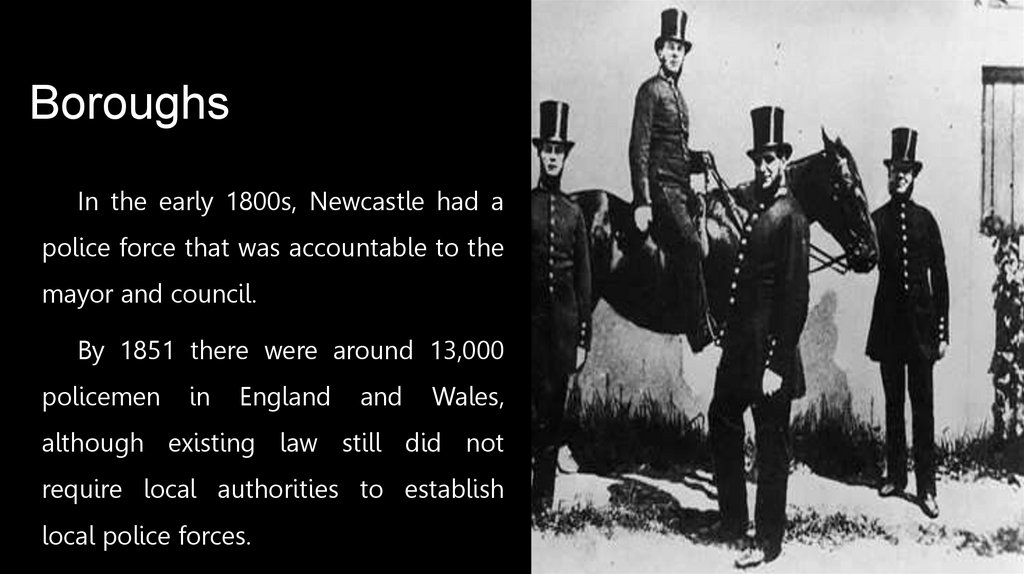
BoroughsIn the early 1800s, Newcastle had a
police force that was accountable to the
mayor and council.
By 1851 there were around 13,000
policemen
in
England
and
Wales,
although existing law still did not
require local authorities to establish
local police forces.
7.
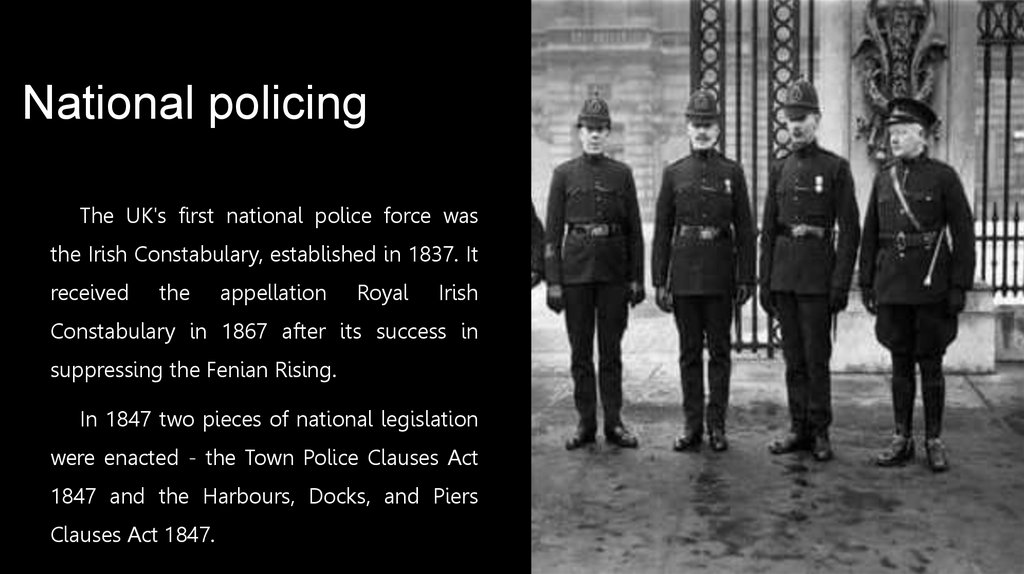
National policingThe UK's first national police force was
the Irish Constabulary, established in 1837. It
received
the
appellation
Royal
Irish
Constabulary in 1867 after its success in
suppressing the Fenian Rising.
In 1847 two pieces of national legislation
were enacted - the Town Police Clauses Act
1847 and the Harbours, Docks, and Piers
Clauses Act 1847.
8.
Modern policingChief
Popkess
Constable
is
credited
Captain
with
Athelstan
being
largely
responsible for transforming the British Police
Service from its Victorian era 'beat policing'
model to the modern reactive response
model, through his development of the
'Mechanized Division'.
'Q Cars' or 'Q Cruisers', unmarked vehicles
disguised as civilian cars or delivery vans for
covert patrol.
9.
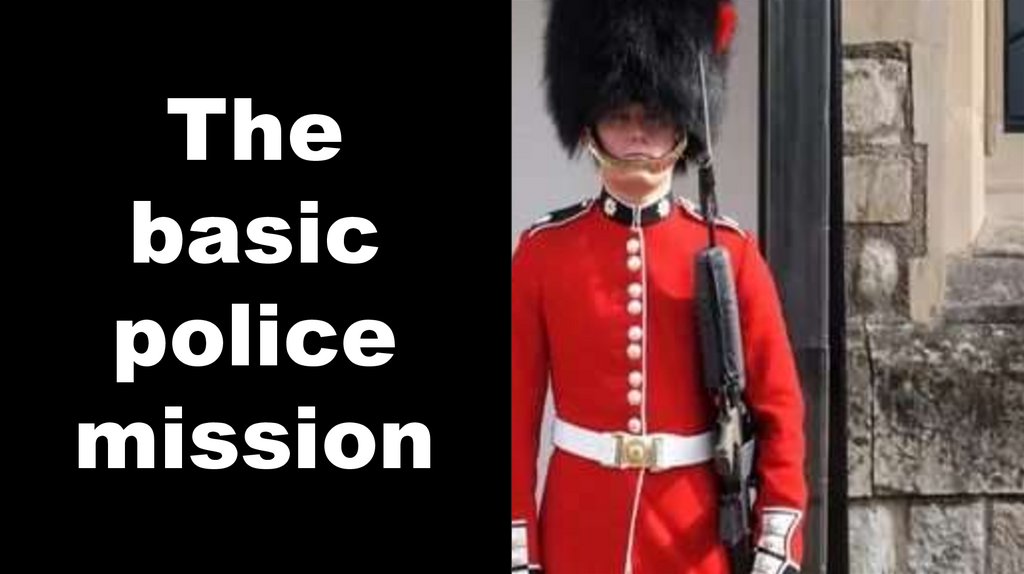
Thebasic
police
mission
10.
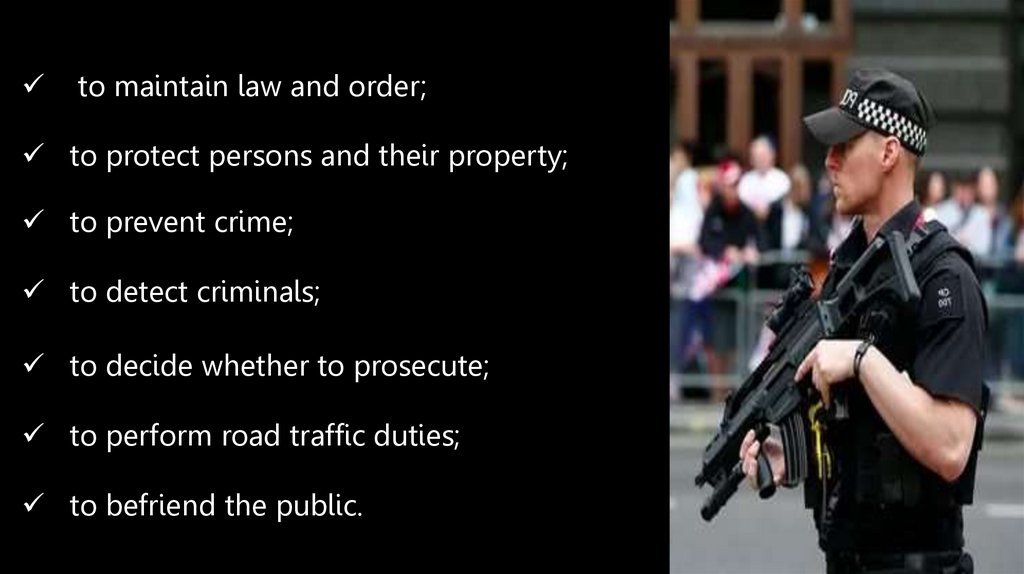
to maintain law and order;to protect persons and their property;
to prevent crime;
to detect criminals;
to decide whether to prosecute;
to perform road traffic duties;
to befriend the public.
11.
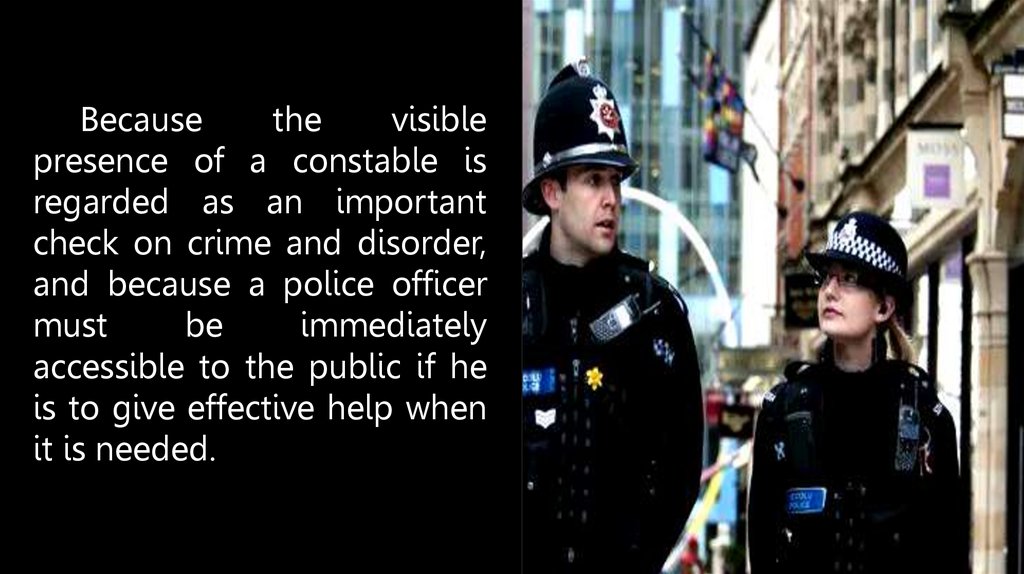
Becausethe
visible
presence of a constable is
regarded as an important
check on crime and disorder,
and because a police officer
must
be
immediately
accessible to the public if he
is to give effective help when
it is needed.
12.
Thanks for yourattention!