


 education
Similar presentations:





Higher education levels and the system of university degrees in Russia and European countries
1.
Higher education levels and thesystem of university degrees in
Russia and European countries: a
comparative analysis
Pushkarev.N.A Yacyuk.S.
Information Technologies In Business Faculty Siberian
Transport University
Supervisors : Cand. Sc. (Ped.),Volegzhanna I.S.
2.
Contents• Structure
• Duration of study
• Entry Requirements
• Scientific work
3.
Relevance of study• The study will help international students better
understand the similarities and differences
between the education systems for Russia and
European countries.
• The modern labor market requires graduates of
higher educational institutions not only to have
theoretical knowledge, but also practical skills.
• A comparative analysis of higher education levels
and university degree systems in Russia and
European countries will reveal key differences and
similarities.
4.
• GoalCompare education systems and help international
students easily integrate and become a Russian student
Tasks
1) To make a comparative analysis of the education systems of Russia
and European countries
2) To determine the influence of cultural, economic, and sociopolitical factors on the development of higher education
3) To formulate recommendations for improving and modernizing the
Russian higher education system in order to create more
convenient conditions for international students
• Methods of study
theoretical: comparative analysis, synthesis
5.
Higher education in Russia6.
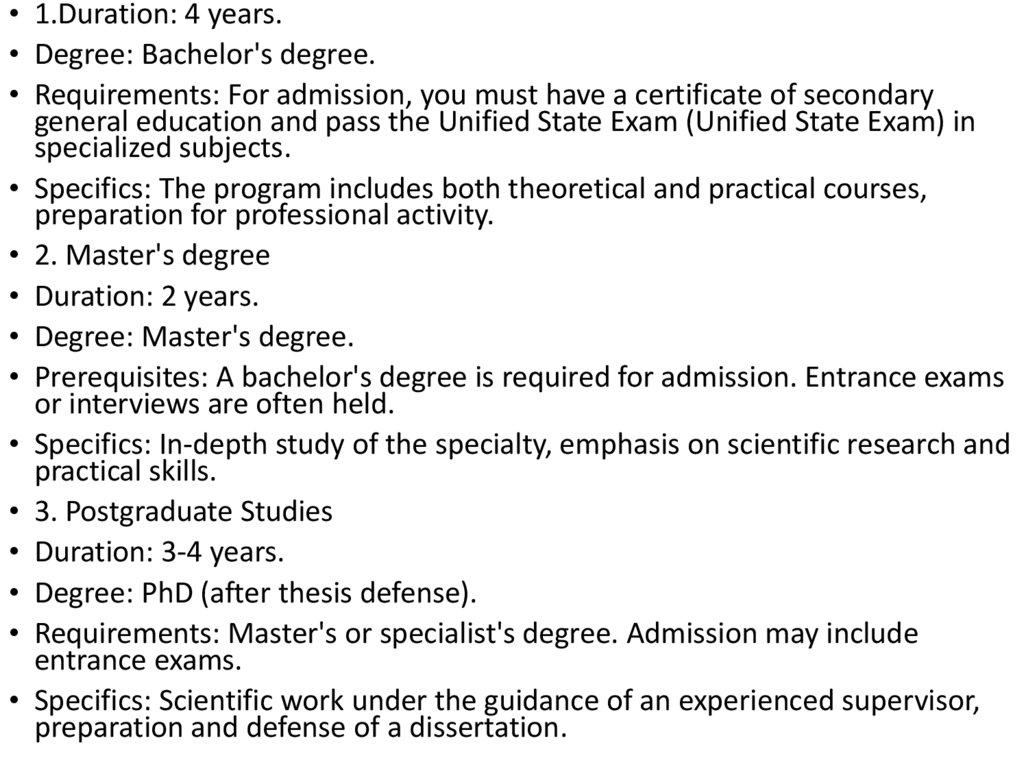
• 1.Duration: 4 years.• Degree: Bachelor's degree.
• Requirements: For admission, you must have a certificate of secondary
general education and pass the Unified State Exam (Unified State Exam) in
specialized subjects.
• Specifics: The program includes both theoretical and practical courses,
preparation for professional activity.
• 2. Master's degree
• Duration: 2 years.
• Degree: Master's degree.
• Prerequisites: A bachelor's degree is required for admission. Entrance exams
or interviews are often held.
• Specifics: In-depth study of the specialty, emphasis on scientific research and
practical skills.
• 3. Postgraduate Studies
• Duration: 3-4 years.
• Degree: PhD (after thesis defense).
• Requirements: Master's or specialist's degree. Admission may include
entrance exams.
• Specifics: Scientific work under the guidance of an experienced supervisor,
preparation and defense of a dissertation.
7.
Higher education in Germany8.
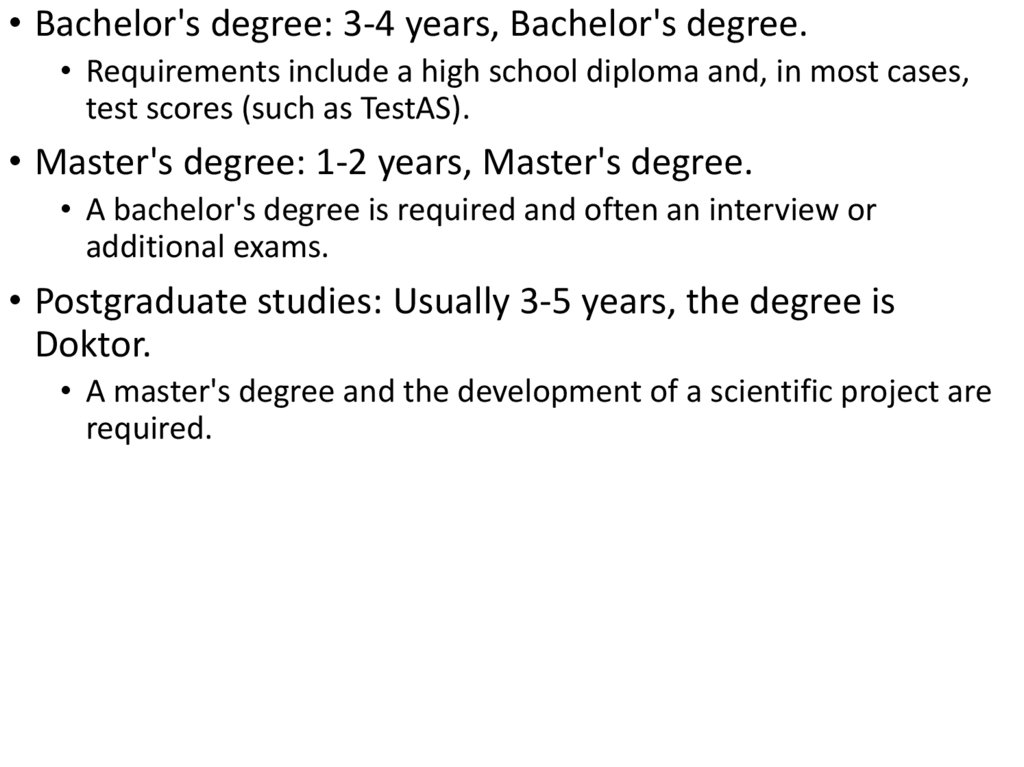
• Bachelor's degree: 3-4 years, Bachelor's degree.• Requirements include a high school diploma and, in most cases,
test scores (such as TestAS).
• Master's degree: 1-2 years, Master's degree.
• A bachelor's degree is required and often an interview or
additional exams.
• Postgraduate studies: Usually 3-5 years, the degree is
Doktor.
• A master's degree and the development of a scientific project are
required.
9.
Higher education in France10.
• Bachelor's degree: 3 years, Licence degree.• A high school diploma (Baccalauréat) is required.
• Master's degree: 2 years, Master's degree.
• Admission based on a Licence diploma and interviews.
• Postgraduate studies: 3-5 years, Doctorate degree.
• A master's degree and thesis writing are required.
11.
Comparative analysis12.
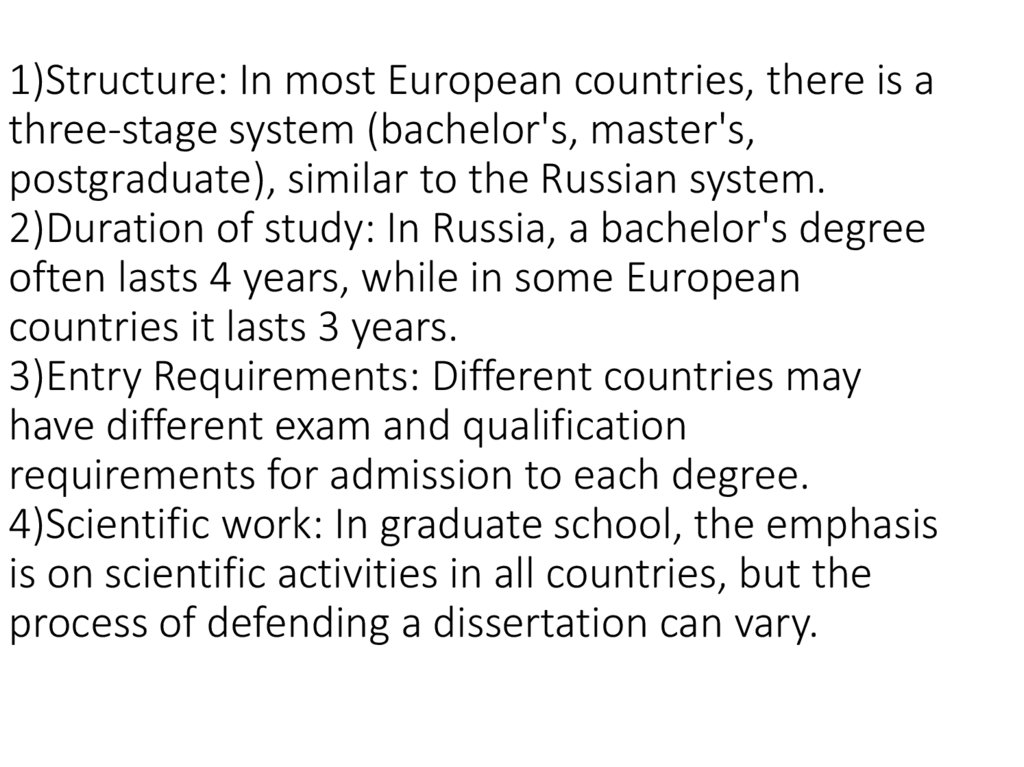
1)Structure: In most European countries, there is athree-stage system (bachelor's, master's,
postgraduate), similar to the Russian system.
2)Duration of study: In Russia, a bachelor's degree
often lasts 4 years, while in some European
countries it lasts 3 years.
3)Entry Requirements: Different countries may
have different exam and qualification
requirements for admission to each degree.
4)Scientific work: In graduate school, the emphasis
is on scientific activities in all countries, but the
process of defending a dissertation can vary.
13.
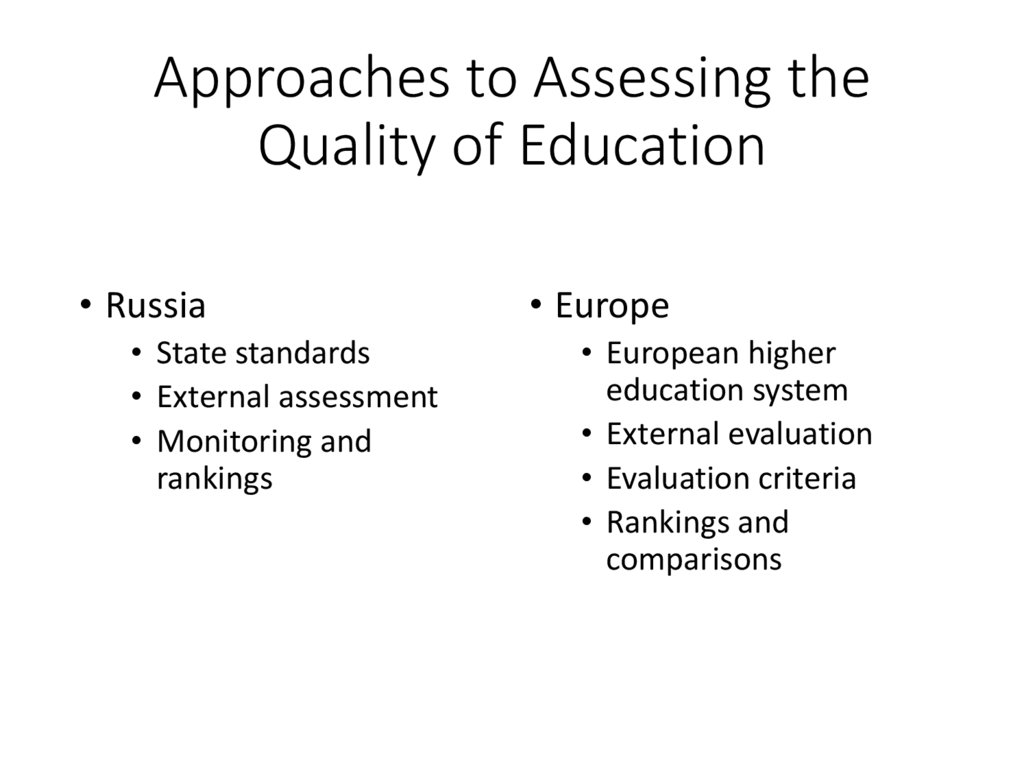
Approaches to Assessing theQuality of Education
• Russia
• State standards
• External assessment
• Monitoring and
rankings
• Europe
• European higher
education system
• External evaluation
• Evaluation criteria
• Rankings and
comparisons
14.
Other comparisonpurposes
1) Cultural factors
2) Economic factors
3) Socio-political factors
15.
Expert Interview16.
Conclusion• There are many differences in our education
systems. Every country approaches the issue of
education differently.
• It will be difficult for an international student to
get used to some of the differences, but it is quite
easy if you are prepared for them.
17.
References• Frauscher Sensor Technology [Electronic resource] //
https://www.frauscher.us (accessed: 25.03.2019)
• Russia’s digital railway begins to take shape / Sue Morant
• // International Railway Journal (c). – 2017 // [Electronic resource] //
https://www.railjournal.com(accessed: 01.04.2019)
• Frauscher Ultimate Rail – 2018 // [Electronic resource] //
https://www.frauscher.us/assets/USA/customer_magazine/Frauscher_Ult
imate_Rail_2018_02.pdf (accessed: 20.03.2019)
• Uchebno-obrazovatel'nyy portal "Vselektsii" [in Russian] // http://vselekcii.ru(accessed: 28.03.2019)
• Frauscher Sensornaya Tekhnologiya [in Russian] //
https://www.frauscher.com/ru/home/ (accessed: 28.03.2019)
• OAO "RZhD" [in Russian] // http://www.rzd.ru (accessed: 28.03.2019)
• Development of digital technologies for Russian Railways [Electronic
resource] // https://www.globalrailwayreview.com/article/70358/digitaltechnologies-russian-railways/ (accessed: 25.03.2019)
18.
Thank you for your attention19.
Higher education levels and thesystem of university degrees in
Russia and European countries: a
comparative analysis
Pushkarev.N.A Yacyuk.S.
Information Technologies In Business Faculty Siberian
Transport University
Supervisors : Cand. Sc. (Ped.),Volegzhanna I.S.