 culturology
Similar presentations:










Religious cults
1. Religious cults
International IT UniversityRELIGIOUS CULTS
Done by:Koyshegul N.
Group:IS1803K
Almaty 2020
2.
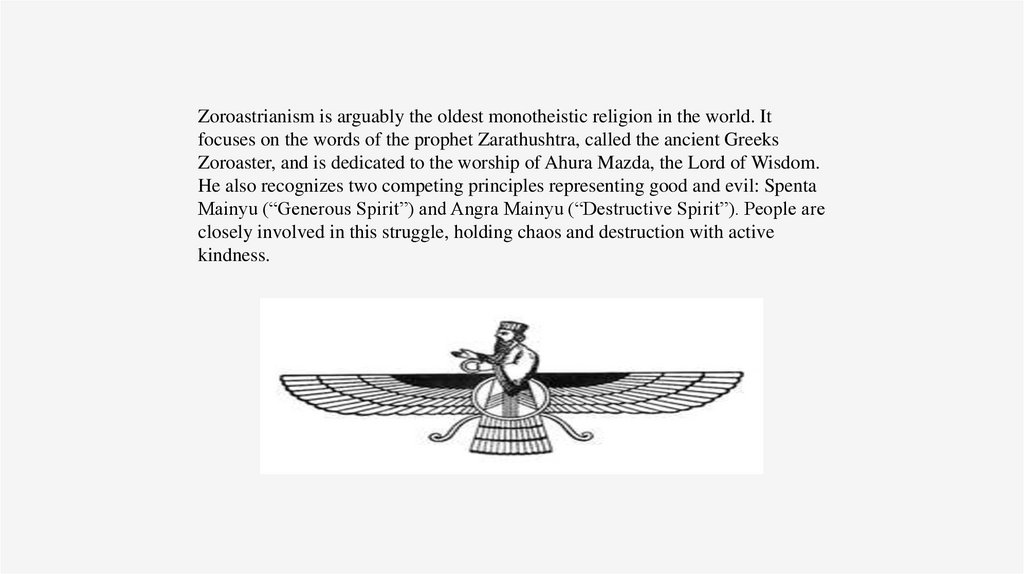
Zoroastrianism is arguably the oldest monotheistic religion in the world. Itfocuses on the words of the prophet Zarathushtra, called the ancient Greeks
Zoroaster, and is dedicated to the worship of Ahura Mazda, the Lord of Wisdom.
He also recognizes two competing principles representing good and evil: Spenta
Mainyu (“Generous Spirit”) and Angra Mainyu (“Destructive Spirit”). People are
closely involved in this struggle, holding chaos and destruction with active
kindness.
3.
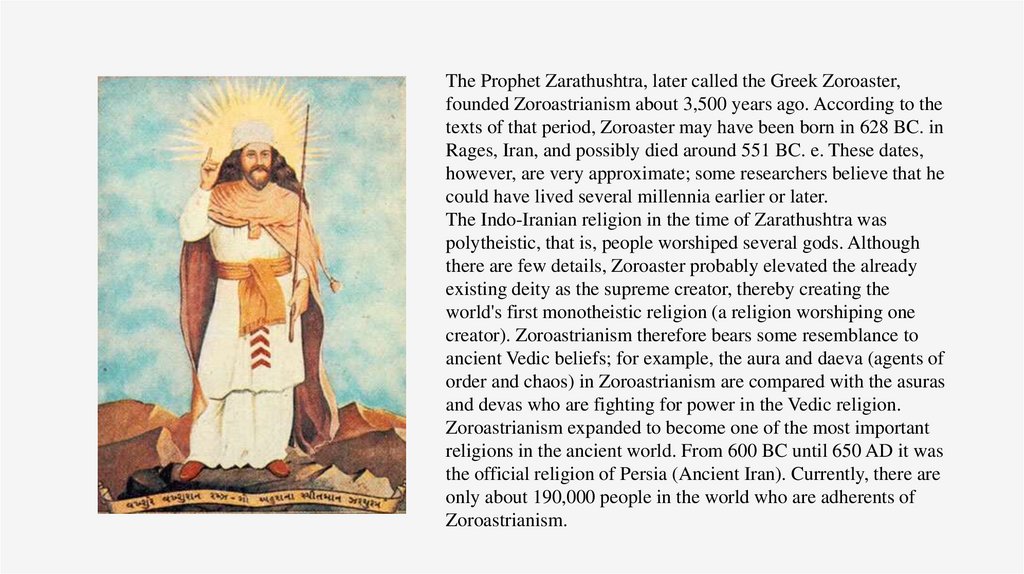
The Prophet Zarathushtra, later called the Greek Zoroaster,founded Zoroastrianism about 3,500 years ago. According to the
texts of that period, Zoroaster may have been born in 628 BC. in
Rages, Iran, and possibly died around 551 BC. e. These dates,
however, are very approximate; some researchers believe that he
could have lived several millennia earlier or later.
The Indo-Iranian religion in the time of Zarathushtra was
polytheistic, that is, people worshiped several gods. Although
there are few details, Zoroaster probably elevated the already
existing deity as the supreme creator, thereby creating the
world's first monotheistic religion (a religion worshiping one
creator). Zoroastrianism therefore bears some resemblance to
ancient Vedic beliefs; for example, the aura and daeva (agents of
order and chaos) in Zoroastrianism are compared with the asuras
and devas who are fighting for power in the Vedic religion.
Zoroastrianism expanded to become one of the most important
religions in the ancient world. From 600 BC until 650 AD it was
the official religion of Persia (Ancient Iran). Currently, there are
only about 190,000 people in the world who are adherents of
Zoroastrianism.
4.
Main customsAlong with the existing Zoroastrian temples in which believers worship all together, some services were held at home. Worship
is centered on core ethical values: Good Words, Good Thoughts, and Good Deeds.
Many Zoroastrians prayed several times a day, always referring to a source of fire or light. Until now, some have tied a cord
called kushi. Kusti is tied three times to symbolize three Zoroastrian meanings.
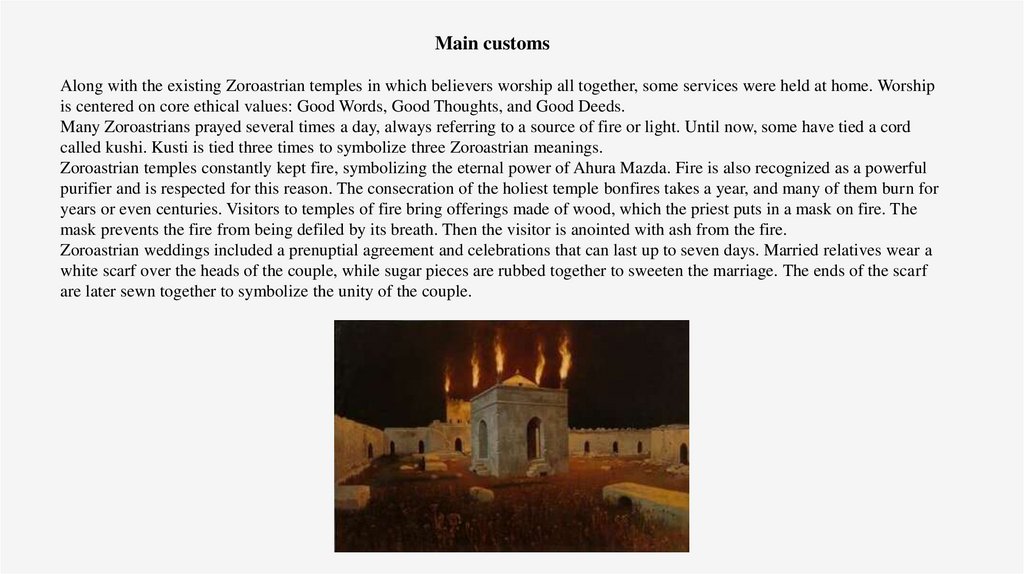
Zoroastrian temples constantly kept fire, symbolizing the eternal power of Ahura Mazda. Fire is also recognized as a powerful
purifier and is respected for this reason. The consecration of the holiest temple bonfires takes a year, and many of them burn for
years or even centuries. Visitors to temples of fire bring offerings made of wood, which the priest puts in a mask on fire. The
mask prevents the fire from being defiled by its breath. Then the visitor is anointed with ash from the fire.
Zoroastrian weddings included a prenuptial agreement and celebrations that can last up to seven days. Married relatives wear a
white scarf over the heads of the couple, while sugar pieces are rubbed together to sweeten the marriage. The ends of the scarf
are later sewn together to symbolize the unity of the couple.
5.
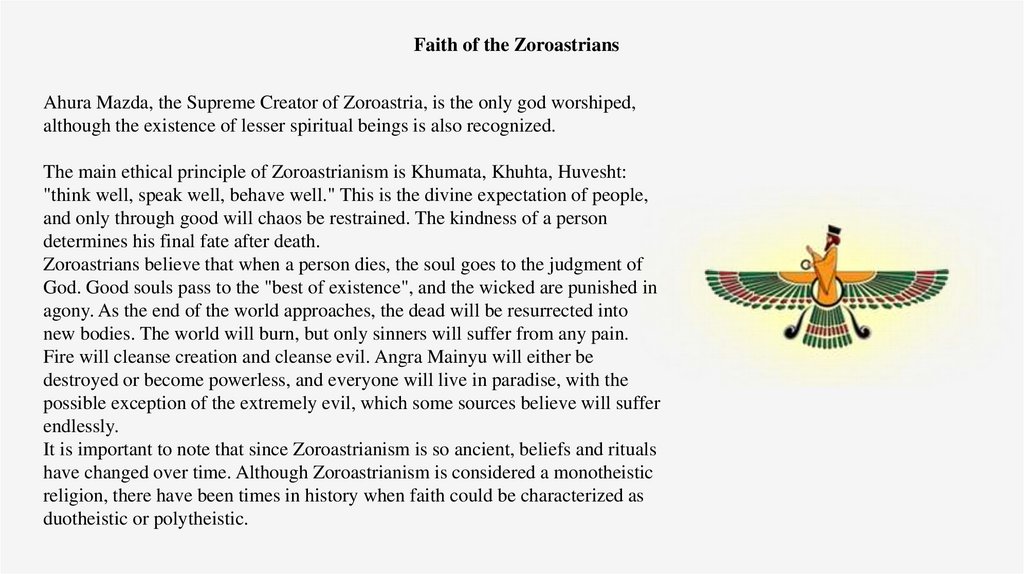
Faith of the ZoroastriansAhura Mazda, the Supreme Creator of Zoroastria, is the only god worshiped,
although the existence of lesser spiritual beings is also recognized.
The main ethical principle of Zoroastrianism is Khumata, Khuhta, Huvesht:
"think well, speak well, behave well." This is the divine expectation of people,
and only through good will chaos be restrained. The kindness of a person
determines his final fate after death.
Zoroastrians believe that when a person dies, the soul goes to the judgment of
God. Good souls pass to the "best of existence", and the wicked are punished in
agony. As the end of the world approaches, the dead will be resurrected into
new bodies. The world will burn, but only sinners will suffer from any pain.
Fire will cleanse creation and cleanse evil. Angra Mainyu will either be
destroyed or become powerless, and everyone will live in paradise, with the
possible exception of the extremely evil, which some sources believe will suffer
endlessly.
It is important to note that since Zoroastrianism is so ancient, beliefs and rituals
have changed over time. Although Zoroastrianism is considered a monotheistic
religion, there have been times in history when faith could be characterized as
duotheistic or polytheistic.
6.
Religious writings of ZoroastrianismThe sacred texts of Zorastrianism are called the Avesta. It is believed that the original Avesta was largely
destroyed when Alexander the Great attacked Persia. The remaining texts were compiled and compiled between
the 3rd and 7th centuries A.D. Avesta contains several sections.
The Yasna and Visperad sections include hymns, songs, and prayers used during worship.
Vendidad describes evil spirits and their various manifestations and explains how to deal with them.
The yachts include 21 hymns of praise.
Syroza invokes 30 deities who rule on different days of the Zoroastrian months.
Nyaeshes and Gahs include prayers to the Sun and Mithra, the Moon, Water and Fire.
Afrinagans is a blessing to read at various seasonal holidays and holidays in honor of the dead.