 english
Similar presentations:



Eponyms in english
1.
Your Name Sounds Familiar:A collection of eponyms.
Volume #1,
“Bad Habits”.
2.
VOCABULARY: EPONYMSWords in all languages have various origins.
Perhaps one of the most exciting ways for a
lexical unit to come into existence is being
named after a person. (But hey, we didn’t
ask words if it’s true.) Such words are
called “eponyms”. Here are some.
3.
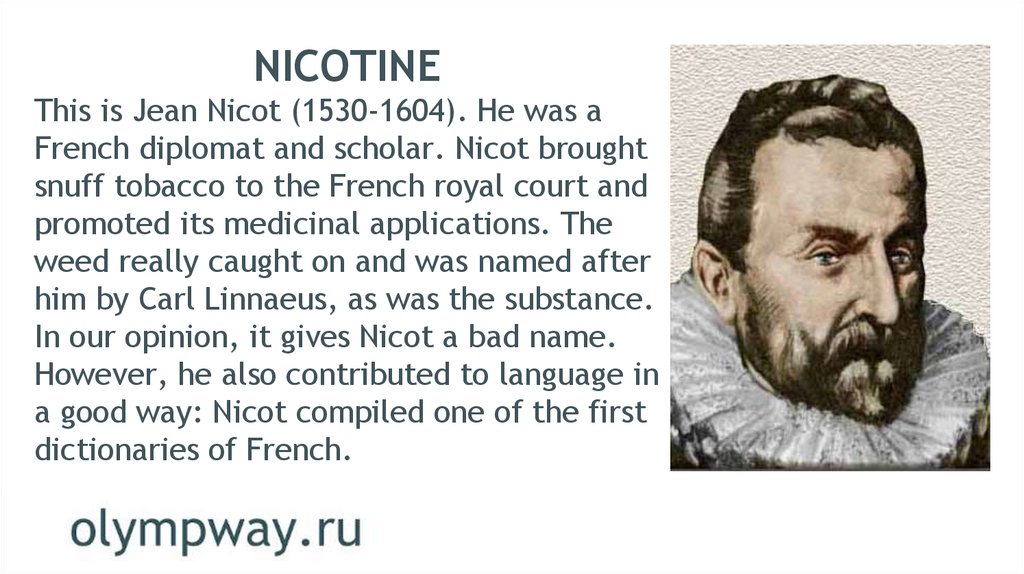
NICOTINEThis is Jean Nicot (1530-1604). He was a
French diplomat and scholar. Nicot brought
snuff tobacco to the French royal court and
promoted its medicinal applications. The
weed really caught on and was named after
him by Carl Linnaeus, as was the substance.
In our opinion, it gives Nicot a bad name.
However, he also contributed to language in
a good way: Nicot compiled one of the first
dictionaries of French.
4.
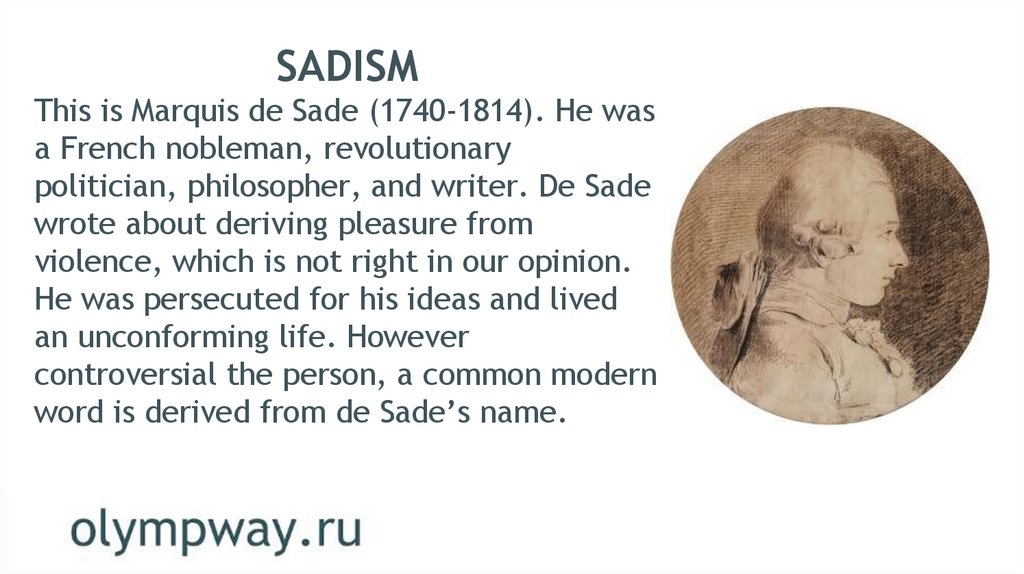
SADISMThis is Marquis de Sade (1740-1814). He was
a French nobleman, revolutionary
politician, philosopher, and writer. De Sade
wrote about deriving pleasure from
violence, which is not right in our opinion.
He was persecuted for his ideas and lived
an unconforming life. However
controversial the person, a common modern
word is derived from de Sade’s name.
5.
BOYCOTTThis is Charles C. Boycott (1832-1897). He
was an English and Irish land agent. During
the Irish Land War Boycott demanded some
payments and threatened to evict several
tenants, who were unable to pay due to the
poor harvest. In 1880 Boycott was
deliberately shun and refused any services.
He had to leave Ireland. The protesters
made a point and cost the government a lot
of pounds. (The war wasn’t over with that.)
6.
CASANOVAThis is Giacomo Casanova (1725-1798). He
was an was an Italian adventurer and author
from the Republic of Venice. Casanova
reflects the customs and norms of the era
and is associated with royalty and
luminaries like Jean-Jacques Rousseau. He
became so famous for his often complicated
and elaborate affairs with women that his
name is now synonymous with "womanizer".