Similar presentations:






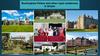


Palace and Park Ensemble "Tsarina
1.
Palace and ParkEnsemble "Tsarina
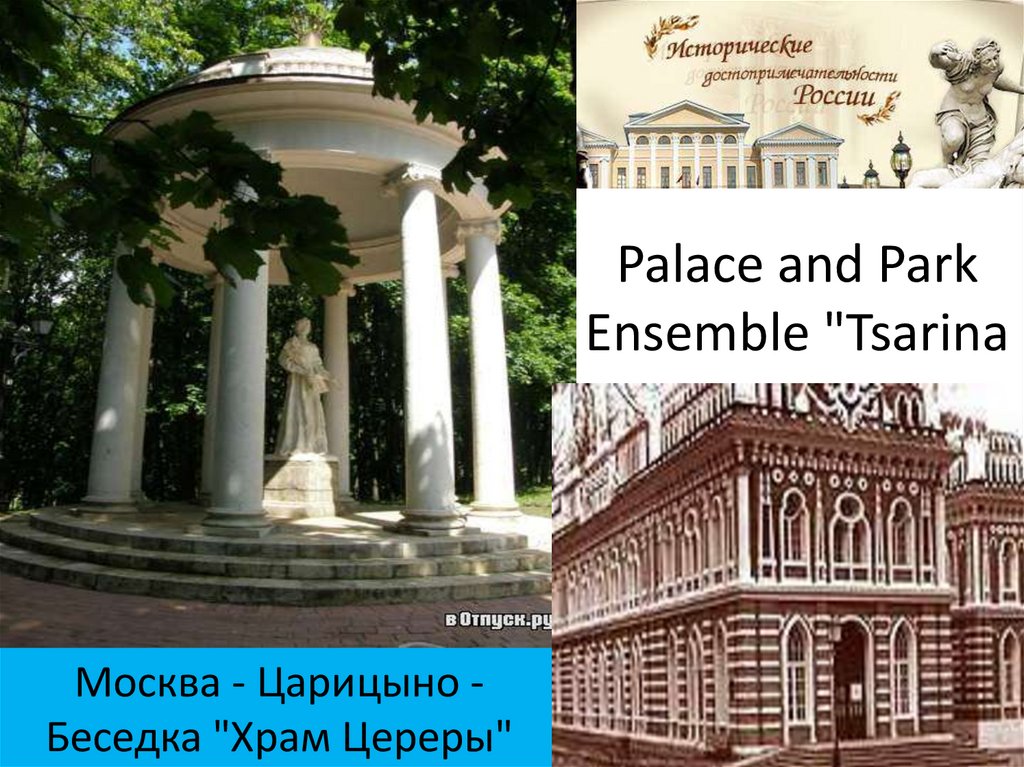
Москва - Царицыно Беседка "Храм Цереры"
2.
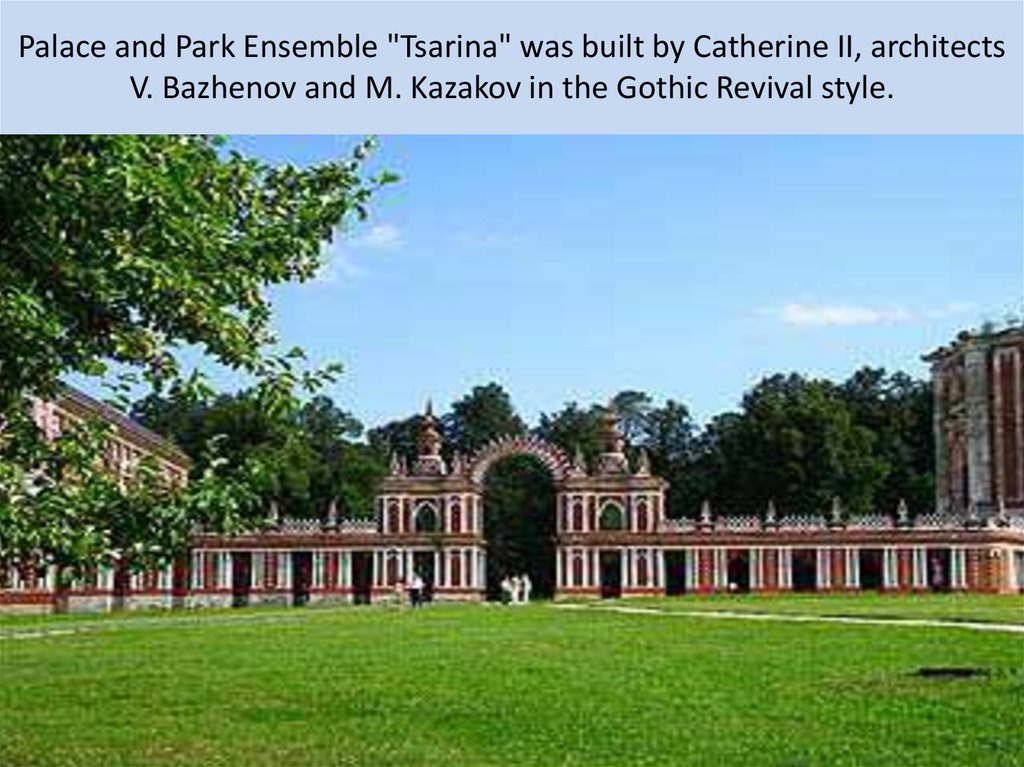
Palace and Park Ensemble "Tsarina" was built by Catherine II, architectsV. Bazhenov and M. Kazakov in the Gothic Revival style.
3.
History and OwnersThe area was first mentioned as part of the palace estate
Kolomenskoye. In the 1590s the land from Kolomna to the mouth of the Godunov family owned
Pakhra. At that time belonged to the black dirt sister of Boris Godunov queen Irina Fedorovna.
From 1633 to mid 1680's mansion owned Streshneva. Then in 1680, e Golitsyn. Further, court
administration. At 1711g barony granted to D. Cantemir. After the death of D. Cantemir went to
his son Alexander Cantemir. In 1775, Black Dirt was bought by Catherine II, who decided to
arrange this royal residence near Moscow. Barton was given a new name - the Tsarina. In the
XIX century in the possession of Specific department.
4.
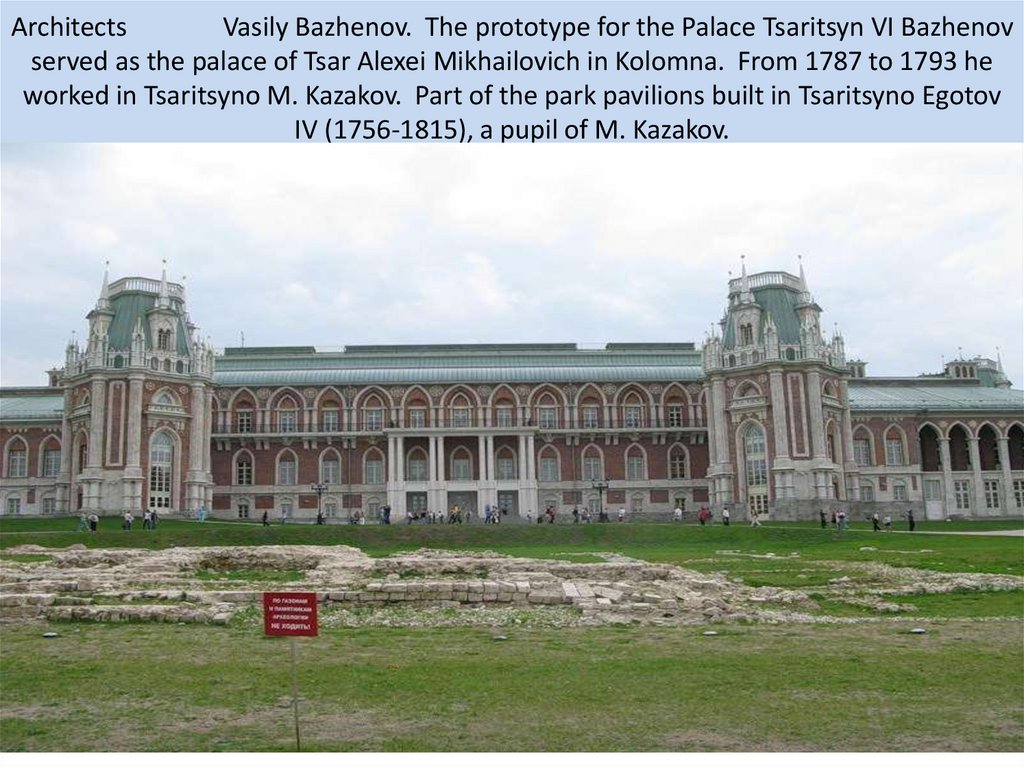
ArchitectsVasily Bazhenov. The prototype for the Palace Tsaritsyn VI Bazhenov
served as the palace of Tsar Alexei Mikhailovich in Kolomna. From 1787 to 1793 he
worked in Tsaritsyno M. Kazakov. Part of the park pavilions built in Tsaritsyno Egotov
IV (1756-1815), a pupil of M. Kazakov.
5.
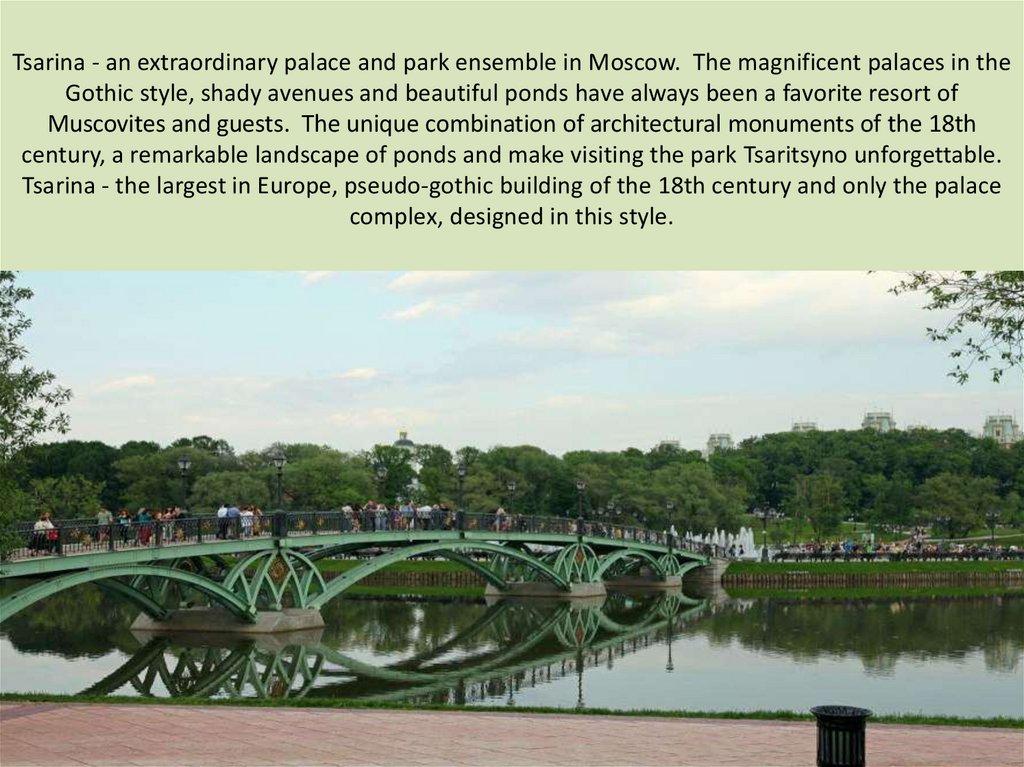
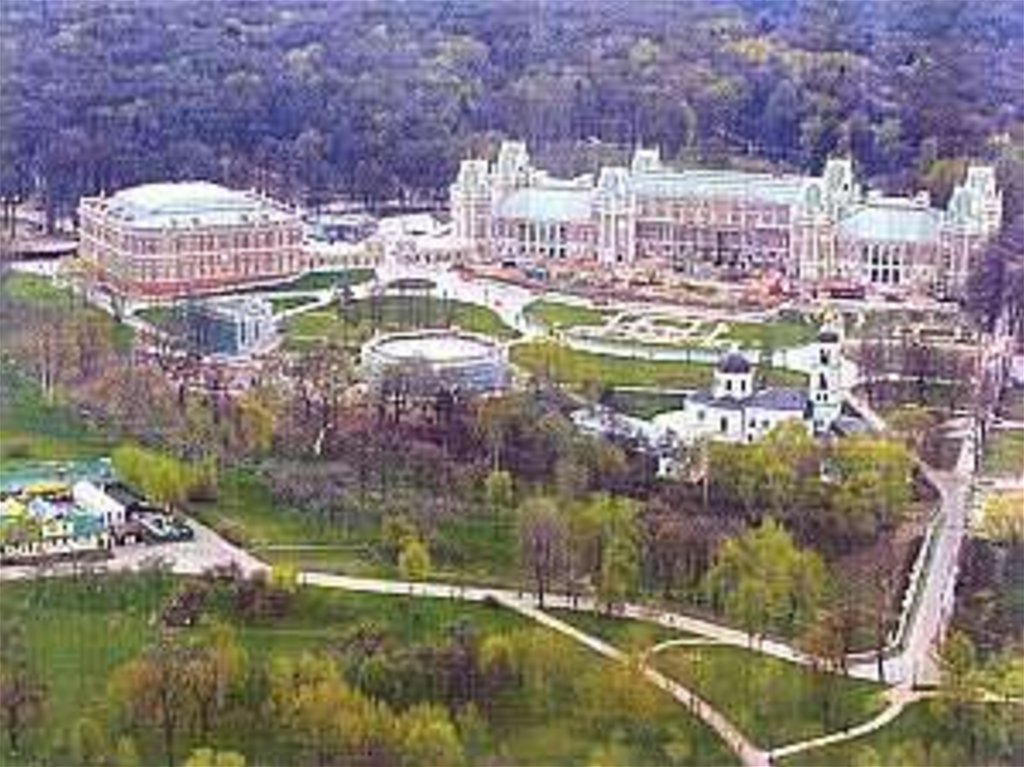
Tsarina - an extraordinary palace and park ensemble in Moscow. The magnificent palaces in theGothic style, shady avenues and beautiful ponds have always been a favorite resort of
Muscovites and guests. The unique combination of architectural monuments of the 18th
century, a remarkable landscape of ponds and make visiting the park Tsaritsyno unforgettable.
Tsarina - the largest in Europe, pseudo-gothic building of the 18th century and only the palace
complex, designed in this style.
6.
Cascade ponds 8 km long, without which it is now impossible to provide Tsarina, wascreated more by Boris Godunov. Earth in the upper reaches this stage belonged to the
queen Irina Godunov. Later, Heath "The black mud," owned by the family of boyars
Streshneva, Heath moved from their Prince Vasili and Aleksei Golitsyn, the allies of the
princess Sophia. After the Prut campaign of the year 1712 and the deposition of
Sophia, the property was confiscated by the princes. Black dirt was donated by Peter I
the Moldavian Prince Dmitry Kantemir, an ally of Russia.
7.
In 1775, theyear the splendor of black mud was noted by Catherine II, the area was
purchased by his son Dmitri Cantemir - Sergei Dmitrievich, and here the construction
of an architectural ensemble Caricino, under the leadership of one of the famous
Russian architect Vasily Bazhenov.
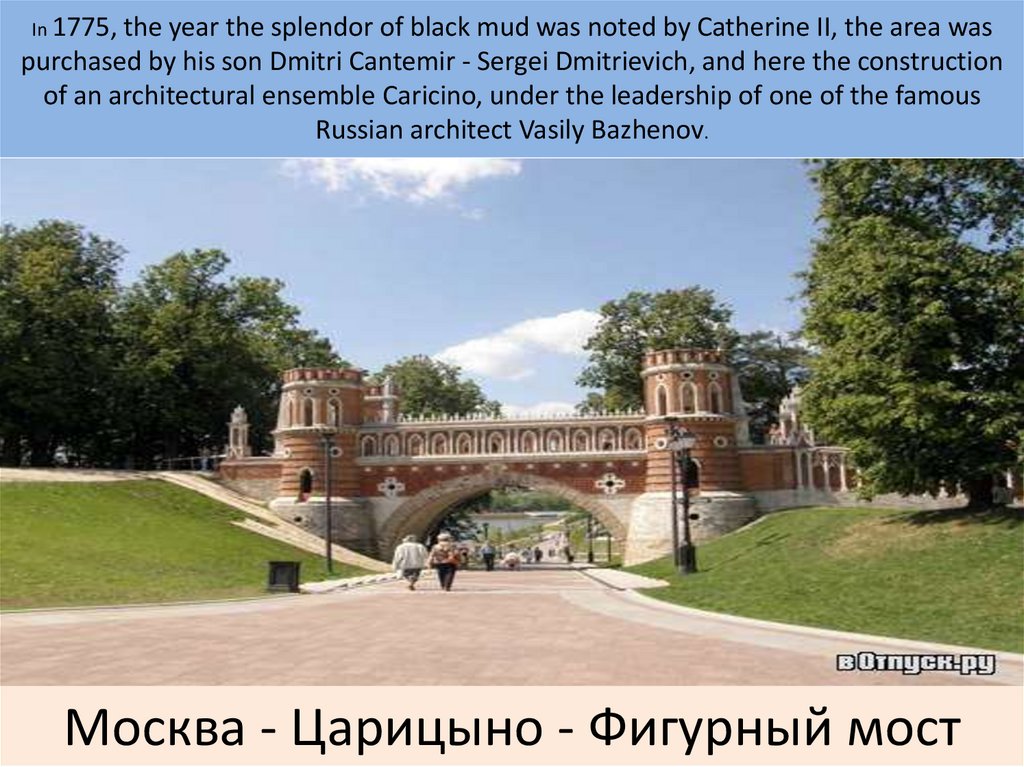
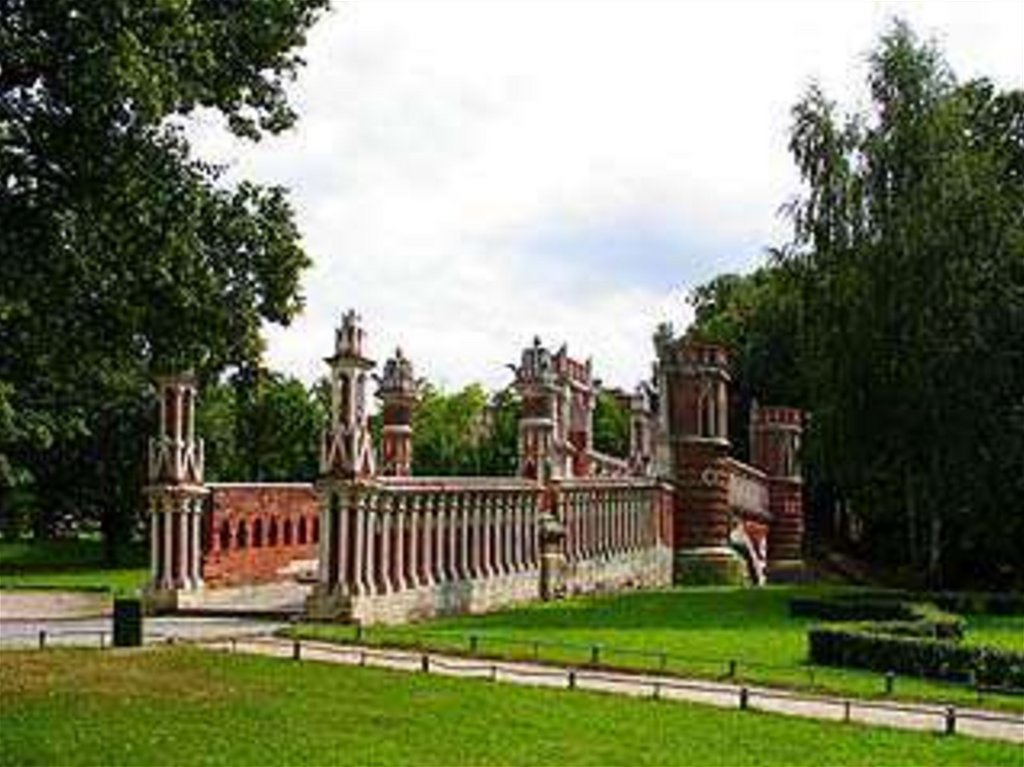
Москва - Царицыно - Фигурный мост
8.
in the spring of 1785,when the creation of park landscapes and most of the facilities is nearing completion,
Tsaritsyno visited Catherine II. After inspecting the palaces she ordered to destroy buildings Bazhenov, and
then completely remove him from office. According to one version, she did not like the narrow stairs and
heavy arches. On the other hand, this was caused by the proximity to the heir to Paul Bazhenov and their
relationship both with Freemasonry. Interestingly, when the creation of the park Tsaritsyno great Russian
architect VI Bazhenov helped specially ordered from overseas growers F. Reed and I. SANS. The result of
their collaboration was great.
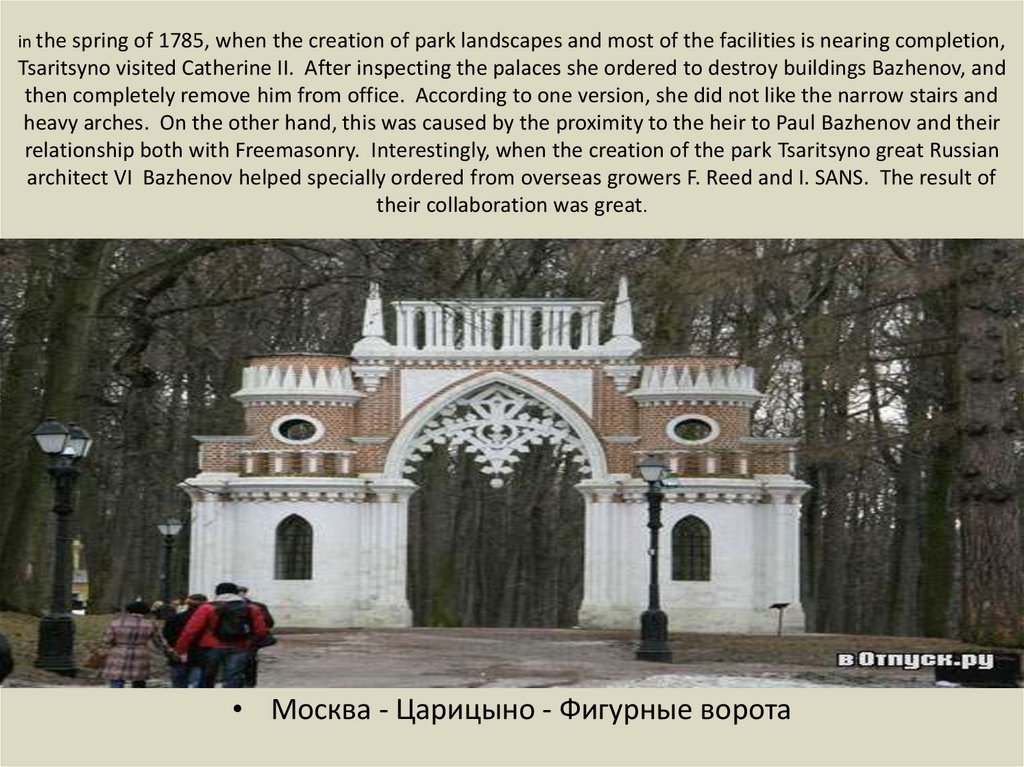
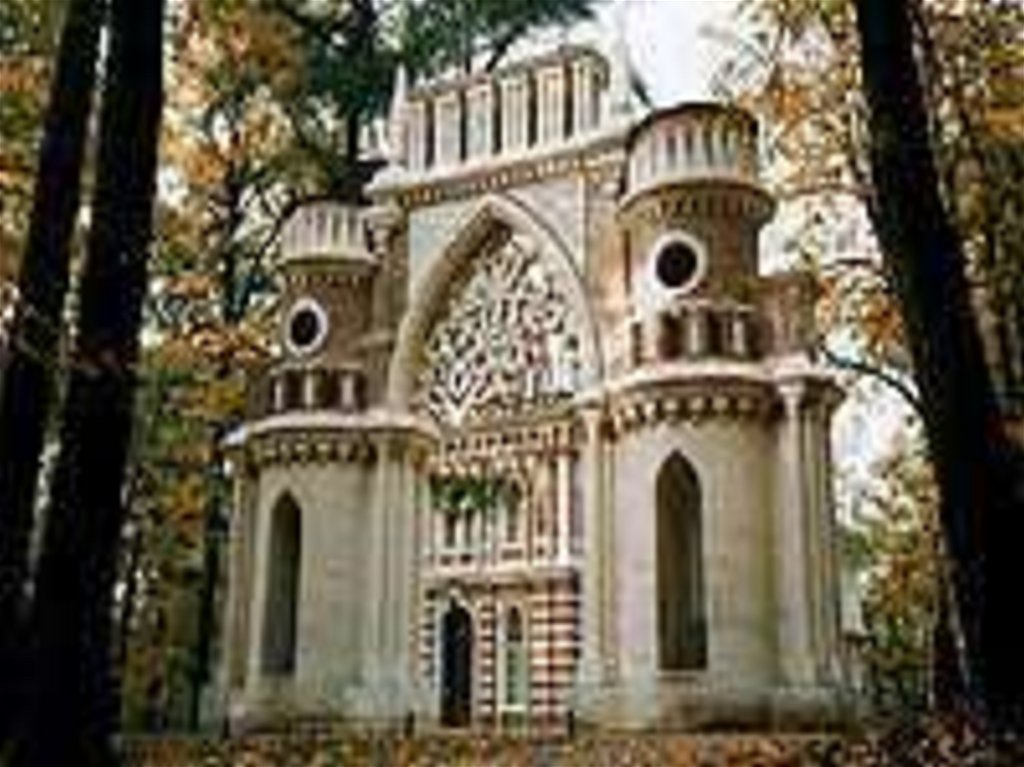
• Москва - Царицыно - Фигурные ворота
9.
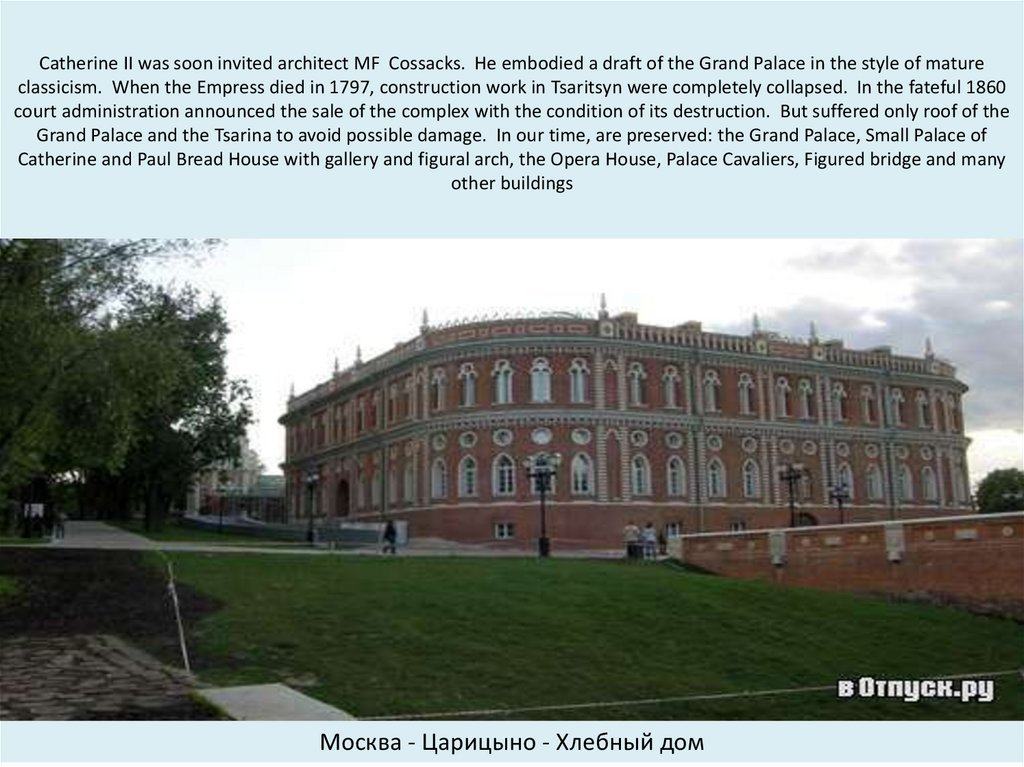
Catherine II was soon invited architect MF Cossacks. He embodied a draft of the Grand Palace in the style of matureclassicism. When the Empress died in 1797, construction work in Tsaritsyn were completely collapsed. In the fateful 1860
court administration announced the sale of the complex with the condition of its destruction. But suffered only roof of the
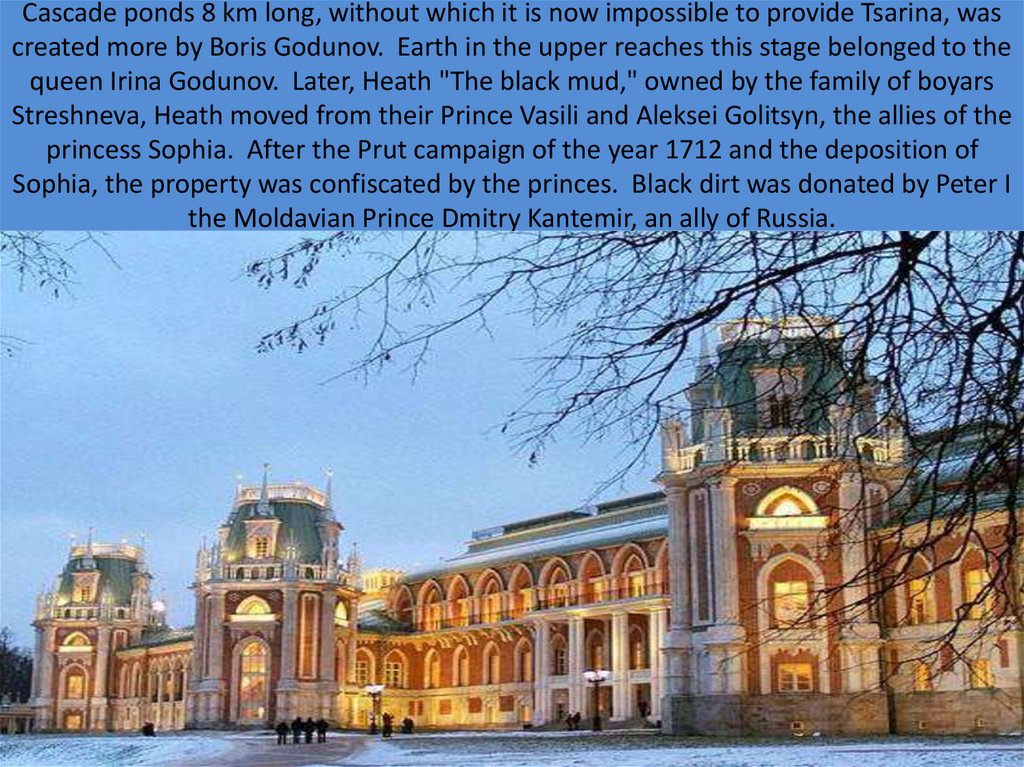
Grand Palace and the Tsarina to avoid possible damage. In our time, are preserved: the Grand Palace, Small Palace of
Catherine and Paul Bread House with gallery and figural arch, the Opera House, Palace Cavaliers, Figured bridge and many
other buildings
Москва - Царицыно - Хлебный дом
10.
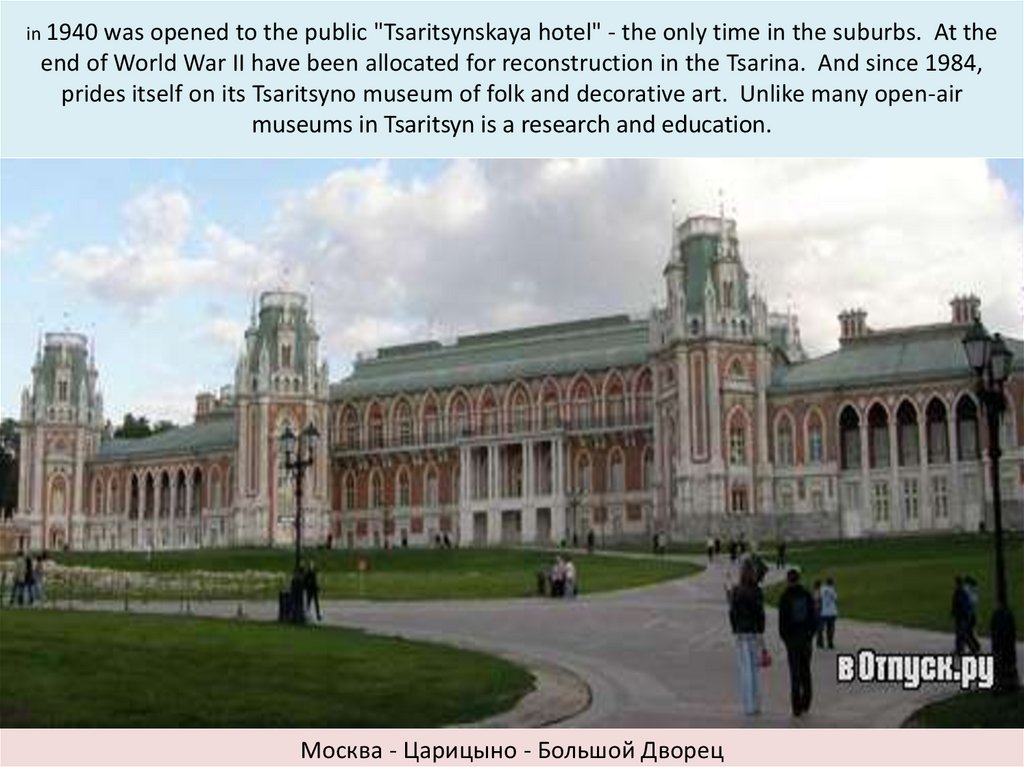
in 1940 was openedto the public "Tsaritsynskaya hotel" - the only time in the suburbs. At the
end of World War II have been allocated for reconstruction in the Tsarina. And since 1984,
prides itself on its Tsaritsyno museum of folk and decorative art. Unlike many open-air
museums in Tsaritsyn is a research and education.
Москва - Царицыно - Большой Дворец
11.
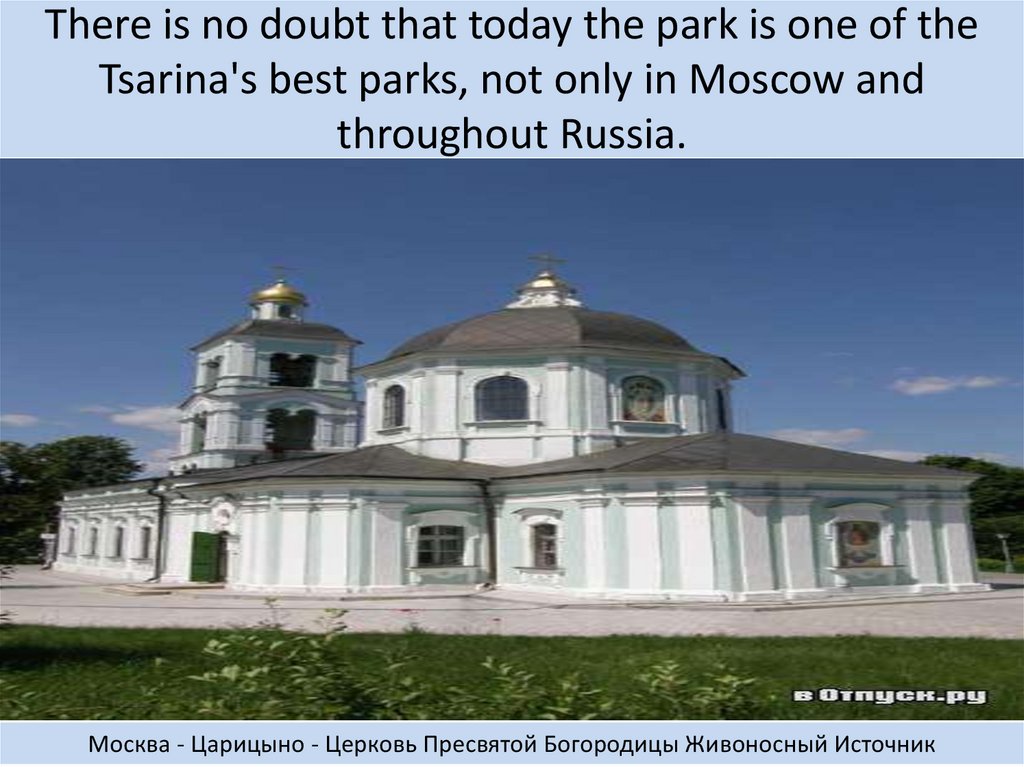
There is no doubt that today the park is one of theTsarina's best parks, not only in Moscow and
throughout Russia.
Москва - Царицыно - Церковь Пресвятой Богородицы Живоносный Источник